
MELU-215 · Lesson 6 of 12 · 18 min
Permits, inspections and the inspection authority
▶ Video coming soon A video version of this lesson is on the way.
Boone Ridge had three new jobs on Linda's board one Monday in May 2026: a service upgrade and new branch circuits for a machine shop in Millbrook, a four-plex in Grant Corners for Prairie Creek Builders, and a new shop building on the Sundquist family's farm north of Ames. Megan, now preparing for the master exam, asked to file the permits herself so that she would understand the process before she was responsible for it. Linda handed her the three addresses and one instruction: "Before you file anything, find out who inspects each one." The answer was different for all three.
Who inspects: the first question on every job
Under section 103.29 inspection in Iowa is shared between the state and local governments. Cities and counties that ran electrical inspection programs before statewide licensing could keep them, new programs can be created by filing the local ordinance and code with the board, and existing programs can be given up by notifying the board. Where a local program covers a job, the permit is filed with the city or county and its inspector makes the inspections. Where no local program covers a job, the state is the authority: the permit is filed through DIAL's online permit and inspection system and a state inspector inspects.
Two kinds of property have special rules. Installations on property owned by the state are inspected by the state, even inside a city with its own program. Farm installations are treated differently again: the statute prevents counties from inspecting farms, and the board's rules exempt many farm installations from state inspection, as described below. A contractor therefore needs to know not just the town but also who owns the property and how it is used.
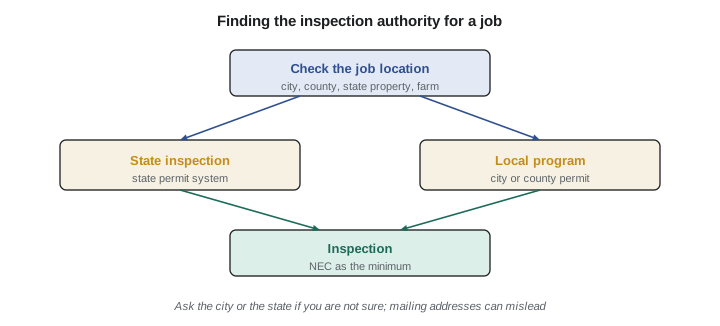
Megan worked through the three jobs. Millbrook, a small town, had no local electrical program, so the state was the authority and the permit would be filed online with DIAL. Grant Corners had kept the inspection program it ran before 2008, so the four-plex permit went to the city's building department. The Sundquist shop was a farm building outside any city, which raised the farm question. Linda's list of local programs answered the first two questions in a minute. The third took a phone call.
Who may file a permit
The board's rules require a permit to be obtained before electrical work subject to inspection begins. A permit may be obtained by a licensed electrical contractor or, in the situations the rules allow, by the property owner. Owners who are not licensed use the state system's process for non-contractor permit access, which DIAL describes on its permits page. Iowa law permits some owners to do work on their own property, subject to conditions, but contractors should not rely on that route for customers, and Boone Ridge never asks a customer to pull a permit for work the company performs.
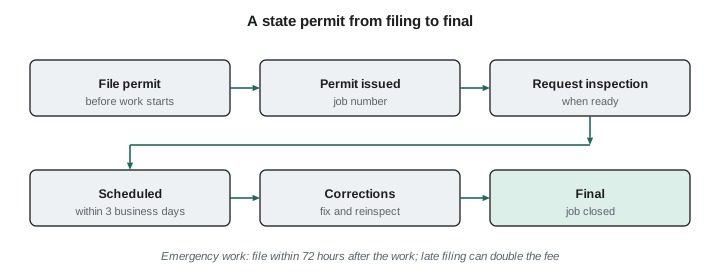
For state permits, the online system is the normal route. DIAL's page directs contractors to its electrical permit and inspection system at iowaelectrical.gov, where a contractor creates an account, enters the job address and scope, pays the fee and receives a permit number. The rule also allows a manual application by mail, but it must be submitted at least seven days before the work begins, which is a strong reason to use the online system.
Emergencies and late permits
Some work cannot wait for a permit: a failed service on a winter night, a storm-damaged mast, a burned panel at a dairy. The rule allows emergency work to start before a permit is filed, provided the permit is obtained within 72 hours after the work is completed. Contractors should document the emergency, including the time of the call and the condition found, in case the timing is later questioned.
Permits filed late for work that was not an emergency cost more. The rule provides that the fee is doubled when a permit is not obtained before the work begins, and late filing can also lead to discipline when it becomes a pattern. Boone Ridge treats a late permit as a mistake to be explained to the master, not as a routine charge.
| Situation | Rule (summary of 481 IAC chapter 404) | Boone Ridge practice |
|---|---|---|
| Normal job | Permit before work begins | File online the day the job is sold |
| Mailed application | Submit at least seven days before work | Not used |
| Emergency work | Permit within 72 hours after completion | Log the call and the condition found |
| Late permit | Fee doubled | Reviewed by the master |
| Inspection request | Scheduled within three business days | Request the day the work is ready |
Requesting and getting inspections
The permit does not end the contractor's obligations. When work is ready, the contractor requests an inspection through the system, and the rules call for state inspections to be scheduled within three business days. Most jobs need more than one visit: a rough-in inspection before walls or trenches are covered, and a final inspection when the work is complete. Service work is often inspected before the utility will connect. The inspector can approve the work, approve it with corrections or reject it, and any corrections must be made before the job is closed.
The rules also deal with the case where the state does not inspect in time. If an inspection has been properly requested and the work is not inspected within three business days after it was completed and ready, the contractor may energize the new circuits, while the inspection still has to happen. This protects customers from long waits without removing the inspection. Megan noted that the clock starts when the work is complete and the request has been made, not when the permit was filed.
Work that does not need a state inspection
Chapter 404 lists installations that do not require state inspection. One exception covers certain minor work by licensed electricians: work that does not involve panel work and stays within limits on circuit rating and voltage in the rule, 30 amperes and 277 volts in the version Megan read. A second exception covers many farm installations, but it does not cover farm residences, and it does not cover farm buildings used for retail sales open to the public. Even where an exception applies, the work must still meet the NEC; the exception removes only the inspection. DIAL publishes a form for reporting electrical work for which an inspection is not required by law, and contractors working under an exception should ask whether a report is expected.
The Sundquist shop fell under the farm exception. It was a machine shop for the family's own equipment, not a residence and not open to the public, and it was outside any city. Linda called DIAL to confirm, logged the answer and the name of the person she spoke with, and filed the note in the job folder. Megan was surprised that a building with a 200-ampere service could be built without an inspection. Dale was not. "The code still applies," he said. "We build it like an inspector is coming, because one day the insurance company's will."
# Sorting jobs by inspection authority (a study aid; rules summarized and simplified)
jobs = [
    {"name": "Millbrook machine shop", "local_program": False, "state_owned": False, "farm": False},
    {"name": "Grant Corners four-plex", "local_program": True,  "state_owned": False, "farm": False},
    {"name": "Sundquist farm shop",     "local_program": False, "state_owned": False, "farm": True},
    {"name": "State office remodel",    "local_program": True,  "state_owned": True,  "farm": False},
]
def authority(j):
    if j["state_owned"]:
        return "state inspector"
    if j["farm"]:
        return "check the farm exception (no county inspection; residences and retail are inspected)"
    return "local program" if j["local_program"] else "state inspector"
for j in jobs:
print(f"{j['name']:25} -> {authority(j)}")Millbrook machine shop -> state inspector Grant Corners four-plex -> local program Sundquist farm shop -> check the farm exception (no county inspection; residences and retail are inspected) State office remodel -> state inspector
Local programs
Local programs set their own permit forms and fees and run their own inspections, but section 103.29 puts limits on them. They must enforce at least the state code, and any local amendments must be filed with the board and may not be less stringent. They may not require a separate local license or exam from properly licensed electricians, and they may not charge a local license fee, although they may keep a copy of a contractor's state license on file. The statute also addresses supervision ratios for apprentices and unclassified persons, and local programs must follow the state's approach. Local inspectors must hold certification within a year of being hired, which is meant to keep inspection quality consistent across the state.
Grant Corners' building department issued the four-plex permit at the counter, charged its own fee and scheduled its own rough-in inspection. The city inspector applied the 2023 NEC, the same code the state uses, so the only real difference for Boone Ridge was the form and the phone number.
Keeping the job file
A permit creates a record, and the contractor's own job file should match it. Boone Ridge's file for every job holds the permit number and authority, the scope as filed, the dates of each inspection request and result, any correction and its fix, and the final approval. If the scope changes during the job, for example when a customer adds a subpanel to a garage, the permit is updated before the added work is installed. An inspector who arrives to find work that is not on the permit has every reason to look harder at everything else.
The file also protects the company later. Insurance claims, warranty questions and the occasional complaint to the board all turn on what was permitted, what was inspected and when. Megan learned to treat the permit system as part of the job, not as paperwork after it, and to check that every open permit had a request or a final before the job was invoiced.
Correction notices and disputes
When an inspector finds a violation, the contractor receives a written correction and must fix the work and request a reinspection. A contractor who believes an inspector has misread the code should first discuss it with the inspector, bringing the section and the edition. If the disagreement continues, the board's rules provide for review and appeal, and local programs have their own procedures. Arguments on the job site rarely help, and a well-documented question to DIAL often settles the matter in a day.
Megan started a habit that she kept as master: every correction notice goes into a simple log with the job, the inspector, the section cited and the cause. Once a quarter she reviews the log at a crew meeting. If the same section appears twice, the crew gets a short training session on it.
Worked problem
Three jobs, three authorities
Megan has a Millbrook machine shop (small town, no local program), a Grant Corners four-plex (city with a local program) and a farm shop outside any city used only for the family's own equipment. Where does each permit go, and which job may not need an inspection?
Show solution
- Millbrook has no local program, so the state is the authority: file online with DIAL before work begins.
- Grant Corners runs its own program, so the permit and inspections go through the city.
- The farm shop is outside any city, so no local program applies, and counties may not inspect farms.
- The farm exception in chapter 404 applies because the shop is not a residence or a retail building; confirm and record it.
Answer: State permit for Millbrook, city permit for Grant Corners, and the farm shop may be exempt from inspection though it must still meet the NEC.
Common mistakes
MistakeStarting work and filing the permit at the end of the job.
InsteadFile before work begins; the fee doubles for a late permit, except for emergencies filed within 72 hours.
MistakeAssuming a county inspects farm buildings.
InsteadCounties may not inspect farms; many farm installations are exempt from state inspection, but residences and retail buildings are not.
MistakeTreating an inspection exception as permission to ignore the code.
InsteadExempt work must still meet the NEC; only the inspection is removed.
MistakeFiling a state permit for state-owned property inside a city and expecting a city inspector.
InsteadState-owned property is inspected by the state.
Summary and key terms
- Inspection is shared: local programs inspect where they exist, and the state inspects elsewhere and on state property.
- Permits are obtained before work begins by a licensed contractor or, where allowed, the owner; emergency permits within 72 hours after completion.
- Mailed state applications need seven days; late permits pay double.
- State inspections are scheduled within three business days, and new circuits may be energized if not inspected in that time.
- Some minor work by licensees and many farm installations are exempt from inspection, but not from the code.
- Inspection authority
- The state or local body that issues permits and inspects in a given place.
- Permit
- Authorization filed before electrical work that identifies the job and the responsible contractor.
- Rough-in inspection
- An inspection before wiring is concealed.
- Farm exception
- The rule exempting many farm installations, other than residences and retail buildings, from state inspection.
- Correction
- An inspector's written finding that work must be fixed before approval.
Practice problems
Work each problem on paper first, then reveal the answer to check.
Within what time after completing emergency work must the permit be obtained?
Show answer
Within 72 hours.
Who inspects electrical work on state-owned property inside a city with its own program?
Show answer
The state.
What happens to the permit fee if a permit is not obtained before non-emergency work begins?
Show answer
It is doubled.
Lesson quiz · 5 questions
Score 60% or more to complete this lesson.
Create a free account to save your progress, take quizzes and earn a certificate.