
MELU-215 · Lesson 11 of 12 · 18 min
Renewal and continuing education
▶ Video coming soon A video version of this lesson is on the way.
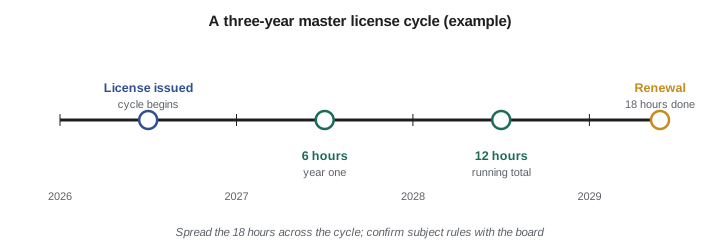
Dale's master license had been renewed nine times, and he admitted that at least three of those renewals had been closer calls than he liked. Once he had taken a full weekend of continuing education in the last month of a cycle. Once his renewal notice had gone to an old address. Once he had simply forgotten until Linda asked. When Megan's license was issued in June 2026, Linda opened a new page in the office planner, wrote Megan's renewal month three years ahead, and divided the continuing education requirement into three equal pieces, one for each year.
License terms and fees
Most Iowa electrical licenses are issued for three years. Under 481 IAC 401.3, the fee in 2026 for a Class A master license was 375 dollars for three years, and the same fee and term applied to an electrical contractor license. A Class A journeyman license cost 75 dollars for three years. An inactive master license cost 75 dollars for three years, and an apprentice license 20 dollars for one year. A replacement license for a lost card cost 15 dollars. These figures show the board's general approach: licenses that qualify contractors cost more, and the inactive license keeps a master's status at a much lower cost.
| License | Term | Fee in 2026 (summary of 401.3) |
|---|---|---|
| Class A master | 3 years | 375 dollars |
| Electrical contractor | 3 years | 375 dollars |
| Class A journeyman | 3 years | 75 dollars |
| Inactive master | 3 years | 75 dollars |
| Apprentice | 1 year | 20 dollars |
Renewal is done through DIAL's online licensing system before the license expires. The system shows the license's expiration date and the continuing education the board has on record. Licensees should keep their contact information current so that renewal notices reach them, but a missed notice is not an excuse: the duty to renew belongs to the licensee.
Continuing education: 18 hours per three-year license
Chapter 403 requires continuing education for license renewal. For a three-year license the requirement is 18 hours, and for licenses issued for shorter periods the rule sets 6 hours for each year or part of a year. The hours must be earned during the license period in courses approved by the board, and the board's rules set subject requirements that commonly include study of the currently adopted NEC and of Iowa's electrical law and rules. Because the subject rules can change, a licensee should check the current breakdown before choosing courses.
Approved courses are offered by trade associations, training centers, community colleges, unions, manufacturers and private providers. The board approves each course, and providers must follow the board's rules on attendance, instructors and records. Under chapter 403 an approved provider submits a roster of attendees to the board, within 30 days after the course in the current rule, and gives each attendee a certificate of completion. The licensee should keep every certificate, because the board may ask for proof.
# Planning 18 hours over a three-year license (dates and courses invented for this course)
plan = [
    ("2026-11", "2023 NEC changes, part 1", 4),
    ("2027-02", "Iowa electrical law and rules", 2),
    ("2027-10", "2023 NEC changes, part 2", 4),
    ("2028-03", "Grounding and bonding review", 4),
    ("2028-11", "Energy storage and solar installations", 4),
]
total = 0
for month, course, hours in plan:
    total += hours
    print(f"{month}  {course:40} {hours} h  (running {total})")
print("required for a three-year license:", 18, "| planned:", total, "| ok:", total >= 18)2026-11 2023 NEC changes, part 1 4 h (running 4) 2027-02 Iowa electrical law and rules 2 h (running 6) 2027-10 2023 NEC changes, part 2 4 h (running 10) 2028-03 Grounding and bonding review 4 h (running 14) 2028-11 Energy storage and solar installations 4 h (running 18) required for a three-year license: 18 | planned: 18 | ok: True
A plan that works
Linda's plan for Megan follows a simple rule: six hours a year, booked early, with the code and law hours first. Taking hours steadily has three benefits. It avoids the rush and higher prices of last-minute courses. It spreads the cost across three budget years. And it means that if an approved course is canceled or a certificate is lost, there is time to fix the problem. Boone Ridge pays for every licensee's continuing education and counts the hours as part of the company's training plan, so that the same courses that renew licenses also improve the crews' work.
Megan chose her first course carefully. With the ground-fault amendments removed in June 2026, a code-update course on the 2023 NEC was useful for her own work and for the crews she supervised. She took it in November 2026 with three of the company's journeymen and then held a short session at the shop to share what they had learned.
Renewing the contractor license
The electrical contractor license renews on its own three-year schedule, and the renewal requires the same things as the original license: a licensed master, current insurance meeting 401.7 and current 91C registration. A contractor renewing with a lapsed policy, an expired registration or no active master will find the renewal delayed or refused. Linda renews the contractor license and checks all three items at the same sitting.
Because the master's license, the contractor license, the 91C registration and the insurance all run on different dates, the safest approach is a single calendar that shows them together, as described in lesson 8. A master should know where that calendar is and check it, even if the office keeps it.
Tracking the whole crew
A master's responsibility for supervision extends to making sure the people being relied on are licensed. Boone Ridge has nine journeymen, three apprentices and two unclassified persons, and every license has its own date. Apprentice licenses renew each year, journeyman licenses every three years, and each journeyman has a continuing education requirement of their own. A journeyman whose license has lapsed is no longer a licensed electrician for supervision purposes, which can quietly put a crew over the ratio described in lesson 7.
Linda keeps a single spreadsheet of every license in the company with its number, class, expiration date and hours completed, and she checks each new hire's license in the board's lookup on the first day. Megan reviews the sheet once a quarter. When a journeyman is short of hours late in a cycle, the company schedules a course for them rather than leaving it to chance, because the company's crews depend on the license as much as the journeyman does.
Choosing courses that are worth the time
Not every approved course is equally useful. Megan looks for three things. First, the course should be on the edition Iowa has actually adopted, which in 2026 means the 2023 NEC. Second, the instructor should work in the trade or in inspection, because practical examples stick. Third, the course should connect to work the company actually does, such as agricultural wiring, services and feeders, or energy storage. A course that meets those tests improves the work as well as renewing the license.
Before paying for a course, confirm that it is approved for Iowa and for the subject category you need, and ask the provider how and when it reports attendance to the board. A certificate from a course that is not approved, or a roster that never reaches the board, can leave a licensee short of hours at the last minute.
Renewal day
When the renewal window opens, the process is short if the cycle was planned. The licensee logs in to DIAL's licensing system, confirms contact and employer information, checks that every course is on record, answers the application's questions, pays the fee and submits. If an hour is missing from the record, the licensee uploads the certificate or asks the provider to correct the roster. Megan plans to renew a month before her expiration date, which leaves time to fix any problem without a gap.
Inactive status and returning to active
A master who stops doing electrical work but wants to keep the license can move to inactive status, as Dale plans to do. The inactive license costs less and does not allow the holder to do electrical work or qualify a contractor. Returning to active status requires meeting the board's conditions for reactivation, which can include completing continuing education. Dale's plan is to keep taking a few hours of code-update courses each cycle anyway, because he expects to consult with Boone Ridge on large projects and wants to stay current.
Lapsed licenses
A license that is not renewed by its expiration date lapses, and a person with a lapsed license may not do the work the license allows. The board's rules describe how a lapsed license can be restored, which may involve fees, proof of continuing education and, if enough time has passed, retesting. The details change, so a licensee who has missed a renewal should contact the board immediately rather than continue working. For a master who qualifies a contractor, a lapse also affects the company, as lessons 7 and 8 explained.
Continuing education after a failed exam
Continuing education also appears in the exam rules. As lesson 2 explained, a candidate who fails an exam twice must complete 12 hours of continuing education and wait six months before a third attempt, and the same applies after a fourth failure. Those hours must come from approved courses, and they are a reminder that the board treats continuing education as part of competence, not just a renewal formality.
Candidates sometimes treat those hours as a hurdle to clear quickly. A better approach is to choose courses aimed at the content areas the score report showed as weak, so that the required hours double as targeted study for the next attempt.
Audits and honesty
The board may check continuing education claims, and false claims are grounds for discipline. Licensees should claim only hours they actually completed in approved courses, keep certificates for at least the license period and the following cycle, and correct any error as soon as it is found. Providers who issue certificates for courses not actually attended face discipline too. Megan keeps scanned copies of every certificate in a folder named for each license cycle.
Keeping up beyond the minimum
Eighteen hours over three years is a minimum. Masters who lead crews and design installations need more than that to keep up with new equipment, new code editions and new kinds of work. Manufacturer training on new equipment, seminars on electric vehicle charging and battery storage, and courses on estimating and business management may not all count toward renewal, but they make a master better at the job. Dale's rule of thumb was to learn one new thing a month, and Megan has adopted it.
The next code edition is also a planning question. When the board adopts the 2026 NEC, the exam will move to it, inspectors will enforce it from the effective date, and code-update courses will shift to it. A master who starts studying the changes when the board announces the adoption, rather than on the effective date, will be ready when the first job under the new edition arrives.
Worked problem
Is Megan on track?
Megan's three-year master license was issued in June 2026. By June 2028 she has completed a 4-hour code-update course, a 2-hour Iowa law course and a 4-hour grounding course, all approved. How many hours remain for her renewal in 2029, and what should she do?
Show solution
- The requirement for a three-year license is 18 hours.
- Completed hours: 4 + 2 + 4 = 10.
- Remaining: 18 - 10 = 8 hours.
- She should book the remaining 8 hours in approved courses within the license period and check the current subject rules.
Answer: 8 hours remain; book them well before the 2029 renewal and keep the certificates.
Common mistakes
MistakeWaiting for the renewal notice before planning hours.
InsteadPlan hours across the cycle; the duty to renew belongs to the licensee.
MistakeCounting courses that the board has not approved.
InsteadOnly board-approved courses count toward renewal.
MistakeAssuming an inactive master may keep qualifying the company.
InsteadAn inactive license does not allow electrical work or qualifying a contractor.
MistakeContinuing to work after a license lapses.
InsteadStop and contact the board; a lapsed license allows no work.
Summary and key terms
- Most Iowa electrical licenses run for three years; a Class A master and a contractor license each cost 375 dollars in 2026.
- Renewal of a three-year license requires 18 hours of approved continuing education, or 6 hours per year for shorter licenses.
- Providers submit rosters to the board and give certificates; licensees keep proof.
- The contractor license renewal requires a licensed master, current insurance and current 91C registration.
- An inactive master license keeps status at lower cost but allows no electrical work.
- Continuing education
- Approved courses required to renew an electrical license.
- License period
- The term of a license, usually three years in Iowa.
- Roster
- A provider's list of attendees submitted to the board after an approved course.
- Lapsed license
- A license not renewed by its expiration date.
- Reactivation
- Returning an inactive license to active status under the board's conditions.
Practice problems
Work each problem on paper first, then reveal the answer to check.
How many hours of continuing education does a three-year Iowa license require?
Show answer
18 hours.
What was the fee for a three-year Class A master license in 2026?
Show answer
375 dollars.
Who submits the attendance roster for an approved course?
Show answer
The approved provider, to the board.
Lesson quiz · 5 questions
Score 60% or more to complete this lesson.
Create a free account to save your progress, take quizzes and earn a certificate.