
MELU-215 · Lesson 10 of 12 · 18 min
Workplace safety law and OSHA for electrical contractors
▶ Video coming soon A video version of this lesson is on the way.
In August 2026 Caleb Moore, Boone Ridge's apprentice, was pulling wire in a hot attic at the Millbrook machine shop when he stepped off a joist, put his foot through the ceiling drywall and caught himself on a truss. He wrenched his shoulder badly. Nobody was shocked, nothing was energized and the injury was not life-threatening, but Caleb could not work for two weeks. For Megan it was the first injury on her watch as the company's master, and it raised three questions at once: what had gone wrong, who had to be told, and what the company would do so that it did not happen again.
Iowa OSHA: a state plan
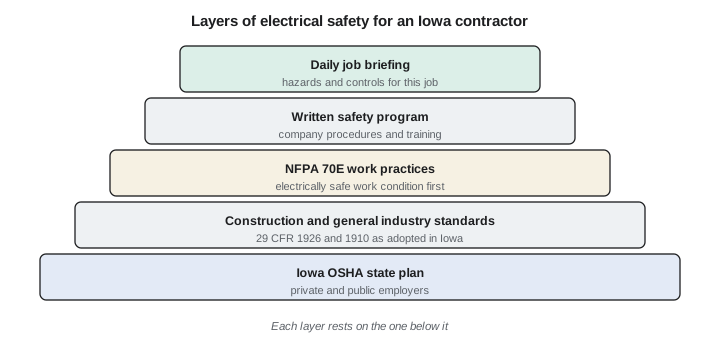
Federal law allows states to run their own occupational safety and health programs, called state plans, if they are at least as effective as federal OSHA. Iowa is one of those states. Iowa OSHA, part of the state's labor services division, enforces safety and health standards for private employers in Iowa and for state and local government employers as well. For an electrical contractor, Iowa OSHA is the agency that inspects job sites, issues citations and investigates serious accidents.
Iowa's program adopts the federal standards and enforces them under Iowa law. The construction standards in 29 CFR 1926 apply to construction work, including new installations and renovations, and the general industry standards in 29 CFR 1910 apply to maintenance and other non-construction work. Most of what an Iowa electrical contractor must know about safety law is therefore the same material taught in the core courses, enforced by a state agency rather than a federal one.
The standards that matter most
For electrical work, the most important standards fall into a few groups. The electrical safety standards in subpart K of 1926 cover construction electrical work and temporary wiring, including ground-fault protection for temporary receptacles or an assured equipment grounding conductor program. The general industry electrical standards in subpart S of 1910 cover work practices for qualified and unqualified persons. The control of hazardous energy standard, often called lockout/tagout, applies to servicing and maintenance in general industry. Fall protection, ladders, scaffolds and excavation standards apply to the work around the electrical work, and they are where many electricians are actually hurt.
Caleb's injury fell into that last group. Attic work is not usually thought of as a fall hazard, but stepping between joists is a fall through a surface, and the company had no rule about walking boards in unfinished attics. Megan's first change after the injury was a simple one: plywood walking boards on every truck, and a rule that they are used whenever a crew works in an unfinished attic.
| Standard | What it covers (summary) | Where Boone Ridge meets it |
|---|---|---|
| 29 CFR 1926 subpart K | Construction electrical safety, temporary wiring, GFCI or assured grounding | Every construction job |
| 29 CFR 1910 subpart S | Electrical work practices in general industry | Maintenance and service work |
| 29 CFR 1910.147 | Control of hazardous energy (lockout/tagout) | Machine and plant maintenance |
| Fall protection, ladders, scaffolds | Work at height | Attics, roofs, lifts and ladders |
| Injury and illness records | Logs and annual summaries where required | Office records |
NFPA 70E and the electrically safe work condition
OSHA standards say what must be achieved. NFPA 70E, the Standard for Electrical Safety in the Workplace, explains how. It is a consensus standard, not a law, but OSHA treats it as the recognized way to meet the general requirements for protecting workers from electrical hazards, and Iowa OSHA does the same. Its central rule is that energized work should be avoided: equipment is put into an electrically safe work condition, with the circuit identified, disconnected, locked and tagged, and tested for absence of voltage before work begins. Energized work is justified only in limited cases, and then requires a risk assessment, an energized work permit where required and the right protective equipment.
For a master, 70E is a management issue as much as a technical one. Someone must decide which employees are qualified for which tasks, train them, document the training, provide the right equipment and audit the work. At Boone Ridge Megan is that person, and she reviews the company's 70E program every year with the lead journeymen.
A written safety program and training
Iowa OSHA expects employers to have safety programs suited to their work, and several standards require written programs or plans, such as hazard communication for chemicals and lockout/tagout procedures. A good written program for an electrical contractor covers electrical safe work practices, fall protection, ladders and lifts, trenching, hazard communication, personal protective equipment, first aid, and the steps to take after an injury. It names who is responsible for each part and how training is given and recorded.
Training should match the work. New hires such as Tyrell Banks get a first-day orientation, a session on the company's electrical safety rules and job-specific training before they work on any new task. Apprentices like Caleb also learn safety in their training program, but the employer remains responsible for training on its own procedures and equipment. Every job starts with a short briefing on that day's hazards.
# A simple training matrix check (names from the course; requirements illustrative)
required = {"orientation", "electrical safe work", "fall protection", "ladders and lifts", "hazard communication"}
trained = {
    "Megan Thorsen": required | {"energized work permit"},
    "Caleb Moore":   {"orientation", "electrical safe work", "ladders and lifts", "hazard communication"},
    "Tyrell Banks":  {"orientation", "hazard communication"},
}
for person, done in trained.items():
    missing = sorted(required - done)
print(f"{person:14} missing: {', '.join(missing) if missing else 'none'}")Megan Thorsen missing: none Caleb Moore missing: fall protection Tyrell Banks missing: electrical safe work, fall protection, ladders and lifts
Reporting serious injuries to Iowa OSHA
Employers must report the most serious workplace injuries to OSHA directly. Under the federal rule, which state plans must match or exceed, an employer must report a work-related fatality within 8 hours, and an in-patient hospitalization, an amputation or the loss of an eye within 24 hours. In Iowa these reports go to Iowa OSHA, which publishes how to make them. Caleb's injury did not involve hospitalization, so no report to Iowa OSHA was required, but it did need to be recorded and reported to the workers' compensation insurer.
Many employers must also keep records of work-related injuries and illnesses on OSHA's log forms and post an annual summary. Small employers and some low-hazard industries are partly exempt, but construction contractors with more than ten employees are generally covered. Boone Ridge keeps the log and posts the summary each February.
Workers' compensation in Iowa
Workers' compensation is the system that pays medical costs and lost wages for workers injured on the job, regardless of fault, in exchange for limits on lawsuits against the employer. Iowa's law is in Iowa Code chapter 85 and related chapters, and it is administered by the Division of Workers' Compensation, which DIAL's website hosts. Iowa employers must generally carry workers' compensation insurance for their employees, and as lesson 8 explained, contractors with employees must show proof of coverage for chapter 91C registration.
The system has deadlines for everyone. According to DIAL's guidance, an injured employee should give the employer notice of the injury within 90 days. The employer must file a first report of injury with the division within four days after it has notice of an injury that causes more than three days of lost time, permanent injury or death, usually through its insurer. If a claim is disputed, the employee generally has two years from the injury, or three years from the last weekly benefit payment, to file a petition with the division.
| Event | Who | Deadline (summary of DIAL guidance) |
|---|---|---|
| Injury reported to employer | Employee | Within 90 days |
| First report of injury | Employer or insurer | Within 4 days of notice, for more than 3 days lost, permanent injury or death |
| Petition for a disputed claim | Employee | 2 years from injury, or 3 years from last weekly payment |
| Work-related death reported to Iowa OSHA | Employer | Within 8 hours (federal rule as the minimum) |
| Hospitalization, amputation or eye loss | Employer | Within 24 hours (federal rule as the minimum) |
Caleb told his lead about the injury immediately, and Linda reported it to the insurer the same day. Because he lost more than three days, the first report of injury was required, and the insurer filed it within the four-day window. The insurer paid his medical bills and weekly benefits while he recovered, and Megan arranged light-duty office work for the second week, with his doctor's approval, which kept him connected to the crew.
Shared job sites
Electrical contractors rarely work alone. On the Grant Corners four-plex, Boone Ridge worked alongside framers, plumbers, drywall crews and the general contractor's own staff. OSHA's approach to multi-employer sites, which Iowa OSHA follows, means that more than one employer can be responsible for a hazard: the employer whose workers are exposed, the employer who created the hazard, the employer responsible for correcting it and the employer who controls the site. An open floor hole left by another trade is still a hazard to Boone Ridge's crew, and Boone Ridge must protect its own workers from it and report it to the general contractor.
Temporary power is the electrical contractor's special responsibility on many sites. The temporary service, cords and receptacles that every trade uses are often installed by the electrician, and the ground-fault protection or assured equipment grounding program for them is a frequent subject of citations. Megan assigns one journeyman on each larger site to check temporary power weekly and record the check.
Learning from the incident
After any injury, the most useful thing a master can do is find out why it happened without looking for someone to blame. Megan met with Caleb and his lead the day he returned and walked through the attic work step by step. The cause was not carelessness but the absence of a rule and a tool: no walking boards and no expectation that they be used. The fix was cheap and quick. She wrote it into the safety program, briefed every crew and checked the next three attic jobs herself.
She also changed how near misses are handled. Before the injury, a crew member who slipped and caught himself might mention it at lunch. Now a near miss gets a two-line note to Megan, and the notes are read at the monthly crew meeting. The point is not paperwork but attention: the attic fall had almost certainly been preceded by other stumbles nobody wrote down.
Iowa OSHA also offers a free and confidential consultation service for small employers, separate from enforcement, that can review a company's program and job sites. Dale had used it years earlier and recommended it to Megan as a way to get an outside view without the risk of citations.
Worked problem
What must be reported, and when?
Caleb's shoulder injury in August 2026 keeps him off work for two weeks. He is treated at a clinic and is not admitted to the hospital. Which reports are required, and by when?
Show solution
- There is no fatality, in-patient hospitalization, amputation or eye loss, so no report to Iowa OSHA is required.
- The injury is work-related and involved lost time, so it is recorded on the injury log if the company keeps one.
- More than three days of lost time means a first report of injury must be filed within four days after the employer has notice.
- Caleb has given notice immediately, well within the 90-day period.
Answer: A first report of injury within four days of notice and an entry on the injury log; no report to Iowa OSHA.
Common mistakes
MistakeAssuming federal OSHA inspects Iowa job sites.
InsteadIowa runs a state plan; Iowa OSHA enforces the standards for private and public employers.
MistakeTreating NFPA 70E as optional because it is not a law.
InsteadOSHA and Iowa OSHA treat it as the recognized way to meet electrical safety duties.
MistakeWaiting to see whether an injured worker returns before reporting.
InsteadFile the first report within four days of notice when more than three days are lost.
MistakeFocusing only on shock hazards.
InsteadFalls, ladders and lifts injure many electricians; plan for them on every job.
Summary and key terms
- Iowa runs an OSHA state plan covering private employers and state and local government employers.
- The federal construction and general industry standards apply as enforced by Iowa OSHA, with NFPA 70E as the recognized practice for electrical safety.
- Work-related deaths must be reported within 8 hours and hospitalizations, amputations and eye losses within 24 hours, at a minimum.
- Iowa employers generally carry workers' compensation; employees give notice within 90 days.
- A first report of injury is due within four days of notice for more than three days lost, permanent injury or death.
- State plan
- A state-run occupational safety and health program approved under federal law.
- Electrically safe work condition
- Equipment disconnected, locked, tagged and tested for absence of voltage.
- Lockout/tagout
- Procedures for controlling hazardous energy during servicing and maintenance.
- First report of injury
- The employer's report of a work injury to the workers' compensation division.
- Workers' compensation
- No-fault benefits for workers injured on the job.
Practice problems
Work each problem on paper first, then reveal the answer to check.
Which agency enforces workplace safety standards on Iowa construction sites?
Show answer
Iowa OSHA, under Iowa's state plan.
Within how many hours must a work-related fatality be reported, at a minimum?
Show answer
Within 8 hours.
Within what time must an injured Iowa employee give notice to the employer?
Show answer
Within 90 days.
Lesson quiz · 5 questions
Score 60% or more to complete this lesson.
Create a free account to save your progress, take quizzes and earn a certificate.