
MELU-215 · Lesson 4 of 12 · 18 min
The exam format and the references allowed
▶ Video coming soon A video version of this lesson is on the way.
With her authorization on the way, Megan turned to the exam itself. Ben Adeyemi, Boone Ridge's estimator, had passed the Iowa master exam four years earlier and still remembered the moment the clock appeared on the screen. "It is a long day with one book," he told her. "The people who fail usually know the material. They just spend twenty minutes hunting for one table and then rush the last thirty questions." This lesson explains what the exam looks like, what you may bring and how to plan your time.
The shape of the master exam
The Iowa master exam is a computer-based, multiple-choice exam given at a PSI test center. According to the 2025 bulletin it contains 100 scored questions and 10 unscored pretest questions, for 110 questions in all. The pretest questions are new items being tried out for future exams. They look exactly like the scored questions and are mixed in with them, so a candidate should answer every question as if it counts. The bulletin's timing table allows 240 minutes for the master exam, with additional time listed for the tutorial and administration. Plan your pacing on the 240 minutes.
A score of 70 is passing. Megan's arithmetic was quick: 110 questions in 240 minutes is a little over two minutes a question on average. That sounds generous until you remember that a feeder calculation or a service load can take six or eight minutes, and that many questions require finding a specific section, exception or table entry before you can answer.
| Item | Master exam (2025 bulletin, summary) |
|---|---|
| Questions | 100 scored plus 10 unscored pretest questions |
| Time | 240 minutes of testing time |
| Passing score | 70 |
| Reference | One book: the 2023 NEC or the 2023 NEC Handbook |
| Book markings | Highlighting, underlining and permanent tabs allowed; no handwritten notes |
| Calculator | Silent, non-programmable, without a printer or alphabet keyboard |
The one book you may bring
The master exam is open book, but with only one book. The bulletin allows the 2023 edition of the National Electrical Code or the 2023 NEC Handbook, which contains the code text along with explanations and illustrations. Many candidates prefer the plain code book because it is lighter and the pages are easier to scan, while others like the Handbook's diagrams. Whichever you choose, practice with that book and only that book.
The bulletin sets rules for what the book may contain. Candidates may highlight, underline and use permanent index tabs. They may not write notes, formulas or examples in the book, and loose papers or removable notes are not allowed. Popular pocket reference guides, such as the widely used electrical formula and table handbooks, are specifically not allowed. Proctors inspect the book before the exam begins, and a book with prohibited material can be refused, which leaves the candidate to test without it. Megan bought a new 2023 NEC with a set of permanent tabs and never wrote a single note in it.
Because only the code may come in, anything else a candidate needs must be in their head. That includes formulas for voltage drop and three-phase power, the steps of a service load calculation, the layout of the code itself, and any Iowa law and business material listed in the content outline. If the outline in your bulletin lists Iowa laws and rules, the board's chapter 103 and chapter 401 to 404 material in this course is what you study for it, because you will not have those documents at the test center.
Tabbing the book
Permanent tabs save time, but only if you know them. Ben's rule was to tab the places you go most often and to stop there. A book with a hundred tabs is as slow as a book with none. Megan tabbed the start of each chapter, Article 100, the branch circuit, feeder and service calculation articles, the conductor ampacity tables, the overcurrent protection article, the grounding and bonding article, the motor article, the raceway fill material and the tables in Chapter 9. She also highlighted the exceptions she had missed in practice, so that her eye would stop on them.
The calculator
A calculator is allowed and is essential for a master exam. The bulletin requires a silent, battery-powered calculator without a printing tape, alphabetic keyboard, programmable memory or communication functions, and it prohibits phones and watches as calculators. Basic scientific calculators of the kind sold for trade exams are the safe choice. Practice with the calculator you will bring, including the square root of three, which appears in every three-phase calculation and is worth knowing as roughly 1.732.
What the questions test
The bulletin's content outline lists the subject areas on the master exam and the number of questions drawn from each. For a master exam these typically include general code knowledge and definitions, services, feeders and branch circuits, load calculations, wiring methods and materials, equipment for general use, special occupancies and equipment, motors and transformers, grounding and bonding, and electrical theory. The outline is the best guide to where your study time should go, so read it before you plan and match your practice to it.
Master questions differ from journeyman questions mainly in depth. A journeyman question might ask for the minimum size of a conductor for a given load. A master question is more likely to ask for the minimum service size for a building after a full load calculation with demand factors, or for the correct overcurrent protection for a motor branch circuit and its feeder. They also tend to combine several steps, so an early mistake leads to a wrong final answer that may well appear among the choices.
A pacing plan
Ben taught Megan a two-pass plan. On the first pass she would answer every question she could answer in about a minute, flag the long ones and keep moving. On the second pass she would work the flagged calculations and code searches carefully. The last stretch would be for review of flagged answers and for making sure no question was left blank, because an unanswered question is always wrong while a guess has a chance.
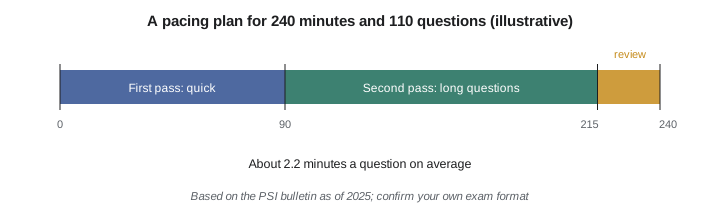
# Pacing checkpoints for a 240-minute, 110-question exam (illustrative)
total_minutes, questions = 240, 110
print("average minutes per question:", round(total_minutes / questions, 2))
plan = [("first pass ends", 90), ("second pass ends", 215), ("review ends", 240)]
for label, minute in plan:
    print(f"{label:18} at minute {minute:3}  ({total_minutes - minute} minutes left)")
# How far behind is too far? Check at minute 60 on the first pass.
answered_at_60 = 58
on_pace = answered_at_60 >= questions * 60 / 90 * 0.8
print("on pace at minute 60:", on_pace)average minutes per question: 2.18 first pass ends at minute 90 (150 minutes left) second pass ends at minute 215 (25 minutes left) review ends at minute 240 (0 minutes left) on pace at minute 60: False
Practice that matches the real thing
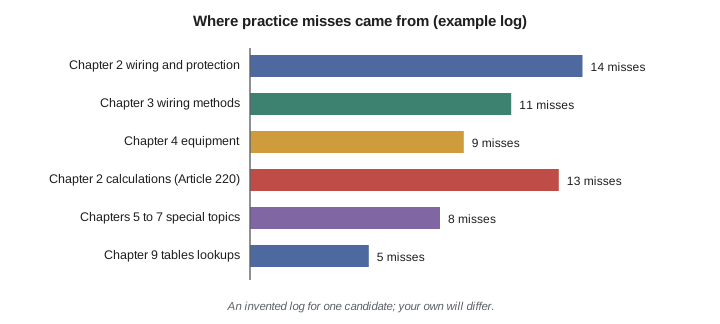
The most useful practice copies the test conditions. Megan took full timed practice exams at the kitchen table with her tabbed code book, her exam calculator and nothing else, and logged every miss by code area and by cause. Some misses were knowledge gaps. Others were reading errors, such as missing the word not or an exception, and some were time problems. The log told her which chapters to study and which habits to fix. Lesson 12 returns to this method in the final weeks.
Three kinds of questions
Ben sorted the questions he remembered into three kinds, and Megan found the sorting useful in practice. The first kind is the direct lookup: a question that names a topic and asks for a value or a rule. These are fast if you know where the topic lives, which is why the index and the tabs matter. Start with the index entry for the key noun in the question, not with a guess at the article number, and read the whole section before choosing an answer, including its exceptions.
The second kind is the calculation: a load calculation, a conductor or overcurrent sizing, a voltage drop, a box or raceway fill, or a motor circuit. These reward a fixed routine. Note the knowns, using whatever scratch material the test center provides, decide which article governs, work the steps in order and check whether the answer must be rounded up to a standard size. Many wrong answers on the choice list are the result of one common slip, such as using the wrong demand factor or forgetting a continuous-load multiplier, so a result that matches a choice is not proof that it is right.
The third kind is the reading question, where the difficulty is the wording rather than the code. Questions may use not, except or minimum, or describe a situation in a paragraph and ask about one detail. Read the last sentence first to learn what is being asked, then read the paragraph for the facts that matter. Megan's practice log showed that reading errors cost her almost as many points as knowledge gaps in her first three practice exams, and that they nearly disappeared once she made the habit automatic.
When a question will not come
Every candidate meets a question that will not yield. The two-pass method handles most of them, but on the second pass a question can still eat time. Ben's limit was six minutes. If a question was still open after six minutes, he chose the most reasonable answer, flagged it and moved on, returning only if time remained at the end. One question is worth one point, the same as a two-minute lookup, and the minutes it steals can cost three or four answers later.
Building speed with the index
Speed in an open-book exam comes from the index more than from memory. The NEC index lists topics by key noun, so a question about receptacles in a bathroom is found under receptacles or bathrooms, not under the article number you think it might be. In the first two weeks of study Megan answered every practice question twice: once by memory and once by finding it through the index, timing the second search. Her average search time fell from about three minutes to under one, and she began to recognize the handful of index entries that led to most answers. That habit, more than any single tab, is what made the 240 minutes feel long enough.
On the day
The test center routine is predictable. Arrive early, show ID, store personal items, have the book inspected, take a short tutorial on the computer system, and begin. The clock on the screen counts down. Questions can be flagged and revisited. When time runs out, the exam ends and unanswered questions count as wrong. Many candidates find the first fifteen minutes the hardest, and Ben's advice was to start with a few quick questions to settle in rather than fight the first long calculation.
Worked problem
How many minutes for the long questions?
Megan expects to answer 75 questions on her first pass at an average of 1.1 minutes each and to leave 25 minutes at the end for review. How many minutes will remain for the 35 flagged questions on her second pass, and what is the average per question?
Show solution
- First pass: 75 questions x 1.1 minutes = 82.5 minutes.
- Time left after the first pass: 240 - 82.5 = 157.5 minutes.
- Reserve 25 minutes for review: 157.5 - 25 = 132.5 minutes for the second pass.
- Average for flagged questions: 132.5 / 35 = about 3.8 minutes each.
Answer: About 132 minutes, or about 3.8 minutes for each flagged question.
Common mistakes
MistakeBringing a pocket formula guide along with the code book.
InsteadOnly the 2023 NEC or the 2023 NEC Handbook is allowed; formula guides are not.
MistakeWriting formulas inside the code book's covers.
InsteadHighlighting, underlining and permanent tabs are allowed, but handwritten notes are not.
MistakeSkipping questions that look like pretest items.
InsteadPretest questions look like scored ones; answer every question.
MistakeLeaving questions blank at the end.
InsteadA blank answer is always wrong; leave time to answer every question.
Summary and key terms
- The master exam has 100 scored and 10 unscored questions in 240 minutes, and 70 passes (2025 bulletin).
- The only reference is the 2023 NEC or the 2023 NEC Handbook, with highlighting and permanent tabs but no notes.
- Pocket formula guides are not allowed; formulas and any Iowa law content must be learned.
- A silent, non-programmable calculator is allowed.
- A two-pass plan protects time for long calculations and review.
- Pretest question
- An unscored question being tested for future exams, mixed in with scored ones.
- Content outline
- The bulletin's list of subject areas and question counts for the exam.
- Permanent tab
- An index tab fixed to a code book page, allowed on the Iowa exam.
- Two-pass method
- Answering quick questions first, flagging long ones and returning to them.
- NEC Handbook
- An edition of the NEC with added commentary and illustrations.
Practice problems
Work each problem on paper first, then reveal the answer to check.
What book may an Iowa master candidate bring to the exam under the 2025 bulletin?
Show answer
One book: the 2023 NEC or the 2023 NEC Handbook.
May a candidate write formulas in the margins of the code book?
Show answer
No. Highlighting, underlining and permanent tabs are allowed, but not handwritten notes.
What is the average time per question on a 110-question, 240-minute exam?
Show answer
About 2.2 minutes.
Lesson quiz · 5 questions
Score 60% or more to complete this lesson.
Create a free account to save your progress, take quizzes and earn a certificate.