
MELU-215 · Lesson 1 of 12 · 18 min
How electrical licensing works in Iowa
▶ Video coming soon A video version of this lesson is on the way.
Boone Ridge Electric has wired houses, machine sheds, grain sites and small commercial buildings around Ames since 1994. Its founder, Dale Brekke, holds a Class A master electrician license, and for three decades the company has met Iowa's contractor rules because Dale is both the owner and the licensed master. This winter Dale told the crew he wants to step back within two years, and he asked Megan Thorsen whether she would take on the master's role. Megan finished her apprenticeship at Boone Ridge, passed the journeyman exam in the spring of 2025 and has been running crews ever since. She said yes, then asked the obvious question: what exactly would she be signing up for? "In Iowa it is mostly a state system now," Dale told her. "One board, one license that works everywhere, and a state code. Learn how the pieces fit before you start tabbing a code book."
This course follows Megan from that conversation to the day Boone Ridge lists her as its licensed master. It builds on the master electrician core courses (MELU-101 to MELU-107), which teach the National Electrical Code and the business topics common to every state. This course adds what is specific to Iowa: the board and the department behind it, the license classes and eligibility, the application and the exam, the code as adopted, permits and inspection, the master's duties, contractor licensing and insurance, mechanics' liens, workplace safety, and renewal.
The board and the department
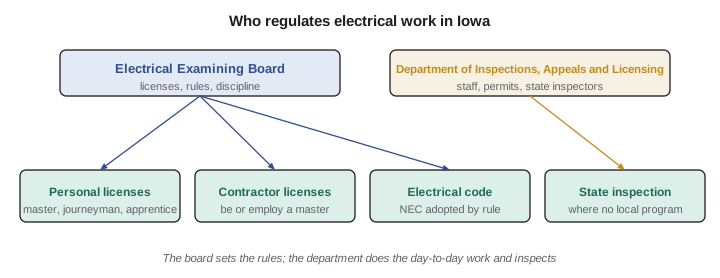
Statewide electrical licensing in Iowa is created by Iowa Code chapter 103. The chapter sets up the Electrical Examining Board, a board whose members include electricians, contractors, inspectors and members of the public. The board adopts rules on licensing, continuing education, permits and inspection, adopts the National Electrical Code as the state's electrical standard, and has the power to discipline license holders. Most of its rules are found in the 481 chapters of the Iowa Administrative Code: chapter 401 covers licensing, chapter 403 continuing education and chapter 404 the electrical code, permits and inspections.
Day-to-day work is done by staff of the Department of Inspections, Appeals and Licensing, usually called DIAL. Before the state's 2023 reorganization the electrical program sat in the Department of Public Safety under the State Fire Marshal, and some older documents, including some exam vendor material, still use that name. Today DIAL processes license applications and renewals, runs the online permit and inspection system, employs the state electrical inspectors and answers questions on behalf of the board.
A useful way to remember the arrangement is that the board makes the rules and DIAL carries them out. When the code edition changes, the board adopts it by rule. When Megan applies for her exam, renews her license or files a permit, she deals with DIAL staff and DIAL's online systems. When a complaint is filed against a licensee, DIAL investigates and the board decides what discipline, if any, follows.
Personal licenses and the contractor license
Iowa separates two questions. The first is who is qualified to do electrical work, and it is answered by personal licenses held by individuals. The second is which businesses may offer electrical work to the public, and it is answered by the electrical contractor license held by a business. Iowa Code section 103.9 ties the two together: an electrical contractor must either be a licensed master electrician or employ one, and it must also be registered as a contractor under Iowa Code chapter 91C. Lesson 8 covers the contractor side in detail.
The personal licenses form a ladder. An unclassified person may do electrical work only under the supervision of a licensed electrician and must be employed by a licensed contractor. An apprentice holds an apprentice license while working and learning in a training program. A journeyman electrician has met the experience requirement and passed the journeyman exam, and may do electrical work on their own but may not qualify a contractor. A master electrician has met the master requirement and passed the master exam, and may be the licensed master who qualifies a contractor.
Iowa issues both Class A and Class B master and journeyman licenses. The Class A licenses are the standard ones and are valid throughout the state. The Class B licenses are a narrower category that came out of the transition to statewide licensing, with their own rules for moving up to Class A. Iowa also issues a residential electrician license, a residential master license and a residential electrical contractor license, along with special electrician licenses for limited kinds of work. This course follows the Class A path, because it is the one most candidates take and the one Megan is on.
| License | What it allows (summary) | How it is earned (summary) |
|---|---|---|
| Unclassified person | Work under the supervision of a licensed electrician, employed by a contractor | No exam; employer and board requirements apply |
| Apprentice | Work while in an apprenticeship or training program | Board application; renewed each year |
| Class A journeyman | Electrical work without direct supervision | Experience or apprenticeship, then the journeyman exam |
| Class A master | All of the above; may qualify an electrical contractor | One year as a licensed journeyman, then the master exam |
| Electrical contractor (business) | Offer and perform electrical work for others | Be or employ a master, carry insurance, register under 91C |
One license for the whole state
Before statewide licensing, which began in 2008, electricians in many Iowa cities held city licenses and some had to hold several. Chapter 103 replaced that patchwork with state licenses that are valid everywhere in Iowa. A city that runs its own inspection program may not charge its own license fee or give its own license exam to a properly licensed state electrician, although it may keep a copy of a contractor's state license on file. For Boone Ridge this means Megan's master license will be good in Ames, in Des Moines and in the smallest town in the state on the same terms.
State and local inspection
Licensing is statewide, but inspection is shared. The state inspects electrical work where no local program exists, and cities and counties may run their own electrical inspection programs under section 103.29. Programs that existed before statewide licensing could continue, and a local government may also start a new program by filing its ordinances and code with the board, or give its program up by notifying the board. Where a local program exists, permits and inspections run through the city or county. Where none exists, they run through DIAL's online system and a state inspector.
For a contractor the first question on any new job is therefore who inspects there. Linda Ochoa, Boone Ridge's office manager, keeps a list of the local programs in the company's service area and checks every new address against it. Lesson 6 covers permits and inspection in detail, including the special rules for farms and state-owned property.
# Who handles what in Iowa electrical regulation (study aid)
roles = {
    "adopts the electrical code": "Electrical Examining Board",
    "adopts licensing rules": "Electrical Examining Board",
    "processes license applications": "DIAL staff",
    "runs the state permit system": "DIAL staff",
    "inspects where no local program": "State electrical inspectors",
    "inspects inside a local program": "City or county inspectors",
    "decides discipline": "Electrical Examining Board",
}
for task in sorted(roles):
print(f"{task:34} -> {roles[task]}")adopts licensing rules -> Electrical Examining Board adopts the electrical code -> Electrical Examining Board decides discipline -> Electrical Examining Board inspects inside a local program -> City or county inspectors inspects where no local program -> State electrical inspectors processes license applications -> DIAL staff runs the state permit system -> DIAL staff
The code
The board adopts the National Electrical Code by rule in 481 IAC chapter 404, and the adopted edition is the minimum standard everywhere in Iowa. In 2026 that edition is the 2023 NEC. The board first adopted the 2023 NEC with an effective date of July 1, 2025, together with three state amendments on ground-fault circuit-interrupter protection. In 2026 the legislature passed House File 2800, which removed those amendments, so from June 2, 2026 the 2023 NEC applies in Iowa as published. A local program may adopt amendments of its own, filed with the board, but they may not be less stringent than the state code. Lesson 5 explains the history and why it matters on the exam.
Megan asked Dale whether the code book on the truck was still good. It was a 2023 edition, so the answer was yes, but Dale made a point of it: the edition that matters is the one the board has adopted, not the newest one on the shelf. When the board moves to a later edition, both the inspectors and the exam will follow, and a candidate who studied the wrong book can lose easy points.
The exam vendor
Iowa's license exams are given by PSI, a national testing company, under a contract with the state. The board decides who is eligible and sends an authorization; PSI schedules the exam, gives it at its test centers and reports the score. The master exam is open book with the 2023 NEC as its reference. Lessons 3 and 4 explain how to get approved, how to book and what the exam looks like.
What the master license adds
Megan already does nearly every kind of work Boone Ridge sells. What changes when she becomes the company's master is responsibility. The master is the person through whom the contractor holds its license, so permits, inspection results and the quality of every crew's work will reflect on her license as well as the company's. She will decide how apprentices and unclassified persons are supervised, be the person an inspector calls about a correction, and need to make sure the company's insurance and registration stay current.
That is why the master exam goes further than the journeyman exam into design-level calculations, services and feeders, special occupancies and the business of contracting. The core courses in this series prepare you for the code and calculation side. This course prepares you for the Iowa side: who regulates, how the code is adopted, how permits work and what a master and a contractor must do to stay licensed.
Dale summed it up in one sentence: "Your license says you can do it, the contractor license says the company can sell it, the permit says this job is happening, and the inspector checks that it was done right." Each of the following lessons takes one of those links and looks at it closely.
Worked problem
Sorting the roles
Linda asks Megan to sort four tasks: (1) deciding which NEC edition applies in Iowa, (2) processing Megan's master exam application, (3) inspecting a service change in a small town with no local program, and (4) inspecting a remodel inside a city that runs its own electrical program. Who handles each?
Show solution
- Adopting the code edition is a rule-making act of the Electrical Examining Board.
- Applications are processed by DIAL staff for the board, which decides eligibility.
- With no local program, a state electrical inspector inspects the job.
- Inside a local program, the city's own inspector handles the permit and inspection.
Answer: The board; DIAL staff for the board; a state inspector; the city inspector.
Common mistakes
MistakeAssuming a city can require its own electrician license or license exam.
InsteadState licenses are valid statewide; a local program may not charge its own license fee or give its own exam to a properly licensed electrician.
MistakeTreating a journeyman license as enough to qualify a contractor.
InsteadAn electrical contractor must be or employ a licensed master electrician.
MistakeFiling a state permit for a job inside a city that runs its own inspection program.
InsteadCheck the location first; local programs issue their own permits.
MistakeLooking for the electrical program under the Department of Public Safety.
InsteadSince the 2023 reorganization the program is part of DIAL, although some older documents still use the old name.
Summary and key terms
- Iowa Code chapter 103 creates the Electrical Examining Board and statewide electrical licensing.
- The board adopts rules and the code; DIAL staff process applications, run permits and inspect.
- Personal licenses qualify individuals; an electrical contractor must be or employ a licensed master and register under chapter 91C.
- Inspection is shared: the state inspects where no local program exists.
- The 2023 NEC is Iowa's code, applied as published from June 2, 2026.
- Electrical Examining Board
- The state board that licenses electricians and contractors, adopts the electrical code and disciplines licensees.
- DIAL
- The Iowa Department of Inspections, Appeals and Licensing, which staffs the board and runs state inspection.
- Unclassified person
- A person who does electrical work under supervision while employed by a contractor, without a journeyman or master license.
- Local program
- A city or county electrical inspection program operating under Iowa Code section 103.29.
- PSI
- The testing company that gives Iowa's electrical license exams.
Practice problems
Work each problem on paper first, then reveal the answer to check.
Which body adopts the edition of the NEC used in Iowa?
Show answer
The Electrical Examining Board, by rule in 481 IAC chapter 404.
May an Iowa city with its own inspection program require a state-licensed electrician to pass a city license exam?
Show answer
No. A local program may not charge its own license fee or give its own exam to a properly licensed electrician.
What two things does section 103.9 require of an electrical contractor?
Show answer
It must be or employ a licensed master electrician, and it must be registered as a contractor under chapter 91C.
Lesson quiz · 5 questions
Score 60% or more to complete this lesson.
Create a free account to save your progress, take quizzes and earn a certificate.