
MELU-215 · Lesson 7 of 12 · 18 min
Duties and responsibilities of the Master Electrician License holder
▶ Video coming soon A video version of this lesson is on the way.
Megan passed the master exam in May 2026 with a score in the low eighties, and her Class A master license appeared in the state lookup two weeks later. Dale took her to lunch to celebrate and then, over coffee, handed her a single page he had written by hand. At the top it said "What the license means." Underneath were six lines: the company's license rests on yours; every permit is your work; every crew is your crew; the code is the floor; the paperwork is real; and the board can take it away. "I learned most of those the hard way," he said. "You can learn them from this."
The company's license rests on the master's
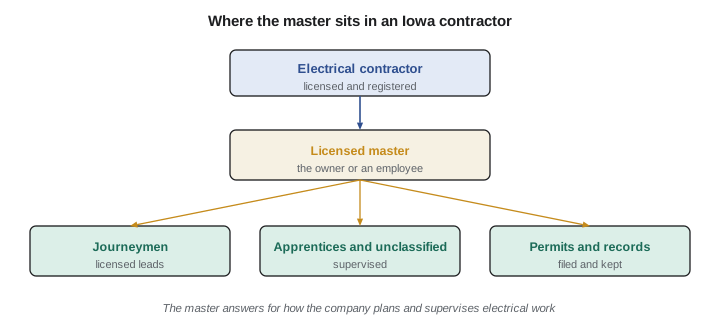
Iowa Code section 103.9 requires every electrical contractor to be a licensed master electrician or to employ one. For a company like Boone Ridge, which is a corporation rather than a person, that means the contractor license exists only because a licensed master works there. When Dale moves to inactive status, the company will continue to qualify only because Megan holds an active Class A master license and is employed by the company.
This makes the master's license the foundation of the business. If it lapses because a renewal or continuing education requirement is missed, or if it is suspended by the board, the contractor no longer meets section 103.9 unless another master is employed. Lesson 8 explains how the contractor license records the master and what the company must do if its master leaves. For the master personally, the point is that keeping the license current is not a private matter; the jobs of everyone at the company depend on it.
Every permit is the master's work
Permits are filed in the contractor's name, and the contractor exists through its master. When an inspector finds a problem on a Boone Ridge job, the call goes to the company, and the company's master is the person who must make sure it is fixed. When a job is done without a required permit, the board can act against the contractor and its licensees. In practice this means the master sets the rules for when permits are filed, reviews the permits list and makes sure every inspection is requested and closed.
Megan adopted Linda's weekly permit review as her own. Every Friday she looks at the list of open permits, checks that each one has a current inspection request or a reason for waiting, and asks about any job that has been open for more than sixty days. It takes fifteen minutes and it catches the jobs that quietly stall.
Every crew is the master's crew
Iowa allows unlicensed people to do electrical work only under supervision. Apprentices work under licensed electricians while they train, and unclassified persons, who hold no journeyman or master license, may do electrical work only under the supervision of a licensed electrician and only while employed by a licensed contractor. Section 103.29 refers to a supervision ratio of three such persons to each licensed electrician, and the board's rules explain how it applies. The master is the person who sets crew assignments so that every apprentice and unclassified person is properly supervised.
Supervision is more than a ratio on paper. A licensed electrician on the job must actually direct and check the work. The master decides which jobs need a journeyman on site at all times, which tasks an apprentice may do with periodic checks, and when a new hire is ready to work with less oversight. When Tyrell Banks joined Boone Ridge as an unclassified person, Megan paired him with a journeyman for his first three months and wrote down the tasks he had been trained on, so that any lead could see what he was ready for.
| Role | May do electrical work? | Supervision (summary) |
|---|---|---|
| Unclassified person | Yes, while employed by a licensed contractor | Under the supervision of a licensed electrician |
| Apprentice | Yes, while in a training program | Under licensed electricians, within the ratio |
| Class A journeyman | Yes | Works without direct supervision; may supervise others |
| Class A master | Yes | May supervise and may qualify a contractor |
# Checking crew assignments against a three-to-one ratio (illustrative)
crews = {
    "Millbrook shop":   {"licensed": 1, "apprentices": 2, "unclassified": 1},
    "Grant Corners":    {"licensed": 2, "apprentices": 3, "unclassified": 2},
    "Sundquist farm":   {"licensed": 1, "apprentices": 2, "unclassified": 2},
}
RATIO = 3   # supervised workers per licensed electrician, as summarized
for job, c in crews.items():
    supervised = c["apprentices"] + c["unclassified"]
    ok = supervised <= RATIO * c["licensed"]
print(f"{job:16} supervised {supervised}, licensed {c['licensed']}: {'ok' if ok else 'add a licensed electrician'}")Millbrook shop supervised 3, licensed 1: ok Grant Corners supervised 5, licensed 2: ok Sundquist farm supervised 4, licensed 1: add a licensed electrician
The code is the floor
The adopted NEC is the minimum standard. A master's duty is to make sure every installation meets at least that standard, whether or not it will be inspected. This is most important on work exempt from inspection, such as many farm buildings, where the master's own judgment is the only check. Dale's habit was to have a second licensed electrician walk every exempt job before the customer was billed, and Megan kept the practice.
The code is also a floor in the sense that customers and engineers can ask for more. A design may call for larger conductors, additional circuits or better equipment than the code requires. The master's job is to know the difference between what the code requires and what the contract requires, and to make sure the crew builds to whichever is higher.
The paperwork is real
Licensing law treats records seriously. Permits, inspection requests, insurance certificates, license renewals, continuing education certificates and supervision records all show whether a contractor and its master are meeting their duties. Inaccurate records are treated as seriously as poor workmanship. Filing a permit that misstates the scope, signing for work you did not supervise or claiming continuing education you did not complete can all lead to discipline.
Masters should also keep their own personal license information current with the board. A change of address or employer, a legal name change or a change in the company's information should be reported as the rules require. A master who works on their own account rather than for a licensed contractor has an additional duty under 481 IAC 401.7: to carry general and completed operations liability insurance of at least 1 million dollars, the same as a contractor. In practice a master who works independently also needs a contractor license, because offering electrical work to the public is contracting.
The board can take it away
The board has authority under chapter 103 to deny, suspend or revoke licenses, to place licensees on probation and to impose civil penalties. Grounds for discipline in the statute and rules include fraud in obtaining a license, gross negligence or incompetence, repeated code violations, working without required permits, allowing unlicensed people to do work without proper supervision and violating the board's rules. Complaints can come from customers, inspectors, other contractors or the board's own staff, and DIAL investigates before the board decides.
A master who receives a complaint should respond promptly and factually, provide the records requested and, if the matter is serious, consider getting legal advice. Most complaints that reach the board involve permits, supervision or workmanship that could have been caught with the habits described in this lesson.
Planning, estimating and design
Beyond the legal duties, a master in a contracting company usually takes on technical leadership. At Boone Ridge Megan reviews every estimate over a set size for service and feeder sizing, available fault current, voltage drop and grounding. She signs off on load calculations, chooses the wiring methods for unusual occupancies and decides when a job needs an engineer. The master exam's emphasis on calculations reflects this role: the master is expected to get the design right, not just install it.
Knowing when to call an engineer is itself a master's skill. Large services, health care occupancies, hazardous locations and systems where the available fault current is high or uncertain often call for an engineered design. A master who recognizes the limits of the company's experience protects the customer and the company alike.
She also became the person crews call with code questions. Dale's advice was to answer with the section, not just the answer, so that the crew learned where to look. Within a year Caleb, the apprentice, was finding most answers himself.
Working with inspectors and customers
The master is also the company's face to the people who judge its work. With inspectors, that means being reachable, answering questions with the section and the edition, fixing corrections quickly and never asking for approval of work that is not ready. Jim Voss told Megan that the contractors he trusts most are the ones who call him before cover when they are unsure, rather than after a correction. A master who builds that reputation finds that inspections go faster and disagreements are settled on the phone.
With customers, the master's duty is honesty about what the law requires. Customers sometimes ask a contractor to skip the permit to save money or time, to reuse equipment that does not meet the code, or to let a relative do part of the work. The answer from a licensed contractor is no, explained in plain terms: the permit protects the customer's insurance and resale, the code is the law, and the contractor's license is at stake. Megan found that most customers accepted the explanation once they understood that the permit fee was small compared with the risk of an uninsured fire.
Finally, the master is responsible for the company's own learning. The code changes every three years, the state's rules change more often, and new kinds of work such as battery storage and electric vehicle charging bring new requirements. Planning the crew's training is part of the job, and it overlaps with the continuing education every licensee needs, described in lesson 11.
Handing over from Dale
Dale's handover took six months. He walked Megan through the company's open permits, its insurance and registration, its relationships with the inspectors and local programs, and the customers whose systems the company had maintained for decades. He introduced her to Jim Voss and to the building officials in the local programs as the company's new master. Then he applied to move his own license to inactive status, which kept it available but meant he would no longer do electrical work or qualify the company.
Worked problem
Is the crew properly supervised?
On the Grant Corners job, Boone Ridge has two journeymen, three apprentices and two unclassified persons. One journeyman is called away to an emergency for the afternoon. Using the three-to-one ratio as summarized in this lesson, is the job still within the ratio, and what should Megan do?
Show solution
- Supervised workers: three apprentices plus two unclassified persons = five.
- With two journeymen the limit is 3 x 2 = 6, so the job was within the ratio.
- With one journeyman the limit is 3 x 1 = 3, and five supervised workers exceeds it.
- Megan should send another licensed electrician, move two supervised workers to another job or pause work for the afternoon.
Answer: No; with one licensed electrician the job is over the ratio, so Megan must add a licensed electrician or reduce the crew.
Common mistakes
MistakeTreating the master license as a personal matter separate from the company.
InsteadThe contractor's license depends on its master; a lapse affects the whole company.
MistakeCounting a ratio on paper without real supervision.
InsteadA licensed electrician must actually direct and check the work of apprentices and unclassified persons.
MistakeBuilding exempt farm work to a lower standard.
InsteadThe NEC applies whether or not the work is inspected.
MistakeWorking independently on a master license alone.
InsteadOffering electrical work to the public requires a contractor license and the insurance in 401.7.
Summary and key terms
- Under section 103.9 a contractor must be or employ a licensed master, so the company's license rests on the master's.
- The master is responsible for permits, inspections and corrections on the company's jobs.
- Apprentices and unclassified persons may work only under the supervision of licensed electricians, within the ratio the law describes.
- The adopted NEC is the minimum on every job, inspected or not.
- The board can deny, suspend or revoke licenses and impose penalties for violations of chapter 103 and its rules.
- Licensed master
- A master electrician through whom a contractor meets section 103.9.
- Supervision
- A licensed electrician directing and checking the work of unlicensed workers.
- Supervision ratio
- The number of apprentices and unclassified persons allowed for each licensed electrician.
- Discipline
- Board action against a license, such as probation, suspension, revocation or a civil penalty.
- Completed operations coverage
- Liability insurance covering claims that arise after work is finished.
Practice problems
Work each problem on paper first, then reveal the answer to check.
What does section 103.9 require for a company to hold an electrical contractor license?
Show answer
It must be or employ a licensed master electrician, and register under chapter 91C.
May an unclassified person work without supervision if experienced?
Show answer
No. Unclassified persons work only under the supervision of a licensed electrician.
What insurance must a master carry who works on their own account?
Show answer
General and completed operations liability of at least 1 million dollars under 401.7.
Lesson quiz · 5 questions
Score 60% or more to complete this lesson.
Create a free account to save your progress, take quizzes and earn a certificate.