
MELU-215 · Lesson 12 of 12 · 24 min
Practice exam review and test-day strategy
▶ Video coming soon A video version of this lesson is on the way.
Ten weeks before her exam date, Megan sat down with Ben and a blank calendar. Ben had passed the Iowa master exam on his first attempt and had also watched two friends fail it, both strong electricians. "They knew the code," he said. "One never practiced with the clock and the other never practiced with the book he brought. You have to practice the exam, not just the material." This lesson pulls the course together into a study plan, a method for reviewing practice exams and a routine for test day.
A ten-week plan
Megan's plan had five phases. In the first two weeks she learned the layout of the 2023 NEC: the chapters, the index, Article 100 and where the most common tables live. In weeks three to six she worked through the content areas in the bulletin's outline, spending the most time on load calculations, services and feeders, overcurrent protection, grounding and bonding, and motors. Week seven was for the Iowa material in this course: the board and DIAL, the license routes, the code adoption history, permits and inspection, contractor requirements, liens, safety and renewal. Weeks eight and nine were timed practice exams. Week ten was for review and rest.
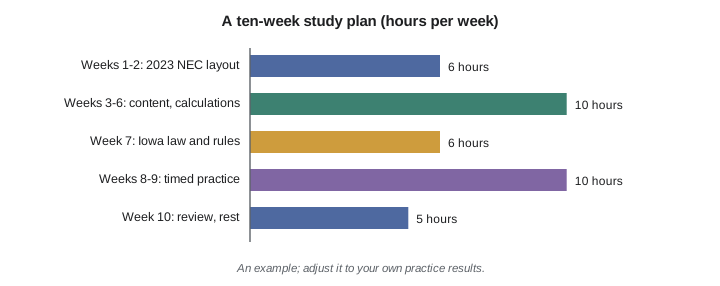
The hours were modest, six to ten a week, because Megan was working full time and running crews. Ben's advice was that steady hours beat long weekends, and that two sessions of an hour and a half during the week, plus a longer session on Saturday, would keep the material fresh without burning her out.
Practice that copies the exam
From week three on, every practice session used the same tools Megan would bring on test day: her tabbed 2023 NEC, her exam calculator and nothing else. She did not use her phone to look things up, did not keep a formula sheet beside her and did not use a different copy of the code. In weeks eight and nine she took full timed practice exams of 110 questions in 240 minutes, at the same time of day as her booked exam, with a kitchen timer and no breaks beyond what the test center would allow.
The first full practice exam was humbling. She scored 66, ran out of time with twelve questions unanswered and found that she had spent eighteen minutes on a single motor feeder question. The second scored 72 with three unanswered. By the fourth she was scoring in the high seventies with time to spare, mostly because she had stopped fighting single questions and started using the two-pass method from lesson 4.
The miss log
The most useful tool in Megan's plan was a miss log: one line for every practice question she got wrong or guessed, with the code area, the cause and the fix. Ben insisted on the cause column, because it separates three very different problems. A knowledge miss means she did not know the rule. A search miss means she knew the rule existed but could not find it in time. A reading miss means she knew the rule and found it, but misread the question, missed an exception or made an arithmetic slip.
| Cause | Typical sign | Fix |
|---|---|---|
| Knowledge | Did not know the rule existed | Study the section and work three more questions on it |
| Search | Knew it, could not find it in time | Practice the index route; tab if it recurs |
| Reading | Missed not, except or a unit | Read the last sentence first; underline key words in the question |
| Arithmetic | Right method, wrong number | Check each step; recompute before choosing |
| Time | Left blank or rushed | Flag after a set limit and return later |
# Summarizing a miss log (counts invented for this course)
from collections import Counter
log = [
    ("calculations", "knowledge"), ("calculations", "arithmetic"), ("services", "search"),
    ("grounding", "knowledge"), ("motors", "time"), ("calculations", "reading"),
    ("wiring methods", "search"), ("Iowa rules", "knowledge"), ("motors", "knowledge"),
    ("calculations", "knowledge"), ("special occupancies", "reading"), ("grounding", "search"),
]
by_area = Counter(a for a, _ in log)
by_cause = Counter(c for _, c in log)
print("by area: ", by_area.most_common(3))
print("by cause:", by_cause.most_common())
print("study first:", by_area.most_common(1)[0][0])by area: [('calculations', 4), ('grounding', 2), ('motors', 2)]
by cause: [('knowledge', 5), ('search', 3), ('reading', 2), ('arithmetic', 1), ('time', 1)]
study first: calculationsAfter each practice exam Megan sorted the log. The area column told her where to study, and the cause column told her how. Calculations led every week, so she worked through the load calculation steps until she could do a dwelling service calculation from memory. Search misses dropped as she practiced the index. Reading misses fell once she began reading the last sentence of each question first.
Reviewing the Iowa material
Week seven was for the Iowa-specific material. Even if the content outline in your bulletin lists few or no state law questions, the master needs this knowledge for the job, and any Iowa questions that do appear must be answered without a reference. Megan made a single page of facts from this course and reviewed it twice a week until the exam:
- The Electrical Examining Board adopts the rules and the code; DIAL staff process licenses, run permits and inspect.
- The usual master route is one year as a licensed Class A journeyman plus the master exam; reciprocity only with agreement states.
- After two failures: six months and 12 hours of continuing education before the next attempt.
- The 2023 NEC took effect July 1, 2025 with three GFCI amendments; from June 2, 2026 it applies as published.
- Permits before work; emergency permits within 72 hours after completion; late permits double the fee; state inspections scheduled within three business days.
- A contractor must be or employ a master, register under 91C and carry at least 1 million dollars of liability insurance.
- Liens go on MNLR; full protection within 90 days after last furnishing; residential notices matter.
- Iowa OSHA runs a state plan; first report of injury within four days of notice for more than three days lost.
- Three-year licenses; 18 hours of continuing education per cycle; master and contractor licenses 375 dollars each in 2026.
A worked practice set
Ben gave Megan a short set of practice questions each week, mixing code, calculation and Iowa topics. Three examples show the style and the reasoning.
Worked problem
Practice 1: average time
An exam has 110 questions and 240 minutes. A candidate spends 80 minutes on the first 60 questions. If the remaining time is shared equally among the remaining questions, how many minutes does each get?
Show solution
- Remaining questions: 110 - 60 = 50.
- Remaining time: 240 - 80 = 160 minutes.
- Time per question: 160 / 50 = 3.2 minutes.
Answer: 3.2 minutes per question.
Worked problem
Practice 2: an Iowa permit question
A storm damages a service mast at a house in a town with no local program on a Saturday night. Boone Ridge restores power on Sunday morning. What must the company do about the permit?
Show solution
- The work was an emergency, which the rules allow to start before a permit.
- With no local program, the state is the authority.
- The permit must be obtained within 72 hours after the work is completed.
Answer: Obtain a state permit within 72 hours after completing the work, and request the inspection.
Worked problem
Practice 3: a three-phase load
A 480-volt, three-phase feeder supplies a balanced load of 100 kVA. What is the current, to the nearest ampere? (Illustrative values.)
Show solution
- Three-phase current = kVA x 1,000 / (volts x 1.732).
- 100 x 1,000 = 100,000 volt-amperes.
- 480 x 1.732 = 831.4.
- 100,000 / 831.4 = 120.3 amperes.
Answer: About 120 amperes.
Worked problem
Practice 4: an Iowa contractor question
A new company owned by a journeyman wants to bid electrical work. It has 91C registration and a 1 million dollar liability policy but no master on staff. May it obtain an electrical contractor license?
Show solution
- Section 103.9 requires a contractor to be or employ a licensed master electrician.
- A journeyman owner does not meet that condition.
- The registration and insurance are necessary but not enough on their own.
Answer: No. It must employ a licensed master (or the owner must become one) before the board will license it.
Ben's point in mixing the topics was that the real exam does not announce which kind of question comes next. A candidate who can move from a lookup to a calculation to a state rule without losing a minute to resetting has gained time that no amount of tabbing provides.
The last week
The week before the exam is not for new material. Megan took one last timed practice exam on the Saturday a week before her date, reviewed its misses on Sunday and then spent the week on light review of her one-page Iowa sheet and the tabs she used most. She checked her code book against the bulletin's rules one more time, making sure there were no loose notes or writing, and put a fresh battery in her calculator.
Two days before the exam she stopped studying entirely, apart from a short look at the Iowa page. Ben's view was that a rested mind finds sections faster than a tired one, and Megan's practice scores had shown the same thing.
Test-day routine
On the morning of the exam Megan ate a real breakfast, left home with extra time for the hour's drive to Des Moines and arrived 45 minutes early. She brought her ID, her confirmation, her code book and her calculator, and left everything else in the car. At the test center she showed her ID, had her book inspected, stored her keys and phone in a locker and took the short tutorial on the computer system before the clock started.
Once the exam began, she followed her plan. The first pass took her to minute 92 with 71 questions answered and 39 flagged. The second pass took her to minute 214. In the last 26 minutes she reviewed the flagged answers she was least sure of and made sure nothing was blank. When the score report appeared, it said she had passed.
| Before | During | After |
|---|---|---|
| Check the current bulletin and your authorization | Start with quick questions to settle in | Keep the score report in the license folder |
| Inspect your code book for prohibited notes | First pass: answer in about a minute or flag | Complete the license step with the board |
| Fresh calculator battery; ID and confirmation ready | Second pass: long calculations and searches | Update the contractor's records once the license issues |
| Arrive early; plan the route | Final minutes: review flags; no blanks | Plan continuing education for the new cycle |
If you do not pass
Not everyone passes on the first attempt, and a failing score is information, not a verdict. The score report shows performance by content area. Compare it with your miss log, decide whether the problem was knowledge, search, reading or time, and plan four to six weeks of targeted work before the next attempt. Check how much of your authorization remains, remembering that it is valid for a limited time and number of attempts, and that after two failures the rules require a six-month wait and 12 hours of continuing education.
After the license
Passing the exam is the start of the master's job, not the end of the study. Megan's last step was the one this course began with: the license was issued, Linda updated Boone Ridge's records, Dale moved to inactive status, and the company's license now rested on Megan's. Her first acts as master were to review the open permits, check the company's insurance and registration, and book her first continuing education course. Dale's handwritten page, "What the license means," went into a frame above her desk.
Common mistakes
MistakePracticing with a different code book from the one you will bring.
InsteadUse the same tabbed 2023 NEC for every timed session.
MistakeRecording only which questions were wrong.
InsteadRecord the cause too, so you know whether to study, practice searching or slow down.
MistakeCramming new material the night before.
InsteadUse the last week for light review and rest the final two days.
MistakeIgnoring the Iowa material because the reference is only the NEC.
InsteadLearn it; the master needs it on the job and any state questions must be answered from memory.
Summary and key terms
- Practice the exam itself: same book, same calculator, same time limit.
- A miss log by area and cause shows where and how to study.
- Week seven of the plan covers the Iowa material from this course.
- Use the two-pass method and leave no question blank.
- After passing, complete the license step and update the contractor's records.
- Miss log
- A record of every practice question missed, with its area and cause.
- Search miss
- A miss caused by not finding a known rule in time.
- Reading miss
- A miss caused by misreading the question or overlooking an exception.
- Timed practice exam
- A full-length practice exam under real time limits and reference rules.
- Score report
- The result given at the test center, with content-area detail for failing candidates.
Practice problems
Work each problem on paper first, then reveal the answer to check.
What three things should every timed practice session use?
Show answer
The same tabbed code book, the same calculator and the real time limit.
What is the difference between a search miss and a knowledge miss?
Show answer
A search miss is a known rule not found in time; a knowledge miss is a rule not known.
What should the last two days before the exam be used for?
Show answer
Rest, with at most a short look at the Iowa summary page.
Lesson quiz · 5 questions
Score 60% or more to complete this lesson.
Create a free account to save your progress, take quizzes and earn a certificate.