
MELU-207 · Lesson 9 of 12 · 19 min
Contracts and mechanics' liens in Connecticut
▶ Video coming soon A video version of this lesson is on the way.
In June, a developer in Southington stopped paying Tunxis Valley for a six-unit townhouse project. The last invoice, for the rough wiring and services, was 46,000 dollars, and the developer's project manager had stopped returning calls. Denise brought the file to Marisol and Walt. "We finished the rough on May 28," she said. "The clock is running." Walt called the company's lawyer, who said three things before anything else: find the date the company last furnished labor or materials, confirm that the company had a contract with the developer or worked with the owner's consent, and get the certificate of lien to the town clerk well before the deadline. This lesson covers the contract basics every Connecticut contractor needs, the mechanic's lien law in chapter 847 of the General Statutes, and the bond claims that replace liens on public work.
Contract basics
Every job starts with a contract, written or not. A good electrical contract identifies the parties and the property, describes the scope of work and what is excluded, states the price or how it is calculated, sets the payment schedule and retainage if any, explains how changes are priced and approved, sets the schedule, allocates responsibility for permits and inspections, lists insurance requirements and says how disputes are resolved. On subcontracts, read the flow-down clauses, which bind the electrical subcontractor to the terms of the general contract, and the pay-when-paid or pay-if-paid clauses, which can shift the risk of owner nonpayment.
Home improvement contracts have extra rules. As Lesson 8 explained, when a contractor does home improvement work on residential property, the contract must be in writing, signed and dated, with the registration number, start and completion dates, and the three-day cancellation notice. A contract that does not comply may be unenforceable against the homeowner. Connecticut courts have allowed recovery in some cases when the homeowner acted in bad faith, but a contractor should never plan on that.
| Clause | Why it matters for an electrical contractor |
|---|---|
| Scope and exclusions | Prevents disputes about fixtures, low-voltage, utility fees and patching |
| Payment schedule and retainage | Sets cash flow and when the final amount is due |
| Change orders | Requires written approval and pricing before extra work |
| Permits and inspections | Makes clear who files, pays and schedules |
| Pay-when-paid or pay-if-paid | Can shift the risk of owner nonpayment to the subcontractor |
| Dispute resolution | Sets mediation, arbitration or court and where |
Prompt payment on private projects
Connecticut has prompt payment statutes for private construction contracts above a set size. In general terms, they require owners to pay contractors, and contractors to pay subcontractors, within set periods after a payment request or after receiving payment, and allow interest on late payments. They also limit retainage on covered projects. Contractors should know the current thresholds and periods, because a clear statutory deadline can be a strong tool in a payment dispute, often stronger than a lien threat.
What a mechanic's lien is
A mechanic's lien is a claim against real property for the value of labor, materials or services that improved it. Under section 49-33, a person who has a claim for more than a nominal amount for materials furnished or services rendered in the construction, raising, removal or repairs of a building, or any of its appurtenances, under an agreement with the owner or with the owner's consent, may claim a lien on the land and building. Subcontractors and suppliers who work for a general contractor also have lien rights, because the general contractor's work is done with the owner's consent. The lien gives the claimant security: if the claim is not paid, the claimant can ask a court to foreclose the lien and have the property sold.
Connecticut's statute uses the singular phrase mechanic's lien; this course's title uses the general plural for the topic. Either way, the rules are the same: the lien is a statutory right, and the claimant must follow the statute's steps exactly to keep it.
The 90-day certificate
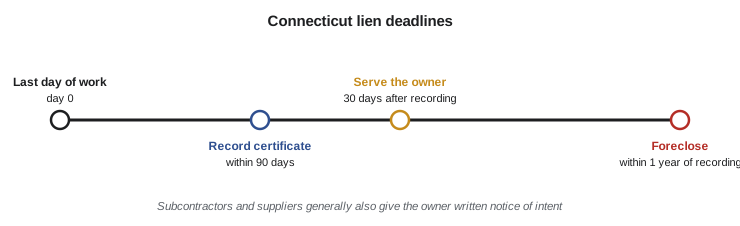
The central deadline is in section 49-34. A lien is not valid unless, within 90 days after the claimant has ceased to perform services or furnish materials, the claimant records a certificate of lien in the land records of the town where the property is located. The certificate must be in writing and subscribed and sworn to by the claimant. It describes the property, states the amount claimed and the dates on which the claimant began and ceased work, names the owner, and states that the amount is justly due, as nearly as can be determined. The claimant then must serve a true and attested copy of the certificate on the owner not later than 30 days after recording it, by the methods the statute allows.
The 90 days run from the last date the claimant furnished labor or materials, not from the invoice date and not from when the money became overdue. Small punch-list trips made only to extend the deadline may not count. Claimants should find the true last date in their records and work back from it.
Subcontractor notice
Section 49-35 adds a step for claimants who did not contract directly with the owner. A subcontractor or supplier generally must give the owner written notice of the intent to claim a lien, within the same 90-day period, by the methods the statute describes. The details depend on the facts, including whether the general contractor has recorded the affidavit the statute allows. Because the notice costs little and missing it can defeat the lien, many subcontractors simply send the notice in every case where they record a lien. Residential projects, and projects where a homeowner has already paid the general contractor, raise additional questions about how much the owner can be required to pay, which is another reason to involve a lawyer.
Enforcing the lien
Recording the lien starts another clock. Under section 49-39, a mechanic's lien generally does not continue in force for longer than one year after it is recorded unless the claimant begins an action to foreclose it within that year and records a notice of the pending action, called a lis pendens, in the land records. A lien that is not foreclosed in time is discharged. In practice, a recorded lien often leads to settlement, because owners need clear title to sell or refinance. But a claimant should calendar the one-year deadline the day the certificate is recorded.
The statutes also protect owners. An owner can ask the court for a hearing to discharge or reduce a lien that lacks probable cause or overstates the amount, and an owner can substitute a bond for the lien so the property is released and the claimant looks to the bond instead. A claimant who records a lien for an amount it knows is inflated can face consequences, so the amount should be supported by the contract and the records.
# Lien deadline calculator (simplified study aid; confirm with counsel)
from datetime import date, timedelta

last_work = date(2026, 5, 28)
record_by = last_work + timedelta(days=90)
recorded = date(2026, 7, 20)          # date the certificate was recorded
serve_by = recorded + timedelta(days=30)
foreclose_by = recorded.replace(year=recorded.year + 1)
print("Last day of work:          ", last_work.isoformat())
print("Record certificate by:     ", record_by.isoformat())
print("Recorded on:               ", recorded.isoformat(), "ok" if recorded <= record_by else "LATE")
print("Serve owner by:            ", serve_by.isoformat())
print("Start foreclosure by about:", foreclose_by.isoformat())Last day of work: 2026-05-28 Record certificate by: 2026-08-26 Recorded on: 2026-07-20 ok Serve owner by: 2026-08-19 Start foreclosure by about: 2027-07-20
For the Southington townhouses, the last day of work was May 28, so the certificate had to be recorded by August 26. Tunxis Valley's lawyer recorded it on July 20 and served the developer within the next 30 days. The company then had about a year from July 20 to start a foreclosure action if the developer still did not pay. The developer, who was trying to refinance, settled in September.
Public projects and payment bonds
Liens are not available against public property such as state buildings, schools and town halls. Instead, Connecticut's General Statutes, starting at section 49-41, require general contractors on public works above set contract amounts to furnish payment bonds that protect subcontractors and suppliers. A subcontractor or supplier who is not paid can claim against the bond by giving the required written notice to the surety and the general contractor within the period the statute sets after last furnishing work, and then suing on the bond if the claim is not paid. The notice periods and the procedure differ from the lien statutes, so a contractor working on public projects should learn them separately and calendar them from the start.
| Private project | Public project |
|---|---|
| Mechanic's lien on the land and building | No lien on public property |
| Certificate recorded within 90 days of last work | Written notice to the surety within the statutory period |
| Serve the owner within 30 days of recording | Claim against the general contractor's payment bond |
| Foreclose within one year of recording | Sue on the bond within the statutory period |
Lien waivers
Owners and general contractors commonly ask subcontractors to sign lien waivers with each payment. A conditional waiver gives up lien rights for a stated amount once that payment is actually received; an unconditional waiver gives them up immediately. Signing an unconditional waiver before the check clears, or a waiver that covers more than the amount paid, can give away rights the contractor still needs. Read every waiver before signing, and match its amount and dates to the payment.
Worked problem
Is the lien still possible?
Tunxis Valley finished the trim-out at a private house in Harwinton on February 10 and has not been paid. The bookkeeper finds the file on May 20. Can the company still record a lien?
Show solution
- The certificate must be recorded within 90 days after the last day of work.
- February 10 plus 90 days is May 11.
- May 20 is after May 11, so the 90-day period has run.
- The lien is likely lost; the company can still sue on the contract.
Answer: Likely not; the 90 days ran on May 11. The contract claim remains.
Documenting the claim
A lien is only as good as the records behind it. Keep the signed contract, approved change orders, daily reports that show who was on site and when, delivery tickets for materials, invoices and payment records. The last day of work should be clear from the daily reports. If the amount claimed includes extra work, there should be a written approval or at least correspondence showing the owner or general contractor asked for it. Good records also help in settlement talks, because they show the other side that the claim will stand up in court.
Finally, calendar every lien date the day the job ends: the 90-day recording deadline, the 30-day service deadline once the lien is recorded and the one-year foreclosure deadline. A missed date usually cannot be fixed later, however strong the claim.
Common mistakes
MistakeCounting the 90 days from the invoice date.
InsteadCount from the last day the claimant performed services or furnished materials.
MistakeRecording the certificate and forgetting to serve the owner.
InsteadServe a true and attested copy on the owner within 30 days after recording.
MistakeLetting a year pass after recording without starting foreclosure.
InsteadBegin the action and record a lis pendens within one year, or the lien is discharged.
MistakeRecording a lien on a public school.
InsteadPublic property cannot be liened; claim against the payment bond.
Summary and key terms
- A good contract covers scope, payment, changes, permits, schedule, insurance and disputes; home improvement contracts have extra statutory requirements.
- Section 49-33 gives a lien to those who improve property under an agreement with or the consent of the owner.
- Under section 49-34, record the certificate within 90 days after last work and serve the owner within 30 days after recording.
- Subcontractors and suppliers generally must also give the owner written notice of intent under section 49-35.
- Foreclose within one year of recording under section 49-39; on public work, claim against the payment bond instead.
- Mechanic's lien
- A statutory claim against real property for the value of labor or materials that improved it.
- Certificate of lien
- The sworn document recorded in the town land records to create the lien.
- Lis pendens
- A notice recorded in the land records that a lawsuit affecting the property is pending.
- Substitution of bond
- Replacing a lien with a bond so the property is released.
- Lien waiver
- A document giving up lien rights, conditionally or unconditionally, usually in exchange for payment.
Practice problems
Work each problem on paper first, then reveal the answer to check.
Within how many days after last work must the certificate of lien be recorded?
Show answer
90 days.
Within how many days after recording must the owner be served?
Show answer
30 days.
How long does a lien generally last unless foreclosure is started?
Show answer
One year after recording.
What replaces lien rights on Connecticut public works?
Show answer
A claim against the general contractor's payment bond.
Lesson quiz · 5 questions
Score 60% or more to complete this lesson.
Create a free account to save your progress, take quizzes and earn a certificate.