
MELU-207 · Lesson 7 of 12 · 19 min
Duties and responsibilities of the E-1 Unlimited Electrical Contractor License holder
▶ Video coming soon A video version of this lesson is on the way.
The week Marisol's E-1 appeared in the state lookup, Walt took her to lunch at a diner on Route 6 and slid a list across the table. It had nineteen items: open permits, apprentices and who supervised each one, insurance certificates due to general contractors, the renewal date for every license in the company, a complaint from a homeowner in Wolcott that needed an answer, and more. "This is what the license really is," he said. "The exam proves you know the code. This list is what the state holds you responsible for." This lesson covers the duties that come with the E-1: what the license allows, supervision of journeypersons and apprentices, responsibility for permits and work, the rules about lending a license, advertising and records, and how discipline works when things go wrong.
What the E-1 allows
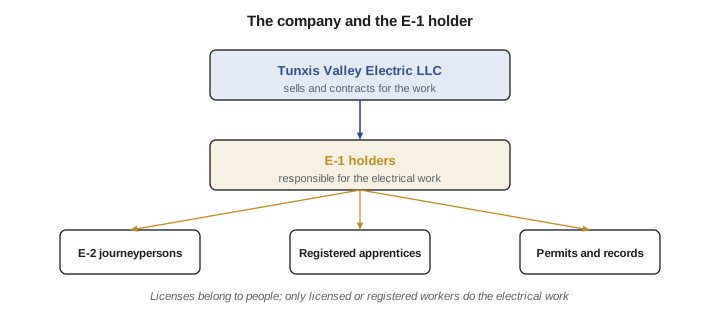
The department's license types page says the E-1 holder may do all electrical work as defined in section 20-330. In practice, that means the E-1 holder may contract with the public for electrical work, bid and advertise it, take out permits for it as a contractor, and employ E-2 journeypersons and registered apprentices to do it. Those privileges are why the E-1 carries more responsibility than the E-2. An E-2 is responsible for doing the work correctly; an E-1 is responsible for the work, the people doing it and the business that sells it.
Employing only licensed people
Every person who does electrical work for an E-1 contractor must be licensed for that work or registered as an apprentice. Section 20-334 allows discipline of a contractor who employs unlicensed people to do work that requires a license, and section 20-341 provides penalties for the violation. The contractor should check every new hire's license or apprentice registration in the state lookup before the first day, keep a copy on file and track expiration dates. Helpers and laborers who are not licensed or registered may do general construction tasks, such as unloading material or digging, but may not do the electrical work itself.
Supervising apprentices
Registered apprentices learn the trade by working under licensed people. Connecticut's rules require apprentices to work under supervision, and the department's regulations describe job-site supervision in which each apprentice works with a licensed person. Separately, section 20-332b sets a ratio of apprentices to licensed journeypersons and contractors that an employer may have. That ratio schedule was amended by legislation effective October 1, 2025, so contractors should read the current version of section 20-332b and the department's guidance before planning crews. Employers can apply for relief from the ratio in some circumstances under the procedure the statute sets out.
Two distinctions trip people up. The employer ratio counts how many apprentices a company may employ relative to its licensed staff; the job-site supervision rule governs how apprentices work on a given day. A company can comply with the ratio and still violate supervision rules by sending an apprentice alone to a job. And apprentices must be registered: hours worked before registration generally do not count toward the apprenticeship, and an unregistered helper doing electrical work is an unlicensed worker.
| Duty | What it means day to day | Where it comes from |
|---|---|---|
| Employ only licensed or registered people | Check the lookup before hiring; track renewals | Sections 20-334 and 20-341 |
| Supervise apprentices | No apprentice alone on electrical work | Department regulations |
| Respect the apprentice ratio | Plan hiring against licensed staff | Section 20-332b, as amended |
| Take responsibility for permits | Only for work you actually do or supervise | Chapter 393 and the State Building Code |
| Never lend the license | No permits or contracts for others' work | Section 20-334 |
Permits and responsibility for the work
When an E-1 contractor takes out a permit, the contractor tells the building official that the work under that permit will be done by the contractor's licensed people under the contractor's supervision and will meet the code. That is a serious statement. The contractor is responsible for corrections the inspector requires, for closing out the permit and for the quality of the work. An E-1 who takes out a permit for work that someone else is actually doing, such as an unlicensed handyman or a contractor whose license has lapsed, is lending the license, which is grounds for discipline. Walt's rule was simple: "If we're not doing it, it's not on our permit."
Advertising and identification
Contractors must advertise honestly and identify themselves properly. The department expects advertising of licensed trade work to come from licensed contractors, and contractors are expected to include their license information in advertising and on contracts as the department's rules require. An E-2 who advertises electrical services in his or her own name is advertising unlicensed contracting. Contractors should check the department's current rules on how license numbers must appear in advertisements, on vehicles and on proposals, and should make sure web listings and social media pages match.
Records
Good records protect the contractor. An E-1 should keep, at a minimum, a list of employees with license or registration numbers and expiration dates; apprentice registrations and the supervising licensee for each; permits pulled, with inspection results and close-out dates; contracts, change orders and payment records; insurance certificates issued and received; and continuing education certificates for everyone in the company. The department requires licensees to keep their own continuing education certificates for several years in case of audit, as Lesson 11 explains.
# Checking a crew against the license list (simplified study aid)
from datetime import date

today = date(2026, 11, 10)
crew = [  # name, credential, expires
    ("Marisol Vega", "E-1", date(2027, 9, 30)),
    ("Tom Reyes", "E-2", date(2027, 9, 30)),
    ("Ana Liu", "E-2", date(2026, 9, 30)),      # not renewed
    ("Ben Okafor", "apprentice", date(2027, 4, 1)),
    ("Sam Duarte", "helper", None),
]
for name, cred, exp in crew:
    if exp is None:
        status = "no electrical work"
    elif exp < today:
        status = "EXPIRED - stop electrical work"
    else:
        status = "current"
print(name.ljust(14), cred.ljust(11), status)Marisol Vega E-1 current Tom Reyes E-2 current Ana Liu E-2 EXPIRED - stop electrical work Ben Okafor apprentice current Sam Duarte helper no electrical work
The output flags one journeyperson whose license expired on September 30 and was not renewed. Until she renews, she cannot do electrical work, and the company cannot assign her to it. A weekly check like this, run against the state lookup, catches lapses before an inspector or investigator does.
Complaints and discipline
Customers, inspectors, other contractors and the department's own investigators can start a complaint. The department investigates, may request records or interviews, and may resolve the matter by agreement or refer it to the Electrical Work Examining Board for a hearing. Section 20-334 lists grounds for discipline, which include incompetence, negligence, misrepresentation, permitting unlicensed work and violating the licensing laws. Penalties range from a reprimand or civil penalty to probation, suspension or revocation. Section 20-341 adds penalties for unlicensed work and makes willful violations a crime.
Most complaints are about workmanship, delays or billing, and many are resolved by communication. The contractor's best defense is a clear contract, documented change orders, permits and inspection approvals, and a prompt, professional response. Ignoring a department letter is the worst possible choice; it turns a workmanship dispute into a cooperation problem.
Working with other trades and the general contractor
On larger jobs, the E-1 contractor works as a subcontractor to a general contractor or construction manager. The E-1 remains responsible for the electrical work even though the general contractor runs the schedule. That means insisting on enough time for inspections, refusing to let other trades cover uninspected work, coordinating with the fire alarm, data and solar subcontractors, and making sure anyone doing electrical work on the site under the E-1's permit is actually the E-1's licensed employee.
Worked problem
A lending-the-license problem
A general contractor in Waterbury asks Marisol to take out the electrical permit for a small retail fit-out. He says his own electrician, an E-2 who works for himself on weekends, will do the work, and he will pay Tunxis Valley a fee for the permit. What should she do?
Show solution
- The E-2 cannot contract or work on his own; he may work only for a licensed contractor.
- Taking out the permit for work Tunxis Valley will not do or supervise would be lending the E-1.
- Lending a license is grounds for discipline under chapter 393.
- Decline, or offer to bid the job with Tunxis Valley's own crew doing and supervising the work.
Answer: Decline the permit-only arrangement; offer to do the job properly under Tunxis Valley's own supervision.
Supervision in practice
Supervision is more than being reachable by phone. A supervising licensee should know what each apprentice is doing, be close enough to check the work, and review it before it is covered or energized. Good supervision also teaches: an apprentice who learns why a rule exists will apply it correctly on the next job. Tunxis Valley paired every apprentice with a named journeyperson for each job, wrote the pairing on the daily job sheet and asked journeypersons to sign off on their apprentice's work at the end of each day. That record helped when an inspector asked who had done a particular installation, and it helped the company show that it was meeting supervision rules if the department ever asked.
Succession and leaving a company
An E-1 holder who leaves a company, retires or becomes unable to work creates a gap. The company cannot keep contracting for electrical work under that person's license after the person is gone. Good planning means having a second E-1 in place before the first one leaves, telling the department about changes the rules require, and making sure open permits are handled, either by the remaining E-1 or by notifying the building officials. Walt planned his retirement in stages: Marisol took the E-1 exam while he was still active, they worked side by side on permits for a year, and only then did he reduce his role. An abrupt departure, by contrast, can leave a company with open jobs it cannot legally finish.
| Step | Why it matters |
|---|---|
| Identify a successor early | The E-1 path takes a year or more |
| Overlap the two licensees | Permits and relationships transfer smoothly |
| Review open permits | Each needs a responsible licensee to close it |
| Update records and the department as required | Keeps the company's information accurate |
| Tell general contractors and key customers | Avoids confusion about who is responsible |
The same planning applies to a sudden illness or injury. A company with only one E-1 holder should know, in writing, what happens if that person cannot work tomorrow.
Customer communication
Many complaints that reach the department start as poor communication. A customer who is told in advance about a delay for an inspection or a utility appointment usually accepts it; a customer who hears nothing for two weeks often calls the department. A contractor who returns calls the same day, confirms changes in writing and explains what the inspector found in plain language avoids most complaints before they start.
Common mistakes
MistakeAssuming a helper may do electrical work if a journeyperson is nearby.
InsteadOnly licensed people and registered apprentices under supervision may do the work.
MistakeCounting only the ratio and ignoring job-site supervision.
InsteadBoth the employer ratio and the supervision rule apply.
MistakeTaking out a permit as a favor for someone else's work.
InsteadThat is lending the license and is grounds for discipline.
MistakeIgnoring a letter from the department.
InsteadRespond promptly and professionally, with records.
Summary and key terms
- The E-1 holder may contract, advertise, take out permits and employ licensed and registered workers for all electrical work.
- Employ only licensed people or registered apprentices for electrical work, and check the state lookup.
- Apprentices must be supervised, and the employer ratio in section 20-332b, amended in 2025, applies.
- A permit is a statement of responsibility; never lend the license.
- Keep records, answer complaints promptly and know the grounds for discipline in section 20-334.
- Apprentice ratio
- The statutory limit on apprentices an employer may have relative to licensed staff.
- Job-site supervision
- The rule that an apprentice works under a licensed person on the job.
- Lending a license
- Allowing a license to be used for work the licensee does not actually do or supervise.
- Section 20-334
- The statute listing grounds for discipline of licensees.
- Section 20-341
- The statute setting penalties for violations of chapter 393.
Practice problems
Work each problem on paper first, then reveal the answer to check.
Which statute section sets the apprentice ratio?
Show answer
Section 20-332b, as amended effective October 1, 2025.
May an unregistered helper pull wire for a branch circuit?
Show answer
No; electrical work requires a license or apprentice registration.
What is it called when an E-1 takes out a permit for someone else's work?
Show answer
Lending the license; it is grounds for discipline.
Who may hold a hearing on a disciplinary complaint?
Show answer
The Electrical Work Examining Board.
Lesson quiz · 5 questions
Score 60% or more to complete this lesson.
Create a free account to save your progress, take quizzes and earn a certificate.