
MELU-207 · Lesson 8 of 12 · 19 min
Contractor licensing, insurance and bonding
▶ Video coming soon A video version of this lesson is on the way.
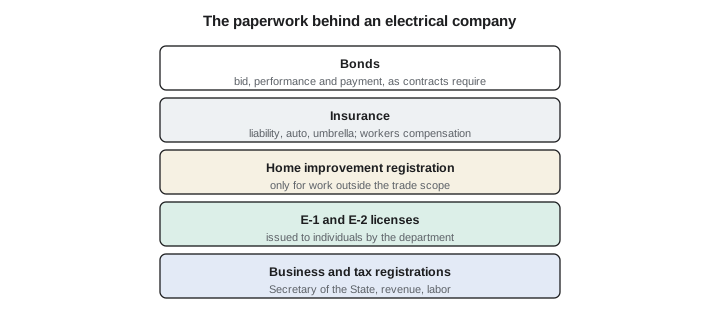
Walt's office manager, Denise, kept a binder she called the company's paperwork spine. It held the LLC's filing with the Secretary of the State, the tax registration, every E-1 and E-2 license, the workers' compensation policy, the general liability and auto policies, the umbrella, a stack of certificates of insurance issued to general contractors, two payment bonds from school jobs and the company's home improvement contractor registration. "Why do we need a home improvement registration?" Marisol asked. "We're electricians." Denise flipped to a job file from Burlington: a kitchen where Tunxis Valley had also hung the drywall and installed the cabinets for the homeowner. "That's why," she said. This lesson covers the business side of being licensed: forming and registering the company, the home improvement contractor registration and how it interacts with the E-1, the insurance an electrical contractor carries, and bonds.
The license and the business
Connecticut issues the E-1 to an individual. The business that sells the work is a separate thing: a sole proprietorship, partnership, limited liability company or corporation. A company that forms an LLC or corporation registers with the Secretary of the State, registers with the Department of Revenue Services for the taxes that apply to it, obtains a federal employer identification number if it has employees, and registers with the Department of Labor for unemployment insurance. None of those registrations is a license to do electrical work. The company can do electrical work only through an E-1 holder who is responsible for that work, and Lesson 7 covers what that responsibility means.
Ownership and licensing do not have to match. Walt owns Tunxis Valley, but a company could be owned by someone with no license at all, as long as a licensed E-1 is responsible for its electrical work and the company does not mislead customers about who holds the license. When an E-1 leaves a company, the company must have another E-1 in place before it continues contracting for electrical work. That is the succession problem Walt was solving by sponsoring Marisol.
The home improvement contractor registration
The Home Improvement Act, chapter 400, requires anyone who offers or performs home improvement work on residential property in Connecticut to register with the Department of Consumer Protection as a home improvement contractor. The department's guide says it is illegal to perform or offer home improvement work without a valid registration. Home improvement is defined broadly: repair, remodeling, alteration, conversion, modernization, improvement and additions to residential property, including kitchens, bathrooms, basements, decks, siding, roofing, windows and similar work.
The key point for electricians is an exclusion. The department's guidance says home improvement does not include work that is covered under the scope of a trade license. A licensed electrical contractor doing only electrical work within the scope of the E-1 does not need a home improvement registration for that work. But the moment the contractor offers or performs work outside the trade, such as hanging drywall, installing cabinets, patching plaster beyond what the electrical work required or building a deck for a hot tub, that work is home improvement, and the contractor needs the registration. That was the Burlington kitchen.
| Job | Within the E-1 scope? | Home improvement registration needed? |
|---|---|---|
| Service upgrade on a house | Yes | No, for the electrical work |
| Rewiring a kitchen and installing fixtures | Yes | No, for the electrical work |
| Rewiring a kitchen and also hanging the drywall and cabinets | Partly | Yes, for the non-electrical work |
| Installing a generator and building the pad and enclosure | Partly | Likely, for the non-electrical work; confirm with DCP |
| Wiring a new commercial office | Yes | No; the act covers residential property |
What registration brings with it
Registration is not just a fee. A registered home improvement contractor must follow the act's contract rules for home improvement work. The department's guide lists the main ones: the contract must be in writing and in plain language, signed and dated by both parties, with the contractor's name, address and registration number, a start date and a completion date, and a notice of the owner's right to cancel by midnight of the third business day after the transaction. Changes to the contract or completion date must be in writing. A contract missing required items may be unenforceable against the homeowner, which can make it hard for the contractor to collect.
Each registration and renewal also pays into the Home Improvement Guaranty Fund, which the department's guide says can reimburse a consumer up to 15,000 dollars after the consumer obtains a court judgment or restitution order against a registered contractor and cannot collect it. If the fund pays a claim, the contractor's registration can be affected until the fund is repaid. And section 29-263 requires a home improvement contractor's permit application to show the registration number, so the building department will ask for it on residential work outside the trade scope.
Certificates of insurance
General contractors and owners usually ask for a certificate of insurance before a subcontractor starts. The certificate summarizes the policies, limits and dates, and often lists the general contractor or owner as an additional insured. A certificate is only a summary; the actual protection comes from the policy and its endorsements. Read the contract's insurance section for required limits, additional insured status, waiver of subrogation and primary and noncontributory wording, then ask the agent to confirm the policy actually provides them. Track the certificates you issue and the ones you collect from your own subcontractors, with expiration dates, so nothing lapses in the middle of a job.
Keep a simple log of every certificate requested, issued and received, with the job, the holder and the expiration date. When a policy renews, send updated certificates to every general contractor and owner on active jobs before they ask. A general contractor who finds an expired certificate on file may hold payment until a current one arrives, which hurts cash flow for no good reason.
Common mistakes
MistakeAssuming the E-1 covers all work on a residential job.
InsteadWork outside the electrical trade, such as drywall and carpentry, is home improvement and needs the registration.
MistakeUsing a handshake for a home improvement job.
InsteadThe act requires a written, signed contract with specific items, including the three-day cancellation notice.
MistakeStarting work during the three-day cancellation period.
InsteadA homeowner who cancels may owe nothing for work done in that period, except in a documented emergency the homeowner initiated.
MistakeIgnoring the act on small jobs.
InsteadThe registration and contract rules apply regardless of job size when the work is home improvement.
Insurance
Chapter 393 is not built around a statewide liability insurance minimum for the E-1 in the way some states tie insurance to permits; in the materials reviewed for this course, the license itself does not carry a general liability minimum. In practice, though, an electrical contractor cannot work without insurance. Owners, general contractors, property managers, public agencies and some towns require certificates of insurance before work starts, often with specific limits and endorsements. Workers' compensation is required by law for employers, as explained below.
| Coverage | What it protects against | Who usually requires it |
|---|---|---|
| Commercial general liability | Property damage and injury to others, including completed operations | Owners, general contractors, public agencies |
| Workers' compensation | Employee injuries on the job | State law for employers; every general contractor |
| Commercial auto | Accidents in company vehicles | State law for vehicles; contracts |
| Umbrella or excess | Claims above the primary limits | Larger contracts |
| Inland marine (tools and equipment) | Theft or damage to tools and equipment | The contractor's own choice |
| Professional liability | Design errors on design-build work | Owners on design-build jobs |
Completed operations coverage deserves attention. An electrical fire can start years after a job is finished. Completed operations coverage, part of most general liability policies, responds to claims arising from finished work. Contractors should keep it in force and keep records of which policies were in force for each job, because a claim is usually handled by the policy in force when the injury or damage happens, not when the work was done.
Workers' compensation
Connecticut's workers' compensation law, chapter 568, requires employers to secure compensation for their employees, either through insurance from an authorized carrier or by qualifying to self-insure. Section 31-284 makes workers' compensation the exclusive remedy for most workplace injuries when the employer has complied, and lets an injured employee sue an employer who has not. Commonly cited guidance says the requirement applies to employers with one or more employees, full- or part-time. Sole proprietors are generally not required to cover themselves but may elect to. Employers must post a notice telling employees about the availability of compensation. Lesson 10 covers the enforcement side, including stop-work orders and the liability of a general contractor for an uninsured subcontractor's employees.
# Rough workers' compensation premium estimate (illustrative rates only)
payroll = {  # class: annual payroll in dollars
    "electrical wiring": 980000,
    "clerical office": 140000,
}
rate_per_100 = {"electrical wiring": 4.10, "clerical office": 0.20}   # illustrative
mod = 0.92   # experience modification factor, illustrative
total = 0
for cls, pay in payroll.items():
    manual = pay / 100 * rate_per_100[cls]
    total += manual
    print(cls.ljust(18), "manual premium", round(manual))
print("Before modification:", round(total))
print("After modification: ", round(total * mod))electrical wiring manual premium 40180 clerical office manual premium 280 Before modification: 40460 After modification: 37223
The calculation shows why classification and safety matter. Premiums are figured per 100 dollars of payroll in each class, then adjusted by an experience modification that reflects the company's own claims history. Putting a field electrician's payroll in the clerical class to save money is misclassification and can lead to large audit bills and penalties. A safer company earns a lower modification over time.
Bonds
A bond is a promise by a surety company to pay if the contractor fails to meet an obligation. Electrical contractors meet three kinds most often. A bid bond guarantees that a bidder who wins will sign the contract and provide the required bonds. A performance bond guarantees that the contractor will complete the work. A payment bond guarantees that the contractor will pay its subcontractors and suppliers. On Connecticut public works projects, the General Statutes require general contractors to furnish payment bonds above set contract amounts, because liens are not available against public property; Lesson 9 explains how a subcontractor claims against such a bond. Private owners may also require bonds by contract.
Some licenses and registrations involve bonds too. Chapter 400 allows the department to require a bond from a home improvement contractor in certain situations, and some towns or utilities may ask for bonds for work in public rights of way. Bonding capacity depends on the contractor's financial statements, experience and character, so contractors who expect to bid public work should build a relationship with a surety agent early.
Worked problem
Sorting out the Burlington kitchen
Tunxis Valley agreed to rewire a kitchen in Burlington and, at the homeowner's request, to hang drywall and install cabinets. The proposal was a one-page quote with no start or completion date. What should the company have done?
Show solution
- The electrical work falls within the E-1 scope.
- The drywall and cabinet work is home improvement, so the company needed a home improvement registration.
- The home improvement contract had to be written and signed, with the registration number, start and completion dates and the three-day cancellation notice.
- The permit application had to show the registration number.
Answer: Register as a home improvement contractor and use a compliant written contract, or limit the job to the electrical work.
Summary and key terms
- The E-1 is issued to an individual; the business registers separately with the Secretary of the State and tax and labor agencies.
- Home improvement work on residential property needs a DCP registration, but work within the scope of a trade license is excluded.
- Registered home improvement contractors must use written contracts with required items and the three-day cancellation notice, and pay into the guaranty fund.
- Contractors carry general liability with completed operations, auto, umbrella and other coverage, usually required by contract.
- Employers must secure workers' compensation; bonds guarantee bids, performance and payment, and public works require payment bonds.
- Home Improvement Act
- Chapter 400 of the General Statutes, which requires registration of home improvement contractors.
- Trade license exclusion
- The rule that work within the scope of a trade license is not home improvement.
- Home Improvement Guaranty Fund
- The state fund that can reimburse consumers who cannot collect a judgment against a registered contractor.
- Completed operations
- Liability coverage for claims arising from finished work.
- Payment bond
- A surety's promise that the contractor will pay subcontractors and suppliers.
Practice problems
Work each problem on paper first, then reveal the answer to check.
Does a licensed E-1 need a home improvement registration to rewire a house?
Show answer
No, for work within the scope of the trade license.
By when may a homeowner cancel a home improvement contract?
Show answer
By midnight of the third business day after the transaction.
What maximum does the department's guide give for a guaranty fund reimbursement?
Show answer
15,000 dollars.
Which bond guarantees payment to subcontractors and suppliers?
Show answer
A payment bond.
Lesson quiz · 5 questions
Score 60% or more to complete this lesson.
Create a free account to save your progress, take quizzes and earn a certificate.