
MELU-207 · Lesson 10 of 12 · 18 min
Workplace safety law and OSHA for electrical contractors
▶ Video coming soon A video version of this lesson is on the way.
In August, a second-year apprentice on a Tunxis Valley crew at a warehouse in Plainville reached into a panel to tighten a lug on a circuit everyone thought was off. It was fed from a second source no one had labeled. The arc flash singed his sleeve and the meter in his other hand, and he walked away with a scare and a minor burn on his wrist. Walt shut down every job that afternoon and held a meeting in the shop. "We had a lockout procedure," he said. "We didn't follow it, and we didn't test before touching. That's on me." This lesson covers the safety law that applies to Connecticut electrical contractors: who enforces it, the main federal rules for electrical and construction work, injury records and reports, and the workers' compensation system that responds when someone does get hurt.
Who enforces safety in Connecticut
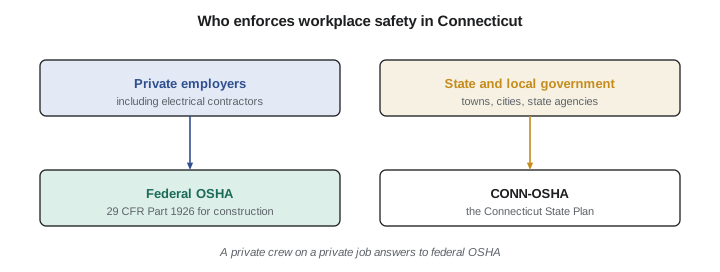
Connecticut has an OSHA-approved State Plan, run by the Connecticut Department of Labor as CONN-OSHA, but it covers only state and local government workplaces. Private employers in Connecticut, including private electrical contractors, are covered by federal OSHA, which enforces through its area offices in the state. A Tunxis Valley crew at a private warehouse is under federal OSHA. A town's own public works electricians, by contrast, fall under CONN-OSHA. Both programs apply rules at least as effective as the federal standards, and CONN-OSHA also offers free consultation services to some employers.
The general duty and the construction standards
The Occupational Safety and Health Act requires every employer to provide a workplace free from recognized hazards likely to cause death or serious harm, and to comply with the standards OSHA issues. For construction work, including electrical installation, the main standards are in 29 CFR Part 1926. Subpart K covers electrical safety on construction sites, including ground-fault protection or an assured equipment grounding conductor program for temporary power, work near energized parts, and lockout and tagging of circuits. Other subparts cover fall protection, ladders, scaffolds, excavations, personal protective equipment, hazard communication and training. Work in existing operating facilities can also bring in the general industry rules in 29 CFR Part 1910, including the electrical safety-related work practices and lockout rules there.
The trade exam's reference list includes Part 1926, so candidates should know how it is organized and be able to find the electrical, fall protection, ladder and excavation rules quickly. The industry consensus standard NFPA 70E, which describes electrically safe work conditions, arc flash risk assessment and protective equipment, is widely used to meet OSHA's general requirements, even though it is not itself an OSHA regulation.
| Hazard | Where the rules are | Typical control |
|---|---|---|
| Contact with energized parts | Part 1926 Subpart K; NFPA 70E | Deenergize, lock, tag and test before touching |
| Arc flash | NFPA 70E; OSHA general duty | Risk assessment, boundaries, arc-rated clothing |
| Falls from ladders and lifts | Part 1926 Subparts L, M and X | Right ladder, three points of contact, fall protection |
| Trench collapse | Part 1926 Subpart P | Protective systems for trenches as the standard requires |
| Temporary power faults | Part 1926 Subpart K | Ground-fault protection or an assured grounding program |
Electrically safe work conditions
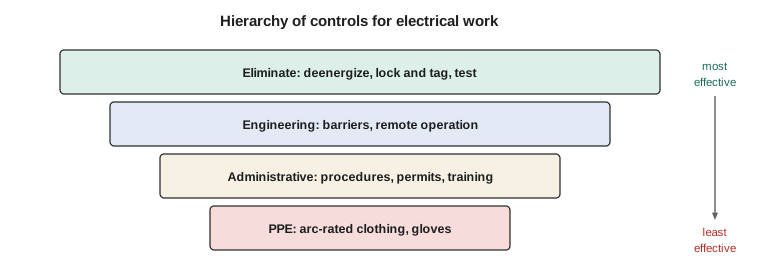
The Plainville incident shows the rule that matters most: treat every conductor as energized until it has been proven otherwise. An electrically safe work condition means identifying every source of supply, opening the disconnecting means, verifying the visible break where possible, applying locks and tags, testing for absence of voltage with a meter that has been checked on a known source before and after, and grounding where stored or induced energy is possible. Energized work is justified only when deenergizing would create a greater hazard or is infeasible, and it then requires a written energized work permit and the right protective equipment. A second source of supply, such as a generator, a solar inverter, a battery system or a feed from another panel, is a common cause of injuries.
Training and programs
OSHA expects employers to train workers on the hazards of their work and to keep written programs where the standards require them, such as hazard communication. A typical electrical contractor's safety program includes a written lockout procedure, an arc flash policy, ladder and fall protection rules, a trenching plan for underground work, a hazard communication program for chemicals such as pipe glue and cleaners, first aid and emergency procedures, and regular toolbox talks. Training should be documented. After the Plainville incident, Walt required a signed test-before-touch checklist for every panel job and paired each apprentice with a named journeyperson responsible for verifying the lockout.
Records and reports
Employers above OSHA's size threshold that are not in a partially exempt industry keep the OSHA 300 log of work-related injuries and illnesses, complete an incident report for each recordable case, and post an annual summary each year. Construction contractors are not in the exempt group. Separately, every employer must report to OSHA within set short periods any work-related fatality, inpatient hospitalization, amputation or loss of an eye. Records must be kept for several years.
Safety performance is often measured with the total recordable incident rate. It is the number of recordable cases multiplied by 200,000, divided by the total hours worked by all employees in the year. The 200,000 represents 100 full-time workers working 40 hours a week for 50 weeks. General contractors and owners commonly ask for this rate and for the experience modification factor when prequalifying subcontractors.
# Total recordable incident rate (TRIR) and days away rate (study aid)
recordable_cases = 2
days_away_cases = 1
hours_worked = 31200        # about 15 workers for a year
trir = recordable_cases * 200000 / hours_worked
dart = days_away_cases * 200000 / hours_worked
print("TRIR:", round(trir, 2), "cases per 100 full-time workers")
print("Days-away rate:", round(dart, 2))
for target in (3.0, 5.0):
    allowed = target * hours_worked / 200000
print("Cases allowed for a rate of", target, "->", round(allowed, 2))TRIR: 12.82 cases per 100 full-time workers Days-away rate: 6.41 Cases allowed for a rate of 3.0 -> 0.47 Cases allowed for a rate of 5.0 -> 0.78
With two recordable cases in 31,200 hours, the rate is about 12.82, high enough to concern a general contractor's safety manager. For a company of this size, every case moves the rate a lot, which is one reason small contractors focus hard on preventing even minor recordable injuries.
Workers' compensation when someone is hurt
When a worker is injured on the job, Connecticut's workers' compensation system, under chapter 568, pays medical treatment and wage replacement benefits regardless of fault, and in exchange it is generally the employee's exclusive remedy against a complying employer under section 31-284. The Workers' Compensation Commission administers the system, approves agreements and decides disputes through its district offices. Employers must secure coverage through an authorized insurer or by qualifying to self-insure, and must post a notice of the availability of compensation in a conspicuous place. The apprentice's burn was reported to the insurer the same day, and the claim paid for his treatment.
Injured workers must give notice of a claim within the time the statute allows, commonly one year from the date of injury for an accident, and employers should report injuries to their insurer promptly. Employers should not discourage reporting; retaliation against an employee for filing a claim is prohibited.
| Rule | What it means for a contractor |
|---|---|
| Coverage required for employees | Commonly cited guidance: one or more employees, full- or part-time |
| Exclusive remedy | A complying employer is generally protected from injury lawsuits by employees |
| Noncompliant employer | Employees may sue, and state agencies can stop work and impose penalties |
| Principal employer liability | A general contractor can be liable for an uninsured subcontractor's injured employees |
| Posting | A notice about compensation must be posted at the workplace |
Enforcement and uninsured subcontractors
Connecticut enforces the coverage requirement in several ways. The Workers' Compensation Commission can pursue employers who fail to insure, and the Department of Labor can issue stop-work orders to employers on construction sites who fail to carry workers' compensation coverage or misclassify employees as independent contractors, with daily civil penalties until they comply. The state's labor investigators have run joint sweeps of construction sites with the Department of Consumer Protection that turned up both unlicensed electricians and uninsured employers.
Section 31-291 adds a risk for contractors who hire subcontractors. Under that principal employer provision, a contractor who hires a subcontractor to do part of its work can be liable for compensation to the subcontractor's injured employees if the subcontractor is uninsured. Connecticut courts have applied the rule in construction cases. The practical protection is simple: collect a current certificate of workers' compensation insurance from every subcontractor before it starts, and track the expiration dates.
Worked problem
Hiring a low-voltage subcontractor
Tunxis Valley hires a small data cabling company to pull network cable at an office job. The owner says he has two employees but no workers' compensation policy because they are part-time. What should Marisol do?
Show solution
- Coverage is commonly required for one or more employees, including part-time workers.
- If an employee of the uninsured subcontractor is hurt, Tunxis Valley could be liable as a principal employer.
- Require a current certificate of workers' compensation insurance before the subcontractor starts.
- Also confirm that the subcontractor holds the right limited license for the work.
Answer: Do not let the subcontractor start until it shows workers' compensation coverage and the right license.
Fall protection and ladders
Falls remain one of the leading causes of death in construction, and electricians spend much of their day on ladders, lifts and roofs. Choose the right ladder for the task, set extension ladders at the right angle and secure them, keep three points of contact, and never stand on the top steps. Use nonconductive ladders near energized equipment. On roofs and elevated work, follow the fall protection rules in Part 1926, which require protection above set heights for construction work, and train workers on aerial lifts before they use them. Solar installers and service workers on roofs face both fall and electrical hazards at once and need plans for both.
Investigating incidents and near misses
Every incident and near miss is information. After the Plainville arc flash, Walt and Marisol walked through what happened step by step: who decided the circuit was off, why no one found the second source, why the meter test was skipped, and what the procedure said. They found that the panel directory was out of date, that the crew had been rushed by a general contractor's schedule and that the lockout procedure did not mention checking for other sources. They fixed all three. A good investigation looks for causes in the system, not only in the person who got hurt, and writes down the corrective actions and who will do them.
| Question | Plainville answer | Corrective action |
|---|---|---|
| What happened? | Contact with a circuit fed from a second source | Shared at a company-wide meeting |
| Why was the source missed? | Out-of-date panel directory | Verify directories before work |
| Why was the test skipped? | Schedule pressure | Signed test-before-touch checklist |
| What did the procedure miss? | No step for other sources | Procedure rewritten and retrained |
Common mistakes
MistakeAssuming CONN-OSHA inspects private contractors.
InsteadCONN-OSHA covers state and local government; federal OSHA covers private employers.
MistakeTreating a circuit as dead because the breaker is off.
InsteadLock, tag and test for absence of voltage, and look for other sources.
MistakeSkipping workers' compensation for part-time employees.
InsteadCoverage commonly applies to one or more employees, full- or part-time.
MistakeHiring a subcontractor without a coverage certificate.
InsteadA principal employer can be liable for an uninsured subcontractor's injured employees.
Summary and key terms
- Federal OSHA covers private Connecticut employers; CONN-OSHA covers state and local government workplaces.
- 29 CFR Part 1926 governs construction safety, with electrical rules in Subpart K; NFPA 70E guides electrically safe work.
- Deenergize, lock, tag and test before touching; energized work needs justification and a permit.
- Keep injury records, report serious events quickly and track the incident rate.
- Chapter 568 requires workers' compensation coverage, posts a notice and makes the general contractor liable for uninsured subcontractors' employees under section 31-291.
- CONN-OSHA
- Connecticut's OSHA-approved State Plan covering state and local government workplaces.
- Subpart K
- The electrical section of the OSHA construction standards in 29 CFR Part 1926.
- Electrically safe work condition
- A state in which equipment has been deenergized, locked, tagged and tested.
- Total recordable incident rate
- Recordable cases times 200,000, divided by hours worked.
- Principal employer
- A contractor who can be liable for compensation to an uninsured subcontractor's employees.
Practice problems
Work each problem on paper first, then reveal the answer to check.
Who enforces safety rules for a private electrical contractor in Connecticut?
Show answer
Federal OSHA.
Which part of the federal rules covers construction?
Show answer
29 CFR Part 1926.
What is the TRIR for 3 cases in 60,000 hours?
Show answer
3 times 200,000 divided by 60,000 equals 10.0.
Which section makes a principal employer liable for an uninsured subcontractor's employees?
Show answer
Section 31-291.
Lesson quiz · 5 questions
Score 60% or more to complete this lesson.
Create a free account to save your progress, take quizzes and earn a certificate.