
MELU-207 · Lesson 3 of 12 · 19 min
Applying, approval and booking the exam
▶ Video coming soon A video version of this lesson is on the way.
On the Sunday after Thanksgiving, Marisol sat at her kitchen table in Plainville with a laptop, a scanner and the folder Walt had helped her build. The application went in that night through the department's online licensing system. Eleven days later an email asked for one more item: a clearer copy of her apprenticeship completion certificate. She sent it the next morning. Three weeks after that, the approval arrived, along with instructions for booking with PSI. This lesson walks through the steps from application to license, the fees and deadlines that matter, how PSI scheduling works, what happens on exam day and after, and the mistakes that cost candidates time and money.
The order of operations
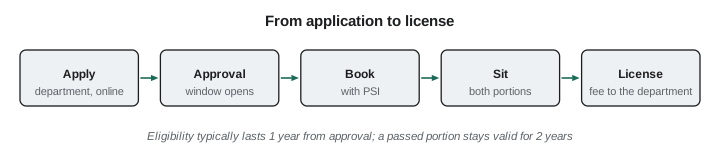
Connecticut uses a common sequence for trade licenses. The candidate applies to the department first, not to PSI. The department checks the application, sends questions on experience to the Electrical Work Examining Board when needed and decides whether the candidate is eligible. Only after approval does the candidate register and pay PSI for the examination. After passing, the candidate pays the license fee to the department and receives the license. Skipping ahead, for example by trying to book with PSI before approval, does not work; PSI's system will not show the candidate as eligible.
The application
The application is filed through the department's online licensing system, which most Connecticut trades now use. The applicant creates an account, chooses the E-1 exam application, enters personal and employment details, uploads documents and pays a nonrefundable application fee. The application asks for the experience details covered in Lesson 2, along with background questions. Uploaded documents should be legible, complete and named so a reviewer can tell what they are. A blurry phone photo of a certificate is one of the most common reasons for a follow-up request, as Marisol found.
Some applicants still file on paper when a particular situation calls for it, but the online route is faster and lets the applicant see the status. Either way, the applicant should keep copies of everything submitted and a record of the date.
Review and approval
Review times vary with the season and the department's workload. Straightforward applications on the usual route, with clear documents, often move through in a few weeks. Applications on the equivalent experience route, or with gaps and questions, can take much longer, especially if they go to the board. The department communicates by email and through the online account, so applicants should check both and respond quickly to any request.
When the application is approved, the candidate is notified and becomes eligible to test. The PSI bulletin says eligibility lasts one year from the date the state approves the application. That year is the window to pass the exam. A candidate who does not pass within it may need to reapply. Marisol's approval came on December 22, so her window ran to the following December.
Booking with PSI
PSI administers the exams for Connecticut's trade licenses at its test centers. Once eligible, the candidate registers with PSI online or by phone, pays the examination fee and chooses a date, time and location. The bulletin lists the fee per examination portion, and an E-1 candidate takes two portions, the trade exam and the Business and Law exam, so expect to pay for each. Fees are generally not refundable or transferable, and the bulletin explains the deadlines for rescheduling without losing the fee.
Candidates can schedule both portions on the same day or on different days. Many choose separate days. The trade exam is four hours long and the Business and Law exam is two, and six hours of open-book testing in one day is exhausting. Others prefer one trip. Marisol booked the Business and Law portion first, in late February, and the trade portion three weeks later, so she could focus her final weeks of study on the code.
| Step | Who you deal with | What to watch |
|---|---|---|
| Apply and pay the application fee | DCP online system | Legible uploads; answer every question |
| Respond to follow-up requests | DCP staff, sometimes the board | Check email and the online account |
| Approval | DCP | Eligibility typically lasts one year |
| Register, pay and schedule each portion | PSI | Fee per portion; rescheduling deadlines |
| Sit for the exams | PSI test center | Matching photo ID; arrive early |
| Pay the license fee and receive the license | DCP | Follow the instructions on the score report |
Rescheduling and missed appointments
Life happens: a sick child, a snowstorm, an emergency call. The bulletin explains how far ahead a candidate must reschedule to avoid losing the fee, and what happens if the candidate does not show up. Candidates who miss an appointment without proper notice typically forfeit the fee and must pay again. PSI may close a test center for weather and will reschedule candidates in that case. The practical rule is to read the rescheduling section before booking and to put the cutoff date on your calendar.
Exam day
The bulletin tells candidates to arrive about 30 minutes before the appointment, with one valid, unexpired, signed photo ID whose name exactly matches the name used to register. A driver's license, state ID card, passport or military ID usually works. A candidate whose ID does not match the registration may be turned away and lose the fee. Marisol had married in 2022 and used her married name everywhere, but she checked that her PSI registration, her DCP application and her driver's license all said the same thing.
At the center, candidates store personal items, check in, may be photographed, and receive instructions. The exams are open book, so candidates bring the allowed references, which staff inspect. Lesson 4 covers the reference rules and what is not allowed. The test is taken on a computer, with a clock on the screen and the ability to mark questions for review.
Scores, retakes and the two-year rule
Results are usually given at the center when the candidate finishes. A passing candidate receives a score report with instructions for the license fee. A failing candidate receives a report that shows performance by content area, which is valuable for planning study. The bulletin also describes a short review of missed items right after a failed attempt.
The two portions are scored separately, and each must be passed. The bulletin says a passed portion remains valid for two years, so a contractor candidate who passes Business and Law has two years to pass the trade portion. It also says contractor candidates may retest on an unlimited basis, though not on the same day, and each retake is paid again. Unlimited retakes do not mean unlimited time, though, because the eligibility window still applies.
# Tracking the eligibility window and the two-year portion rule (simplified)
from datetime import date, timedelta

approved = date(2025, 12, 22)
window_end = approved.replace(year=approved.year + 1)
attempts = [("Business and Law", date(2026, 2, 26), True),
            ("Trade", date(2026, 3, 19), False),
            ("Trade", date(2026, 4, 30), True)]
print("Eligibility window ends:", window_end.isoformat())
for name, day, passed in attempts:
    inside = day <= window_end
    print(day.isoformat(), name.ljust(17), "pass" if passed else "fail",
          "(inside window)" if inside else "(outside window)")
bl_pass = attempts[0][1]
print("Business and Law pass good until about", (bl_pass + timedelta(days=730)).isoformat())Eligibility window ends: 2026-12-22 2026-02-26 Business and Law pass (inside window) 2026-03-19 Trade fail (inside window) 2026-04-30 Trade pass (inside window) Business and Law pass good until about 2028-02-26
The output shows the pattern most candidates follow. One portion passes, the other takes two attempts, and both fall comfortably inside the window. A candidate who passed Business and Law but kept failing the trade portion would want to track both dates, the end of eligibility and the end of the two-year validity, and talk with the department before either runs out.
After you pass
After passing both portions, the candidate follows the score report's instructions to pay the license fee to the department. The license is then issued and appears in the state's online license lookup, which is what building officials, general contractors and customers use to verify a license. Until the license appears, the candidate should not contract or take out permits as an E-1. Marisol's E-1 appeared in the lookup on May 12, eight days after she paid the fee.
Worked problem
Planning around the window
Ken was approved on January 10. He books Business and Law for March 2 and passes. He fails the trade portion on April 5 and again on June 20, then gets busy and forgets. In December he calls PSI to book again. What should he check first?
Show solution
- Eligibility typically lasts one year from approval, so his window ends around January 10 of the next year.
- His Business and Law pass is valid for two years, so it is still good.
- He should book the trade retake before the window closes and confirm with PSI that he is still eligible.
- If the window has closed, he should ask the department whether he must reapply.
Answer: Check the end of the eligibility window first; book the trade retake before it closes.
Accommodations and special arrangements
Candidates with a disability or another condition that affects testing can ask for accommodations, such as extra time or a separate room. The bulletin explains how to request them, usually with documentation from a qualified professional, and the request must be approved before the exam is scheduled. Because approval takes time, candidates who need accommodations should start the request as soon as they are approved to test, not a week before the date they want. Candidates who need a reader or other arrangements for language reasons should read the bulletin's rules carefully, because trade licensing exams often have specific limits on what is allowed.
Keeping a paper trail
Every step in this lesson produces a record: the application confirmation, follow-up emails, the approval notice, PSI registration and payment receipts, score reports, the license fee receipt and the final license. Keep all of them in one folder. If anything goes wrong later, such as a dispute about when a portion was passed, a fee charged twice or a question about whether the eligibility window was met, those records settle it quickly. Marisol kept a single PDF folder on her phone and a printed copy in the binder at the shop.
| Record | Why keep it |
|---|---|
| Application confirmation | Proves the date the application was filed |
| Approval notice | Starts the eligibility window |
| PSI receipts | Show fees paid for each portion and attempt |
| Score reports | Prove the dates each portion was passed |
| License fee receipt and license | Show when the license was issued |
Employers who pay exam fees for employees, as Tunxis Valley did, often keep a copy too, both for their own accounting and to confirm when a new E-1 holder can start taking on contractor responsibilities.
One more practical point: the department and PSI are separate organizations with separate systems. A question about eligibility, documents or the license fee goes to the department. A question about booking, rescheduling, test center locations or the reference inspection goes to PSI. Calling the wrong one wastes time, and neither can fix a problem in the other's system.
Common mistakes
MistakeBooking with PSI before the department approves the application.
InsteadApply to the department first; PSI books only eligible candidates.
MistakeAssuming one fee covers both portions.
InsteadThe bulletin lists a fee per examination portion.
MistakeRegistering with PSI under a name that does not match the photo ID.
InsteadUse the exact name on the ID; a mismatch can mean being turned away.
MistakeStarting to contract as soon as both portions are passed.
InsteadWait until the license fee is paid and the license is issued.
Summary and key terms
- Apply to DCP first, pay the nonrefundable application fee and answer any follow-up quickly.
- Approval typically opens a one-year eligibility window for testing.
- Register, pay and schedule each portion with PSI; read the rescheduling rules.
- Bring one valid signed photo ID that exactly matches the registered name, and arrive early.
- Each portion is scored separately; a passed portion is valid for two years; then pay the license fee to DCP.
- Eligibility window
- The period after approval, typically one year, during which the candidate must pass.
- Examination portion
- One of the two separately scored exams for the E-1: the trade exam and the Business and Law exam.
- Score report
- The PSI report given after the exam, showing pass or fail and, for a failure, performance by area.
- License lookup
- The state's online search used to verify that a license is current.
- Rescheduling deadline
- The latest time a candidate can move an appointment without losing the fee.
Practice problems
Work each problem on paper first, then reveal the answer to check.
Where does an E-1 candidate apply first?
Show answer
To the Department of Consumer Protection.
How long does eligibility typically last after approval?
Show answer
One year from the approval date, according to the PSI bulletin.
How long is a passed portion valid?
Show answer
Two years, according to the bulletin.
What must match the name on the PSI registration?
Show answer
The name on the candidate's photo ID.
Lesson quiz · 5 questions
Score 60% or more to complete this lesson.
Create a free account to save your progress, take quizzes and earn a certificate.