
MELU-207 · Lesson 4 of 12 · 18 min
The exam format and the references allowed
▶ Video coming soon A video version of this lesson is on the way.
Two weeks after her approval, Marisol took a timed practice set at the Tunxis Valley shop with her code book, her Ugly's and a stopwatch. She finished 50 questions in 2 hours and 40 minutes and felt good about it, until Walt pointed out that the real trade exam gives her 4 hours for 100 questions. "That's 2.4 minutes a question," he said. "You just spent 3.2. On test day you'd run out of time with 25 questions left." This lesson describes the two portions of the E-1 examination, the passing standard, the content of each portion, the references the bulletin allows and how to use them, and a pacing plan that fits the clock.
Two portions, scored separately
The E-1 examination has two portions. The trade portion tests electrical knowledge: the code, calculations, safety and related topics. The Business and Law portion tests the business knowledge a contractor needs: licensing, estimating, liens, finance, tax and labor law, project management, contracts, business organization, risk management, and environmental and safety rules. The bulletin lists the trade portion as 100 questions in 4 hours and the Business and Law portion as 50 questions in 2 hours. Both are multiple choice, taken on a computer at a PSI center, and both are open book.
Each portion is scored on its own, and each must be passed. The bulletin sets the passing score at 70 correct answers out of every 100 questions, which means 70 correct on the trade portion and 35 correct on Business and Law. A strong score on one portion does not make up for a weak score on the other.
| Portion | Questions | Time | Correct answers to pass | Book rule |
|---|---|---|---|---|
| Trade (E-1) | 100 | 4 hours | 70 | Open book, listed references |
| Business and Law | 50 | 2 hours | 35 | Open book, listed reference |
What the trade portion covers
The trade portion draws mostly on the National Electrical Code, but not only on it. The bulletin's reference list also includes the OSHA construction standards in 29 CFR Part 1926, a pocket reference of electrical formulas and tables, the National Fire Alarm and Signaling Code, a photovoltaic textbook and the National Electrical Safety Code. That mix signals what the exam expects: core NEC topics such as wiring methods, services, feeders and branch circuits, grounding and bonding, overcurrent protection, motors and transformers, and special occupancies, plus calculations, job-site safety, fire alarm basics, solar systems and utility-side topics.
Expect a heavy share of questions that require a lookup or a calculation rather than memory. A typical question might ask for the minimum size of an equipment grounding conductor for a given overcurrent device, the demand load for a group of appliances, the number of conductors allowed in a box, or the clearance needed in front of a panel. Some questions test whether you know where a rule lives more than what it says.
What the Business and Law portion covers
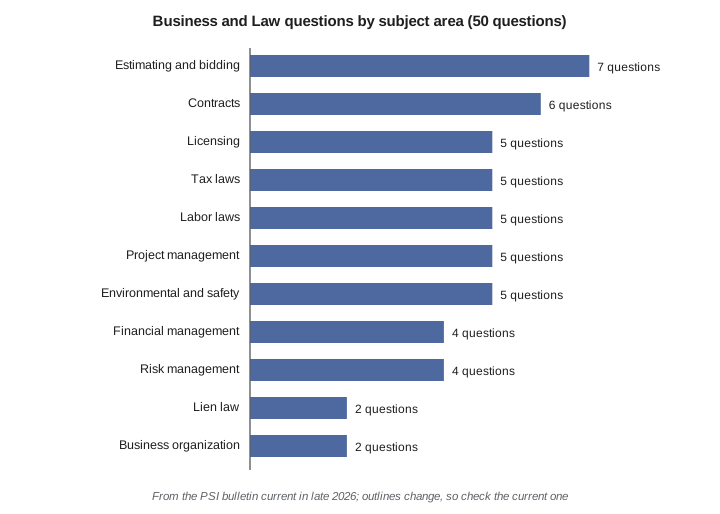
The Business and Law portion uses one reference: the Connecticut edition of the NASCLA contractors' guide to business, law and project management. The bulletin lists the subject areas and how many questions come from each. Estimating and bidding, contracts, licensing, tax law, labor law, project management, and environmental and safety topics carry the most questions. Lien law and business organization carry the fewest. The bulletin also notes that some questions may seem unrelated to electrical work, because the same Business and Law exam serves several trades.
The allowed references
Open book does not mean anything goes. The bulletin lists the references allowed for each portion, often with specific editions. For the trade portion, the list in late 2026 included the NEC or the NEC Handbook in the 2020 or 2023 edition, OSHA 29 CFR Part 1926, Ugly's Electrical References, NFPA 72, two photovoltaic texts and the National Electrical Safety Code. For Business and Law, the NASCLA Connecticut guide is the reference. The bulletin also names a solar trainee guide that is not allowed. Bring only listed books, in listed editions.
References are inspected at check-in. Bulletins for open-book exams typically allow highlighting, underlining and permanently attached tabs, and do not allow loose papers, handwritten notes or removable sticky notes in the books. Read the bulletin's rules on marking and tabbing before you prepare your books, because a reference that fails inspection can be held back, leaving you without it for the exam.
| Reference | Portion | Main use |
|---|---|---|
| NEC or NEC Handbook, edition listed in the bulletin | Trade | Installation rules and tables |
| OSHA 29 CFR Part 1926 | Trade | Construction safety questions |
| Pocket electrical reference | Trade | Formulas and quick tables |
| NFPA 72 | Trade | Fire alarm questions |
| Photovoltaic texts | Trade | Solar system questions |
| National Electrical Safety Code | Trade | Utility and lines questions |
| NASCLA Connecticut contractors' guide | Business and Law | All business and law questions |
Which NEC edition to bring
The bulletin in late 2026 allowed either the 2020 or the 2023 NEC. That reflects the transition discussed in Lesson 5: the 2022 State Building Code enforces the 2020 NEC, while the pending 2026 code package references the 2023 edition. The safest approach is to study from the edition the bulletin says the questions are written to, and to bring that edition. If the bulletin allows two editions, choose the one you have tabbed and practiced with; changing books in the last month costs more in lookup speed than any difference in content.
Pacing
Open-book exams are lost on time more often than on knowledge. On the trade portion, 240 minutes for 100 questions is 2.4 minutes a question. On Business and Law, 120 minutes for 50 questions is also 2.4 minutes. That sounds generous until a single box fill calculation takes six minutes. The standard method is two passes. On the first pass, answer every question you can in about a minute, and mark any that need a long lookup or calculation. On the second pass, work the marked questions, longest last. Never leave a question blank; there is no penalty for a wrong answer.
# Pacing plan for the trade portion (simplified study aid)
minutes, questions = 240, 100
per_q = minutes / questions
print("Average minutes per question:", round(per_q, 2))

first_pass_q, first_pass_min = 70, 75        # quick questions answered
left_q = questions - first_pass_q
left_min = minutes - first_pass_min - 15     # keep 15 minutes to review
print("After pass 1:", left_q, "questions,", left_min, "minutes")
print("Minutes per marked question:", round(left_min / left_q, 1))
for checkpoint in (60, 120, 180):
    target = int(checkpoint / per_q)
print("At", checkpoint, "minutes, be past question", target)Average minutes per question: 2.4 After pass 1: 30 questions, 150 minutes Minutes per marked question: 5.0 At 60 minutes, be past question 25 At 120 minutes, be past question 50 At 180 minutes, be past question 75
The plan in the code budgets about 75 minutes to answer 70 quick questions, keeps 15 minutes in reserve and leaves 150 minutes, five minutes each, for the 30 harder ones. The checkpoints help: if the clock shows 120 minutes and you are on question 30 of your first pass, speed up.
Using the references well
Lookup speed comes from practice with your own books. Tab the major articles and the tables you use most. Learn the index well enough to go from a key word to the right article in under a minute. For the NASCLA guide, tab each chapter and learn where the lien, tax and labor law sections sit. When a question names a specific code section, go straight there; when it does not, decide which article governs before you open the book. Marisol spent her first month of study just doing lookups, timing herself on each, until her average dropped below a minute.
Worked problem
Can she finish?
On a practice run of the full Business and Law portion, Marisol answers 38 questions in 70 minutes on her first pass and marks 12. She keeps 10 minutes for review. How many minutes does she have for each marked question?
Show solution
- Total time is 120 minutes.
- 120 minus 70 minus 10 leaves 40 minutes.
- 40 minutes divided by 12 questions is about 3.3 minutes each.
Answer: About 3.3 minutes per marked question, which is enough for most lookups.
How questions are written
Exam questions on licensing tests follow familiar patterns. A direct question asks for a value or rule, such as a minimum size or a required clearance. A scenario question describes an installation and asks what is required or what is wrong. A calculation question gives loads, lengths or conductor data and asks for a result. A best-answer question offers several choices that may all be partly true and asks for the most correct one. Read the last line of the question first to see what is actually asked, then read the details. Watch for words such as minimum, maximum, not, except and shall, which change the answer completely.
Distractors, the wrong answers, are often built from common mistakes: the value from the wrong table, a calculation that skips a demand factor, or the rule for a dwelling applied to a commercial building. When two answers look close, ask which one matches the exact condition in the question. When you are not sure, eliminate the answers you know are wrong and choose among the rest.
Calculations on the trade portion
Calculation questions take the most time, so they deserve a method. Write the given values with their units, identify the rule or table that applies, do the arithmetic step by step and check that the units of the answer match what is asked. Common calculation topics include branch circuit and feeder loads, dwelling service calculations, conductor ampacity with adjustment and correction, voltage drop, box and conduit fill, motor circuit sizing, transformer currents and overcurrent device sizing. Practice each type until you can do a typical example in three or four minutes, and mark the long ones for the second pass on exam day.
| Calculation type | Typical inputs | Common error |
|---|---|---|
| Dwelling service load | Area, appliances, heating and cooling | Skipping a demand factor |
| Conductor ampacity | Conductor type, ambient, number of conductors | Applying only one adjustment |
| Voltage drop | Load, length, conductor size, voltage | Using one-way length for a two-wire circuit |
| Box fill | Conductors, devices, clamps, grounds | Forgetting device or clamp allowances |
| Motor circuits | Motor horsepower, voltage, phase | Using the nameplate current where the tables are required |
Remember that tables and values should come from the references you bring. This course does not reproduce code tables, and you should not rely on remembered numbers when the book is in front of you.
Finally, practice under the same conditions you will face. Use a computer-style practice test if you can, because scrolling and marking on a screen feel different from paper. Sit for the full four hours at least twice before the real exam, with only the allowed references on the table, so that the third and fourth hours hold no surprises.
Common mistakes
MistakeTreating open book as a reason not to study.
InsteadThe clock allows about 2.4 minutes a question; you must already know where to look.
MistakeBringing a book or edition not on the bulletin's list.
InsteadBring only listed references, in listed editions.
MistakeAdding handwritten notes or loose sticky notes to the books.
InsteadFollow the bulletin's rules on marking and tabbing.
MistakeLeaving hard questions blank.
InsteadGuess on every question; there is no penalty for a wrong answer.
Summary and key terms
- The E-1 exam has a trade portion of 100 questions in 4 hours and a Business and Law portion of 50 questions in 2 hours.
- Each portion must be passed on its own with 70 correct out of every 100 questions: 70 on the trade portion and 35 on Business and Law.
- Both portions are open book with listed references; Business and Law uses the NASCLA Connecticut guide.
- Bring only listed books in listed editions and follow the marking rules.
- Plan about 2.4 minutes per question and use a two-pass method.
- Trade portion
- The 100-question part of the E-1 exam on the code, calculations and safety.
- Business and Law portion
- The 50-question part of the exam on business, contracts, liens, tax and labor law.
- Open book
- An exam that allows listed references in the test room.
- Two-pass method
- Answering quick questions first, marking slow ones, then returning to them.
- NASCLA guide
- The Connecticut edition of the contractors' guide to business, law and project management.
Practice problems
Work each problem on paper first, then reveal the answer to check.
How many questions and how much time does the trade portion have?
Show answer
100 questions in 4 hours.
How many correct answers are needed on Business and Law?
Show answer
35 of 50.
What is the single reference for Business and Law?
Show answer
The NASCLA Connecticut contractors' guide.
What is the average time per question on the trade portion?
Show answer
2.4 minutes.
Lesson quiz · 5 questions
Score 60% or more to complete this lesson.
Create a free account to save your progress, take quizzes and earn a certificate.