
MELU-207 · Lesson 5 of 12 · 19 min
The NEC as adopted in Connecticut and state amendments
▶ Video coming soon A video version of this lesson is on the way.
In January, Tunxis Valley bid a small medical office in Southington. The architect's drawings referenced the 2023 NEC in the general notes, the general contractor's project manager assumed the 2026 NEC because he had read about it in a trade magazine, and the plan reviewer at the town building department marked up the set against the 2020 NEC with Connecticut amendments. Walt asked Marisol to sort it out before the bid went in. Her answer was the subject of this lesson: in Connecticut, the code that governs an electrical installation is whatever the Connecticut State Building Code adopts on the date the permit application is filed, and the drawings, the trade press and anyone's preference do not change that.
One code for the whole state
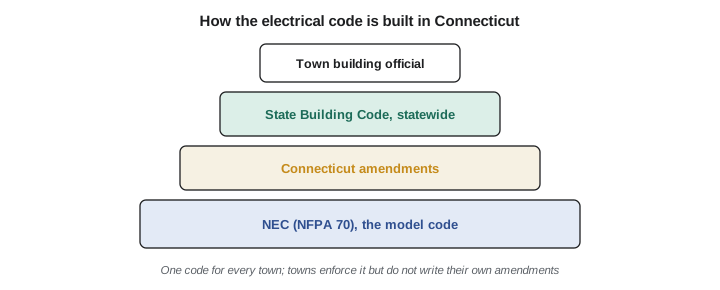
Connecticut has a single State Building Code that applies in every town and city. The State Building Inspector and the Codes and Standards Committee adopt it under chapter 541 of the General Statutes, and the legislature's Regulation Review Committee approves it before it takes effect. The building code adopts a set of model codes by reference, including the International Building Code, the International Residential Code, the energy code and, for electrical work, the National Electrical Code published by the National Fire Protection Association as NFPA 70. Each model code is adopted with a set of Connecticut amendments that add, delete or change specific provisions.
Because the code is statewide, towns enforce it but do not write their own technical amendments to it. A building official in Bristol and one in Greenwich enforce the same electrical rules. What differs from town to town is administration: forms, fees, online portals, scheduling, and how a particular office prefers to see plans and inspection requests. A contractor who hears that a town has its own electrical rules is usually hearing about one of those administrative practices, or about a local zoning or utility requirement, rather than a separate electrical code.
The 2022 code and the 2020 NEC
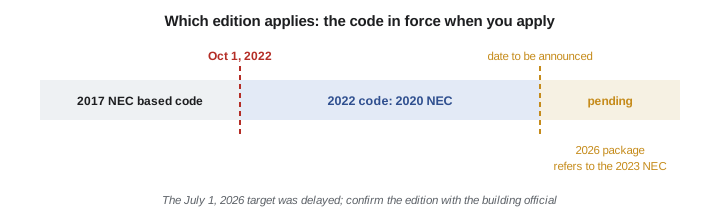
The 2022 Connecticut State Building Code took effect on October 1, 2022, after the Regulation Review Committee approved it in late September of that year. Its electrical provisions are based on the 2020 NEC with Connecticut amendments. That edition replaced the earlier code that had been based on the 2017 NEC. For permits applied for under the 2022 code, the 2020 NEC with Connecticut amendments is the electrical standard, even though newer NEC editions have since been published.
The 2026 code package
Connecticut's next code package, the 2026 Connecticut State Building Code, was developed through 2025 with a public comment period that closed in October of that year. The Office of the State Building Inspector's materials indicate that its electrical references point to the 2023 NEC, not the 2026 edition. The package was expected to take effect on July 1, 2026, but that date was delayed while the package awaited approval by the Regulation Review Committee, and the state said it would announce the new date. Until the department announces that the 2026 package is in effect, the 2022 code and the 2020 NEC continue to govern. Because this can change at any time, check the State Building Inspector's page before relying on either edition.
Which edition applies to a job
A practical rule follows from the adoption process: the code edition in force when the permit application is filed generally governs the work under that permit. When a new code takes effect, the state typically explains how projects already in design or already applied for are handled. Contractors should confirm the edition with the building official at the start of each job, especially near a transition. A job applied for under the 2022 code is generally inspected under the 2020 NEC with Connecticut amendments, even if the inspection takes place after a newer code takes effect.
| Situation | Electrical standard to plan for |
|---|---|
| Permit application filed while the 2022 code is in force | 2020 NEC with Connecticut amendments |
| Architect's notes cite the 2023 NEC on a job applied for under the 2022 code | The code in force governs; clarify the notes with the designer |
| Permit application filed after the 2026 package takes effect | The NEC edition that package adopts, with its amendments |
| A customer asks for a feature from a newer NEC edition | Allowed as an upgrade if it also meets the code in force |
What the amendments do
Connecticut's amendments to the NEC fall into a few groups. Administrative amendments tie the NEC into the State Building Code's system of permits, inspections, appeals and enforcement, replacing or supplementing the NEC's own administrative chapter. Coordination amendments line the NEC up with the other model codes Connecticut adopts, such as the residential and energy codes, so the same building is not subject to conflicting rules. Technical amendments change specific installation requirements where the state decided the national rule should be modified for Connecticut.
Technical amendments often come from code change proposals submitted by contractors, inspectors, manufacturers and trade groups during each adoption cycle. For the 2022 code, for example, the Office of the State Building Inspector received proposals concerning the 2020 NEC's ground-fault protection requirement for outdoor outlets serving equipment such as heat pumps, a rule that had caused nuisance tripping concerns nationally. The Codes and Standards Committee decides which proposals to accept. Because the outcome of each proposal is recorded in the adopted code, the only reliable way to know how a rule reads in Connecticut is to read the adopted amendments themselves, not a summary from another state.
| Kind of amendment | Purpose | Where it shows up on a job |
|---|---|---|
| Administrative | Ties the NEC into the state's permit and enforcement system | Who issues permits, appeals, inspection authority |
| Coordination | Aligns the NEC with other adopted codes | Residential and energy provisions that touch electrical work |
| Technical | Changes a specific installation rule | A requirement that differs from the national text |
Studying the amendments
The exam bulletin allows NEC editions, not the Connecticut amendments, as trade references. Questions are therefore mostly drawn from the NEC itself, but candidates should still know how Connecticut adopts and amends the code, because those facts appear in business, law and licensing questions and in everyday work. A sensible approach is to read through the electrical amendments once, mark in a notebook which NEC sections they touch, and review that list before the exam. Do not write those notes into the exam references; the bulletin's rules on marking apply.
# Which edition governs? (simplified decision helper)
from datetime import date

codes = [  # (effective date, label)
    (date(2018, 10, 1), "2018 state code (2017 NEC)"),
    (date(2022, 10, 1), "2022 state code (2020 NEC)"),
]
pending = "2026 state code (2023 NEC), effective date to be announced"

def governing(applied):
    current = None
    for start, label in codes:
        if applied >= start:
            current = label
    return current

for d in (date(2022, 6, 15), date(2023, 3, 2), date(2026, 11, 10)):
    print(d.isoformat(), "->", governing(d))
print("Pending:", pending)2022-06-15 -> 2018 state code (2017 NEC) 2023-03-02 -> 2022 state code (2020 NEC) 2026-11-10 -> 2022 state code (2020 NEC) Pending: 2026 state code (2023 NEC), effective date to be announced
The helper keeps a list of codes with their effective dates and picks the latest one that started on or before the application date. When the 2026 package takes effect, adding one line with its date updates the answer. Real transitions have details the helper ignores, such as rules for projects already in design, which is another reason to confirm with the building official.
Modifications, interpretations and appeals
Sometimes an installation cannot meet a code rule exactly, or the contractor and the building official read a rule differently. Connecticut's system gives several routes. The building official can approve alternative methods that provide equivalent safety under the code's own provisions. A party who disagrees with a building official's decision can appeal through the routes set out in the General Statutes, which lead to the State Building Inspector and beyond. And the State Building Inspector can issue formal interpretations of the code that apply statewide. Contractors should raise questions early, in writing, and keep copies of any approval.
The Fire Safety Code and other codes
The State Building Code governs new construction and alterations. The Connecticut State Fire Safety Code and Fire Prevention Code, adopted by the State Fire Marshal, also matter to electrical contractors, especially for fire alarm systems and work in existing occupied buildings. Local fire marshals enforce those codes. On many commercial jobs, fire alarm plans go to both the building official and the fire marshal. Utility service rules, set by the serving utility and approved by state regulators, add requirements on the line side that the NEC does not cover, such as meter locations and service drop clearances.
Worked problem
Sorting out the Southington drawings
The architect's notes say 2023 NEC. The permit application will be filed in February 2026, when the 2022 state code is in force. The project manager thinks the 2026 NEC applies. What should Marisol tell Walt?
Show solution
- The governing code is the one in force when the permit application is filed.
- In February 2026 that is the 2022 state code, based on the 2020 NEC with Connecticut amendments.
- The designer's note does not change the code in force; ask the architect to correct it.
- Price the job to the 2020 NEC with Connecticut amendments, noting any owner-requested upgrades separately.
Answer: Bid to the 2020 NEC with Connecticut amendments and have the drawings corrected.
Reading a Connecticut amendment
Amendments in the State Building Code are usually written as instructions that refer to the NEC's own numbering: delete a section, add an exception, replace a sentence, or add a new subsection. To read one, open the NEC to the section named, then apply the instruction to see how the rule reads in Connecticut. Keep the two documents side by side, because an amendment on its own often makes no sense. When an amendment deletes a requirement, the NEC rule simply does not apply in Connecticut; when it adds or replaces text, the Connecticut text governs. If an amendment seems to conflict with another provision, ask the building official or request a formal interpretation rather than guessing.
Code changes and the bidding calendar
Code transitions affect estimates. A contractor who bids a job in the months before a new code takes effect should ask when the permit application will be filed, because that date decides the edition. If the owner delays the application past the effective date, the job may fall under the new code, with different requirements and costs. Many contractors add a clause to their proposals stating which code edition the price assumes and that work required by a later edition will be priced as a change. That protects both sides and makes the conversation easier if the schedule slips.
| Question for the owner or designer | Why it matters |
|---|---|
| When will the permit application be filed? | The filing date generally decides the code edition |
| Which edition do the drawings assume? | Notes may cite a newer or older edition |
| Who will answer code questions during design? | Early answers prevent costly changes |
| Will the price assume a specific edition? | A clause protects both sides if the schedule moves |
Common mistakes
MistakeAssuming the newest NEC applies as soon as NFPA publishes it.
InsteadConnecticut applies the edition its State Building Code adopts, once that code takes effect.
MistakeThinking each town can adopt its own electrical amendments.
InsteadThe State Building Code applies statewide; towns enforce it.
MistakeRelying on another state's amendments to the same NEC edition.
InsteadRead the Connecticut amendments themselves.
MistakeTreating a designer's note as the governing code.
InsteadThe code in force on the permit application date governs.
Summary and key terms
- Connecticut has one State Building Code that adopts the NEC with state amendments and applies in every town.
- The 2022 code, effective October 1, 2022, is based on the 2020 NEC.
- A 2026 package referencing the 2023 NEC was delayed pending legislative approval; confirm its status.
- The code in force when the permit application is filed generally governs the work.
- Amendments are administrative, coordination or technical; read the adopted text.
- State Building Code
- Connecticut's statewide building code, which adopts model codes including the NEC with amendments.
- State Building Inspector
- The state official who, with the Codes and Standards Committee, adopts and interprets the building code.
- Amendment
- A Connecticut change to a provision of a model code such as the NEC.
- Formal interpretation
- A written statewide ruling on what a code provision means.
- Fire Safety Code
- The state code, adopted by the State Fire Marshal, that applies to existing buildings and fire protection.
Practice problems
Work each problem on paper first, then reveal the answer to check.
Which NEC edition does the 2022 Connecticut State Building Code adopt?
Show answer
The 2020 NEC, with Connecticut amendments.
When did the 2022 code take effect?
Show answer
October 1, 2022.
Can a Connecticut town adopt its own electrical amendments?
Show answer
No; the State Building Code applies statewide and towns enforce it.
Who can issue a formal statewide interpretation of the code?
Show answer
The State Building Inspector.
Lesson quiz · 5 questions
Score 60% or more to complete this lesson.
Create a free account to save your progress, take quizzes and earn a certificate.