
MELU-207 · Lesson 12 of 12 · 18 min
Practice exam review and test-day strategy
▶ Video coming soon A video version of this lesson is on the way.
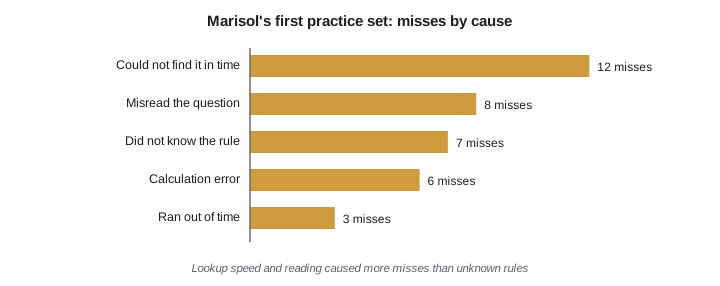
Six weeks before her trade exam, Marisol took a full 100-question practice set under real conditions: a quiet room at the Tunxis Valley shop, her tabbed code book and Ugly's, the other listed references on the table, a four-hour timer and no phone. She scored 64. That was six short of passing, but Walt was pleased. "Now we know what to fix," he said. They went through every miss together and sorted them into causes. Most of her misses were not about rules she did not know; they were about lookups that took too long and questions she misread. Over the next five weeks, her practice scores climbed to 72, 76 and then 81. This lesson covers how to review practice exams, build a miss log, practice lookups, plan the last weeks, and handle test day for both portions of the E-1 exam.
Why practice exams matter
A practice exam does three jobs. It measures where you stand, it trains your pacing and stamina, and it shows you which kind of mistakes you make. The third job is the most valuable and the most often skipped. A candidate who takes practice exam after practice exam without reviewing the misses mostly practices making the same mistakes. A candidate who spends as long reviewing a practice set as taking it improves quickly.
The miss log
A miss log is a simple record of every question you get wrong and why. For each miss, write the topic, the correct answer, where the answer is found in the reference, how long you spent, and the cause. Most misses fall into a few causes: you did not know the rule, you could not find it in time, you misread the question, you made a calculation error, or you ran out of time. Each cause has a different fix. Rules you did not know need study. Lookups that took too long need tabbing and index practice. Misreading needs slower reading of the last line of each question. Calculation errors need a written method. Running out of time needs the two-pass plan from Lesson 4.
| Cause | Fix | How to check the fix worked |
|---|---|---|
| Could not find it in time | Tab the articles you use; drill the index | Timed lookup drills under one minute |
| Misread the question | Read the last line first; underline what is asked | Fewer misreads on the next set |
| Did not know the rule | Study the topic and do targeted questions | Correct answers on the same topic |
| Calculation error | Write each step; check units | Rework the missed calculations cleanly |
| Ran out of time | Use the two-pass plan and checkpoints | Finish the next set with time to spare |
Lookup drills
On an open-book exam, lookup speed is a skill. A lookup drill is a list of short prompts, such as a key word, a table subject or a calculation type, and the task is to find the right place in the reference as fast as possible, without answering the question. Time each lookup. At first, many take two or three minutes. With daily practice, most drop below a minute. Use the index, the table of contents and your tabs. Drill the NASCLA guide too, because Business and Law questions on liens, tax and labor law are fast if you know where the chapters are and slow if you do not.
# Lookup drill log: average time per lookup by week (study aid)
weeks = {
    "week 1": [150, 95, 180, 120, 75, 140],
    "week 2": [90, 70, 110, 85, 60, 95],
    "week 3": [55, 48, 70, 62, 40, 58],
}
for wk, secs in weeks.items():
    avg = sum(secs) / len(secs)
    under = sum(1 for s in secs if s <= 60)
print(wk, "average", round(avg), "seconds;", under, "of", len(secs), "under a minute")week 1 average 127 seconds; 0 of 6 under a minute week 2 average 85 seconds; 1 of 6 under a minute week 3 average 56 seconds; 4 of 6 under a minute
The log turns a vague feeling of improvement into numbers. Marisol's average fell from more than two minutes in the first week to under a minute by the third, and that alone was worth several points on her next practice exam.
Business and Law strategy
The Business and Law portion rewards preparation differently from the trade portion. Its questions are drawn from the NASCLA Connecticut guide and cover a wide range of topics, from estimating and bidding to tax and labor law. Many candidates find the calculation questions, such as markup versus margin, depreciation, payroll taxes and break-even points, the hardest, because they require both a method and a lookup. Practice those by hand until the steps are automatic. For the many questions that are pure lookups, a well-tabbed guide and a habit of reading the question's last line first will carry most of the load. Remember that some questions may seem unrelated to electrical work, because the same exam serves several trades.
Worked problem
Markup versus margin
An estimate for a job has costs of 40,000 dollars. The company wants a gross margin of 20 out of every 100 dollars of the selling price. What selling price gives that margin, and what markup on cost does it represent?
Show solution
- Margin is profit divided by selling price.
- Selling price equals cost divided by 0.80, which is 50,000 dollars.
- Profit is 50,000 minus 40,000, or 10,000 dollars.
- Markup on cost is 10,000 divided by 40,000, which is 0.25, or 25 out of every 100 dollars of cost.
Answer: A 50,000 dollar price gives the desired margin, equal to a markup of 0.25 on cost.
The last four weeks
A good plan for the final month mixes full practice sets with targeted work. In week four before the exam, take a full timed set for each portion and build the miss log. In weeks three and two, spend most of the time on the biggest causes in the log, with daily lookup drills and one more full set each week. In the final week, take a lighter set early in the week, review the miss log and your tabs, check that your references match the bulletin's list and meet its marking rules, confirm your appointment and ID, and rest. Cramming new topics in the last two days rarely helps.
| Week before the exam | Focus |
|---|---|
| Fourth | Full timed sets for each portion; build the miss log |
| Third | Biggest causes in the miss log; daily lookup drills; one full set |
| Second | Remaining weak topics; calculation practice; one full set |
| Final | Light review; check references, appointment and ID; rest |
The night before and the morning of
The night before, pack the references, check the ID against the registration, set out the confirmation and directions, and get a full night's sleep. In the morning, eat, leave early enough to arrive about 30 minutes before the appointment, and allow for traffic on the highway. Marisol drove the route to the test center the week before, at the same time of day, so there were no surprises. At check-in, expect staff to inspect the references, store personal items and explain the rules.
During the exam
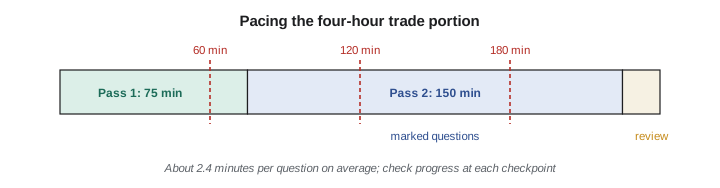
Use the two-pass method. On the first pass, answer every question you can in about a minute and mark the rest. On the second pass, work the marked questions, starting with the ones you expect to be quickest. Check the clock at the checkpoints you planned. Read the last line of each question before the rest, because it tells you what is actually being asked. For calculation questions, write the steps on the scratch material the center provides. Never leave a question blank; there is no penalty for a wrong answer. If you feel stuck or anxious, take a breath, look away from the screen for a few seconds and move on to the next question; the clock rewards steady progress.
After the exam
Results usually come at the center. If you pass both portions, follow the score report's instructions to pay the license fee to the department, and wait for the license to appear in the state lookup before contracting. If you fail a portion, use the score report's breakdown by area to update the miss log, take advantage of any review the bulletin allows, and book a retake within the eligibility window. Remember that a passed portion stays valid for two years. Marisol passed Business and Law on her first attempt with 41 of 50, and the trade portion on her second attempt with 78. Her E-1 appeared in the lookup in May.
# Score check for each portion (study aid)
portions = {"Trade": (78, 100), "Business and Law": (41, 50)}
for name, (correct, total) in portions.items():
    needed = total * 70 // 100
    result = "pass" if correct >= needed else "fail"
print(name.ljust(17), correct, "of", total, "- needed", needed, "-", result)Trade 78 of 100 - needed 70 - pass Business and Law 41 of 50 - needed 35 - pass
The check confirms that each portion was passed on its own: 78 against 70 needed on the trade portion, and 41 against 35 needed on Business and Law.
Building your references
The references are your tools on exam day, so prepare them like tools. Use tabs that are permanently attached, as the bulletin requires, and label them by article or chapter so you can find them by feel. Tab the index pages too. Highlight sparingly; a page with everything highlighted is no easier to read than one with nothing highlighted. Practice only with the books you will bring, in the same editions, so that page positions become familiar. Bring a spare set of tabs to the last few study sessions, not to the exam, in case a tab tears. Check the bulletin once more in the final week to confirm the editions and marking rules.
Managing stress
Most candidates feel some anxiety on exam day, and a little helps focus. Too much leads to misreading and rushing. Simple habits help: sleep well the two nights before, eat a normal meal, arrive early so there is no rush, and use the first minute in the test room to breathe and settle. During the exam, if a question rattles you, mark it and move on; the next one may be easy. A candidate who has practiced full-length sets under time pressure has already done the exam several times and knows what the third hour feels like.
Using the score report
If a portion does not go well, the score report is the best study guide you will get. It shows performance by content area, so a candidate who scored well on wiring methods but poorly on services and calculations knows exactly where to focus. Update the miss log with those areas, take a fresh practice set aimed at them within a week, and book the retake while the material is still fresh. Candidates who wait months before retaking often have to relearn material they already knew.
Common mistakes
MistakeTaking practice exams without reviewing the misses.
InsteadReview every miss and record its cause in a miss log.
MistakeStudying only rules when the misses are about lookups.
InsteadMatch the fix to the cause; drill lookups if that is the problem.
MistakeCramming new topics the night before.
InsteadReview the miss log and tabs, check logistics and sleep.
MistakeSpending ten minutes on one hard question on the first pass.
InsteadMark it and come back on the second pass.
Summary and key terms
- Practice exams measure, train pacing and reveal the causes of mistakes.
- A miss log records each miss and its cause so each cause gets the right fix.
- Daily timed lookup drills cut lookup time and raise scores.
- Plan the last four weeks around full sets, the miss log and logistics.
- On test day, arrive early with matching ID, use two passes, check the clock and answer every question.
- Miss log
- A record of each missed practice question, its answer, its location and its cause.
- Lookup drill
- Timed practice in finding the right place in a reference without answering the question.
- Two-pass method
- Answering quick questions first and returning to marked questions.
- Checkpoint
- A planned time to compare your progress with the clock.
- Gross margin
- Profit divided by selling price.
Practice problems
Work each problem on paper first, then reveal the answer to check.
What is the most common cause of misses on open-book exams?
Show answer
Lookups that take too long, more often than unknown rules.
What should a miss log record for each miss?
Show answer
Topic, correct answer, where it is found, time spent and cause.
How many correct answers are needed on the trade portion?
Show answer
70 of 100.
What should you do with a hard question on the first pass?
Show answer
Mark it and return to it on the second pass.
Lesson quiz · 5 questions
Score 60% or more to complete this lesson.
Create a free account to save your progress, take quizzes and earn a certificate.