
MELU-207 · Lesson 6 of 12 · 19 min
Permits, inspections and the inspection authority
▶ Video coming soon A video version of this lesson is on the way.
On a Tuesday in March, Marisol went with Walt to the Bristol building department to file a permit for a 400 amp service upgrade and new distribution at a machine shop on Middle Street. The clerk checked Walt's E-1 in the state's license lookup, asked for the owner's authorization, took the fee and logged the application. Ten days later the permit was issued. Over the next six weeks the assistant building official who handles electrical work came out three times: once before the trench for the new feeder was backfilled, once to see the rough wiring before the new office walls were closed, and once for the final. "Every one of those visits is on us to call in," Walt said. "If we cover something before it's inspected, we uncover it." This lesson explains how permits and inspections work in Connecticut, who the inspection authority is, and what a contractor must do to keep a job moving.
The building official
Every Connecticut municipality appoints a building official to enforce the State Building Code. Building officials are licensed by the state and must meet training and continuing education requirements. Larger towns have assistant building officials, and many have one or more who specialize in electrical work; in some offices that person is still called the electrical inspector. Smaller towns may share staff or rely on one official for all trades. Whatever the titles, the building official is the authority having jurisdiction for permits and inspections under the code.
Electrical contractors deal with the building department for nearly every job. The building official reviews permit applications, approves plans when plans are required, inspects work, issues correction notices, and signs off on final inspections and certificates of occupancy or approval. The official can also order unsafe work stopped. A good working relationship with each town's inspectors is one of the most valuable things a contractor can build.
When a permit is needed
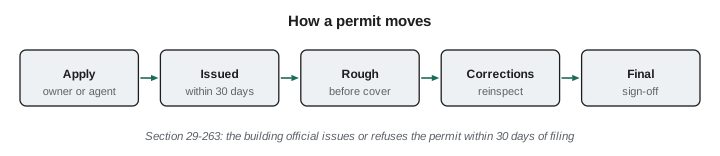
Section 29-263 says, in general terms, that no building or structure may be built or altered until a permit application has been filed and a permit issued, except where the statutes or the State Building Code provide otherwise. Electrical work falls under that rule. New installations, alterations, service changes, additions of circuits and most replacements of equipment need a permit. The code lists limited categories of minor work that do not, such as some like-for-like replacements of devices, but those categories are narrow, and contractors who are unsure should ask the building official before starting.
The permit statute says the application is made by the owner of the premises or the owner's authorized agent. In practice, the licensed contractor files for the electrical work as the owner's agent, and the building department confirms the contractor's license through the state lookup. For residential work where the contractor is also acting as a home improvement contractor, section 29-263 requires the application to show the contractor's name, business address and home improvement registration number. Lesson 8 explains when that registration is needed.
The application and the 30-day rule
Applications are filed in the manner the building official prescribes: in person, by mail, by email, or, increasingly, through an online permit portal. They typically describe the work, the location, the owner, the contractor and the estimated cost of the work, which usually sets the fee. Commercial and larger residential jobs need plans; smaller jobs may need only a description. The statute requires the building official to issue or refuse the permit, in whole or in part, within 30 days after the application is filed, and plan review must also take place within that period.
Each permit application also carries a small education fee set by regulation, which supports training for building officials. It appears as a separate line on the permit fee receipt. Fees themselves are set by each town and vary widely.
| Step | Contractor's job | Building official's job |
|---|---|---|
| Application | File the description, plans if needed and fee as the owner's agent | Check the license, the plans and the fee |
| Review | Answer questions; revise plans if asked | Issue or refuse within 30 days |
| Rough inspection | Call before concealing work | Inspect and approve or issue corrections |
| Corrections | Fix items and request reinspection | Reinspect |
| Final inspection | Call when work is complete | Approve, then sign off for occupancy or use |
Inspections
The code requires inspections at stages where work would otherwise be hidden. Typical electrical inspections are an underground or trench inspection before backfill, a rough inspection before walls and ceilings are covered, any special inspections the official requires, such as for a service or a fire alarm system, and a final inspection when the work is complete. Some towns combine the service and final for small jobs. The contractor calls in each inspection through the town's process and must not cover work that has not been inspected. Work covered too early may have to be uncovered at the contractor's expense.
Inspection results come as approvals or correction notices. A correction notice lists the items to fix, sometimes with code references. The contractor fixes them and requests a reinspection. Contractors who argue with an inspector in the field rarely win; contractors who ask the inspector to show them the code section, take a note, and follow up in writing if they still disagree usually do better.
Utility coordination
Service work involves the serving utility as well as the building official. For a new or upgraded service, the utility typically needs a work request, sets the meter location and service drop or lateral requirements, and will not energize a new service until it receives the building department's release. Contractors should start the utility process early, because the utility's schedule is often slower than the inspector's. Temporary power for construction has its own permit and inspection in most towns.
Fire alarm and the fire marshal
Fire alarm work brings in the local fire marshal, who enforces the Fire Safety Code. On commercial jobs, fire alarm plans typically go to both the building department and the fire marshal, and the fire marshal may witness the acceptance test. Electricians working on fire alarm systems need the right license scope and should coordinate testing dates with the fire marshal well ahead of occupancy.
State buildings and special cases
Not every project goes through a town building department. Buildings owned or leased by the state, and some other categories of projects, fall under the Office of the State Building Inspector or other state agencies for plan review and inspection. Projects at the state's universities, prisons and state office buildings are examples. Contractors bidding state work should read the contract documents carefully to see which authority will permit and inspect.
Homeowner permits
Chapter 393 allows a homeowner, in limited circumstances, to do electrical work on a single-family home that he or she owns and lives in, without a license. That work still needs a permit and inspections, and the building official may require the homeowner to show that he or she understands the work. The exemption is personal: a homeowner cannot hire an unlicensed friend to do the work under a homeowner permit. Contractors sometimes get calls to finish or correct homeowner work, and should treat it like any other alteration, with their own permit.
# Inspection tracker for one job (simplified study aid)
from datetime import date

steps = [
    ("Application filed", date(2026, 3, 3)),
    ("Permit issued", date(2026, 3, 13)),
    ("Trench inspection", date(2026, 3, 24)),
    ("Rough inspection", date(2026, 4, 9)),
    ("Reinspection after corrections", date(2026, 4, 14)),
    ("Final inspection", date(2026, 4, 28)),
]
filed = steps[0][1]
issued = steps[1][1]
print("Days to issue:", (issued - filed).days, "(limit 30)")
for (name, d), (_, nxt) in zip(steps, steps[1:] + [(None, steps[-1][1])]):
print(d.isoformat(), name.ljust(31), "next step in", (nxt - d).days, "days")Days to issue: 10 (limit 30) 2026-03-03 Application filed next step in 10 days 2026-03-13 Permit issued next step in 11 days 2026-03-24 Trench inspection next step in 16 days 2026-04-09 Rough inspection next step in 5 days 2026-04-14 Reinspection after corrections next step in 14 days 2026-04-28 Final inspection next step in 0 days
Keeping a record like this for each job pays off. It shows whether the town met the 30-day rule, helps estimate schedules for similar jobs in the same town and gives the contractor a record if a customer later asks why a job took as long as it did.
Closing out
A permit is not done until the final inspection is approved. Open permits cause problems later: a buyer's lender or attorney may find them in a title search, and the town may not issue a certificate of occupancy or approval for a project with open trade permits. Contractors should track every open permit and close each one promptly. If a customer stops a job midway, the contractor should notify the building official in writing so the permit's status is clear.
Worked problem
A rough inspection gone wrong
A Tunxis Valley crew wired a kitchen remodel in Plainville. The drywall contractor arrived a day early and covered two walls before the rough inspection. What should happen?
Show solution
- Covered work that was not inspected may have to be exposed for inspection.
- Tell the building official honestly what happened and ask how much needs to be opened.
- Open the walls as directed, have the rough inspected and approved, then close them.
- Change the job schedule so drywall cannot start until the rough is approved.
Answer: Open the walls as the inspector directs, get the rough approved, then close up; fix the scheduling gap.
Working with plan review
Commercial jobs and larger residential projects usually need plans for electrical work. Plan reviewers look for service and feeder sizing, load calculations, panel schedules, one-line diagrams, grounding and bonding details, emergency and standby systems, fire alarm layout where it applies, and equipment locations with working clearances. A plan set that is complete and clearly labeled gets through review faster. When the reviewer sends comments, answer every comment in writing, revise the drawings and resubmit; a partial answer starts another round. Contractors on design-build jobs, where they prepare the electrical design themselves, should check whether the town requires plans to be sealed by a licensed design professional for the size and type of project.
Inspection etiquette that saves time
- Be ready before you call: covers off, labels on, circuits identified and the permit card posted.
- Have someone on site who knows the work and can answer questions.
- Keep approved plans and any written approvals on site.
- If you disagree with a correction, ask for the code section and follow up in writing.
- Fix corrections promptly and call for reinspection only when every item is done.
These habits shorten jobs. An inspector who arrives to find the work ready, labeled and explained finishes quickly and is more likely to work with the contractor on scheduling the next visit. An inspector who arrives to find covers still on, no one on site and half the items from the last visit still open will write the job up again, and the schedule slips for everyone.
Each town also has its own habits about scheduling: some take calls the day before, some use an online portal, and some book inspections only on certain days. Learn the habits of each town you work in and keep a list in the office, because a missed scheduling window can cost a day on every inspection.
Common mistakes
MistakeStarting work before the permit is issued.
InsteadFile the application and wait for the permit, except where the code allows otherwise.
MistakeCovering wiring before the rough inspection.
InsteadCall in each inspection before concealment.
MistakeLeaving permits open after the job ends.
InsteadGet the final approved and close every permit.
MistakeLetting a homeowner use a homeowner permit for work you do.
InsteadThe homeowner exemption is personal; pull your own permit.
Summary and key terms
- Each town's building official, licensed by the state, is the inspection authority for permits and inspections.
- Section 29-263 requires a permit before building or altering, except as the code provides, and sets a 30-day decision window.
- Applications are filed by the owner or authorized agent, usually the licensed contractor.
- Inspections happen before work is concealed and at completion; covered work may have to be uncovered.
- Coordinate with the utility and the fire marshal, and close every permit.
- Building official
- The licensed municipal official who enforces the State Building Code.
- Assistant building official
- A licensed deputy, often specializing in electrical work.
- Rough inspection
- The inspection of wiring before walls and ceilings are covered.
- Correction notice
- A written list of items an inspector found that must be fixed.
- Certificate of occupancy
- The building official's approval that a building may be occupied.
Practice problems
Work each problem on paper first, then reveal the answer to check.
Within how many days must a building official issue or refuse a permit?
Show answer
30 days after the application is filed.
Who may apply for a building permit under section 29-263?
Show answer
The owner of the premises or the owner's authorized agent.
When must the rough inspection be called in?
Show answer
Before the work is concealed.
Who enforces the Fire Safety Code locally?
Show answer
The local fire marshal.
Lesson quiz · 5 questions
Score 60% or more to complete this lesson.
Create a free account to save your progress, take quizzes and earn a certificate.