
MELU-207 · Lesson 11 of 12 · 19 min
Renewal and continuing education
▶ Video coming soon A video version of this lesson is on the way.
Every August, Denise taped a sheet to the wall of the Tunxis Valley office with every license in the company, the holder's continuing education status and a box to check when the renewal went in. That year, the sheet had fourteen names. Two were missing their continuing education certificates, and one apprentice's registration was about to expire. "Licenses expire September 30," she told Marisol. "The education had to be done by June 30. If someone's not done, we have a problem we can't fix in September." This lesson covers how Connecticut electrical licenses are renewed, the annual continuing education requirement, audits and records, what happens when a license lapses, and how an E-1 keeps a whole company's licenses current.
The annual cycle
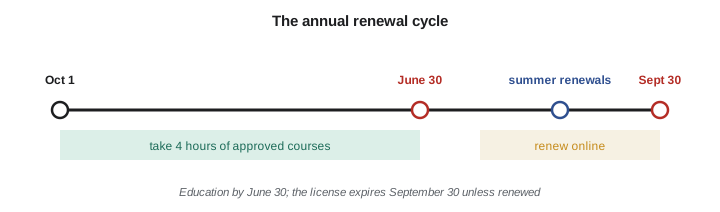
Connecticut electrical licenses run on an annual cycle. All electrical licenses expire on September 30 each year, and the department's renewal period opens in the summer. Licensees renew online through the department's licensing system, attest that they have completed the required continuing education and pay the renewal fee, which is higher for contractor licenses than for journeyperson licenses. The renewed license appears in the state lookup, which is where building officials, general contractors and customers check it.
A first-time licensee does not have to complete continuing education for the first renewal, according to the department's page. Marisol's E-1, issued in May 2026, came up for its first renewal on September 30, 2026, without a continuing education requirement for that cycle. Her E-2 history did not change that, although she had completed the required courses for each E-2 renewal.
How much education and when
The department's page says electricians must complete four credit hours of approved continuing education each year, and that all hours must be completed by June 30, three months before the September 30 renewal deadline. Courses must be approved by the electrical board, and the department publishes the list of approved courses and providers. The board has authority under the statute to set the hours within a range, so the number can change in a given year; check the department's notice for the current cycle. Approved courses commonly cover changes in the NEC and Connecticut's amendments, safety, and the state's licensing laws.
| Item | Rule (current department guidance) |
|---|---|
| Hours | Four credit hours per year |
| Deadline | Complete by June 30 |
| License expiration | September 30 every year |
| First renewal | No continuing education required |
| Approved courses | Only courses approved by the board count |
| Records | Keep certificates at least four years |
Choosing courses
Only approved courses count, so the first step is the department's list. Many trade schools, unions, contractor associations and online providers offer approved courses, often as a single four-hour session in the spring. Contractors with several licensed employees sometimes host a provider at the shop. A course taken from a provider that is approved in another state, but not in Connecticut, does not count, as some electricians who also hold licenses in Massachusetts or New York learn the hard way. Before paying, confirm that the course and the provider are on the current Connecticut list for the license type.
Attestation, audits and records
At renewal, the licensee attests that the required education was completed. The department can audit renewals, and the department's page says licensees must keep their certificates of completion for at least four years. An audited licensee who cannot produce certificates, or whose attestation turns out to be false, can face discipline that is worse than the original shortfall. Denise kept a scanned copy of every employee's certificate in the company's files and asked each employee to keep the original.
# Company continuing education check before June 30 (simplified)
from datetime import date

deadline = date(2026, 6, 30)
required = 4
staff = [  # name, hours completed, first renewal?
    ("Walt Kowalczyk", 4, False),
    ("Marisol Vega", 0, True),
    ("Tom Reyes", 4, False),
    ("Ana Liu", 2, False),
    ("Jordan Pike", 0, False),
]
for name, hours, first in staff:
    need = 0 if first else max(0, required - hours)
    status = "ok" if need == 0 else "needs " + str(need) + " more hours"
    print(name.ljust(16), status)
print("Deadline:", deadline.isoformat())Walt Kowalczyk ok Marisol Vega ok Tom Reyes ok Ana Liu needs 2 more hours Jordan Pike needs 4 more hours Deadline: 2026-06-30
The output flags two people with time to fix the problem, because the check was run in the spring. Run in September, the same check would flag two people who cannot renew on time, because their education deadline passed in June. That is why Denise decided to move her sheet from August to April for the next cycle.
When a license lapses
A license that is not renewed by September 30 expires. An expired license is not a license: the holder may not do the work it covered, and an employer may not assign that person to licensed work. A contractor whose E-1 lapses may not contract for electrical work or take out permits until the license is restored. The statute gives the department some room to accept late renewals within a short period, often with a late fee, and longer lapses lead to reinstatement procedures that can require more education and, after a long enough gap, requalification by examination. The details depend on how long the license has been expired, so a licensee who misses the deadline should contact the department right away rather than wait.
For a company, a lapsed E-1 is serious. If the only E-1 holder's license lapses, the company has no one who may contract for electrical work, and open permits may need attention. If an E-2 lapses, that person must stop electrical work immediately. Either way, work done during the lapse is unlicensed work.
Changes to report
Licensees are expected to keep their information current with the department, including address and employer changes, and to answer renewal questions honestly. A licensee who has been disciplined in another state, convicted of certain crimes or found to have done unlicensed work may need to disclose that at renewal. As with the original application, a truthful yes with an explanation is far better than a false no.
Keeping the whole company current
An E-1 contractor is responsible for employing only licensed people, so renewals are a company task, not just a personal one. A simple system works. Keep a list of every license and registration in the company with numbers and expiration dates. In the spring, check continuing education status for each licensee and schedule anyone who is behind. In the summer, as soon as renewals open, remind each person to renew, and confirm each renewal in the state lookup. On October 1, check the lookup again for every name, and pull anyone who did not renew from licensed work until they do. Apprentice registrations have their own dates and need the same attention.
| Month | Task |
|---|---|
| March to April | Check each licensee's continuing education hours; book courses |
| By June 30 | All continuing education complete; collect certificates |
| Summer, when renewals open | Remind each licensee to renew; renew the E-1 |
| By September 30 | Confirm every renewal in the state lookup |
| October 1 | Pull anyone not renewed from licensed work |
Worked problem
A missed deadline
Jordan, an E-2 at Tunxis Valley, did not take any continuing education this year. It is July 15. His license expires September 30. What are the risks, and what should he do?
Show solution
- The education had to be completed by June 30, so he has missed that deadline.
- He cannot truthfully attest at renewal that he completed the education on time.
- He should contact the department now and ask how to cure the shortfall before September 30.
- If his license expires, he must stop electrical work until it is restored.
Answer: Contact the department now; never make a false attestation, and stop licensed work if the license expires.
Renewing the E-1 as a contractor
Renewing an E-1 is the same process as renewing an E-2, with a higher fee and more at stake. An E-2 who forgets to renew must stop work; a company whose only E-1 forgets to renew must stop contracting for electrical work and may have open permits in limbo. Many contractors renew the E-1 the first week renewals open, before anything else, and set two reminders: one in the spring for continuing education and one in early summer for the renewal itself. Marisol put both on the company calendar and on her phone.
Getting value from continuing education
Four hours a year is not much, and it is easy to treat continuing education as a box to check. It can be more. A good code update course explains why rules changed and how inspectors are applying them, which saves time on the next job. A course on Connecticut law can explain recent changes, such as amendments to apprentice ratios or home improvement rules. A safety course can prompt a review of the company's own procedures. Choose courses with instructors who work in the field, and bring questions from your own jobs. Contractors who host a course for their whole crew often ask the instructor to cover issues the company has run into that year.
| Course topic | What to get out of it |
|---|---|
| NEC changes and Connecticut amendments | How inspectors are applying new rules |
| Connecticut licensing law | Recent changes to ratios, supervision and discipline |
| Electrical safety | Ideas to improve the company's lockout and arc flash procedures |
| Business topics | Contracts, liens and home improvement rules that affect cash flow |
Other renewals to track
Electrical licenses are not the only dates. Apprentice registrations, home improvement registrations, business filings with the Secretary of the State, insurance policies, bonds, vehicle registrations and any certifications the company relies on, such as manufacturer training for generators or battery systems, all have their own renewal dates. A single calendar with every date, owned by one person in the office, prevents most surprises. By that fall, Denise's calendar had forty-one dates on it.
The calendar is also a hiring tool. When a new electrician joins, add the license, the expiration date and the continuing education status to the list on the first day. When someone leaves, remove them and check whether any open permit or job depended on their license.
Name and address changes
Licensees who move, change their name or change employers should update their information with the department promptly, through the online system where possible. Renewal notices and audit letters go to the address on file, and a letter sent to an old address does not excuse a missed deadline or an unanswered audit. A licensee who marries or changes a legal name should also make sure the name on the license matches the name used for permits, contracts and insurance certificates, so that building officials and general contractors can verify it in the state lookup without confusion.
Planning the year
A licensee can make the whole cycle easy with one habit: schedule the continuing education course in the first quarter of the calendar year, well before the June 30 deadline, and file the certificate the day it arrives. With the course done early, the summer renewal takes minutes, and there is time to retake or replace a course if a provider cancels or a certificate is lost. Marisol booked her first full continuing education course for March of her second year as an E-1, through a provider on the department's approved list, and set a reminder for the renewal window the following summer.
Common mistakes
MistakeTaking continuing education in September.
InsteadComplete all hours by June 30.
MistakeTaking a course approved only in another state.
InsteadUse a course on Connecticut's approved list.
MistakeDiscarding certificates after renewal.
InsteadKeep certificates at least four years for audits.
MistakeWorking the week after September 30 while renewal is pending.
InsteadAn unrenewed license is expired; stop licensed work until it is restored.
Summary and key terms
- Connecticut electrical licenses expire every September 30 and are renewed online.
- Current guidance calls for four hours of board-approved continuing education each year, completed by June 30.
- First-time licensees do not need continuing education for the first renewal.
- Licensees attest at renewal and must keep certificates at least four years for audits.
- An expired license allows no licensed work; contractors should track every employee's renewal.
- Renewal
- The annual process of keeping a license current, due by September 30.
- Continuing education
- Board-approved courses licensees must complete each year to renew.
- Attestation
- The licensee's statement at renewal that the education requirement was met.
- Audit
- The department's review of a licensee's education records.
- Reinstatement
- The process of restoring a license that has been expired for some time.
Practice problems
Work each problem on paper first, then reveal the answer to check.
When do Connecticut electrical licenses expire?
Show answer
September 30 every year.
By when must continuing education be completed?
Show answer
June 30.
How many hours does the department's current guidance require each year?
Show answer
Four credit hours.
How long must certificates be kept?
Show answer
At least four years.
Lesson quiz · 5 questions
Score 60% or more to complete this lesson.
Create a free account to save your progress, take quizzes and earn a certificate.