
MELU-202 · Lesson 9 of 12 · 18 min
Contracts and mechanics' liens in Alaska
▶ Video coming soon A video version of this lesson is on the way.
Arne's advice about money is short: write it down before the work starts, and know your lien dates before the job ends. Tanana Ridge has collected on nearly every job it has done, and the few losses came from a missing change order or a deadline nobody tracked. As administrator, Tessa will not run the company's finances, but she will sign proposals and decide, with Arne's successor in the office, when to protect the company's lien rights. This lesson covers the basics of electrical contracts and then Alaska's lien law for mechanics and materialmen in AS 34.35, with its notice of right to lien, notice of completion, recording deadlines and enforcement period, and the payment bonds that replace liens on public work.
This lesson explains general rules, not legal advice for a particular dispute. Lien law is strict, and a lien recorded a day late can be lost. When real money is at stake, talk to an Alaska construction lawyer early. The lien facts below were checked in November 2026 against the statutes and published lien guides.
What a good electrical contract says
A contract does not have to be long, but it must be clear. For an electrical contractor, the essentials are the parties and the job address, the scope of work described specifically enough that both sides can tell what is included and what is not, the price or pricing method, the payment schedule, start and completion dates, and how changes will be handled. Electrical contracts should also say who obtains and pays for any permit, which code edition the price is based on, what happens if concealed conditions are found, who supplies which equipment, and what warranty the contractor gives.
Alaska adds two practical terms that matter more here than in most states. The first is logistics: freight, barge schedules, air charters, lodging and per diem for remote work, and who bears the cost when weather delays a flight or a barge. The second is season: much remote work must be done in a short summer window, and a contract should say what happens if materials or crews cannot reach the site before freeze-up. Tanana Ridge's proposals for jobs off the road system include a freight and travel allowance and a clause on weather delays.
| Contract term | Why it matters |
|---|---|
| Scope of work and exclusions | Defines what the price covers and what is extra |
| Price and payment schedule | Sets when money is due and how much is held back |
| Change order procedure | Makes extra work billable and documented |
| Code edition and permits | Puts the risk of a code change or permit fee where it belongs |
| Freight, travel and weather | Allocates Alaska's logistics costs and delays |
| Lien waivers and payment | Controls when lien rights are released |
Changes and registration
Changes are the biggest source of payment disputes. The contract should require changes to be in writing, signed before the work is done, with a price or a method for pricing them. Tanana Ridge's foremen carry a one-page change order form, and the rule is no signature, no work.
One more point belongs at the start of every contract, because it controls everything after. Under AS 08.18.151, as Lesson 8 explained, a contractor that was not registered when it made the contract generally cannot sue to collect, and that bar extends to enforcing a lien. A current registration is the first requirement of getting paid.
What a mechanics' lien is
A mechanics' lien is a claim against real property, the land and the improvements on it, for the value of labor, materials, services or equipment furnished to improve it. Alaska's lien statute is in Article 2 of chapter 34.35 of the Alaska Statutes, titled Mechanics and Materialmen, beginning with AS 34.35.050. Lien rights reach the general contractor, subcontractors at any tier, material suppliers, equipment lessors, laborers and certain others who furnish labor or materials to improve the property. The lien ties the debt to the property itself, which is what makes it powerful and why the law is strict about it.
The notice of right to lien
Alaska does not require a preliminary notice before a claimant can lien, but it offers one, and using it changes the deadlines. Under AS 34.35.064, a claimant may give the owner a notice of right to lien, and under AS 34.35.067 the notice may be recorded. The notice tells the owner who is furnishing labor or materials to the project. Its main practical effect is on the notice of completion described next: a claimant that has given or recorded a timely notice of right to lien keeps the full period to record its claim, rather than the short period that otherwise applies after an owner records a notice of completion.
Tanana Ridge records a notice of right to lien at the start of every private job of any size where it is not working directly for the owner, and it sends a copy to the owner. The cost is small, and the protection is large.
The notice of completion and the recording deadlines
Under AS 34.35.071, an owner may record a notice of completion when the work is complete. AS 34.35.068 sets the deadlines for recording a claim of lien, and the notice of completion is the switch that changes them.
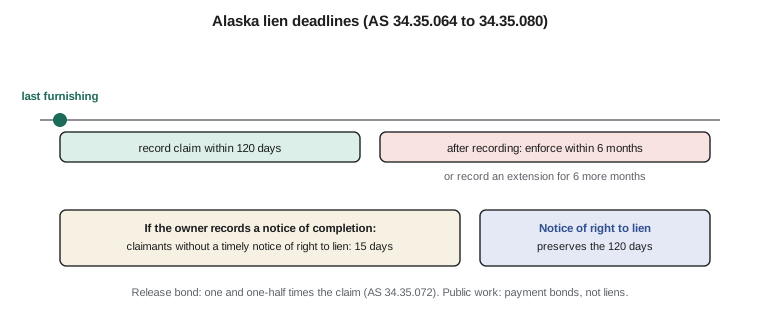
If the owner has not recorded a notice of completion, a claim of lien must be recorded not later than 120 days after the claimant completes its contract or last furnishes labor, materials, services or equipment. If the owner has recorded a notice of completion, a claimant that did not give a notice of right to lien, or that received the owner's advance notice of the recording date, must record its claim within 15 days after the notice of completion is recorded. A claimant that recorded a notice of right to lien early enough, or that gave one but did not receive the advance notice, keeps the 120-day period.
# Alaska lien deadline helper (confirm every date with counsel)
from datetime import date, timedelta
import calendar

def add_months(d, n):
    y, m = divmod(d.month - 1 + n, 12)
    y, m = d.year + y, m + 1
    return date(y, m, min(d.day, calendar.monthrange(y, m)[1]))

last_furnished = date(2026, 9, 18)
print("Record claim (no notice of completion) by:", last_furnished + timedelta(days=120))
notice_of_completion = date(2026, 10, 30)
print("Record claim (no notice of right to lien) by:", notice_of_completion + timedelta(days=15))
recorded = date(2026, 11, 6)
print("Start foreclosure by:", add_months(recorded, 6))Record claim (no notice of completion) by: 2027-01-16 Record claim (no notice of right to lien) by: 2026-11-14 Start foreclosure by: 2027-05-06
The example shows why the notice of right to lien matters. A claimant that last furnished on September 18 would ordinarily have until mid-January to record. If the owner records a notice of completion on October 30 and the claimant never gave a notice of right to lien, the claimant's deadline collapses to November 14. The helper is arithmetic, not law; courts can be strict about counting and about what counts as last furnishing, so record well before the deadline.
The claim of lien
AS 34.35.070 sets out what a claim of lien must contain. It must be in writing and verified by oath, and it identifies the claimant and the owner, the person who contracted with the claimant, a description of the property, a general description of the labor, materials, services or equipment furnished, the contract price, the amount due after credits, and the date the claimant last furnished. The claim is recorded in the recording district where the property is located. Published guides note that Alaska does not require the recorded claim to be served on the owner, but sending a copy is good practice and avoids surprises.
Enforcement and bonding off
A recorded lien does not last forever. Under AS 34.35.080, a claimant must start an action to enforce the lien within six months after recording the claim, unless within that period it records a notice extending the time, which extends the period for another six months. A lien that is not enforced or extended in time is lost, though the contractor may still sue the party that owes it on the contract.
An owner or contractor who disputes a lien can free the property by recording a bond. Under AS 34.35.072, a bond for one and one-half times the amount of the claim releases the property from the lien, and the claimant then looks to the bond instead. Lenders and buyers often insist on this when a lien clouds a title.
Waivers and satisfaction
Owners, lenders and general contractors usually ask for lien waivers before releasing payment, and AS 34.35.117 addresses waivers of lien rights. A conditional waiver gives up rights only when the stated payment is actually received; an unconditional waiver gives them up at once. Never sign an unconditional waiver for money you have not received, and read each waiver for its scope, so that a waiver for one progress payment does not waive retainage or unpaid change orders. Once a lien is paid, the claimant must record a release or satisfaction; published guides note that failing to do so after a written demand can make the claimant liable for damages.
When a payment is late, Tanana Ridge follows a simple sequence before any lien is recorded: a call to the person who owes the money, a written statement that matches the contract and the signed change orders, and then a written demand that names the amount owed and the date the company will record its claim if it is not paid. That date is always well inside the deadline. Most payment problems end at the demand letter, because owners and lenders take a lien seriously.
Public work
A lien cannot be filed against public property such as a school, a state building or a public road. On public work, payment protection comes from bonds. Alaska's public works bond statutes, in AS 36.25 for state contracts and similar rules for municipalities, require the prime contractor on larger public contracts to furnish a payment bond for the protection of those who supply labor and materials. Published guides describe a written notice to the prime contractor within 90 days after the claimant's last furnishing, for claimants who did not contract directly with the prime, and a suit within one year after the contract's final settlement. The thresholds and deadlines should be checked in the current statute and the bond itself before relying on them.
Common mistakes
MistakeSkipping the notice of right to lien because it is optional.
InsteadWithout it, an owner's notice of completion can cut the deadline to 15 days.
MistakeWaiting until day 119 to record.
InsteadDeadlines are strict and last-furnishing dates are disputed; record well ahead.
MistakeForgetting the six-month enforcement period.
InsteadStart the action or record an extension within six months after recording.
MistakeFiling a lien on a public school.
InsteadPublic property is protected by payment bonds, not liens.
MistakeContracting while unregistered.
InsteadAS 08.18.151 can bar collection, including lien enforcement.
Summary and key terms
- A clear written contract with scope, price, changes, code basis and Alaska logistics prevents most disputes.
- Alaska's lien law is AS 34.35, Article 2, Mechanics and Materialmen.
- A notice of right to lien is optional but preserves the full recording period if the owner records a notice of completion.
- Record the claim within 120 days after last furnishing, or within 15 days after a notice of completion for claimants without a timely notice of right to lien.
- Enforce within six months after recording, or record an extension for six more months; a bond of one and one-half times the claim releases the property.
- Public work is protected by payment bonds rather than liens.
- Mechanics' lien
- A claim against real property for unpaid labor, materials, services or equipment used to improve it.
- The notice of right to lien
- An optional notice to the owner, which may be recorded, that preserves the claimant's full lien period.
- The notice of completion
- A document the owner records when work is complete, which can shorten some claimants' deadlines.
- Claim of lien
- The verified document recorded in the recording district to assert the lien.
- Lien release bond
- A bond of one and one-half times the claim that frees the property from the lien.
Practice problems
Work each problem on paper first, then reveal the answer to check.
Tanana Ridge last furnished on a private job on September 18 and no notice of completion was recorded. When must it record?
Show answer
Within 120 days, by January 16, 2027.
The owner recorded a notice of completion on October 30, and Tanana Ridge never gave a notice of right to lien. What is the deadline?
Show answer
15 days after October 30, by November 14.
Tanana Ridge recorded its claim on November 6. When must it start a foreclosure action?
Show answer
Within six months, by May 6, 2027, unless it records an extension.
The owner wants the lien off the title quickly. What can it do?
Show answer
Record a bond for one and one-half times the claim.
Tanana Ridge is unpaid on a state office building. Should it record a lien?
Show answer
No; it should pursue the payment bond.
Lesson quiz · 5 questions
Score 60% or more to complete this lesson.
Create a free account to save your progress, take quizzes and earn a certificate.