
MELU-202 · Lesson 4 of 12 · 17 min
The exam format and the references allowed
▶ Video coming soon A video version of this lesson is on the way.
With her exam booked for December 9, Tessa turned to the question every candidate asks next: what exactly is on the test, how long does she have, and what may she bring? The answers are in the PSI candidate bulletin for Alaska electrical administrators, updated in October 2026. This lesson summarizes the format of the unlimited commercial wiring and residential wiring exams, the content outlines, the references allowed and how to prepare a code book that the test center will accept. It does not reproduce code text; it tells you where to find things and how to practice.
The format
Every Alaska electrical administrator exam requires a score of 70 to pass, but the length varies by category. The unlimited commercial wiring and unlimited linework exams each have 100 questions and a time limit of 240 minutes. The residential wiring exam has 75 questions and 180 minutes. The controls, inside communications and outside communications exams each have 50 questions and 120 minutes. All of them work out to 2.4 minutes per question, which sounds generous until a single load calculation or a long table lookup eats ten minutes.
| Exam | Questions | Time | Passing score |
|---|---|---|---|
| Unlimited commercial wiring administrator | 100 | 240 minutes | 70 |
| Residential wiring administrator | 75 | 180 minutes | 70 |
| Unlimited linework administrator | 100 | 240 minutes | 70 |
| Controls and control wiring administrator | 50 | 120 minutes | 70 |
| Inside communications administrator | 50 | 120 minutes | 70 |
| Outside communications administrator | 50 | 120 minutes | 70 |
The questions are multiple choice. A passing score of 70 on the 100-question commercial exam means at least 70 correct answers; there is no partial credit and no penalty for guessing, so a candidate should answer every question.
What the commercial exam covers
The bulletin breaks the unlimited commercial wiring exam into fourteen content areas and gives the number of questions in each. Five broad code areas dominate: grounding and bonding; services, feeders and branch circuits; raceways and enclosures; and conductors and cables each have 13 questions, and general electrical knowledge has 9. Special occupancies have 8; motors and safety have 5 each; low voltage has 4; electrical power, lighting, photovoltaics and alarm systems have 3 each. Alaska statutes and regulations have 5.
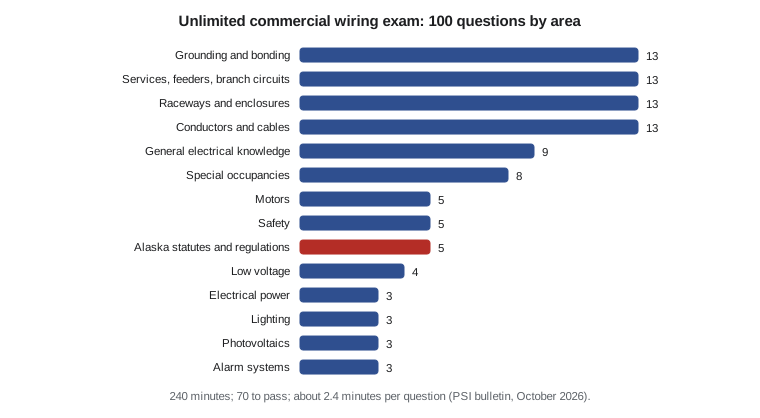
Two features of the outline shape a study plan. First, more than half of the exam, 52 questions, comes from four code areas that a working journeyman uses every day: grounding and bonding, the service and feeder and branch circuit rules, raceways and enclosures, and conductors and cables. A candidate who can find the right article and table quickly in those four areas has most of a passing score. Second, the Alaska statutes and regulations questions, while only five, come from references that most candidates have never read cover to cover, and each one is worth exactly as much as a grounding question.
The residential wiring exam has a similar outline scaled to 75 questions, with ten questions each on grounding and bonding, raceways and enclosures, and conductors and cables, nine on services, feeders and branch circuits, and five on Alaska statutes and regulations, along with smaller groups on lighting, low voltage, alarm systems, photovoltaics, safety and special equipment.
# Pacing for the Alaska unlimited commercial wiring exam
questions, minutes = 100, 240
per_q = minutes / questions
print("Minutes per question:", per_q)

outline = {"Grounding and bonding": 13, "Services, feeders, branch circuits": 13,
           "Raceways and enclosures": 13, "Conductors and cables": 13}
core = sum(outline.values())
print("Questions in the four core areas:", core)
print("Correct answers needed to pass:", 70)
print("Minutes to budget for the core areas:", round(core * per_q))Minutes per question: 2.4 Questions in the four core areas: 52 Correct answers needed to pass: 70 Minutes to budget for the core areas: 125
References allowed in the test center
The commercial exam is open book, but only for the references the bulletin lists. For unlimited commercial wiring, the list is the Alaska Centralized Statutes and Regulations; the Alaska Construction Contractor Statutes and Regulations, AS 08.18 and 12 AAC 21; the Alaska Electrical Administrator Statutes and Regulations, AS 08.40 and 12 AAC 32; the 2020 National Electrical Code; the 2013 edition of NFPA 72, the National Fire Alarm Code; and 29 CFR Part 1926, the federal construction safety standards, either with the latest amendments or in the PSI selections version.
The residential exam's list is similar, with the 2020 National Electrical Code and the 2020 National Electrical Safety Code instead of NFPA 72, along with the same Alaska statutes and regulations and 29 CFR Part 1926. Note the editions. The bulletin names the 2020 NEC, which matches the edition the state has adopted in 8 AAC 70.025, as Lesson 5 explains. Bring the edition the bulletin names, not the newest one on the shelf.
| Reference | Commercial exam | Residential exam |
|---|---|---|
| 2020 National Electrical Code | Yes | Yes |
| 2013 NFPA 72, National Fire Alarm Code | Yes | No |
| 2020 National Electrical Safety Code | No | Yes |
| 29 CFR Part 1926 (OSHA construction) | Yes | Yes |
| AS 08.40 and 12 AAC 32 (administrators) | Yes | Yes |
| AS 08.18 and 12 AAC 21 (contractors) | Yes | Yes |
| Alaska Centralized Statutes and Regulations | Yes | Yes |
The state publishes the administrator and contractor statutes and regulations as free booklets on the division's website, and the centralized statutes and regulations, AS 08.01 to 08.03 and 12 AAC 02, which apply to all professions the division licenses, are published the same way. Tessa printed all three, put them in a binder with tabs and highlighted the sections that answer the questions candidates most often see: categories and scope, the one-contractor rule, the change-of-employer notice, personal inspection, records, discipline, bonds and insurance.
Preparing a code book that passes inspection
Test centers check references before the exam. Bulletins generally allow permanent tabs and highlighting but not loose notes or added written material; read the bulletin's rules on tabs, highlighting and handwriting before you mark your books, because a book that does not meet them may be refused at the door. Tessa used the permanent tabs that come with commercial tab sets for the 2020 NEC, highlighted table titles rather than whole pages, and did not write in the margins. Her binder of Alaska statutes was printed from the state's own booklets and left unmarked except for highlighting and tabs.
The calculator rule is simple: the bulletin allows a silent, nonprinting, non-programmable calculator. A basic scientific calculator with square roots is enough for every calculation on the exam. A phone or a programmable calculator is not allowed.
Three kinds of questions
Looking back over her practice sets, Tessa found that nearly every question fell into one of three kinds, and each kind calls for a different approach.
The first kind is a lookup. The question names a situation, such as the minimum burial depth for a particular wiring method under a driveway, the ampacity of a conductor at a given insulation temperature, or the maximum number of conductors of a given size in a given raceway, and the answer is a value in a table or a single rule. These questions reward a candidate who knows where the table is and reads its title, notes and footnotes before reading the value. Most of the 52 core questions are lookups, and with good tabs they take a minute or two each.
The second kind is a calculation. The question asks for a load, a voltage drop, a conductor size after adjustment and correction, a box fill, or a motor branch circuit rating. Calculations take longer, sometimes five minutes or more, and they combine a lookup with arithmetic. The safest method is to write down each step on the scratch paper the center provides, check the units, and compare the result against the answer choices before committing. When the result is between two choices, reread the question; usually a detail such as a continuous load or an ambient temperature has been missed. The core courses MELU-102 and MELU-103 teach these calculations; this course assumes them.
The third kind is a rule of Alaska law. The question asks who must be notified of a change of employer and how soon, how many contractors one administrator may qualify, which bond amount applies to a specialty contractor, what insurance minimums the contractor statute sets, or what a licensee must do with records of supervised work. These answers are in the state's booklets, and they are quick once the candidate knows which booklet and which section. Tessa's binder had a one-page index on the front listing about thirty Alaska rules with their section numbers, which she built herself from the booklets as she studied.
There is also a fourth, smaller group that does not fit neatly: safety questions answered from 29 CFR Part 1926, and alarm questions answered from NFPA 72. These are worth tabbing even though they are few, because a candidate who has never opened NFPA 72 can lose several minutes simply finding the right chapter.
Remote or on site
The choice between remote testing and a test site is practical, not strategic, but it deserves thought. At a site, the center checks the references, provides scratch paper under its rules and controls the room. Remotely, the candidate supplies the room, the computer, the camera and the internet connection, and the proctor checks the space and the references by camera. A candidate in Bethel or Nome, far from any of the five sites, may have no realistic alternative to remote testing; a candidate with unreliable internet should think hard before choosing it, because a dropped connection in the middle of a four-hour exam is a miserable experience. Read the bulletin's remote testing requirements in full before booking either way.
How to use the references under time pressure
An open book exam rewards navigation, not memory. The fastest candidates know which article governs a topic before they open the book, use the index to find the exact section, and read the whole rule, including exceptions, before they choose an answer. The core courses, especially MELU-101 on code navigation, teach this skill in depth. For Alaska's exam, add one more habit: know which reference a question belongs to. A question about who must notify the division of a change of employer is answered in 12 AAC 32, not the NEC; a question about the minimum bond for a specialty contractor is answered in AS 08.18; a question about guardrails is answered in 29 CFR Part 1926.
Tessa practiced with timed sets of 25 questions, aiming to finish each set in 50 minutes, which left her a cushion of 40 minutes over the full exam for the hardest questions and a final review. She kept a log of every question she missed and which reference would have answered it. After three weeks, the log showed that most of her misses were in special occupancies and alarm systems, areas she rarely works in, so she shifted her study time there.
Common mistakes
MistakeBringing the 2023 NEC because it is newer.
InsteadThe bulletin names the 2020 NEC, the edition the state has adopted.
MistakeSkipping the Alaska statutes because they are only five questions.
InsteadFive questions can be the difference between 68 and 73.
MistakeWriting notes in the margins of the code book.
InsteadFollow the bulletin's rules on tabs, highlighting and writing, or the book may be refused.
MistakeSpending ten minutes on one calculation early.
InsteadAt 2.4 minutes per question, flag it and come back.
MistakeUsing a programmable calculator.
InsteadOnly a silent, nonprinting, non-programmable calculator is allowed.
Summary and key terms
- The unlimited commercial wiring exam has 100 questions in 240 minutes; the residential exam has 75 questions in 180 minutes; all require 70 to pass.
- Four code areas account for 52 of the 100 commercial questions; Alaska statutes and regulations account for 5.
- Allowed commercial references include the 2020 NEC, 2013 NFPA 72, 29 CFR Part 1926 and the Alaska administrator, contractor and centralized statutes and regulations.
- The residential exam allows the 2020 NESC instead of NFPA 72.
- Follow the bulletin's rules on tabs, highlighting and calculators.
- Know which reference answers each kind of question, and pace at about 2.4 minutes per question.
- Content outline
- The bulletin's list of subject areas and how many questions come from each.
- Open book
- An exam in which listed references may be used in the test center.
- Allowed reference
- A book or document the bulletin lists as permitted during the exam.
- NFPA 72
- The National Fire Alarm Code, allowed on the commercial exam in its 2013 edition.
- Pacing
- Planning time per question so the whole exam is finished with time to review.
Practice problems
Work each problem on paper first, then reveal the answer to check.
How many minutes per question does the commercial exam allow on average?
Show answer
2.4 minutes.
Which NEC edition should Tessa bring?
Show answer
The 2020 edition named in the bulletin.
Where would she look to answer a question on the minimum specialty contractor bond?
Show answer
AS 08.18, in the contractor statutes and regulations.
Is NFPA 72 allowed on the residential exam?
Show answer
No; the residential list includes the 2020 NESC instead.
How many correct answers pass the commercial exam?
Show answer
At least 70 of 100.
Lesson quiz · 5 questions
Score 60% or more to complete this lesson.
Create a free account to save your progress, take quizzes and earn a certificate.