
MELU-202 · Lesson 8 of 12 · 18 min
Contractor licensing, insurance and bonding
▶ Video coming soon A video version of this lesson is on the way.
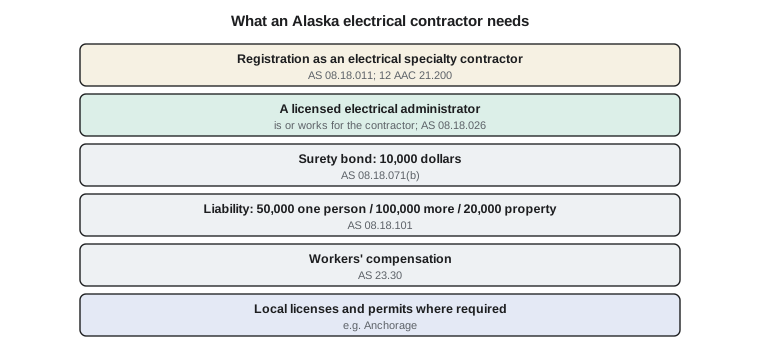
Ruth Ivanoff has run Tanana Ridge's office for twelve years, and every two years she renews a stack of documents that keeps the company legal: its contractor registration, its surety bond, its liability insurance certificate and its proof of workers' compensation coverage. When Tessa becomes the company's administrator, those documents become her concern too, because the administrator license and the contractor registration depend on each other. This lesson covers Alaska's contractor registration law in AS 08.18 and 12 AAC 21 as it applies to electrical contractors: who must register, the administrator requirement, bonds, insurance, workers' compensation, the penalties for working unregistered, and how local programs such as Anchorage's add to the state rules.
Who must register
AS 08.18.011 says a person may not submit a bid or work as a contractor until the department has issued a certificate of registration. It also says a general contractor may not use an unregistered specialty contractor. The contractor statute recognizes several kinds of contractors. A general contractor is one whose work requires more than three trades, or who uses mechanical or specialty contractors and subcontractors under its supervision. A mechanical contractor does plumbing, pipefitting, sheet metal, heating and similar trades. A specialty contractor works in one trade, and 12 AAC 21.200 lists the recognized specialty trades. Electrical contractor is one of them.
So Tanana Ridge is registered as a specialty contractor in the electrical trade. When it works for a general contractor on a school renovation, the general contractor must confirm that Tanana Ridge is registered before using it, and Ruth sends a copy of the current registration with every subcontract.
The administrator requirement
The electrical trade has an extra rule that most specialty trades do not. AS 08.18.026(a) says the department may not issue a registration to an electrical contractor unless the applicant is, or employs, a person currently licensed as an electrical administrator under AS 08.40. 12 AAC 21.310 adds that an electrical contractor may bid and work only on projects for which it has a licensed electrical administrator, which in practice means an administrator licensed in the category the project requires. A company that wants to bid utility distribution work, for example, needs an administrator licensed in unlimited linework.
The requirement runs both ways. The contractor needs the administrator, and, under AS 08.40.130, the administrator can serve only one contractor. If the company loses its only administrator, it loses the basis of its registration and must stop bidding electrical work until it has a new one.
The surety bond
AS 08.18.071 requires each registered contractor to file a surety bond, or an approved substitute, with the department. The bond protects people who deal with the contractor: it is available to pay claims for the contractor's failure to perform a contract, for unpaid wages, for unpaid materials and for similar obligations, within the limits and procedures the statute sets. It is not insurance for the contractor, and claims paid from it can be recovered from the contractor by the surety.
The amounts depend on the kind of registration. Under AS 08.18.071(b), a general contractor's bond is 25,000 dollars; a general contractor with a residential endorsement that does exclusively residential work files a bond of 20,000 dollars; and a mechanical or specialty contractor's bond is 10,000 dollars. A contractor that does a single project with an aggregate contract price of 10,000 dollars or less, not part of a larger operation and not split to avoid the higher bond, may file a bond of 5,000 dollars.
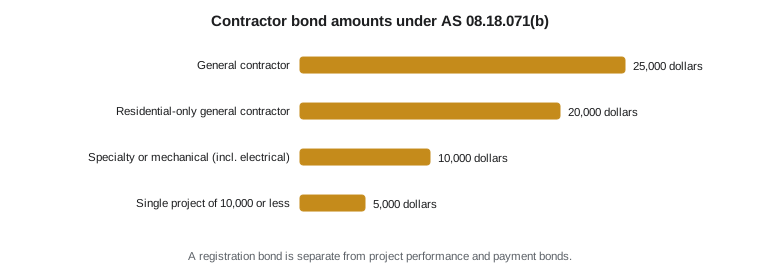
Tanana Ridge files a 10,000-dollar specialty contractor bond. That bond is a registration requirement, and it is much smaller than the performance and payment bonds that owners often require on large projects, which are written for the contract amount. A school district's 2-million-dollar renovation might require the general contractor to post a performance bond and a payment bond for the full contract price, and the general contractor may require its subcontractors, including Tanana Ridge, to post their own. Those project bonds are a matter of contract and public works law, which Lesson 9 covers, not of registration.
Insurance
AS 08.18.101 requires a registered contractor to carry workers' compensation insurance to the extent AS 23.30 requires it, and public liability and property damage insurance with minimums of 20,000 dollars for property damage, 50,000 dollars for injury or death to one person, and 100,000 dollars for injury or death to more than one person. The statute exempts projects with an aggregate contract price of 2,500 dollars or less from the liability insurance requirement.
| Coverage | Statutory minimum under AS 08.18.101 |
|---|---|
| Property damage | 20,000 dollars |
| Injury or death, one person | 50,000 dollars |
| Injury or death, more than one person | 100,000 dollars |
| Workers' compensation | As required by AS 23.30 |
| Small project exemption from liability insurance | Aggregate contract price of 2,500 dollars or less |
Those minimums are low by modern standards, and almost no commercial customer accepts them. Owners, general contractors and public agencies routinely require a million dollars or more of general liability coverage, additional insured endorsements and specific automobile coverage, and the contract sets those terms. Tanana Ridge carries far more than the statute requires. For the exam, though, the statutory numbers are the ones to know.
Workers' compensation
Alaska's workers' compensation act, AS 23.30, requires employers to secure compensation for their employees, by insurance or by approved self-insurance. The contractor statute ties registration to that requirement: a contractor with employees must provide evidence of coverage to register and renew. Lesson 10 covers workers' compensation reporting duties; for registration purposes the point is that a contractor with employees cannot keep its registration without coverage.
Renewal of the registration
AS 08.18.031 says a registration is renewed on the same requirements as the original. Under 12 AAC 21.070, a renewal application includes the fee, a current bond, current liability insurance and evidence of workers' compensation coverage if applicable, and the department may require documents issued no more than 30 days before the application. Under 12 AAC 21.043, a lapsed registration may be reinstated within five years after it expires. The registration period and expiration date should be confirmed on the division's contractor pages; Ruth keeps the date on the company calendar.
Working unregistered
The penalties for contracting without a registration are real. AS 08.18.125 allows an administrative fine of up to 1,000 dollars for a first violation of the registration requirements and up to 1,500 dollars for a second or later violation. AS 08.18.131 allows a civil penalty of up to 1,000 dollars per violation, with each day a separate violation, and AS 08.18.117 lets the department cite violators, with each day after a citation a separate violation. AS 08.18.141 makes a knowing violation after a prior conviction, finding or fine a class B misdemeanor.
The penalty that matters most in practice is in AS 08.18.151. An unregistered person acting as a contractor may not sue in an Alaska court to collect compensation for work or to enforce a contract that requires registration, unless the person proves it was registered when the contract was made. A contractor who lets its registration lapse, even briefly, may find that it cannot collect what it is owed or file a lien, as Lesson 9 explains.
Claims against the bond
When someone has a claim against a contractor, the registration bond is often the first place they look, so an administrator should understand how it works. A customer who says the contractor abandoned a job, a supplier who was not paid for materials, or a worker who was not paid wages may bring a claim within the limits AS 08.18.071 and the related sections set. The bond amount is the most the surety will pay on all claims during the bond's period, not on each claim, so a contractor with several unhappy customers can exhaust a 10,000-dollar bond quickly. When the surety pays, it will ask the contractor to repay it under the indemnity agreement the contractor signed when it bought the bond.
A claim against the bond is also a warning sign that the division and the surety both notice. A surety that has paid claims may cancel the bond or refuse to renew it, and without a bond the registration cannot be renewed. The best protection is the ordinary discipline of a good contractor: clear contracts, prompt payment of suppliers and workers, and finishing what the company starts.
Ruth's renewal file
Every two years, Ruth's renewal file for Tanana Ridge holds the same documents. It has the renewal application for the specialty contractor registration, signed by the owner. It has the surety's continuation certificate showing that the 10,000-dollar bond remains in force. It has a current certificate of liability insurance naming the division as certificate holder and showing at least the statutory minimums, though the company's actual limits are much higher. It has proof of workers' compensation coverage. And it has a copy of the administrator's current license, because the registration depends on it. Because the division may ask for documents issued no more than 30 days before the application, Ruth orders the insurance certificate and the bond continuation in the same week she files.
Residential endorsement
AS 08.18.025 requires a general contractor to hold a residential contractor endorsement before it builds, alters or bids on a privately owned residence of one to four units, or advertises that it does that work. The endorsement requires a residential contractor exam and completion of a cold climate building course, such as the Alaska craftsman home program. The endorsement applies to general contractors. An electrical specialty contractor that wires a house for a general contractor or an owner is working within its specialty trade; whether a particular residential job also requires the endorsement depends on who is acting as the general contractor, and a specialty contractor that takes on general contracting for a house should check the endorsement rules before bidding.
Ruth keeps the company's business license current as well. Alaska requires a state business license for businesses operating in the state, issued by the same division, and the registration and the business license are separate credentials with separate renewals.
Finally, Ruth checks every general contractor and subcontractor Tanana Ridge works with on the division's public license search before signing a contract. A general contractor that is not registered may be unable to pay, and a lower-tier subcontractor that is not registered exposes Tanana Ridge to the rule in AS 08.18.011 against using unregistered specialty contractors.
Local licensing
Some municipalities add their own contractor requirements. Anchorage's building code, for example, describes electrical contractors as licensed by both the state and the municipality and requires them to be registered as, or employ, an electrical administrator licensed under AS 08.40. The local requirements, fees and forms are set by the municipality and change from time to time. Before Tanana Ridge bids a job in Anchorage, Ruth checks the municipality's current contractor requirements and the permit rules, in addition to the state registration.
Common mistakes
MistakeThinking the 10,000-dollar bond covers the contractor's own losses.
InsteadA contractor's bond protects people who deal with the contractor; the surety can recover from the contractor.
MistakeRegistering as a general contractor to do only electrical work.
InsteadElectrical contractor is a specialty trade under 12 AAC 21.200.
MistakeBidding linework with only a commercial wiring administrator.
Instead12 AAC 21.310 limits bids to projects for which the contractor has a licensed administrator in the right category.
MistakeLetting the registration lapse during a slow month.
InsteadAS 08.18.151 can bar suits to collect for work done while unregistered.
MistakeAssuming the statutory insurance minimums satisfy customers.
InsteadContracts commonly require much higher limits.
Summary and key terms
- AS 08.18.011 requires registration before bidding or working as a contractor; electrical contractor is a specialty trade.
- AS 08.18.026 requires an electrical contractor to be or employ a licensed electrical administrator.
- Bonds under AS 08.18.071(b): general 25,000, residential-only general 20,000, specialty 10,000, single small project 5,000 dollars.
- Insurance under AS 08.18.101: 20,000 property damage, 50,000 one person, 100,000 more than one person, plus workers' compensation.
- Unregistered work brings fines and, under AS 08.18.151, can bar suits to collect.
- Municipalities such as Anchorage may add local contractor requirements.
- Certificate of registration
- The state document that allows a contractor to bid and work under AS 08.18.
- Specialty contractor
- A contractor registered for one trade listed in 12 AAC 21.200.
- Surety bond
- A bond filed with the department that pays valid claims against the contractor up to its amount.
- Residential endorsement
- The added credential a general contractor needs for one-to-four-unit residential work.
- Additional insured
- A party, such as an owner, added to the contractor's liability policy by endorsement.
Practice problems
Work each problem on paper first, then reveal the answer to check.
What bond must Tanana Ridge file as an electrical specialty contractor?
Show answer
10,000 dollars.
A homeowner hires an unregistered handyman for a 30,000-dollar rewiring job and refuses to pay. Can the handyman sue?
Show answer
Generally not; AS 08.18.151 bars suits by an unregistered contractor on contracts that require registration.
What is the minimum liability coverage for injury to more than one person?
Show answer
100,000 dollars.
Tanana Ridge's only administrator retires with no replacement. Can it keep bidding electrical work?
Show answer
No; it must be or employ a licensed administrator.
A one-time project of 8,000 dollars, not part of a larger operation. What bond may apply?
Show answer
A 5,000-dollar bond under AS 08.18.071(b).
Lesson quiz · 5 questions
Score 60% or more to complete this lesson.
Create a free account to save your progress, take quizzes and earn a certificate.