
MELU-202 · Lesson 5 of 12 · 18 min
The NEC as adopted in Alaska and local amendments
▶ Video coming soon A video version of this lesson is on the way.
Tanana Ridge's newest job is a two-story clinic addition in North Pole, a few miles southeast of Fairbanks. Before Tessa prices the electrical work, she needs to know which code applies to it. In Alaska that question has two layers. The state has adopted the National Electrical Code as its statewide minimum, and a small number of municipalities have adopted their own electrical codes, with local amendments, for work inside their boundaries. This lesson explains both layers: what the state has adopted and how, what the state has and has not amended, how local adoption works, and how to decide which code governs a particular job.
How the state adopts the code
The authority comes from the Alaska Statutes. AS 18.60.580 provides that once the American National Standards Institute approves a new edition of the National Electrical Code or the National Electrical Safety Code, the Department of Labor and Workforce Development may adopt it by regulation. The adoption itself is in the Alaska Administrative Code at 8 AAC 70.025.
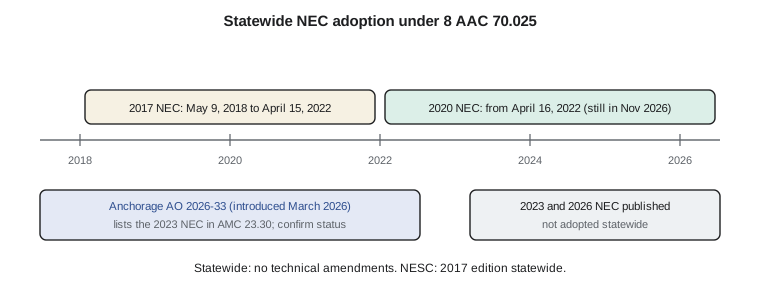
Under 8 AAC 70.025(a), the 2020 edition of NFPA 70, the National Electrical Code, is the minimum electrical code for the state and is adopted by reference. The regulation's history notes show that the 2020 edition took effect on April 16, 2022, replacing the 2017 edition, which had been in force since May 2018. Under 8 AAC 70.025(b), the 2017 edition of the National Electrical Safety Code, ANSI C2-2017, is the state's minimum electrical safety standard. The Mechanical Inspection Section's home page, checked in November 2026, still lists the 2020 NEC and the 2017 NESC as the codes it enforces.
So as of this writing, the statewide electrical code in Alaska is the 2020 NEC, even though NFPA published the 2023 edition and has since published the 2026 edition. The state adopts on its own schedule, and its schedule has run several years behind NFPA's. A contractor who prices a job to a newer edition than the state enforces is not violating anything, since the state code is a minimum, but he may be spending money the customer did not need to spend. A contractor who prices to an older edition than the one in force is building a problem.
No statewide technical amendments
Many states adopt the NEC and then amend it, changing specific sections to suit local conditions. Alaska's statute allows that: AS 18.60.590(a) lets the department adopt amendments by regulation. But 8 AAC 70.025 adopts the 2020 NEC by reference without a list of technical changes, and the earlier regulations that once held state amendments were repealed decades ago. On the statewide level, then, the code is the NEC as published, with no Alaska modifications to its technical rules.
That is why this lesson's title speaks of local amendments. The catalog for this series originally described the topic as the NEC as adopted in Alaska and state amendments. For Alaska the accurate description is that the state adopts the NEC without technical amendments and that the amendments a contractor actually meets are local ones, adopted by municipalities under the authority described next.
The state code does contain some scope rules in its own regulations. 8 AAC 70.035 says the electrical code does not apply to maintenance, but that replacing conduit, other wiring methods or conductors is installation, not maintenance. AS 18.60.640 says the state standards apply to new installations and to alterations of existing installations, and that they are recommended minimums for all new structures in the state. Those rules matter for enforcement, but they do not change any NEC section.
Local adoption
AS 18.60.590(b) says the state's electrical code provisions do not limit the power of a municipality or a rural electrification association to set standards for its own area by ordinance, rule or order, so long as those standards are no less stringent than the state's. That sentence is the foundation of every local electrical code in Alaska.
The Municipality of Anchorage adopts its electrical code in chapter 23.30 of the Anchorage Municipal Code, which adopts the NEC by reference and then lists local amendments numbered to match the NEC sections they change. An ordinance introduced to the Anchorage Assembly in March 2026, AO 2026-33, would repeal and reenact the municipality's Title 23 building code chapters and lists the 2023 NEC in chapter 23.30. Whether and when that ordinance took effect should be confirmed with the municipality before relying on it, but it shows the pattern: a large municipality can move to a newer edition than the state, because a newer edition is no less stringent.
The City of Fairbanks adopts the NEC in chapter 10 of its city code. Its ordinances over the years have adopted the 2014 edition and later the 2020 edition, each with local amendments. The city's building department issues permits and inspects within city limits. The clinic in North Pole, however, is outside the City of Fairbanks, so the city's amendments do not apply to it; the state code, the 2020 NEC as published, sets the minimum there. The City of North Pole's own rules, if any, should be checked separately.
| Where the job is | Code that sets the minimum | Who to ask |
|---|---|---|
| Inside the Municipality of Anchorage | Anchorage's adopted NEC with AMC 23.30 amendments | Anchorage Development Services |
| Inside the City of Fairbanks | Fairbanks's adopted NEC with city amendments | City of Fairbanks Building Department |
| Inside another city with a building department | That city's adopted code, no less stringent than the state's | That city's building official |
| Outside any local program | The state code: 2020 NEC under 8 AAC 70.025 | Mechanical Inspection, Labor and Workforce Development |
| Utility distribution work | The NESC as adopted (2017 statewide) | The utility and Mechanical Inspection |
How a new edition reaches Alaska
A new statewide edition does not arrive automatically. After ANSI approves a new NEC, the department must go through the state's regulation process to amend 8 AAC 70.025: it publishes a notice of proposed changes, takes public comment, adopts the final regulation, and files it with the Lieutenant Governor, after which the regulation takes effect on the date the notice states. Proposed and adopted regulations are posted on the state's online public notice system and on the department's regulations page. An administrator who wants advance warning of a code change should watch those notices, and the trade associations that offer code update classes usually announce changes as soon as they are proposed.
When a change does come, the transition matters to jobs already in progress. The regulation's effective date tells you when the new edition becomes the minimum, but it does not by itself say how a job designed or permitted under the old edition is treated. Local building departments usually tie the edition to the date of the permit application. Where there is no permit, the safest course is to build to the edition in force when the work is installed and to state the edition clearly in the contract, so that any added cost from a change is handled openly.
Reading a local amendment
Local amendments are written to be read alongside the NEC. Anchorage's chapter numbers its amendments to match the NEC sections they change, so an amendment to a section of Article 210 appears under the same article and section number in AMC 23.30. An amendment may add a requirement, delete one, or replace a section entirely. The only safe way to use a local code is to read the NEC section and the local amendment together, and to note on the drawings or in the job file which amendments affect the work. When Tanana Ridge bids an Anchorage job, Tessa pulls the current chapter from the municipality's website rather than relying on a printed copy, because chapters are repealed and reenacted when the municipality moves to a new edition.
Cold climate is a common reason for local amendments in northern jurisdictions, for example in rules on service equipment location, heat tape and engine block heater receptacles, or snow and ice loads on service masts. This course does not list any municipality's current amendments, because they change with each adoption; the point is to know that they exist and where to find them.
Rural electrification associations and utilities
AS 18.60.590(b) also names rural electrification associations. Much of rural Alaska is served by electric cooperatives and small utilities, and some have service rules that affect how a customer's installation must be built before the utility will connect it, such as meter location, service entrance requirements or inspection before energizing. Lesson 6 covers the inspection side. For code purposes, the point is that a utility's requirements are an additional layer on the customer side of the service point; they must be at least as stringent as the state code and do not replace it.
Which edition the exam uses
The PSI bulletin names the 2020 NEC as the reference for the commercial and residential administrator exams, matching the edition the state has adopted. The exam tests the published edition, not any local amendments. A candidate who works mostly in Anchorage, and who has learned a local amendment by heart, should answer exam questions from the published 2020 NEC, and should be careful not to answer from memory of a local change.
Putting it together for the clinic
For the North Pole clinic, Tessa confirms that the site is outside the City of Fairbanks and that no other local electrical code applies. The state code, the 2020 NEC as published, sets the minimum. The building's owner, a regional health nonprofit, has its own design standards that ask for some features beyond the code, such as additional receptacle circuits in exam rooms, and the engineer of record has drawn the job to those standards. Tessa's estimate states that the price is based on the 2020 NEC and the drawings, a clause Lesson 9 will return to. If the state adopts a newer edition before the permit or start of work, the change will be handled as a change order rather than a loss.
Tessa also notes that a clinic is a health care facility, so NEC Article 517 governs much of the work, along with the general chapters. The core course MELU-106 covers Article 517 in depth; for this job, she reviews the sections on patient care spaces and the essential electrical system with the engineer before ordering equipment.
One last check concerns the fire alarm. The clinic's fire alarm system will be designed and installed to the fire code the State Fire Marshal enforces, which references NFPA 72, and the electrical code's own fire alarm article, Article 760, governs the wiring. That is one reason NFPA 72 appears on the commercial exam's reference list: an administrator in Alaska is expected to know where the wiring rules end and the alarm standard begins, even if a specialty subcontractor does the alarm work.
Common mistakes
MistakeAssuming Alaska enforces the newest NEC.
InsteadThe state code under 8 AAC 70.025 is the 2020 NEC until the department adopts a newer edition.
MistakeLooking for a list of Alaska state amendments.
InsteadThe state adopts the NEC by reference without technical amendments; amendments are local.
MistakeApplying City of Fairbanks amendments outside city limits.
InsteadLocal amendments apply only inside the adopting municipality.
MistakeAnswering exam questions from a local amendment.
InsteadThe exam tests the published edition the bulletin names.
MistakeTreating maintenance and replacement the same way.
Instead8 AAC 70.035 excludes maintenance but treats replacing conduit or conductors as installation.
Summary and key terms
- AS 18.60.580 lets the department adopt new NEC and NESC editions after ANSI approval.
- 8 AAC 70.025 adopts the 2020 NEC, effective April 16, 2022, and the 2017 NESC as statewide minimums.
- The state adopts the NEC without technical amendments; amendments come from municipalities.
- AS 18.60.590(b) lets municipalities and rural electrification associations adopt standards no less stringent than the state's.
- Anchorage adopts the NEC in AMC 23.30 with local amendments; the City of Fairbanks adopts it in its city code.
- The administrator exams test the published 2020 NEC.
- Adopted by reference
- Made part of the law by naming a published document rather than reprinting it.
- Minimum code
- The least stringent standard allowed; local codes and owners may require more.
- Local amendment
- A change to an NEC section adopted by a municipality for its own area.
- NESC
- The National Electrical Safety Code, which governs utility and linework installations.
- Rural electrification association
- An electric cooperative or similar body that AS 18.60.590(b) allows to set standards for its area.
Practice problems
Work each problem on paper first, then reveal the answer to check.
Which NEC edition sets the minimum for the North Pole clinic?
Show answer
The 2020 NEC under 8 AAC 70.025, as published.
Can Anchorage adopt the 2023 NEC while the state is on 2020?
Show answer
Yes; a newer edition is no less stringent, which AS 18.60.590(b) allows.
Where would Tessa find Anchorage's local electrical amendments?
Show answer
In Anchorage Municipal Code chapter 23.30.
A crew replaces a run of damaged conduit and conductors. Is that maintenance?
Show answer
No; 8 AAC 70.035 treats it as installation.
Which edition should Tessa answer from on the exam?
Show answer
The 2020 NEC named in the bulletin.
Lesson quiz · 5 questions
Score 60% or more to complete this lesson.
Create a free account to save your progress, take quizzes and earn a certificate.