
MELU-202 · Lesson 6 of 12 · 18 min
Permits, inspections and the inspection authority
▶ Video coming soon A video version of this lesson is on the way.
In many states, every electrical job begins with a permit and ends with a final inspection by a state or city inspector. Alaska is more varied. Inside the Municipality of Anchorage, the City of Fairbanks and the other places with their own building departments, the familiar permit and inspection cycle applies. Across most of the rest of the state, there is no local building department and no routine electrical permit, and enforcement rests on the state's authority to inspect places of employment and public structures, on utilities' inspections before energizing, and on the administrator's own duty to inspect the work. This lesson explains each of these and how an administrator manages them.
The state's inspection authority
AS 18.60.600 gives the Department of Labor and Workforce Development authority to adopt regulations to carry out the electrical code and to inspect electrical wiring in any place of employment or public structure in the state. AS 18.60.660 defines public structures broadly, to include hotels, multi-unit rental housing, restaurants and places built for public assembly. The Mechanical Inspection Section's electrical inspectors use that authority to inspect installations, respond to complaints and enforce the code where no local program does.
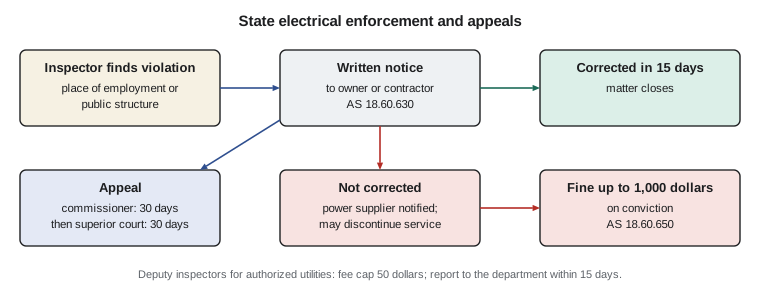
When an authorized inspector finds a violation, AS 18.60.630 requires written notice to the owner or the contractor. If the violation is not corrected within 15 days, the inspector notifies the power supplier, and the supplier may discontinue service to the installation. That is a serious consequence for a business or a public building, and in practice the 15-day notice is a strong incentive to fix problems quickly. AS 18.60.650 adds a criminal penalty: a person who installs wiring that does not comply and fails to correct it after written notice may be fined up to 1,000 dollars on conviction.
Deputy inspectors and utility inspections
Because the state cannot send an inspector to every job in a state the size of Alaska, the statutes let others inspect on its behalf. AS 18.60.610 allows the commissioner to authorize a utility, corporation or similar entity to inspect wiring before it is energized. Under 8 AAC 70.040, an application for that authorization is made on the employer's letterhead and includes the inspector's name, experience and certificate of fitness number; approved applicants are appointed as deputy electrical inspectors. Under 8 AAC 70.060, authorized inspections must be reported to the department within 15 days, with the owner, installer, premises, violations observed and fee charged. Under 8 AAC 70.070, the fee for an authorized inspection or reinspection may not exceed 50 dollars.
If an installation fails an authorized inspection, AS 18.60.610 lets the installer appeal for a new inspection by a designee not connected with the original inspection, to be made within 15 days. That protects a contractor from being held hostage by a single inspector's reading of the code.
Whether a particular utility in a particular area actually inspects before energizing, and on what kinds of services, varies, and this course could not confirm a current statewide list. Before starting work in a new service area, Ruth calls the utility and asks what it requires before it will connect a new or altered service.
Local permits and inspections
Inside a municipality with a building department, the local permit cycle applies in addition to the state rules. In Anchorage, the municipal code defines a trade permit as an official document issued by the building official to permit electrical, mechanical or plumbing work, and it requires an electrical contractor to be registered as, or employ, an electrical administrator licensed under AS 08.40. The City of Fairbanks building department issues electrical permits within city limits and inspects under the city's adopted code. Other cities with building departments run similar programs.
A typical local cycle follows the order of the work. The contractor applies for the permit before starting, with plans if the department requires them. Inspections follow the stages of construction: underground or slab work before it is covered, rough-in before walls are closed, service before the utility connects, and final when the job is complete. Each department sets its own stages, request procedures and fees, and each publishes them. Work covered before inspection may have to be uncovered at the contractor's expense.
| Setting | Who inspects | What triggers it |
|---|---|---|
| Municipality with a building department | Local building official's inspectors | Permit issued for the job; staged inspections |
| Place of employment or public structure anywhere | Mechanical Inspection electrical inspectors | Department inspection, often on complaint or referral |
| Area served by an authorized utility or entity | Deputy electrical inspector | Inspection before energizing |
| Any job a contractor does | The electrical administrator | Personal inspection duty under AS 08.40.195 |
Working where no one issues a permit
Much of Tanana Ridge's work outside Fairbanks is in places with no local building department: lodges, mine camps, village clinics and school additions in communities reached by air or river. On those jobs there is no permit to pull and often no inspector who will visit. That does not mean the code does not apply. The state code under 8 AAC 70.025 sets the minimum everywhere, the department may inspect any place of employment or public structure, and the administrator's certification under 12 AAC 32.903 vouches for the work whether or not anyone else looks at it.
Arne's practice on those jobs is to treat the administrator's inspection as if it were the only inspection, because it often is. He uses a written checklist organized by the stages a local inspector would use: underground or slab work before cover, rough-in before walls close, service before energizing, and final. Each stage is signed and dated by the foreman and checked by the administrator, with photographs of anything that will be concealed. When the utility serving the community inspects before connecting, the utility's report goes in the same file. If a dispute arises years later, that file shows exactly what was built and who checked it.
Owners on remote jobs sometimes ask whether the work can skip a step because no one will check. The answer is always no, and Tessa intends to say so in writing. The administrator's certification is a statement under state law that the work meets the code; a shortcut on a job no one inspects is still a false certification.
Plan review and the fire marshal
Building plans for many commercial and public buildings in Alaska are reviewed for fire and life safety by the State Fire Marshal's office, or by local building departments that the Fire Marshal recognizes. That review is about the building and fire codes, not the electrical code as such, but it often includes fire alarm and emergency systems that affect the electrical design. For a project like the North Pole clinic, the engineer of record handles plan review; the administrator's job is to build what the approved plans show and to coordinate any changes back through the engineer.
The administrator's own inspection
The most important inspection on many Alaska jobs is the one the law requires the administrator to make. AS 08.40.195 says an electrical administrator who is responsible for an installation or repair, or for certifying that it complies with the code, must personally inspect the work when it is completed. The exception is simple or highly standardized work of less than 24 man-hours that is performed under general supervision. Under 12 AAC 32.903, completing work under an administrator's license certifies that the work and materials meet the applicable codes and standards, and the administrator must keep signed records of the supervised work and produce them on request for at least three years after certification.
For a remote job where no local inspector or utility inspector will ever look at the wiring, the administrator's inspection is the only one. Arne made a point of flying out to every Tanana Ridge job outside the road system before final, even when it meant a day on a small plane, and Tessa intends to do the same. The record of that inspection, signed and dated, is what protects the company if a problem surfaces years later.
When the state inspector arrives
A state electrical inspection on a commercial job usually comes without much notice, often after a complaint or a referral from another agency. The inspector identifies himself, explains why he is there and asks to see the work. The foreman's job is to cooperate, to call the administrator, and to show the inspector what he asks to see. He should be able to name the company's administrator and show his own certificate of fitness, and each worker doing code work should be able to show his. The inspector may ask who is supervising trainees and how many there are; the crew plan should answer that question at a glance.
After the walkthrough, the inspector may leave with no findings, give a verbal correction to be confirmed in writing, or issue a written notice. Whatever happens, the foreman writes it down the same day, with the inspector's name, the time, the areas inspected and anything said. Tessa wants that note in the job file before the end of the shift, because it starts the clock if a notice follows.
If the inspector asks for documents, such as the crew list or the administrator's records, the foreman should provide what the job file holds and tell the inspector that the administrator will follow up on anything else. Records that are complete and easy to find tell an inspector more about a company than any explanation can, and they are what the administrator would have to produce on request under 12 AAC 32.903 in any case.
Corrections and appeals
When a state inspector issues a notice, the contractor's first move should be to understand it. A notice that cites a specific NEC section and describes the condition is easy to evaluate. If the contractor agrees, it corrects the work within the 15 days and documents the correction with photographs and a note to the inspector. If it disagrees, 8 AAC 70.075 provides the appeal: a department inspection notice is final unless appealed to the commissioner in writing within 30 days, and the commissioner's decision may be appealed to the superior court within 30 days.
Local programs have their own appeal procedures, usually to a board of appeals created by the local building code. The deadlines and forms differ, so the notice itself, or the local code, is the place to look.
An appeal is not a way to delay a correction the contractor knows is needed. Arne's rule was simple: if the inspector is right, fix it the same week and thank him; if the inspector is wrong, say so politely, show the code section, and appeal only if the conversation goes nowhere. In thirty years he appealed twice.
Common mistakes
MistakeAssuming every Alaska job needs a local electrical permit.
InsteadPermits are issued only where a local building department exists; elsewhere the state code still applies.
MistakeIgnoring a state violation notice.
InsteadAfter 15 days the inspector notifies the power supplier, which may discontinue service.
MistakeMissing the 30-day appeal window.
InsteadA department notice becomes final unless appealed to the commissioner within 30 days.
MistakeSkipping the administrator's final inspection on a remote job.
InsteadAS 08.40.195 requires personal inspection except for small standardized work under 24 man-hours.
MistakeDiscarding job records after final.
Instead12 AAC 32.903 requires keeping signed records for at least three years after certification.
Summary and key terms
- AS 18.60.600 lets the department inspect wiring in any place of employment or public structure.
- A violation notice gives 15 days to correct; after that the power supplier is notified and may disconnect.
- Failing to correct after notice can bring a fine of up to 1,000 dollars under AS 18.60.650.
- Utilities and similar entities may be authorized to inspect before energizing; their fees are capped at 50 dollars and inspections reported within 15 days.
- Local building departments in Anchorage, Fairbanks and elsewhere issue permits and inspect in stages.
- The administrator must personally inspect completed work and keep signed records for three years.
- Place of employment
- Any workplace, where the state may inspect electrical wiring under AS 18.60.600.
- Public structure
- A building such as a hotel, rental housing, restaurant or assembly place, as defined in AS 18.60.660.
- Deputy electrical inspector
- A person employed by an authorized entity and appointed to inspect wiring before energizing.
- Violation notice
- The written notice an inspector gives the owner or contractor, starting the 15-day correction period.
- Personal inspection
- The administrator's own inspection of completed work required by AS 08.40.195.
Practice problems
Work each problem on paper first, then reveal the answer to check.
A state inspector issued a notice on November 2. When does the 15-day correction period end?
Show answer
November 17.
Tanana Ridge disagrees with a department notice dated November 2. What is the deadline to appeal?
Show answer
Within 30 days, in writing to the commissioner.
What is the most an authorized deputy inspector may charge for an inspection?
Show answer
50 dollars under 8 AAC 70.070.
A two-hour receptacle replacement under general supervision. Must Tessa inspect it personally?
Show answer
Not necessarily; simple standardized work under 24 man-hours is excepted.
How long must Tessa keep signed records of supervised work?
Show answer
At least three years after certification.
Lesson quiz · 5 questions
Score 60% or more to complete this lesson.
Create a free account to save your progress, take quizzes and earn a certificate.