
MELU-202 · Lesson 3 of 12 · 18 min
Applying, approval and booking the exam
▶ Video coming soon A video version of this lesson is on the way.
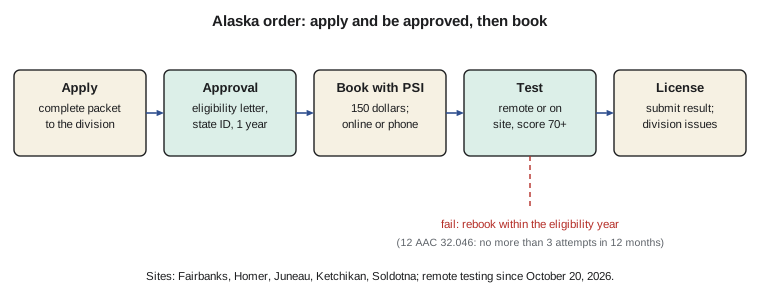
In some states a candidate books a national exam first and applies for a license with the score report afterward. Alaska works the other way around for electrical administrators. The licensing division's exam information page says a candidate must submit a complete application, with supporting documentation, before registering for the exam, and must obtain the state's approval before taking it. This lesson walks through that sequence as Tessa lived it: the application, the eligibility letter, booking with the testing company, test day logistics, and what happens after a pass or a fail.
Step one: the application
Tessa downloaded the electrical administrator application from the Division of Corporations, Business and Professional Licensing in July 2026. The application asks for the category being sought, the applicant's identity and contact information, and the experience that qualifies her under 12 AAC 32, documented on the division's verification forms and signed by the people who supervised or employed her. It also asks the background questions the division uses to decide whether there is any reason to deny or condition a license, and it requires the application fee set in 12 AAC 02. Fees change, so Ruth checked the current fee schedule on the division's website rather than relying on an old copy of the form.
The most common reason an application stalls is incomplete experience documentation. The division needs to see that the applicant meets one of the routes in 12 AAC 32.145, with dates and hours, and it may ask for more evidence. Tessa included her journeyman certificate number for every period she claimed, which let the division match her claimed experience to the Mechanical Inspection records. She mailed the packet in early August.
Building the packet
Ruth keeps a checklist for license applications, because Tanana Ridge has sent several over the years and learned which gaps cause delays. The checklist is not a state form; it is the company's own way of making sure the state's form is complete before it goes in the mail.
| Packet item | Why it matters |
|---|---|
| Current application form for the right category | Old versions may ask for different information or fees |
| Application fee from the current schedule | Fees are set by regulation and change |
| Experience verification for each employer and period | The division must see qualifying years within the window |
| Certificate of fitness numbers for each period | Lets the division match claimed journeyman experience to state records |
| Answers to every background question | A blank answer is treated as incomplete |
| Copies of everything sent | Needed if the packet is lost or the division asks a question |
The background questions deserve care. AS 08.40.170 lets the department refuse to issue a license for a fraudulent or misleading application, among other grounds. An applicant who has had a license disciplined elsewhere, or who has a conviction the form asks about, should answer truthfully and attach any explanation the form allows. A truthful answer that the division can evaluate is far better than a false one that it discovers later, which is itself a ground for refusing or revoking the license.
Finally, a candidate should think about timing before mailing. Because the passing result must be within the twelve months before the license application, and the eligibility letter lasts a year, a candidate who applies and then waits many months to test is spending her own margin. Tessa applied only when she was ready to study seriously, so the clock started when it would do her the most good.
One more practical point concerns mail and email. The division communicates by the contact information on the application, and an eligibility letter sent to an old address is no help. Tessa used her home address and personal email rather than the company's, because the license will be hers, not Tanana Ridge's, and she wanted every notice from the division to reach her directly. Ruth keeps a copy of the letter in the company file so the office knows when the eligibility window closes.
Step two: approval and the eligibility letter
When the division approved the application, it sent Tessa an examination eligibility letter. The testing company's candidate bulletin explains what the letter does. It contains instructions for scheduling and a state-assigned identification number that the candidate must use when booking. The letter is valid for one year from its date. If the candidate does not pass within that year, she must apply to the state again.
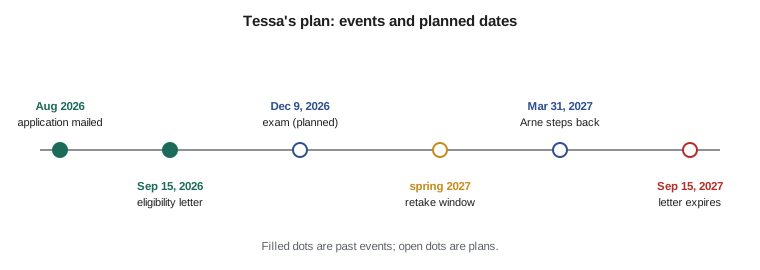
Tessa's letter was dated September 15, 2026, so her eligibility runs to September 15, 2027. That gives her room for a retake if she needs one, and it fits Arne's plan to step back at the end of March 2027. She decided to book an exam date far enough out to finish her review, but early enough that a second attempt would still leave months before Arne leaves.
Step three: booking with PSI
The state's exams for electrical administrators are delivered by PSI. The candidate bulletin, updated in October 2026, explains how to schedule. A candidate can register and pay online at any time through PSI's website, or by telephone during PSI's business hours with a credit card. The exam fee is 150 dollars per registration, whether the exam is a first attempt or a retake. The fee is not refundable or transferable and is valid for one year from payment.
Since October 20, 2026, the bulletin offers a choice between remote online testing and testing at a PSI site. The licensing division's exam page lists on-site testing centers in Fairbanks, Homer, Juneau, Ketchikan and Soldotna, and notes that the Anchorage site at the University of Alaska Anchorage has closed, with Soldotna as the interim alternative. For Tessa the Fairbanks site is a short drive, and she prefers to test in person with her own code book on the desk. A candidate in a remote community, where the nearest site may be a flight away, may find the remote option far more practical.
| Item | What the bulletin or division page says |
|---|---|
| Order of steps | Apply and be approved by the state before booking |
| Eligibility letter | Contains a state identification number; valid one year |
| Exam fee | 150 dollars per registration, nonrefundable, valid one year from payment |
| Ways to book | Online at any time, or by telephone with a credit card |
| Where to test | Remote online, or on site in Fairbanks, Homer, Juneau, Ketchikan or Soldotna |
| Rescheduling | Give notice at least two days before the exam to avoid losing the fee; voicemail does not count |
| Identification | Valid, unexpired, with photo and signature, matching the name used to book |
Rescheduling, identification and test day
The bulletin requires notice at least two days before the exam date to cancel or reschedule without forfeiting the fee, and it says a voicemail message is not an acceptable form of cancellation. A candidate who simply misses the appointment loses the fee and must pay again to rebook.
On test day, the candidate must present identification that is valid and unexpired, carries a photo and signature, and matches the name used to schedule. A name mismatch is a common and avoidable problem: a candidate who booked under a nickname or a maiden name may be turned away. Tessa booked under the name on her driver's license, which is also the name on her eligibility letter.
For the exam itself, the bulletin lists the references a candidate may bring into the test center, and it allows a silent, nonprinting, non-programmable calculator. Lesson 4 covers the references and the format. Remote testing has its own technical and room requirements, which the bulletin describes; a candidate choosing that option should run the system check well before exam day.
After the exam
If Tessa passes, the testing company reports the result, and the division's exam page says examination results must be submitted to the division and are valid for one year. 12 AAC 32.015 requires a passing score of 70 on a department-approved exam taken within the twelve months before the license application, so the score has a shelf life. Once the division has the passing result and everything else it needs, it issues the license. The license is effective when issued, not when the exam is passed, so Tessa should not begin acting as Tanana Ridge's administrator until she has it in hand.
If she does not pass, she can retake. The bulletin says a candidate cannot schedule a new exam on the same day she tested, gives an example in which a candidate who fails on a Wednesday calls on Thursday and retests as early as Friday, and says a candidate may retake an unlimited number of times within the one-year eligibility period, paying the fee each time. 12 AAC 32.046, however, says an applicant may not take an exam more than three times within a twelve-month period. The two sources do not agree on their face. A careful candidate plans on no more than three attempts in a year and asks the division if a fourth ever becomes necessary.
# Tessa's eligibility window (the letter is valid one year from its date)
from datetime import date

letter = date(2026, 9, 15)
expires = date(letter.year + 1, letter.month, letter.day)
exam = date(2026, 12, 9)
handover = date(2027, 3, 31)
print("Eligibility expires:", expires)
print("Days from exam to handover:", (handover - exam).days)
print("Days from exam to expiry:", (expires - exam).days)Eligibility expires: 2027-09-15 Days from exam to handover: 112 Days from exam to expiry: 280
The arithmetic shows why Tessa booked in December. If she passes, the division has more than three months to issue her license before Arne steps back. If she does not, she has time for at least one more attempt before the handover and a further margin before her eligibility letter expires.
A candidate who fails should read the score report closely. It shows performance by content area, which tells her where to spend the time before the next attempt. Booking the retake the next morning, without changing anything, rarely changes the result.
Changing categories or adding one later
An administrator who later wants to add a category, such as residential wiring or controls, follows the same path for that category. Under 12 AAC 32.032 she submits the information the division requires to show she qualifies and passes that category's exam. The categories are separate licenses on one record, not a ladder; holding unlimited commercial wiring does not mean a licensee has passed, or may claim, the linework category.
Common mistakes
MistakeBooking the PSI exam before applying to the state.
InsteadThe division requires a complete application and approval before the candidate can register.
MistakeLeaving a voicemail to cancel two days out.
InsteadThe bulletin says voicemail is not an acceptable cancellation.
MistakeLetting the eligibility letter expire.
InsteadThe letter is valid one year; after that the candidate must apply again.
MistakeActing as administrator the day after passing.
InsteadThe license is effective when the division issues it.
MistakePlanning on unlimited retakes.
Instead12 AAC 32.046 limits attempts to three within twelve months; confirm with the division before planning more.
Summary and key terms
- In Alaska the candidate applies to the licensing division and is approved before booking the administrator exam.
- The eligibility letter carries a state identification number and is valid for one year.
- PSI delivers the exam; the fee is 150 dollars per registration, and testing is remote or at sites in Fairbanks, Homer, Juneau, Ketchikan and Soldotna.
- Reschedule at least two days ahead; bring valid photo identification that matches the booking name.
- Passing results go to the division and are valid for one year; the license is issued by the division.
- 12 AAC 32.046 limits attempts to three in twelve months, even though the bulletin describes unlimited retakes.
- Examination eligibility letter
- The state's approval to schedule the exam, with an identification number, valid one year.
- Candidate bulletin
- The testing company's document describing exam content, references, fees and procedures.
- Remote online testing
- Taking the exam from a private location under online supervision instead of at a test site.
- Retake
- A repeat attempt after a failed exam, which requires a new registration and fee.
- Results validity
- The one-year period in which a passing result can be used to obtain the license.
Practice problems
Work each problem on paper first, then reveal the answer to check.
Tessa's letter is dated September 15, 2026. When must she pass?
Show answer
By September 15, 2027, or she must apply again.
Can Tessa book her exam before the division approves her application?
Show answer
No; she needs the eligibility letter and its identification number first.
Tessa needs to move her exam date four days before the exam. How should she do it?
Show answer
Contact PSI online or by a live call; at least two days' notice avoids losing the fee, and voicemail does not count.
Which on-site test center is closest for a Fairbanks candidate?
Show answer
The Fairbanks site.
Tessa passed. Can she sign permits as administrator that afternoon?
Show answer
No; she must wait until the division issues the license.
Lesson quiz · 5 questions
Score 60% or more to complete this lesson.
Create a free account to save your progress, take quizzes and earn a certificate.