
MELU-202 · Lesson 1 of 12 · 18 min
How electrical licensing works in Alaska
▶ Video coming soon A video version of this lesson is on the way.
Tessa Moberly has worked in the electrical trade in Fairbanks for eleven years. She started in 2015 as a registered apprentice with a union training program, logged her hours on commercial jobs around the Interior, and in 2019 passed the state journeyman exam and received her Electrician Journeyman Certificate of Fitness from the Alaska Department of Labor and Workforce Development. Since then she has run crews for Tanana Ridge Electric, LLC, a sixteen-person contractor on the east side of Fairbanks that wires schools, clinics, shops and the occasional gold mine camp. The company's owner, Arne Solheim, has been its licensed electrical administrator since 1998. Arne plans to step back on March 31, 2027, and the company cannot keep bidding electrical work without someone licensed to take his place. Tessa has agreed to become that person.
That decision put Tessa on the path this course follows: earning an Alaska electrical administrator license in the unlimited commercial wiring category. In August 2026 she sent her application to the state licensing division, and in September she received her examination eligibility letter. Her exam is booked for December 9, 2026. Over the next twelve lessons we will follow her preparation, and Arne's handover, through every part of the license path and the business and law topics the exam covers.
This is the Alaska course in the HSM University master electrician exam prep series. The core courses, MELU-101 through MELU-107, teach the National Electrical Code skills that every master-level exam tests: navigating the code, load calculations, conductors and overcurrent protection, grounding and bonding, motors and transformers, special occupancies, and business and law. This course adds what is specific to Alaska: the two state agencies, the license categories, the exam and its references, the code the state has adopted, inspections, contractor registration, liens, workplace safety and renewal.
Two cautions apply to every lesson. First, licensing rules change. The facts in this course were checked in November 2026 against the Alaska Statutes, the Alaska Administrative Code, the licensing division's electrical administrator pages and forms, the Mechanical Inspection pages of the Department of Labor and Workforce Development, and the current testing company bulletin. Where a detail could not be confirmed from a primary source, the lesson says so and tells you what to check. Second, this course teaches the rules; it does not replace them. Before you rely on a number, read the current statute, regulation or bulletin yourself.
Why Alaska uses the word administrator
Most states call their top electrical license a master electrician license. Alaska does not. Its top license is the electrical administrator license, issued under Alaska Statutes chapter 08.40 and the regulations in 12 AAC 32. The name tells you what the license is for. An electrical administrator is the person who takes responsibility for electrical work done by a contractor: supervising it, certifying that it meets the code and answering for it to the state. The license is about responsibility and supervision. It is not, by itself, a license to pick up tools.
That surprises many people moving to Alaska from other states. The Mechanical Inspection pages say plainly that the electrical administrator license does not permit code work. A person who wants to install wiring personally needs a certificate of fitness from the Department of Labor and Workforce Development, such as the Electrician Journeyman Certificate of Fitness that Tessa already holds. Many administrators, like Tessa and Arne, hold both: a certificate of fitness that lets them do the work and an administrator license that lets them be responsible for a company's work. Some administrators, such as electrical engineers who manage construction, hold only the administrator license.
Two agencies, two sets of rules
Electrical regulation in Alaska is split between two state departments, and knowing which one does what is the first thing the exam expects you to know.
The Department of Commerce, Community, and Economic Development, through its Division of Corporations, Business and Professional Licensing, licenses electrical administrators under AS 08.40 and 12 AAC 32. The same division registers construction contractors under AS 08.18 and 12 AAC 21, including electrical contractors. When Tessa applies for her administrator license, renews it, reports a change of employer or answers a complaint about her supervision, she deals with this division.
The Department of Labor and Workforce Development, through the Mechanical Inspection Section of its Division of Labor Standards and Safety, issues certificates of fitness to the people who do the work, under AS 18.62 and 8 AAC 90. It also administers the state's electrical code under AS 18.60.580 to AS 18.60.660 and the regulations in 8 AAC 70, and it has authority to inspect electrical wiring at places of employment and public structures. When Tessa renews her journeyman certificate, or when a state inspector finds a violation on one of Tanana Ridge's jobs, she deals with this department. The same department runs Alaska Occupational Safety and Health, the state's workplace safety program, which we cover in Lesson 10.
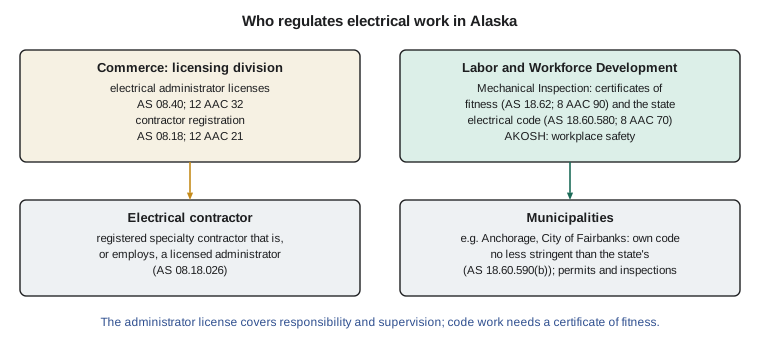
| Credential or rule | Issued or enforced by | Main law |
|---|---|---|
| Electrical administrator license | Division of Corporations, Business and Professional Licensing | AS 08.40; 12 AAC 32 |
| Electrical contractor registration | Division of Corporations, Business and Professional Licensing | AS 08.18; 12 AAC 21 |
| Certificates of fitness (journeyman, residential wireman, power lineman, trainee) | Mechanical Inspection, Department of Labor and Workforce Development | AS 18.62; 8 AAC 90 |
| State electrical code (NEC and NESC) | Mechanical Inspection, Department of Labor and Workforce Development | AS 18.60.580 to 18.60.660; 8 AAC 70 |
| Workplace safety | Alaska Occupational Safety and Health | AS 18.60; 8 AAC 61 |
The contractor and the administrator
The link between the two licensing systems is the contractor. Alaska requires anyone who bids or works as a contractor to hold a certificate of registration under AS 08.18.011. An electrical contractor registers as a specialty contractor, and AS 08.18.026 says the division may not issue that registration unless the applicant is, or employs, a person currently licensed as an electrical administrator under AS 08.40. Under 12 AAC 21.310 an electrical contractor may bid and work only on projects for which it has a licensed electrical administrator. In other words, the administrator is what makes an electrical contractor legal.
That is why Arne's retirement matters so much to Tanana Ridge. If the company's only administrator leaves and no one replaces him, the registration loses its foundation. Under 12 AAC 32.920 an administrator must tell the division in writing within 15 days when his employer or company affiliation changes, and AS 08.40.130 allows an administrator to qualify for only one registered contractor at a time. Tessa will become the company's administrator before Arne leaves, so there is no gap.
Six license categories
AS 08.40.045 lets the department set categories for electrical administrator licenses, and 12 AAC 32 establishes six. Each category has its own experience requirements, its own exam and its own scope. A licensee may work only in a category for which she is licensed, under AS 08.40.090(b), and may add a category later by meeting its requirements and passing its exam, under 12 AAC 32.032.
| Category | What it covers |
|---|---|
| Unlimited commercial wiring | Inside wiring under the National Electrical Code; may also supervise inside communications, residential wiring and controls work |
| Residential wiring | Dwellings of no more than three stories and no larger than a four-plex, single-phase only |
| Unlimited linework | Outside distribution systems to the primary side of transformers, with poles, towers and outdoor substations |
| Outside communications | Telephone, cable television and similar systems outside buildings |
| Inside communications | Telephone, cable television and intercom work inside buildings |
| Controls and control wiring | Low-voltage controls of 48 volts or less for heating, cooling and similar equipment; applicant must also hold a mechanical administrator license |
Tanana Ridge wires commercial and institutional buildings, so Tessa needs the unlimited commercial wiring category, the one that corresponds most closely to a master electrician license in other states. The residential wiring category is narrower: under 12 AAC 32.235 it covers dwellings of no more than three stories and no more than four units on a common foundation, and it excludes three-phase services and wiring. The linework and communications categories are tested against the National Electrical Safety Code as well as, or instead of, the National Electrical Code, depending on the category.
Choosing the category is the first real decision for a candidate, because it fixes which experience counts, which exam she takes and what work she may later supervise. Tessa considered whether to sit for the residential wiring exam as well, since Tanana Ridge occasionally wires a duplex for a long-time customer. Arne pointed out that the unlimited commercial wiring category already allows supervision of residential wiring work, so a second exam would add nothing for the company. A contractor that wanted to move into utility distribution or telecommunications, on the other hand, would need an administrator licensed in the linework or communications categories, and a single person can hold several categories if she qualifies for each.
Where local government fits
Alaska is a large state with a small population and very few local building departments. Most of the state is outside any municipal building code program. The state electrical code applies statewide as a minimum, and AS 18.60.590(b) lets a municipality or rural electrification association adopt its own standards for its area, so long as they are no less stringent than the state's. The Municipality of Anchorage and the City of Fairbanks both run building departments that adopt the National Electrical Code by local ordinance, issue electrical permits and inspect. Some other cities, such as Juneau, also have building departments; outside those, there is often no local electrical permit at all.
Local programs do not replace the state credentials. Anchorage's code, for example, requires an electrical contractor to be registered as, or employ, an electrical administrator licensed under AS 08.40, and requires journeymen to hold a state certificate of fitness. A local program can add requirements, such as a municipal contractor license, permits and fees, but it builds on the state system rather than replacing it.
What this course covers
Lesson 2 covers eligibility for the unlimited commercial wiring and residential wiring categories and how hours are counted. Lesson 3 walks through applying, approval and booking the exam. Lesson 4 covers the exam format and the references allowed. Lessons 5 and 6 cover the code Alaska has adopted and how inspections and enforcement work. Lesson 7 covers the administrator's duties. Lesson 8 covers contractor registration, insurance and bonding. Lesson 9 covers contracts and mechanics' liens. Lesson 10 covers workplace safety and workers' compensation. Lesson 11 covers renewal and continuing education. Lesson 12 brings it together in a practice exam review and a test-day plan.
Throughout, the course treats Tanana Ridge as a realistic small Alaska contractor. Its office manager, Ruth Ivanoff, handles registrations, bonds and insurance certificates. Its senior foreman, Cal Jessup, runs the field crews and the trainees. Arne, the retiring administrator, is the person with the history. The people and the company are invented; the rules they work under are real.
Common mistakes
MistakeThinking the administrator license lets you do wiring yourself.
InsteadCode work requires a certificate of fitness from Labor and Workforce Development; the administrator license covers responsibility and supervision.
MistakeApplying to Labor and Workforce Development for the administrator license.
InsteadAdministrator licenses come from the Division of Corporations, Business and Professional Licensing in Commerce.
MistakeAssuming every Alaska town issues electrical permits.
InsteadMost of the state has no local building department; permits are local only where a municipality runs a program.
MistakeTreating the residential category as covering any dwelling.
InsteadIt is limited to three stories, four units and single-phase work.
MistakeQualifying two companies with one administrator license.
InsteadAS 08.40.130 allows one registered contractor at a time.
Summary and key terms
- Alaska's top electrical license is the electrical administrator license under AS 08.40 and 12 AAC 32.
- The administrator license covers responsibility and supervision; code work requires a certificate of fitness under AS 18.62.
- Commerce licenses administrators and registers contractors; Labor and Workforce Development issues certificates of fitness, enforces the state electrical code and runs AKOSH.
- An electrical contractor must be, or employ, a licensed electrical administrator under AS 08.18.026.
- There are six administrator categories; unlimited commercial wiring is the broadest inside-wiring category.
- Municipalities may adopt standards no less stringent than the state's; Anchorage and the City of Fairbanks issue permits and inspect.
- Electrical administrator
- The person licensed under AS 08.40 to take responsibility for and supervise electrical work done by a contractor.
- Certificate of fitness
- The credential from Labor and Workforce Development that allows a person to perform electrical code work.
- Specialty contractor
- A contractor registered under AS 08.18 for one trade, such as electrical work.
- License category
- One of the six fields, such as unlimited commercial wiring, for which an administrator may be licensed.
- Mechanical Inspection Section
- The part of Labor and Workforce Development that issues certificates of fitness and administers the electrical code.
Practice problems
Work each problem on paper first, then reveal the answer to check.
Which agency will issue Tessa's administrator license?
Show answer
The Division of Corporations, Business and Professional Licensing in the Department of Commerce, Community, and Economic Development.
Can Tessa install wiring personally once she is an administrator?
Show answer
Only because she also holds a journeyman certificate of fitness; the administrator license alone does not allow code work.
Why does Tanana Ridge need an administrator to keep its registration?
Show answer
AS 08.18.026 requires an electrical contractor to be or employ a licensed electrical administrator.
Which category fits a contractor that wires schools and clinics?
Show answer
Unlimited commercial wiring.
May the City of Fairbanks adopt electrical rules stricter than the state's?
Show answer
Yes; AS 18.60.590(b) allows local standards that are no less stringent than the state's.
Lesson quiz · 5 questions
Score 60% or more to complete this lesson.
Create a free account to save your progress, take quizzes and earn a certificate.