
MELU-202 · Lesson 10 of 12 · 18 min
Workplace safety law and OSHA for electrical contractors
▶ Video coming soon A video version of this lesson is on the way.
Two winters ago a Tanana Ridge apprentice slipped on an icy ladder at a job site in Fairbanks, fell about six feet and broke his wrist. He made a full recovery, but the incident taught Ruth and Arne how many separate clocks start running after a work injury in Alaska: a report to the safety agency in some cases, a report to the workers' compensation division in every case that involves a claimed injury, entries in the injury log, and the employee's own notice. This lesson covers who enforces workplace safety in Alaska, the safety rules that matter most to electrical contractors, the reporting deadlines, and the workers' compensation rules an administrator should know.
Alaska runs its own program
Unlike states where private employers fall under federal OSHA, Alaska operates a state plan approved by federal OSHA. The program is Alaska Occupational Safety and Health, AKOSH, in the Department of Labor and Workforce Development's Division of Labor Standards and Safety. Under the Alaska Occupational Safety and Health Act, in AS 18.60, and the regulations in 8 AAC 61, AKOSH sets and enforces safety and health standards for most private and public employers in the state. A state plan must be at least as effective as federal OSHA; Alaska largely adopts the federal standards by reference and adds some state requirements.
Some workplaces in Alaska remain under federal OSHA jurisdiction rather than AKOSH, such as federal agencies and certain maritime and federal enclave work. The exact boundaries are set out in the jurisdictional agreements between AKOSH and federal OSHA, and a contractor working on a military base, a federal facility or a vessel should confirm which agency has jurisdiction before the job starts.
For an electrical contractor the practical result is that the construction standards in 29 CFR Part 1926, as adopted in Alaska, and the general industry standards in Part 1910 where they apply, are enforced by state inspectors who issue state citations. The PSI bulletin lists 29 CFR Part 1926 as an allowed reference on the administrator exams, and the exam's safety questions are drawn from it.
The rules that matter most for electrical work
Electrical contractors face the same hazards on every job: electric shock and arc flash, falls, struck-by and caught-in hazards, trenching, and, in Alaska, cold. The construction standards address each of them. Subpart K of Part 1926 covers electrical safety in construction, including ground-fault protection for temporary power, the condition of cords and tools, and lockout and tagging of circuits. Subpart M covers fall protection, Subpart X covers ladders and stairways, Subpart P covers excavations, and Subpart V covers power transmission and distribution work.
| Hazard | Where the rule is | Typical requirement |
|---|---|---|
| Shock from temporary power | 29 CFR 1926 Subpart K | Ground-fault protection or an assured equipment grounding program |
| Working on energized parts | Subpart K and NFPA 70E | De-energize and lock out unless justified; qualified workers and protective equipment |
| Falls from heights | Subpart M | Fall protection at the heights the standard sets for construction |
| Ladders | Subpart X | Proper ladder type, setup and use; nonconductive side rails near energized parts |
| Trenches | Subpart P | Protective systems for excavations at the depths the standard sets |
| Overhead lines and distribution work | Subpart V and clearance rules | Minimum approach distances and qualified workers |
NFPA 70E, the Standard for Electrical Safety in the Workplace, is not itself an OSHA regulation, but it is the consensus standard employers use to meet OSHA's general requirements for electrical safety: deciding when work on or near energized equipment is justified, performing shock and arc flash risk assessments, establishing approach boundaries and choosing protective equipment. Tanana Ridge's written safety program follows 70E, and Cal trains every new hire on it before the first job.
Cold is Alaska's particular hazard. Ice on ladders and walking surfaces, reduced dexterity, frozen ground for trenching and short daylight all change how work must be planned. No single standard governs cold work, but the general duty to provide a workplace free of recognized hazards applies. Tanana Ridge's winter rules include traction devices on boots, ladder footing checks every morning, warm-up breaks, and a buddy rule for any work outdoors below a set temperature.
Reporting serious incidents to AKOSH
AKOSH's reporting rule is stricter than the federal one. Under federal OSHA, an employer must report a work-related fatality within 8 hours and an inpatient hospitalization, amputation or loss of an eye within 24 hours. AKOSH's page says that incidents involving a death, an inpatient hospitalization, an amputation or the loss of an eye must all be reported to AKOSH within 8 hours. The page lists a business-hours number and an after-hours number. An Alaska employer that waits 24 hours to report an amputation, as a federal employer may, has reported late.
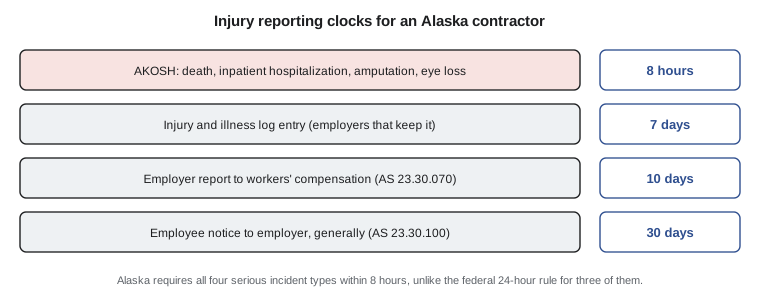
Employers with more than ten employees in most industries, construction among them, must also keep the injury and illness log and summary under the recordkeeping rules, entering a recordable case within seven calendar days of learning of it and posting the annual summary. Tanana Ridge, with sixteen employees, keeps the log; Ruth enters cases and posts the summary each February.
Inspections, citations and consultation
AKOSH inspectors may inspect a workplace in response to a complaint, a referral, a serious incident or a planned inspection program. An inspection usually starts with an opening conference, continues with a walkaround of the site, and ends with a closing conference. If the inspector finds violations, AKOSH issues citations with proposed penalties and abatement dates, and the employer may contest them under the state's procedures, which include review by the Alaska Occupational Safety and Health Review Board.
AKOSH also runs a consultation and training program that offers free, confidential help identifying and fixing hazards. The program's consultants do not issue citations or penalties. For a small contractor, a consultation visit before a big job is an inexpensive way to find problems before an inspector does. Tanana Ridge requested one before its first mine camp job and changed its temporary power setup as a result.
A written safety program is the backbone of all of this. Tanana Ridge's program names who is responsible for safety on each job, sets out the lockout, energized work, fall protection, ladder, excavation and cold weather rules, requires a short safety meeting at the start of every week on every crew, and describes how incidents are reported and investigated. New hires read it and sign for it before their first shift, and Cal updates it every winter.
Training records matter as much as the program. When an AKOSH inspector asks whether a worker was trained on lockout or fall protection, the answer that counts is a dated, signed training record, not a foreman's memory. Ruth keeps those records with each employee's file.
Workers' compensation
Alaska's Workers' Compensation Act, AS 23.30, requires employers to secure compensation for employees who are injured or become ill in the course of employment, through insurance or approved self-insurance. As Lesson 8 noted, a contractor with employees must show coverage to register.
AS 23.30.070 requires the employer to report to the workers' compensation division within 10 days from the date the employer has knowledge of an injury or death, or of a disease or infection, that is claimed to have arisen out of and in the course of employment. The report gives the employer's and employee's names and addresses, the employee's occupation, the cause and nature of the injury, the date, time and location, and anything else the division requires. The penalties for not reporting are significant. If the employer fails to file, the time limits for the employee's claim do not begin to run until the report is filed, and the board may require an additional award equal to one fifth of the amounts that were unpaid when due.
The employee has a duty too. AS 23.30.100 requires notice of an injury to the employer, generally within 30 days, with exceptions the statute describes. In practice, Tanana Ridge asks every worker to report any injury, however small, the same day, and Ruth files the employer's report well inside the 10 days.
When the apprentice broke his wrist, the timeline worked like this. He was treated at the emergency room and released the same day, so there was no inpatient hospitalization and no 8-hour AKOSH report; a broken bone is not an amputation. Ruth entered the case in the injury log within seven days because it involved days away from work, and she filed the employer's report of injury with the workers' compensation division within the 10 days. The insurer handled the claim. Cal reviewed the ladder setup with every crew the next morning.
Lockout and energized work in practice
Most serious electrical injuries happen when someone works on equipment that was supposed to be dead and was not, or chose to work it live without a real reason. Tanana Ridge's written program follows the logic of Subpart K and NFPA 70E. Work is done de-energized unless de-energizing would create a greater hazard or is infeasible because of equipment design or operational limits; inconvenience is not a reason. Before work, the circuit is identified from current drawings, the disconnect is opened, locked and tagged by each worker who will be exposed, and the absence of voltage is verified with a tester that has been checked on a known source before and after.
When energized work is justified, such as testing and troubleshooting, the program requires a qualified worker, a risk assessment for shock and arc flash, the protective equipment the assessment calls for, and a second person nearby for anything beyond simple measurement. Cal keeps a log of energized work permits, and Tessa reviews it monthly. An administrator who reads that log learns quickly whether crews are using the exceptions as intended or as a shortcut.
Temporary power deserves its own mention. On a winter job, cords run through snow, across frozen ground and into heated enclosures, and damage is common. The ground-fault protection rules for temporary power in Subpart K exist for exactly this setting, and Tanana Ridge uses ground-fault protection on all temporary receptacle circuits, inspects cords at the start of each shift, and removes damaged cords from service the same day.
The administrator's role
Safety is the employer's legal duty, but the administrator is responsible for the work, and unsafe work is rarely code-compliant work. An administrator who sees a crew working on energized equipment without justification, or a trainee on a roof without fall protection, has both a safety problem and a supervision problem. Tessa plans to make safety part of every personal inspection: not only whether the installation meets the code, but whether it was built safely.
Common mistakes
MistakeAssuming private Alaska employers are under federal OSHA.
InsteadAlaska runs a state plan, AKOSH, for most private and public employers.
MistakeReporting an amputation within 24 hours.
InsteadAKOSH requires all four serious incident types within 8 hours.
MistakeFiling the employer's injury report after two weeks.
InsteadAS 23.30.070 requires it within 10 days of knowledge.
MistakeTreating NFPA 70E as optional because it is not a regulation.
InsteadIt is the standard employers use to meet OSHA's electrical safety duties.
MistakeIgnoring cold as a hazard.
InsteadThe general duty to address recognized hazards applies to ice, cold and darkness.
Summary and key terms
- Alaska operates a state plan, AKOSH, under AS 18.60 and 8 AAC 61, largely adopting the federal standards.
- 29 CFR Part 1926, as adopted, governs construction safety; Subparts K, M, P, V and X matter most to electrical contractors.
- AKOSH requires reports of fatalities, inpatient hospitalizations, amputations and loss of an eye within 8 hours.
- Recordable cases go in the injury log within seven calendar days for employers that must keep it.
- The employer reports an injury to the workers' compensation division within 10 days of knowledge under AS 23.30.070.
- AKOSH consultation is free and does not lead to citations.
- State plan
- A workplace safety program run by a state with federal OSHA approval.
- AKOSH
- Alaska Occupational Safety and Health, the state plan agency.
- NFPA 70E
- The consensus standard for electrical safety in the workplace.
- Recordable case
- A work injury or illness that must be entered in the injury and illness log.
- Employer's report of injury
- The report AS 23.30.070 requires within 10 days of knowledge of a claimed work injury.
Practice problems
Work each problem on paper first, then reveal the answer to check.
A worker's finger is amputated on a Tanana Ridge job at 9 a.m. By when must AKOSH be notified?
Show answer
By 5 p.m. the same day, within 8 hours.
Ruth learns of a claimed back injury on November 3. By when must the employer's report be filed?
Show answer
Within 10 days, by November 13.
Which agency inspects a private Fairbanks job site for fall protection?
Show answer
AKOSH.
Will an AKOSH consultation visit lead to a citation?
Show answer
No; consultants do not issue citations or penalties.
What happens to the employee's claim deadlines if the employer never files its report?
Show answer
They do not begin to run until the report is filed.
Lesson quiz · 5 questions
Score 60% or more to complete this lesson.
Create a free account to save your progress, take quizzes and earn a certificate.