
MELU-202 · Lesson 11 of 12 · 17 min
Renewal and continuing education
▶ Video coming soon A video version of this lesson is on the way.
Arne has renewed his administrator license fourteen times, and he has never let it lapse. That is not luck. Alaska gives no grace period on administrator licenses, and the renewal form says plainly that it is illegal to work once a license has lapsed. This lesson covers the administrator license cycle, the fees, the continuing education requirement and how to report it, what happens when a license lapses, and the separate renewal rules for certificates of fitness, which Tessa must keep current at the same time. It ends with what Alaska's rules mean for licensees who move between states.
The administrator license cycle
The licensing division's renewal form, revised in October 2025, says electrical administrator licenses are issued for a two-year period and expire on December 31 of odd-numbered years. The current period runs from January 1, 2026, to December 31, 2027. Every administrator license in the state expires on the same day, regardless of when it was first issued.
That fixed date has a consequence for new licensees. Tessa's license, if issued in early 2027, will expire on December 31, 2027, after less than a year. The form addresses this with two fee levels: 170 dollars for licenses first issued on or before December 31, 2024, and a prorated 85 dollars for licenses first issued on or after January 1, 2025. Fees are set in 12 AAC 02 and change, so check the current form before each renewal; the numbers here are the ones on the October 2025 form.
Continuing education for administrators
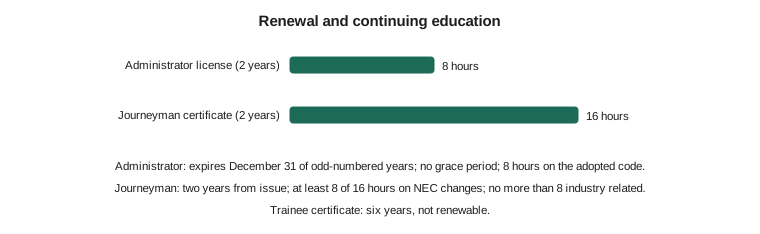
AS 08.40.135 conditions renewal on proof of continued competency, and 12 AAC 32.315 defines what that means. An administrator must complete at least one eight-hour continuing education workshop, or an equivalent number of hours through an approved correspondence or individual study program, during the license period. The subject is the code for the licensee's category: the National Electrical Code adopted under AS 18.60.580 for the inside communications, unlimited commercial wiring, controls and residential wiring categories, and the National Electrical Safety Code for the outside communications and linework categories. Under 12 AAC 32.365, a more recent edition approved by ANSI may be accepted at the department's discretion.
There is one waiver. Under 12 AAC 32.315(a), the requirement is waived if the licensee passed a licensing exam based on the relevant code during the period. If Tessa passes her exam on December 9, 2026, inside the current period, she will not need separate continuing education hours to renew in December 2027, though many administrators take a code update course anyway.
Approved providers are listed in 12 AAC 32.325. Workshops given by organizations such as the Department of Labor and Workforce Development, NECA, NFPA, IEEE and the IBEW are considered approved if they cover the required code edition; other providers need the division's approval. 12 AAC 32.345 requires the licensee's continuing education record to include the sponsor, location, title, instructor, dates and hours, and falsifying the record is grounds for discipline.
Reporting on the renewal form
The renewal form asks the licensee to certify compliance by checking one of two boxes. The first certifies that the licensee completed the continuing education, or passed a licensing exam, during the period that is ending, and agrees to provide documentation if audited. The second is for a licensee who completed some or all of the hours after the period ended but before submitting the renewal; that licensee must attach the certificates, and under 12 AAC 02.965 hours used this way cannot be counted again for the next period. The division audits a sample of renewals, so keep the certificates even when the form does not ask for them.
| Item | Electrical administrator license | Electrician journeyman certificate of fitness |
|---|---|---|
| Issued by | Licensing division, Commerce | Mechanical Inspection, Labor and Workforce Development |
| Period | Two years, ending December 31 of odd-numbered years | Two years from the date of issue |
| Renewal fee | 170 dollars, or 85 dollars prorated for licenses first issued from 2025 (October 2025 form) | 200 dollars |
| Continuing education | One 8-hour workshop on the adopted code, or equivalent | 16 hours in the preceding 24 months, at least 8 on NEC changes, no more than 8 industry related |
| Grace period | None; working on a lapsed license is illegal | May renew up to 90 days before expiration |
| Lapse | Reinstate with competency proof and fees; retake exam after two years lapsed | Renew without reexamination within two years after expiration |
When a license lapses
Because there is no grace period, an administrator whose license lapses on December 31 may not act as an administrator on January 1, and the contractor whose registration depends on that license is suddenly without its administrator. AS 08.40.135(b) allows a lapsed license to be reinstated with proof of competency and payment of the unpaid fees and any penalty fee under AS 08.01.100. If the license has been lapsed for more than two years, the person must pass the exam again.
Ruth starts Tanana Ridge's renewal process in October of every odd year. She checks each administrator's continuing education certificates, completes the form with the administrator, and mails or files it online before Thanksgiving, so that any question from the division can be answered before December 31.
A lapse also has consequences outside the licensing division. The contractor's registration depends on a licensed administrator, so a lapse can put the registration at risk. Work done while the administrator is unlicensed may be challenged by an owner who does not want to pay, and a general contractor that discovers the lapse may stop using the company until it is fixed. A few hours of attention each October in an odd year avoid all of that.
Renewal is also the moment to update the division's records. If an administrator's address, name or employer has changed, the renewal is not a substitute for the notices the rules require at the time of the change, but it is a good time to confirm that everything on file is current.
Certificates of fitness
Tessa's journeyman certificate of fitness has its own cycle, set by the Mechanical Inspection Section. A journeyman certificate is valid for two years from the date it was issued. Renewal costs 200 dollars, and under 8 AAC 90.192 it requires 16 hours of approved continuing education in the 24 months before renewal, at least 8 of them on significant NEC changes or updates and no more than 8 industry related. A certificate holder may apply to renew up to 90 days before expiration, and under 8 AAC 90.180 a certificate may be renewed without reexamination if renewal is requested within two years after it expires. Residential wireman and power lineman certificates renew on a two-year cycle without the 16-hour continuing education requirement listed for journeymen. Trainee certificates last six years and are not renewable, though the holder may apply again.
Because the two credentials renew on different schedules, Tessa will have two renewal dates to track: her administrator license every December 31 of an odd year and her certificate of fitness on the anniversary of its issue every two years. A single code update course can often count toward both if it covers the adopted NEC and is approved by both agencies; she checks before enrolling.
Choosing continuing education that counts
Not every class an electrician takes will satisfy the administrator requirement. The hours must be on the code for the licensee's category, and they must come from an approved provider or be approved by the division. A class on estimating, business management or general construction safety may be valuable, but it is not a code workshop under 12 AAC 32.315. For a commercial wiring administrator, the most efficient choice is a code update course on the adopted NEC, offered by one of the organizations listed in 12 AAC 32.325.
The journeyman certificate has its own definitions. Under 8 AAC 90.192, at least 8 of the 16 hours must cover significant NEC changes or updates, and no more than 8 may be industry related. The regulations define industry related narrowly and exclude some topics, such as general construction safety. Before enrolling, Tessa asks the provider whether the course is approved for both the administrator license and the journeyman certificate and keeps the provider's written confirmation with the certificate of completion.
A renewal calendar
Ruth keeps one calendar for every credential the company depends on. For Tessa, it will show the administrator license expiring December 31, 2027, with a reminder in October; her journeyman certificate expiring two years after its last renewal, with a reminder 90 days ahead; the company's contractor registration, bond and insurance renewals; and Anchorage's municipal contractor license, if the company keeps one. Each entry lists the continuing education hours required, the hours completed so far and where the certificates are filed. A calendar like that is unglamorous, but it is the reason Arne never let a license lapse.
Continuing education as a habit
The minimum requirement for administrators is small: eight hours over two years. Arne treats it as a floor. Every time the state adopts a new NEC edition, he takes a full code change course, and every winter he spends a few evenings reading the articles that matter most to the work Tanana Ridge has booked for the next season. He also attends the code update sessions that the department and the trade associations hold when a new edition is proposed, because they are the best early warning of what will change. Tessa plans to follow the same habit, and to bring Cal and the senior journeymen along, since their certificates require 16 hours anyway and the company benefits when everyone reads the code the same way.
Moving between states
Alaska's rules differ by credential. For journeymen, the Mechanical Inspection Section announced that from August 8, 2025, Alaska accepts electrician journeyman reciprocity applications from other U.S. states and jurisdictions without a mutual agreement, issuing a two-year reciprocal certificate that is renewable as a journey-level certificate and does not depend on keeping the out-of-state license. A worker with a valid out-of-state license can also get a provisional certificate under 8 AAC 90.112, valid for one year or until the out-of-state license expires, but a provisional holder may not supervise trainees.
For administrators, there are no reciprocity agreements. As Lesson 2 explained, AS 08.40.120(b) lets the department waive the exam for an applicant licensed in another state with a substantially equivalent exam, verified directly by that state, but the waiver is discretionary. An Alaska administrator moving to another state should expect to qualify under that state's rules; some states accept the Alaska exam or experience, and others do not.
Common mistakes
MistakeWorking on January 2 while the renewal is in the mail.
InsteadThere is no grace period; a lapsed administrator license may not be used.
MistakeAssuming a new license lasts two full years.
InsteadAll administrator licenses expire December 31 of odd-numbered years.
MistakeCounting late hours toward the next period too.
InsteadHours used to cure a late renewal cannot be reused under 12 AAC 02.965.
MistakeTaking only 8 hours to renew a journeyman certificate.
InsteadThe certificate requires 16 hours, at least 8 on NEC changes.
MistakeLetting a provisional certificate holder supervise trainees.
InsteadProvisional holders may not supervise trainees.
Summary and key terms
- Administrator licenses run two years and expire December 31 of odd-numbered years, with no grace period.
- Renewal requires one 8-hour workshop on the adopted code or equivalent, waived if the licensee passed a licensing exam in the period.
- The October 2025 form lists 170 dollars, or 85 dollars prorated for licenses first issued from 2025.
- A license lapsed more than two years requires a new exam under AS 08.40.135(b).
- Journeyman certificates run two years from issue and require 16 hours, at least 8 on NEC changes, and a 200-dollar fee.
- Journeyman reciprocity is broad since August 2025; administrator reciprocity does not exist, though an exam waiver is possible.
- Renewal period
- The two-year period for which an administrator license is issued.
- Continued competency
- The proof of continuing education required for renewal under AS 08.40.135.
- Prorated renewal
- A reduced renewal fee for a license first issued partway through a period.
- Reinstatement
- Restoring a lapsed license by proving competency and paying fees.
- Reciprocal certificate
- A journeyman certificate issued on the strength of an out-of-state license.
Practice problems
Work each problem on paper first, then reveal the answer to check.
Tessa's license is issued in February 2027. When does it first expire?
Show answer
December 31, 2027.
Tessa passed her exam in December 2026. Does she need 8 hours of continuing education to renew in December 2027?
Show answer
No; the requirement is waived if she passed a licensing exam on the code during the period.
Arne's license lapsed for three years. What must he do to come back?
Show answer
Prove competency, pay fees and pass the exam again.
How many continuing education hours does a journeyman certificate renewal require?
Show answer
16 hours in the preceding 24 months, at least 8 on NEC changes.
A Montana master electrician moves to Anchorage. Can she become an administrator without the exam?
Show answer
Only if the department grants a discretionary waiver under AS 08.40.120(b).
Lesson quiz · 5 questions
Score 60% or more to complete this lesson.
Create a free account to save your progress, take quizzes and earn a certificate.