
MELU-202 · Lesson 12 of 12 · 17 min
Practice exam review and test-day strategy
▶ Video coming soon A video version of this lesson is on the way.
Three weeks before her exam, Tessa sat down at Tanana Ridge's conference table with her code books, her binder of Alaska statutes and regulations, a calculator and a timer, and took a full 100-question practice exam in 240 minutes. She scored 66. Arne, who had scored in the low sixties on his own first practice test in 1998, was not worried. A practice exam is a measuring tool, not a verdict, and the most useful thing about a 66 is that it shows exactly where the missing points are. This lesson covers how to review practice tests, how to plan the last weeks, how to pace the real exam and what to do on test day.
Reviewing a practice test
The value of a practice test is in the review. Tessa used a simple method that works for any open book exam. For every question she missed or guessed, she wrote down four things: the content area from the bulletin's outline, the reference that answers it, the exact section or table, and the reason she missed it. The reasons fall into a few groups: she could not find the rule in time; she found the wrong rule; she found the right rule but misread it or missed an exception; she made an arithmetic error; or she simply did not know the topic.
Each kind of miss has a different fix. If she could not find the rule, the fix is better tabs and more index practice. If she found the wrong rule, the fix is learning which article governs which topic. If she misread the rule, the fix is slowing down and reading the whole section, including exceptions, before answering. If she made an arithmetic error, the fix is writing every step on scratch paper. If she did not know the topic, the fix is study.
| Reason for the miss | Fix |
|---|---|
| Could not find the rule in time | Better tabs; practice using the index |
| Found the wrong rule | Learn which article governs each topic |
| Misread the rule or missed an exception | Read the whole section before answering |
| Arithmetic error | Write every step; check units and compare to the choices |
| Did not know the topic | Study the topic, then practice it timed |
What Tessa's log showed
Tessa's 34 misses sorted out like this. Nine were in special occupancies and alarm systems, which she rarely works on and could not find quickly. Seven were calculations, four of them arithmetic slips. Six were Alaska statutes and regulations questions; she knew where the binder was but not where in it to look. Eight were in the four core areas, mostly misread exceptions, and the last four were scattered across motors, lighting and safety.
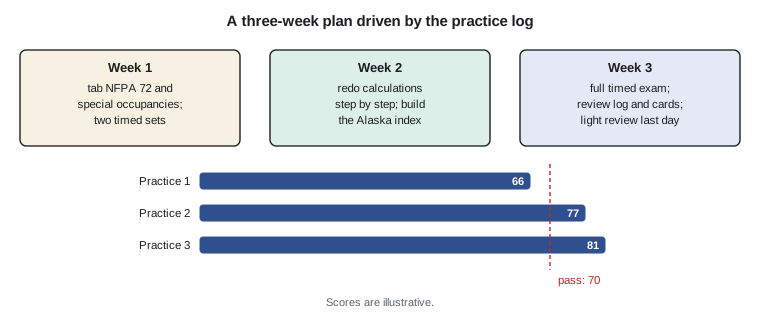
Her plan for the final three weeks followed the log. She added tabs to NFPA 72 and to the special occupancy articles of the NEC and did two timed sets a week in those areas. She redid every missed calculation from scratch, writing each step, until she got them right twice in a row. She built the one-page index of Alaska rules described in Lesson 4, listing about thirty rules with their section numbers. And for every remaining miss, she wrote the exception she had missed on an index card and reviewed the cards each evening.
# Tessa's practice test log: where the points are
misses = {"Special occupancies and alarms": 9, "Calculations": 7,
          "Alaska statutes and regulations": 6, "Core areas, misread exceptions": 8,
          "Other": 4}
score = 100 - sum(misses.values())
print("Practice score:", score)
needed = 70 - score
print("Points needed to pass:", needed)
for area, n in sorted(misses.items(), key=lambda kv: -kv[1]):
print(f"{area}: {n} missed")Practice score: 66 Points needed to pass: 4 Special occupancies and alarms: 9 missed Core areas, misread exceptions: 8 missed Calculations: 7 missed Alaska statutes and regulations: 6 missed Other: 4 missed
The arithmetic is encouraging. She needs only four more correct answers to pass, and her log shows at least 22 points in three areas where focused work pays off quickly. Two weeks later her second full practice test came back at 77, and her third at 81.
The Alaska rules worth memorizing anyway
Even on an open book exam, some Alaska numbers are worth knowing cold because looking them up costs time that is better spent on calculations. These are the ones that come up again and again in this course.
| Rule | Number | Source |
|---|---|---|
| Year of experience | 1,500 hours in 12 consecutive months | 12 AAC 32.930 |
| Commercial wiring experience | 4 of the 6 years as a journeyman | 12 AAC 32.145 |
| Change of employer notice | 15 days | 12 AAC 32.920 |
| Contractors per administrator | One | AS 08.40.130 |
| Personal inspection exception | Under 24 man-hours, simple or standardized | AS 08.40.195 |
| Records of supervised work | 3 years | 12 AAC 32.903 |
| Specialty contractor bond | 10,000 dollars | AS 08.18.071 |
| Liability minimums | 20,000 property; 50,000 one person; 100,000 more than one | AS 08.18.101 |
| Administrator violation fine | Up to 5,000 dollars | AS 08.40.180 |
| Administrator continuing education | 8 hours | 12 AAC 32.315 |
Tessa also reviewed the core courses where her log pointed. For special occupancies she worked through the health care and hazardous location lessons of MELU-106; for calculations she redid the feeder and service examples of MELU-102. The Alaska course gave her the state rules, but the core courses carry most of the exam's weight.
In the last week she took one more full practice exam under real conditions: the same start time as her booking, the same references and calculator, no phone, and no breaks beyond what the bulletin allows. The point was not the score but the rhythm, so that four hours of concentration would feel familiar on December 9.
Pacing the real exam
The commercial exam gives 240 minutes for 100 questions, 2.4 minutes each. A good plan is three passes. On the first pass, answer every question you can answer in about two minutes, and flag the rest. Lookups and Alaska law questions usually fall in this group. On the second pass, take the flagged questions, starting with calculations you know how to do. On the third pass, use the remaining time on the hardest questions and check any answers you marked as uncertain. Answer every question before time runs out; there is no penalty for a wrong answer.
Tessa set three checkpoints for herself: 40 questions done at 80 minutes, 80 at 160 minutes, and all 100 answered with at least 30 minutes left for flagged items. On her third practice exam she hit all three.
Two habits help on every pass. First, read the last line of the question before the details, so you know what is being asked before you read the setup. Second, when two answer choices look close, go back to the rule rather than to your memory; the exam is written so that a candidate who remembers approximately and a candidate who reads exactly will choose differently.
Working a sample question
Here is how the method plays out on a typical Alaska law question, written in the style of the exam but not taken from it. The question says that an electrical administrator leaves one contractor on June 1 to work for another, and asks by what date the department must be notified. On the first pass, Tessa recognizes the topic, opens her one-page index, finds 12 AAC 32.920, confirms the 15-day period in the binder and chooses June 16. Total time: about a minute. A candidate without the index might page through the regulation booklet for five minutes, which is the difference the index makes.
A calculation question works differently. Suppose the question gives a feeder with several continuous and noncontinuous loads, an ambient temperature and a number of current-carrying conductors in the raceway, and asks for the minimum conductor size. Tessa flags it on the first pass. On the second pass, she writes the steps on scratch paper: the load with the continuous portion adjusted as the code requires, the ampacity needed after the correction and adjustment factors from the tables, and the conductor size from the ampacity table, checking the terminal temperature rating last. She compares the result to the choices, finds that it matches one, and moves on. The core course MELU-103 teaches each of those steps; the exam rewards doing them in order and writing them down.
A third kind is the trap question, in which one choice is right under a common rule and another is right once an exception or a special condition is applied. The defense is always the same: read the entire section, including the exceptions and any informational notes that point elsewhere, before choosing. If two choices still look right, the question almost always contains a detail that selects one of them.
The day before and test day
The day before, do light review only: the index cards, the one-page Alaska index and the tab layout. Pack the references the bulletin allows, checking editions against the bulletin: the 2020 NEC, 2013 NFPA 72, 29 CFR Part 1926 and the Alaska statutes and regulations. Pack the calculator, and confirm it is silent, nonprinting and non-programmable. Check that your identification is valid, unexpired, has a photo and signature, and matches the name on your booking. Confirm the test center's address and the arrival time in your PSI confirmation.
In winter, Alaska adds a logistics question. Tessa's exam is on December 9 in Fairbanks, and the morning may be dark, cold and icy. She plans to leave early, with time for a car that will not start. A candidate flying in from a village should book a flight a day early; a candidate testing remotely should test the computer, camera and connection the day before and have a backup plan for a power outage.
At the center, settle in, take a breath, and begin the first pass. If a question rattles you, flag it and move on. Most candidates who fail an open book exam do not fail for lack of knowledge; they fail because they spent too long on a few questions and rushed the rest.
After the exam
If Tessa passes on December 9, the result goes to the licensing division, and she completes whatever the division needs to issue the license. Then she and Arne carry out the handover: Tessa designated as Tanana Ridge's administrator, Arne's change-of-affiliation notice filed within 15 days of March 31, and the company's records, bond and insurance checked for anything that names the administrator. If she does not pass, she has time inside her eligibility year for a retake, and her score report will show the areas to work on.
Arne's last piece of advice was about after the license, not before it. Passing the exam proves that a candidate can find the rules. Being a good administrator means using them every day: on every proposal, every crew plan, every final inspection and every renewal. The exam is the start of the job, not the end of it.
Common mistakes
MistakeTaking practice tests without reviewing them.
InsteadThe review, sorted by cause, is where the points come from.
MistakeStudying only the areas you enjoy.
InsteadStudy where the outline puts questions and where your log shows misses.
MistakeSpending ten minutes on one early question.
InsteadFlag it and return on the second or third pass.
MistakeLeaving questions blank.
InsteadThere is no penalty for guessing; answer every question.
MistakeBringing the wrong code edition.
InsteadCheck every reference against the bulletin before packing.
Summary and key terms
- Review every practice test by content area, reference, section and reason for each miss.
- Fix finding problems with tabs and index practice, misreading with full-section reading, and arithmetic with written steps.
- Memorize the Alaska numbers that recur: 1,500 hours, 15 days, one contractor, 24 man-hours, 3 years, 10,000 dollars, 8 hours.
- Pace at 2.4 minutes per question with three passes and checkpoints.
- Pack the bulletin's references, an allowed calculator and matching identification; plan for winter travel or remote testing.
- After passing, complete the license and the administrator handover before acting as administrator.
- Practice log
- A record of each missed question with its area, reference, section and cause.
- Three-pass method
- Answering easy questions first, then flagged ones, then the hardest, with time to check.
- Checkpoint
- A planned point in the exam for checking progress against time.
- Flag
- To mark a question for return on a later pass.
- Handover
- The steps that move responsibility from one administrator to the next.
Practice problems
Work each problem on paper first, then reveal the answer to check.
Tessa scored 66 on her first practice test. How many more correct answers does she need to pass?
Show answer
Four, for a score of 70.
A miss came from reading a rule but not its exception. What is the fix?
Show answer
Read the whole section, including exceptions, before answering.
Where should Tessa be at 160 minutes on the commercial exam?
Show answer
About 80 questions done.
What should a remote candidate do the day before?
Show answer
Test the computer, camera and connection and plan for an outage.
May Tessa act as administrator the day she passes?
Show answer
No; she waits for the division to issue the license.
Lesson quiz · 5 questions
Score 60% or more to complete this lesson.
Create a free account to save your progress, take quizzes and earn a certificate.