
MELU-103 · Lesson 8 of 12 · 24 min
Box fill under Article 314
▶ Video coming soon A video version of this lesson is on the way.
Box fill is the Article 314 version of raceway fill: a counting exercise with exact rules, a table of allowances and a few traps that catch candidates every year. Section 314.16 requires boxes to be large enough for the conductors, devices and fittings inside them, so conductors are not crushed against sharp edges or overheated and so splices have room. This lesson explains how box volume is determined, the volume allowance for each conductor size, the counting rules for conductors, clamps, support fittings, devices and grounding conductors, and how to size a box for a given set of contents. It closes with the sizing rules for pull and junction boxes in 314.28, which work on a different principle.
Tyler's crowded box
At Maple Street, Tyler Brooks is having trouble folding conductors into a device box behind the kitchen counter. Dana stops him and counts the contents with him: two 12 AWG cables entering, a third leaving, a duplex receptacle, internal cable clamps and the grounding conductors. 'If you have to fight it, it is probably too small,' she says. 'Let us find out what the Code says the box needs.' The count turns out to be a good exam rehearsal.
Box volume
Section 314.16(A) says a box's volume is the total volume of its assembled parts, including plaster rings, extension rings and domed covers that are marked with their volume or made from boxes listed in Table 314.16(A). Standard metal boxes are listed in that table with their volume in cubic inches and the maximum number of conductors of each size they may hold when nothing else is in the box. Nonmetallic boxes and other boxes not in the table are durably and legibly marked by the manufacturer with their volume. A device box with a raised cover or extension ring gains the volume marked on the ring.
Volume allowance per conductor
Table 314.16(B) gives a volume allowance for each conductor size, in cubic inches. The standard values are 1.50 for 18 AWG, 1.75 for 16 AWG, 2.00 for 14 AWG, 2.25 for 12 AWG, 2.50 for 10 AWG, 3.00 for 8 AWG and 5.00 for 6 AWG. Every item in the box is converted into some number of these allowances, based on a particular conductor size, and the total is compared with the box volume.
| Conductor size | Volume allowance (cubic inches) |
|---|---|
| 18 AWG | 1.50 |
| 16 AWG | 1.75 |
| 14 AWG | 2.00 |
| 12 AWG | 2.25 |
| 10 AWG | 2.50 |
| 8 AWG | 3.00 |
| 6 AWG | 5.00 |
The counting rules
Section 314.16(B) lists what counts and how. Each conductor that originates outside the box and terminates or is spliced inside it counts as one allowance for its size. A conductor that passes through the box without splice or termination counts as one; a conductor looped through unbroken but 12 inches or longer, long enough to be cut for termination, counts as two. A conductor that does not leave the box, such as a pigtail or bonding jumper made entirely inside the box, is not counted. Up to four fixture wires smaller than 14 AWG entering from a domed luminaire or similar canopy above the box are not counted, along with an equipment grounding conductor with them.
Clamps: one or more internal cable clamps count as a single allowance, based on the largest conductor in the box. Support fittings: one or more luminaire studs or hickeys count as a single allowance for each type of fitting, based on the largest conductor. Devices: each yoke or strap holding one or more devices, such as a receptacle or switch, counts as two allowances, based on the largest conductor connected to that device; a device or utilization equipment wider than a single 2-inch device box counts two allowances for each gang it needs. Equipment grounding conductors: up to four equipment grounding conductors or bonding jumpers entering the box count as a single allowance based on the largest grounding conductor, and each additional one beyond four counts as a quarter allowance. Isolated grounding conductors for isolated-ground receptacles are counted separately as one more allowance.
| Item in the box | Counts as | Based on |
|---|---|---|
| Each conductor entering and spliced or terminated | 1 | Its own size |
| Conductor passing through unbroken, under 12 inches | 1 | Its own size |
| Unbroken loop 12 inches or longer | 2 | Its own size |
| Pigtails and jumpers that never leave the box | 0 | Not counted |
| All internal cable clamps together | 1 | Largest conductor in the box |
| Each type of support fitting (studs, hickeys) | 1 per type | Largest conductor in the box |
| Each device yoke or strap | 2 | Largest conductor connected to the device |
| Up to four equipment grounding conductors | 1 | Largest grounding conductor |
| Each grounding conductor beyond four | 0.25 | Largest grounding conductor |
Worked problem
Tyler's kitchen box
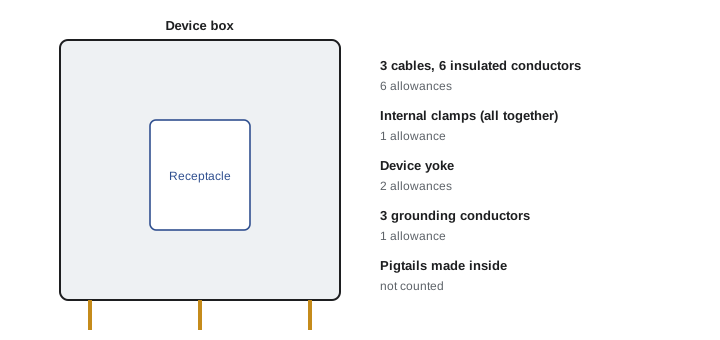
The box contains: two 12/2 cables with ground entering and spliced, and one 12/2 cable with ground leaving to the next receptacle, all terminating or spliced in the box; a duplex receptacle connected with 12 AWG pigtails; internal cable clamps; and three 12 AWG bare grounding conductors joined with a pigtail to the receptacle. What minimum box volume is required?
Show solution
- Insulated conductors: three cables with two insulated conductors each is six conductors, each 2.25 cubic inches: 13.5.
- Clamps: one allowance at 12 AWG: 2.25.
- Device: one yoke counts two allowances at 12 AWG: 4.50.
- Grounding conductors: three, which is four or fewer, count as one allowance at 12 AWG: 2.25. The pigtails are not counted.
- Total: 13.5 plus 2.25 plus 4.50 plus 2.25 is 22.5 cubic inches.
Answer: At least 22.5 cubic inches. Tyler's 18-cubic-inch box was too small; Dana swaps it for a deeper box marked with enough volume.
# Box fill calculator using the standard allowances of Table 314.16(B)
ALLOW = {18: 1.50, 16: 1.75, 14: 2.00, 12: 2.25, 10: 2.50, 8: 3.00, 6: 5.00}

def box_fill(conductors, clamps=False, support_types=0, devices=(), grounds=()):
    total = sum(ALLOW[size] * n for size, n in conductors.items())
    largest = min(conductors)                      # smaller AWG number = larger wire
    if clamps:
        total += ALLOW[largest]
    total += support_types * ALLOW[largest]
    for size in devices:                           # one entry per yoke: size of largest conductor on it
        total += 2 * ALLOW[size]
    if grounds:
        g = ALLOW[min(grounds)]
        extra = max(0, len(grounds) - 4)
        total += g + 0.25 * g * extra
    return total

print("Tyler's box:", box_fill({12: 6}, clamps=True, devices=[12], grounds=[12, 12, 12]), "cubic inches")
print("Switch box, two 14/2 cables:", box_fill({14: 4}, clamps=True, devices=[14], grounds=[14, 14]), "cubic inches")Tyler's box: 22.5 cubic inches Switch box, two 14/2 cables: 16.0 cubic inches
Sizing the box
Once you have the required volume, choose a box at least that large: from Table 314.16(A) for standard metal boxes, or from the manufacturer's marking for others. Extension rings and raised covers add their marked volume. If the table's maximum conductor count is used instead, remember it applies only when the box contains conductors of one size and nothing else, which is rare in practice and sometimes used as an exam trap. When boxes are ganged, their volumes add.
Conduit bodies have their own rules in 314.16(C). A conduit body enclosing 6 AWG or smaller conductors must have a cross-sectional area at least twice that of the largest conduit it is attached to, and splices are permitted only in conduit bodies marked with their volume and sized like boxes. Short-radius conduit bodies, such as capped elbows and service entrance elbows, may not contain splices at all.
Pull and junction boxes: 314.28
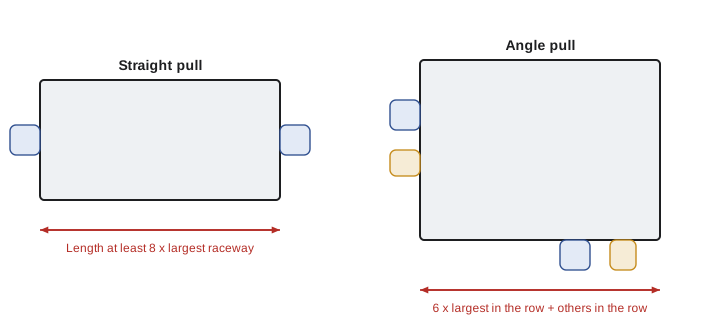
For conductors 4 AWG and larger, box size is set by raceway dimensions rather than conductor volume, under 314.28. In a straight pull, where conductors enter one side and leave the opposite side, the box length must be at least eight times the trade size of the largest raceway. In an angle or U pull, the distance from each raceway entry to the opposite wall must be at least six times the trade size of the largest raceway in that row, plus the sum of the trade sizes of the other raceways in the same row on the same wall; and the distance between raceway entries enclosing the same conductor must be at least six times the trade size of the larger raceway. Each row is calculated separately and the largest result is used.
Worked problem
A pull box for the Delgado feeder
Two 3-inch conduits and one 2-inch conduit enter the left side of a pull box and turn 90 degrees to leave through the bottom. What is the minimum distance from the left wall to the opposite, right wall?
Show solution
- This is an angle pull. Use six times the largest raceway in the row plus the sum of the other raceways in the same row.
- Six times 3 inches is 18 inches.
- Add the other raceways on that wall: one 3-inch and one 2-inch, 5 inches.
- 18 plus 5 is 23 inches.
Answer: At least 23 inches from the left wall to the right wall, with the bottom wall calculated the same way.
Ganged boxes, rings and covers
When device boxes are ganged together, the volume of the assembly is the sum of the individual boxes, and the contents are counted across the whole assembly. Extension rings, plaster rings and raised covers add their marked volume, which is often how an existing box that is too small can be brought into compliance without removing it from a finished wall. Unmarked rings and covers add nothing. Dana carries a few marked extension rings in her truck for exactly that reason: when a remodel adds a device to an existing box, a ring with a marked volume often solves the fill problem.
Boxes listed in Table 314.16(A) also have a maximum number of conductors of a single size, which applies only when the box contains nothing else: no clamps, no devices, no fittings and no grounding conductors. Because almost every real box contains at least grounding conductors, the volume method is the one to use, and exam questions that list several items in a box always expect it.
Large conductors and junction boxes
Pull and junction boxes with conductors 4 AWG and larger must also leave room inside for the conductors to bend. Section 314.28(A)(2) requires the distance between raceway entries enclosing the same conductor to be at least six times the trade size of the larger raceway, and 312.6 gives minimum bending space at terminals in cabinets and cutout boxes. Boxes over 100 cubic inches that contain conductors of 4 AWG or larger, or that are used as pull points, need covers that are accessible after installation, and conductors in them must be supported and protected from abrasion.
Worked problem
An angle pull with two rows
A junction box at Delgado has, on its left wall, one 2-inch and one 1-1/2-inch conduit in a single row, turning to the bottom wall. What is the minimum distance from the left wall to the right wall?
Show solution
- Angle pull: six times the largest raceway in the row, plus the others in that row.
- Six times 2 inches is 12 inches.
- Add the other raceway: 1.5 inches.
- 12 plus 1.5 is 13.5 inches.
Answer: At least 13.5 inches, with the distance between entries for the same conductors also checked.
Common mistakes
MistakeCounting each cable clamp separately.
InsteadAll internal clamps together count as one allowance based on the largest conductor.
MistakeCounting a device as one allowance.
InsteadEach yoke counts as two allowances, based on the largest conductor connected to it.
MistakeCounting every equipment grounding conductor.
InsteadUp to four count as one allowance; each extra counts as a quarter.
MistakeCounting pigtails made inside the box.
InsteadConductors that never leave the box are not counted.
MistakeUsing box fill volumes for a pull box with 4 AWG conductors.
InsteadConductors 4 AWG and larger use the raceway-based rules of 314.28.
Summary and key terms
- A box's volume includes marked rings and covers; standard metal boxes are listed in Table 314.16(A).
- Allowances per conductor run from 2.00 cubic inches for 14 AWG to 5.00 for 6 AWG.
- Each conductor counts once; clamps once together; each device yoke twice; support fittings once per type.
- Up to four grounding conductors count once, with a quarter allowance for each additional one.
- Conduit bodies with splices must be marked with their volume; short-radius bodies may not contain splices.
- Pull boxes for 4 AWG and larger: eight times the largest raceway for straight pulls, six times plus the others for angle pulls.
- Box fill
- The total volume of conductors, devices and fittings in a box, calculated under 314.16.
- Volume allowance
- The volume each conductor size is assigned in Table 314.16(B).
- Yoke
- The metal strap that holds a device, such as a receptacle or switch, in a box.
- Support fitting
- A luminaire stud or hickey inside a box.
- Straight pull
- Conductors entering one side of a box and leaving the opposite side.
- Angle pull
- Conductors entering one side of a box and leaving an adjacent side.
Practice problems
Work each problem on paper first, then reveal the answer to check.
How much volume is required for five 14 AWG conductors alone?
Show answer
5 times 2.00, which is 10.0 cubic inches.
A box holds a switch connected to 12 AWG conductors. How many cubic inches does the switch count?
Show answer
Two allowances at 12 AWG, 4.50 cubic inches.
Six equipment grounding conductors of 12 AWG enter a box. What do they count?
Show answer
One allowance plus two quarter allowances: 1.5 allowances at 2.25, which is 3.375 cubic inches.
A straight pull box has 2-1/2-inch conduits at each end. What is the minimum length?
Show answer
Eight times 2.5, which is 20 inches.
May a capped elbow contain splices?
Show answer
No. Short-radius conduit bodies may not contain splices.
Lesson quiz · 5 questions
Score 60% or more to complete this lesson.
Create a free account to save your progress, take quizzes and earn a certificate.