
MELU-103 · Lesson 5 of 12 · 21 min
Adjustment and correction factors
▶ Video coming soon A video version of this lesson is on the way.
The ampacity table gives a conductor's ampacity under standard conditions: not more than three current-carrying conductors together, at an ambient temperature of 30 degrees Celsius. Real installations are rarely that tidy. Conductors are bundled, run through hot attics and boiler rooms, and laid across sunny rooftops. Section 310.15 provides two kinds of factors to account for this. Correction factors adjust for an ambient temperature different from 30 degrees, and adjustment factors reduce ampacity when more than three current-carrying conductors share a raceway or cable for more than a short distance. Exam writers love these questions because they combine table reading, counting, multiplication and a final check against the terminations, and each step is a chance to go wrong.
Some ampacity and correction values in this lesson are invented for teaching and labeled. The adjustment steps for the number of conductors are given as the plain decimal multipliers the Code uses, so you can check them against your own book.
The Copper Kettle kitchen run
In the Copper Kettle's kitchen, Dana plans a single conduit carrying four 20-ampere multiwire circuits for the prep line: eight ungrounded conductors and four neutrals, all 12 AWG THHN/THWN-2 copper. The conduit crosses the ceiling above the cooking line, where the mechanical engineer's drawings show the ambient can reach 40 degrees Celsius. Ray looks at the layout and asks one question: 'Are those still 20-ampere conductors when you are done derating them?' Dana takes the layout home to find out.
Ambient temperature correction
Section 310.15(B) requires the table ampacity to be multiplied by a correction factor when the ambient temperature differs from 30 degrees Celsius. The correction factors are in Table 310.15(B)(1)(1) for the 30-degree basis, organized by the conductor's temperature rating: a 90-degree conductor loses less ampacity per degree of heat than a 60-degree conductor, because it has more room before reaching its limit. Above 30 degrees the factors are below 1; below 30 degrees they are above 1. The Code also gives a formula for calculating the factor directly from the conductor rating and ambient temperatures, which produces the same values.
Two locations get special attention. Raceways and cables exposed to direct sunlight on or above rooftops have an added temperature: under 310.15(B)(2), where the raceway is less than 7/8 inch above the roof, 33 degrees Celsius is added to the outdoor ambient temperature, unless the conductors are type XHHW-2. Older editions had a table of adders for different heights; recent editions keep only the close-to-roof case. And conductors in hot spaces such as attics or near boilers use the actual ambient of the space.
# Correction factor from the formula in 310.15(B): sqrt((Tc - Ta) / (Tc - 30))
import math

def correction(conductor_rating_c, ambient_c):
    return math.sqrt((conductor_rating_c - ambient_c) / (conductor_rating_c - 30))

for rating in (60, 75, 90):
    for ambient in (20, 35, 40, 50):
print(f"{rating} C conductor at {ambient} C ambient: factor {correction(rating, ambient):.2f}")60 C conductor at 20 C ambient: factor 1.15 60 C conductor at 35 C ambient: factor 0.91 60 C conductor at 40 C ambient: factor 0.82 60 C conductor at 50 C ambient: factor 0.58 75 C conductor at 20 C ambient: factor 1.11 75 C conductor at 35 C ambient: factor 0.94 75 C conductor at 40 C ambient: factor 0.88 75 C conductor at 50 C ambient: factor 0.75 90 C conductor at 20 C ambient: factor 1.08 90 C conductor at 35 C ambient: factor 0.96 90 C conductor at 40 C ambient: factor 0.91 90 C conductor at 50 C ambient: factor 0.82
Adjustment for more than three conductors
Section 310.15(C)(1) applies when more than three current-carrying conductors are in a raceway or cable, or bundled for more than 24 inches without spacing. The table ampacity, after any ambient correction, is multiplied by an adjustment factor that depends on the number of current-carrying conductors. The steps are 0.80 for four to six conductors, 0.70 for seven to nine, 0.50 for ten to twenty, 0.45 for twenty-one to thirty, 0.40 for thirty-one to forty, and 0.35 for forty-one and above. Remember from lesson 4 which conductors count: neutrals carrying only unbalanced current and all grounding conductors are left out.
| Current-carrying conductors | Adjustment multiplier |
|---|---|
| 4 to 6 | 0.80 |
| 7 to 9 | 0.70 |
| 10 to 20 | 0.50 |
| 21 to 30 | 0.45 |
| 31 to 40 | 0.40 |
| 41 and above | 0.35 |
There are exceptions. Adjustment does not apply to conductors in raceway nipples 24 inches or shorter. It does not apply to underground conductors entering or leaving an outdoor trench if they are protected by a raceway that is not longer than 10 feet and contains not more than four conductors. Type AC and MC cables without an overall jacket have their own rule for when bundled cables need adjustment, and some cable assemblies installed through thermal insulation or bundled together for long distances do.
Putting it together: the order of operations
Dana writes her procedure on an index card. First, find the load and the required ampacity: the full load for the adjusted check, and the noncontinuous load plus 125 out of 100 of the continuous load for the termination check. Second, start from the conductor's own temperature column, usually 90 degrees for THHN or XHHW-2, and multiply by the correction factor and the adjustment factor. Third, the result must be at least the full load. Fourth, check that the ampacity in the termination temperature column, without correction or adjustment, is at least the noncontinuous plus 125 out of 100 continuous figure. Fifth, check the overcurrent device: the small conductor rule and 240.4. The conductor is acceptable only if it passes every check.
The reason for starting at the 90-degree column is that correction and adjustment protect the conductor's insulation, which is rated 90 degrees. The termination check protects the terminals, which are rated lower and are not affected by bundling elsewhere in the run. Answering a derating question from the 75-degree column usually gives a wrong, larger conductor; answering from the 90-degree column without the termination check can give a conductor that overheats its terminals.
Worked problem
The Copper Kettle prep line, with a sample 90-degree value
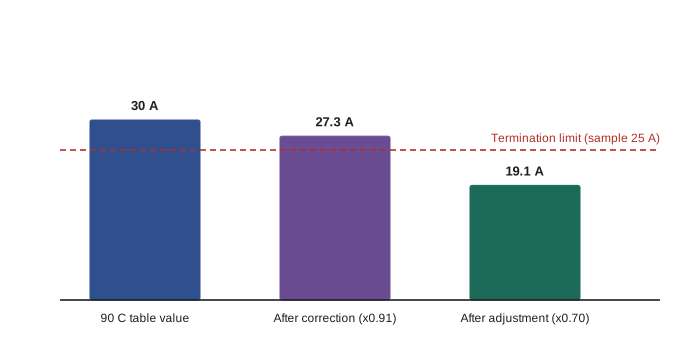
Twelve 12 AWG THHN/THWN-2 copper conductors share a conduit: eight ungrounded conductors and four neutrals of multiwire circuits with mostly linear loads. The ambient is 40 degrees Celsius. Suppose the 90-degree table ampacity of 12 AWG copper is 30 amperes and the correction factor for 90-degree conductors at 40 degrees is 0.91. Each circuit is protected at 20 amperes and carries 16 amperes. Is the design acceptable?
Show solution
- Count: the neutrals carry only unbalanced current, so eight current-carrying conductors. The adjustment multiplier for seven to nine is 0.70.
- Corrected and adjusted ampacity: 30 times 0.91 times 0.70 is 19.1 amperes.
- Full-load check: 19.1 amperes is at least the 16-ampere load, so the insulation is protected.
- Overcurrent check: 240.4(B) allows the next standard rating above 19.1, which is 20 amperes, for circuits that are not multi-outlet receptacle circuits; but these prep circuits do supply several receptacles, so the device must not exceed 19.1 amperes, and 20 amperes is too large.
- Dana's options: split the circuits into two conduits so each carries four current-carrying conductors at 0.80, or upsize to 10 AWG.
Answer: Not acceptable as drawn. With the sample numbers, 12 AWG falls just below 20 amperes after derating, and receptacle circuits cannot use the next size up.
# Derating check for conductors in one raceway (90 C value and factors are inputs)
def adjust(n):
    for top, f in [(3, 1.0), (6, 0.80), (9, 0.70), (20, 0.50), (30, 0.45), (40, 0.40)]:
        if n <= top:
            return f
    return 0.35

def check(table_90, correction, ccc, load, device):
    amp = table_90 * correction * adjust(ccc)
    verdict = "OK" if amp >= load and amp >= device else "too small for this device"
    return round(amp, 1), verdict

print("12 AWG sample, 8 CCC at 40 C:", check(30, 0.91, 8, 16, 20))
print("Split into two raceways, 4 CCC:", check(30, 0.91, 4, 16, 20))
print("10 AWG sample, 8 CCC:", check(40, 0.91, 8, 16, 20))12 AWG sample, 8 CCC at 40 C: (19.1, 'too small for this device') Split into two raceways, 4 CCC: (21.8, 'OK') 10 AWG sample, 8 CCC: (25.5, 'OK')
Common exam traps
Exam questions on derating hide traps in the counting and the wording. A question may list every conductor in a raceway, including grounding conductors and spare conductors, and expect you to count only the current-carrying ones. It may describe a three-phase, four-wire circuit feeding computers, where the neutral counts. It may give an ambient in Fahrenheit and expect you to use the Fahrenheit column of the correction table. It may ask for the ampacity of a conductor, which is the corrected and adjusted value, or for the maximum overcurrent device, which brings in the small conductor rule and 240.4. Read the last line of the question twice before you calculate.
| Wording in the question | What it is really asking |
|---|---|
| What is the ampacity of the conductors? | The 90-degree table value times correction and adjustment, limited by the termination column |
| What is the maximum overcurrent device? | The ampacity, then 240.4(B) or (D), and whether the circuit serves receptacles |
| What is the minimum size conductor? | The smallest size passing every check, including continuous load and terminations |
| The raceway contains a ground and two spares | Count only current-carrying conductors; spares count only if energized |
2026 notes
In the 2026 edition the correction and adjustment rules remain in 310.15, but check the subsection lettering in your book before tabbing; past editions have moved these subsections more than once, and older study guides refer to the adjustment table as 310.15(B)(3)(a), which is now 310.15(C)(1).
Correction below 30 degrees and in cold spaces
Correction works in both directions. Below 30 degrees Celsius the correction factors exceed 1, so a conductor in a cold space has a higher ampacity than the table shows. An exam may ask about a feeder in a cold storage warehouse or a parking structure in winter. The higher corrected value can be used for the insulation check, but it can never raise the usable ampacity above the termination column, and the overcurrent device rules still apply. In practice, designers rarely take credit for cold spaces, because the space may not always stay cold, but the math is fair game on a test.
Correction is also needed where conductors pass through more than one ambient. Section 310.14(A)(2) allows the higher ampacity to be used where the lower-ampacity portion is not more than 10 feet long and not more than 10 out of 100 of the total circuit length; otherwise the lowest ampacity along the run governs. A feeder that crosses a 6-foot section of a hot boiler room on a 200-foot run may use the ampacity of the main run, while one that spends 60 feet in that room may not.
Worked problem
A short hot section
A 150-foot feeder passes 8 feet through a hot mechanical room. Can the ampacity of the cooler portion be used?
Show solution
- The hot portion is 8 feet, which is not more than 10 feet.
- 10 out of 100 of 150 feet is 15 feet, and 8 feet is within that.
- Both conditions are met, so the higher ampacity of the cooler portion may be used for the whole run.
Answer: Yes, under 310.14(A)(2).
Common mistakes
MistakeStarting from the 75-degree column when derating THHN.
InsteadStart from the 90-degree column for 90-degree conductors, then check the result against the termination column.
MistakeCounting the equipment grounding conductor.
InsteadGrounding and bonding conductors are never counted.
MistakeApplying adjustment to a 20-inch nipple between two enclosures.
InsteadNipples 24 inches or shorter are exempt from adjustment.
MistakeForgetting the rooftop temperature adder.
InsteadRaceways less than 7/8 inch above a sunny roof add 33 degrees Celsius to the ambient, except for XHHW-2.
MistakeUsing the next size up on a derated receptacle circuit.
Instead240.4(B) does not apply to circuits with more than one receptacle for portable loads.
Summary and key terms
- Correction factors adjust for ambient temperatures other than 30 degrees Celsius; adjustment factors reduce ampacity for more than three current-carrying conductors.
- Adjustment multipliers step from 0.80 for four to six conductors down to 0.35 for forty-one or more.
- Start from the conductor's own temperature column, apply both factors, then check against the termination column.
- Do two checks: corrected and adjusted ampacity against the full load, and termination ampacity against noncontinuous plus 125 out of 100 continuous.
- Short nipples and some short underground raceways are exempt from adjustment.
- Read the question's last line: ampacity, minimum size and maximum device are different answers.
- Correction factor
- A multiplier for ambient temperatures other than the table basis of 30 degrees Celsius.
- Adjustment factor
- A multiplier for more than three current-carrying conductors in a raceway or cable.
- Ambient temperature
- The temperature of the air or medium surrounding the conductors.
- Nipple
- A raceway 24 inches or shorter connecting two enclosures.
- Derating
- The common field term for applying correction and adjustment factors.
- Spare conductor
- An unused conductor installed for future use; it is not current-carrying while unused.
Practice problems
Work each problem on paper first, then reveal the answer to check.
How many current-carrying conductors are in a raceway with three phase conductors, a neutral of a mostly linear load, and an equipment grounding conductor?
Show answer
Three.
A sample 90-degree ampacity is 55 amperes, the correction factor is 0.87 and there are five current-carrying conductors. What is the adjusted ampacity?
Show answer
55 times 0.87 times 0.80, which is about 38.3 amperes.
What adjustment multiplier applies to fifteen current-carrying conductors?
Show answer
0.50.
A raceway runs 4 inches above a sunny roof. Does the 33-degree adder apply?
Show answer
No. It applies only when the raceway is less than 7/8 inch above the roof.
Why do you check the termination column separately?
Show answer
Terminals are rated lower than 90-degree insulation and must not overheat, regardless of the derated value.
Lesson quiz · 5 questions
Score 60% or more to complete this lesson.
Create a free account to save your progress, take quizzes and earn a certificate.