
MELU-103 · Lesson 3 of 12 · 20 min
Overcurrent protection under Article 240
▶ Video coming soon A video version of this lesson is on the way.
Article 240 decides how conductors and equipment are protected against overload and short circuit. For an exam candidate it holds four of the most useful rules in the book: the basic rule that conductors are protected at their ampacity, with the next-size-up allowance; the small conductor limits; the list of standard ampere ratings; and the tap rules that let a smaller conductor connect to a larger overcurrent device under strict conditions. This lesson works through each, then covers where overcurrent devices must be located and a few rules about their ratings and markings.
Why overcurrent protection exists
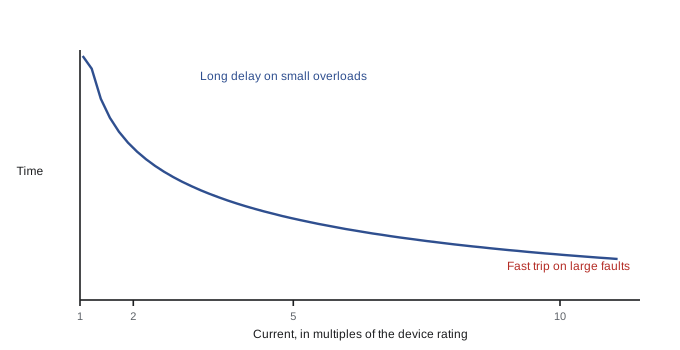
Every conductor has an ampacity: the current it can carry continuously, under its conditions of use, without exceeding its insulation's temperature rating. An overcurrent device, whether a fuse or a circuit breaker, opens the circuit before the current lasts long enough to damage the insulation. Overcurrent comes in three forms that the Code defines in Article 100: an overload, which is too much current in a circuit that is otherwise intact; a short circuit, a fault between conductors; and a ground fault, a fault between a conductor and ground. A device that protects against all three must open quickly on large fault currents and more slowly on modest overloads, which is why breakers and fuses have inverse-time characteristics.
The basic rule and the next size up
Section 240.4 is the starting point: conductors must be protected against overcurrent in accordance with their ampacities. If a conductor's ampacity matches a standard device rating, use that rating. If it does not, 240.4(B) allows the next higher standard rating, provided three conditions are all met: the conductors are not part of a branch circuit supplying more than one receptacle for cord-and-plug-connected portable loads; the ampacity does not correspond with a standard rating; and the next higher standard rating does not exceed 800 amperes. Above 800 amperes, 240.4(C) requires that the ampacity of the conductors be equal to or greater than the rating of the overcurrent device; the next-size-up allowance disappears.
On the exam, the next-size-up rule often hides inside a feeder question. If your calculation produces a conductor with an ampacity of 380 amperes, and 380 is not a standard rating, 240.4(B) allows a 400-ampere device, because 400 is the next standard rating and does not exceed 800. But if the conductor feeds a multi-outlet receptacle circuit, the rule does not apply, and you must step down to the standard rating at or below the ampacity.
| Conductor ampacity | Next standard rating | Is the next size up allowed? |
|---|---|---|
| 380 A, feeder to a panelboard | 400 A | Yes: not a receptacle circuit, and 400 does not exceed 800 |
| 23 A, branch circuit to several receptacles | 25 A | No: multi-receptacle circuit for portable loads |
| 760 A, feeder | 800 A | Yes: 800 does not exceed 800 |
| 960 A, feeder | 1000 A | No: above 800 A, ampacity must equal or exceed the device rating |
The small conductor rule
Section 240.4(D) sets maximum overcurrent protection for small conductors regardless of what their table ampacity might be. These are among the most tested numbers in the book. For copper, 14 AWG is limited to 15 amperes, 12 AWG to 20 amperes and 10 AWG to 30 amperes. For aluminum and copper-clad aluminum, 12 AWG is limited to 15 amperes and 10 AWG to 25 amperes. Smaller copper sizes, 18 and 16 AWG, have their own limits with conditions. The rule applies after any correction and adjustment factors have been applied, unless the section specifically permits otherwise, and the Code lists exceptions in 240.4(G) for specific equipment such as motor circuits, air-conditioning equipment and fire alarm circuits, which have their own protection rules.
| Conductor | Maximum overcurrent protection |
|---|---|
| 14 AWG copper | 15 A |
| 12 AWG copper | 20 A |
| 10 AWG copper | 30 A |
| 12 AWG aluminum or copper-clad aluminum | 15 A |
| 10 AWG aluminum or copper-clad aluminum | 25 A |
This is why a 12 AWG copper conductor whose table ampacity at 90 degrees is higher than 20 amperes still cannot be protected above 20 amperes on a general circuit. The higher table value is useful for derating, as lesson 5 shows, but the overcurrent device is capped.
Standard ampere ratings
Section 240.6(A) lists the standard ampere ratings for fuses and inverse-time circuit breakers. They start at 15 and run in steps of 5 up to 50, then 60, 70, 80 and 90, then 100, 110, 125, 150, 175, 200, 225, 250, 300, 350, 400, 450, 500, 600, 700, 800, and on to 1000, 1200, 1600, 2000, 2500, 3000, 4000, 5000 and 6000 amperes. Additional standard ratings for fuses only include 1, 3, 6, 10 and 601 amperes. Many exam answers depend on rounding to this list, so know where it is and know the gaps: there is no standard 55, 65 or 75-ampere rating.
# The standard ampere ratings of 240.6(A) and the next-size-up rule of 240.4(B)
standard = [15, 20, 25, 30, 35, 40, 45, 50, 60, 70, 80, 90, 100, 110, 125, 150, 175,
            200, 225, 250, 300, 350, 400, 450, 500, 600, 700, 800, 1000, 1200, 1600,
            2000, 2500, 3000, 4000, 5000, 6000]

def max_device(ampacity, receptacle_circuit=False):
    if ampacity in standard:
        return ampacity
    up = next(r for r in standard if r > ampacity)
    if not receptacle_circuit and up <= 800:
        return up
    return max(r for r in standard if r < ampacity)

for amp, rec in [(380, False), (23, True), (760, False), (960, False), (52, False)]:
print(f"Ampacity {amp} A, receptacle circuit {rec}: largest device {max_device(amp, rec)} A")Ampacity 380 A, receptacle circuit False: largest device 400 A Ampacity 23 A, receptacle circuit True: largest device 20 A Ampacity 760 A, receptacle circuit False: largest device 800 A Ampacity 960 A, receptacle circuit False: largest device 800 A Ampacity 52 A, receptacle circuit False: largest device 60 A
Tap rules
A tap is a conductor that connects to a feeder and is protected by an overcurrent device rated higher than the tap conductor's ampacity would normally allow. Section 240.21(B) permits feeder taps under strict length and termination conditions. The two rules exam questions use most are the 10-foot tap and the 25-foot tap.
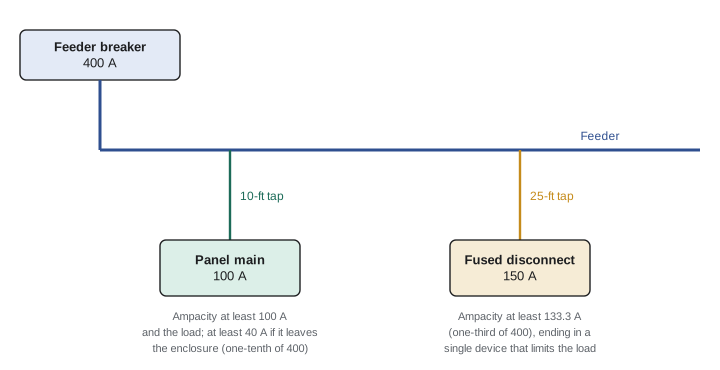
Under the 10-foot rule, the tap conductors must not be longer than 10 feet. Their ampacity must be not less than the combined calculated loads they supply and not less than the rating of the equipment or overcurrent device at their load end. They must not extend beyond the equipment they supply, and they must be enclosed in a raceway when not inside the equipment. If the tap conductors leave the enclosure in which the tap is made, as field-installed conductors, their ampacity must be at least one-tenth of the rating of the overcurrent device protecting the feeder.
Under the 25-foot rule, the tap conductors must not be longer than 25 feet, their ampacity must be at least one-third of the rating of the overcurrent device protecting the feeder, they must terminate in a single circuit breaker or set of fuses that limits the load to the tap conductors' ampacity, and they must be protected from physical damage. Other tap rules cover taps supplying a transformer, taps over 25 feet in high-bay manufacturing buildings and outside taps of unlimited length. Section 240.21(C) has a parallel set of rules for transformer secondary conductors.
Worked problem
A 25-foot tap at Delgado
A 400-ampere feeder breaker protects a feeder in the shop. Dana wants to tap it to supply a 150-ampere fused disconnect for a new CNC machine, 22 feet away. What minimum ampacity must the tap conductors have under the 25-foot rule, and what else must be true?
Show solution
- Length: 22 feet is within 25 feet.
- Ampacity: at least one-third of 400, which is 133.3 amperes.
- The tap must end in a single overcurrent device that limits the load to the tap conductors' ampacity: the 150-ampere disconnect's fuses must not exceed the tap ampacity, so the tap conductors need an ampacity of at least 150 amperes in practice.
- The conductors must be protected from physical damage, for example in a raceway.
Answer: The rule's floor is 133.3 amperes, but because the tap ends in 150-ampere fuses, Dana chooses conductors with an ampacity of at least 150 amperes.
Location of overcurrent devices
Section 240.21 sets the general rule that overcurrent protection is located at the point where the conductors receive their supply, with the tap and transformer secondary rules as the main exceptions. Section 240.24 requires overcurrent devices to be readily accessible, with exceptions for busways, devices next to the equipment they serve, and a few others. The highest position of the operating handle of a breaker or switch, under 240.24(A) and 404.8, must not be more than 6 feet 7 inches above the floor or working platform. Overcurrent devices must not be located in bathrooms of dwelling units or guest rooms, near easily ignitible material such as in clothes closets, or over steps of a stairway.
| Location | Rule in brief | Section |
|---|---|---|
| General | Readily accessible | 240.24(A) |
| Handle height | Not more than 6 ft 7 in above the floor or platform | 240.24(A), 404.8 |
| Occupant access | Each occupant has ready access to devices protecting their conductors | 240.24(B) |
| Dwelling and guest room bathrooms | Not permitted | 240.24(E) |
| Clothes closets and near ignitible material | Not permitted | 240.24(D) |
| Over stairway steps | Not permitted | 240.24(F) |
Ratings, series ratings and arc energy
Section 110.9, from MELU-101, requires every device intended to interrupt current at fault levels to have an interrupting rating at least equal to the available fault current at its line terminals. Section 240.86 allows series-rated combinations, where an upstream device helps a downstream breaker with a lower interrupting rating, but only when the combination has been tested and marked, and only under conditions such as motor contribution limits. Section 240.87 requires a method to reduce clearing time for breakers rated or adjustable to 1200 amperes or higher, such as zone-selective interlocking, differential relaying or an energy-reducing maintenance switch, so workers face less arc-flash energy. Section 240.67 has a similar rule for fuses of 1200 amperes and above.
2026 notes
The 2026 edition replaces the long phrase overcurrent protective device with the abbreviation OCPD in many places and reorganizes medium-voltage overcurrent rules into the articles for systems over 1000 volts. The tap rules, the small conductor rule and the list of standard ratings remain in Article 240.
Coordination and selectivity
Overcurrent devices in series should open in the right order: the device nearest the fault should clear it, leaving the rest of the system in service. The Code calls this selective coordination and requires it for elevators with more than one driving machine on a feeder, emergency systems, legally required standby systems, critical operations power systems and some healthcare circuits, under sections such as 620.62, 700.32, 701.32 and 708.54. For ordinary systems, selectivity is good design but not required. On an exam, a question about selective coordination is almost always testing whether you know which systems require it. In the field it means comparing the time-current curves of the upstream and downstream devices so they never overlap at any fault current the system can deliver, a study usually done by an engineer and reviewed by the inspector for emergency systems.
Coordination also explains why a series-rated combination, which relies on both devices opening together on a large fault, is not allowed where selective coordination is required. Dana notes the conflict in her study guide: series ratings save money on breakers, but they guarantee that an upstream device trips along with the downstream one, which is exactly what an emergency system must avoid.
Common mistakes
MistakeUsing the next size up for a multi-receptacle branch circuit.
Instead240.4(B) excludes branch circuits supplying more than one receptacle for cord-and-plug portable loads.
MistakeApplying the next size up above 800 amperes.
InsteadAbove 800 amperes, the conductor ampacity must equal or exceed the device rating.
MistakeProtecting 12 AWG copper at 25 amperes because its 90-degree table value is higher.
InsteadThe small conductor rule caps 12 AWG copper at 20 amperes on general circuits.
MistakeChoosing a 75-ampere breaker.
Instead75 is not a standard rating; the list jumps from 70 to 80.
MistakeIgnoring the termination requirement in the 25-foot tap rule.
InsteadA 25-foot tap must end in a single device that limits the load to the tap's ampacity.
Summary and key terms
- Conductors are protected at their ampacity, with the next standard rating allowed up to 800 amperes except on multi-receptacle circuits.
- Small conductor limits: copper 14, 12, 10 AWG at 15, 20, 30 amperes; aluminum 12 and 10 AWG at 15 and 25 amperes.
- Know the standard ratings in 240.6(A), including the gaps.
- The 10-foot tap needs ampacity not less than the load and the end device, and one-tenth of the feeder device if it leaves the enclosure.
- The 25-foot tap needs ampacity of at least one-third of the feeder device and a single terminating device.
- Overcurrent devices must be readily accessible, with handles no higher than 6 feet 7 inches, and are not allowed in dwelling bathrooms or clothes closets.
- Overcurrent
- Current beyond the rated current of equipment or the ampacity of a conductor, from overload, short circuit or ground fault.
- Overload
- Operation above normal full-load rating that would cause damage if it lasted long enough.
- Tap conductor
- A conductor protected by an overcurrent device rated higher than the conductor's ampacity, under the tap rules.
- Interrupting rating
- The highest current at rated voltage a device is intended to interrupt.
- Series rating
- A tested and marked combination in which an upstream device protects a downstream device with a lower interrupting rating.
- Standard ampere rating
- A fuse or breaker rating from the list in 240.6(A).
Practice problems
Work each problem on paper first, then reveal the answer to check.
A feeder conductor has an ampacity of 270 amperes. What is the largest overcurrent device permitted?
Show answer
300 amperes, the next standard rating, because 270 is not standard and 300 does not exceed 800.
What is the maximum overcurrent protection for 10 AWG copper on a general branch circuit?
Show answer
30 amperes.
A feeder is protected at 600 amperes. What minimum ampacity is required for a 25-foot tap?
Show answer
One-third of 600, which is 200 amperes.
Name three standard ratings between 100 and 200 amperes.
Show answer
110, 125, 150 or 175 amperes.
May a panelboard's breakers be installed in a dwelling unit's bathroom?
Show answer
No. 240.24(E) prohibits it.
Lesson quiz · 5 questions
Score 60% or more to complete this lesson.
Create a free account to save your progress, take quizzes and earn a certificate.