
MELU-103 · Lesson 4 of 12 · 20 min
Conductor ampacity under Article 310
▶ Video coming soon A video version of this lesson is on the way.
Almost every sizing question on a master exam ends with a conductor choice, and Article 310 is where that choice is made. It describes the conductor types and their insulations, where each may be used, how ampacity is determined, and the table that most electricians know by its number alone. This lesson covers conductor types and markings, how to read the ampacity table correctly, the termination temperature rule that limits which column you may use, parallel conductors and a few special cases. Lesson 5 then adds the correction and adjustment factors that change the table values.
Because the ampacity tables are part of the copyrighted Code, the sample ampacities in this lesson are invented for teaching, labeled as such, and are not the Code's values. Read the real values from your own book.
Tyler's question
On the Maple Street job, Tyler Brooks asks Dana why the 60-ampere feeder to the detached garage is wired with conductors that look larger than a chart on the supply house wall suggests. Dana tells him the chart is a shortcut that ignores half the rules, and uses the question to start her Article 310 review. 'There are four questions every time,' she says. 'What conductor type and temperature rating do I have? What are the terminations rated? How many current-carrying conductors are together, and in what ambient temperature? And what is the small conductor rule or the overcurrent device telling me?'
Conductor types and markings
Section 310.4 and its tables describe insulated conductors by type letters. The letters are a code: T for thermoplastic, H for heat-resistant, HH for higher heat resistance, W for suitable for wet locations, N for a nylon outer jacket, X for cross-linked polymer, and a suffix of -2 for a 90-degree rating in wet locations. THHN is a 90-degree conductor for dry and damp locations; THWN is rated 75 degrees in wet locations; and much of the wire sold today is dual-rated THHN/THWN-2, which is 90 degrees in dry, damp and wet locations. XHHW-2 is a cross-linked conductor rated 90 degrees in all three. USE-2 is for underground service entrance, and RHW-2 has a rubber-type insulation.
| Letter | Meaning |
|---|---|
| T | Thermoplastic insulation |
| H or HH | Heat-resistant: 75 C or 90 C rating depending on type |
| W | Suitable for wet locations |
| N | Nylon outer jacket |
| X | Cross-linked synthetic polymer insulation |
| -2 | 90 C rating in wet locations |
| U, SE | Underground, service entrance |
Section 310.10 says where conductors may be used. Dry locations accept most types; damp and wet locations need types marked for them; and conductors exposed to direct sunlight must be listed or marked as sunlight resistant or covered. Conductors in raceways underground or in concrete slabs in contact with the earth are in a wet location, so they need a W rating. Sizes are in AWG up to 4/0, then in kcmil, thousands of circular mils, from 250 kcmil up. The smallest general-purpose conductor size is 14 AWG copper and 12 AWG aluminum or copper-clad aluminum in most applications.
Reading the ampacity table
Table 310.16 gives allowable ampacities for insulated conductors rated up to 2000 volts, in raceway, cable or directly buried, with not more than three current-carrying conductors and an ambient temperature of 30 degrees Celsius, which is 86 degrees Fahrenheit. Every word of that title is a condition. If more than three current-carrying conductors are together, or the ambient is different, the table values are only the starting point. Other tables cover single conductors in free air, conductors in other conditions, and conductors rated above 2000 volts.
The table has six columns of values: copper at 60, 75 and 90 degrees, and aluminum or copper-clad aluminum at 60, 75 and 90 degrees. The column for a conductor is set by the lowest temperature rating of anything connected to it: the conductor's insulation, the terminals at both ends, and any device. That is the rule of 110.14(C), which MELU-101 introduced.
| Size | Copper 60 C | Copper 75 C | Copper 90 C | Aluminum 75 C | Aluminum 90 C |
|---|---|---|---|---|---|
| Size 1 | 20 | 24 | 28 | 19 | 22 |
| Size 2 | 28 | 34 | 39 | 27 | 31 |
| Size 3 | 41 | 49 | 56 | 39 | 44 |
| Size 4 | 59 | 71 | 81 | 56 | 63 |
| Size 5 | 84 | 101 | 115 | 80 | 90 |
The termination temperature rule
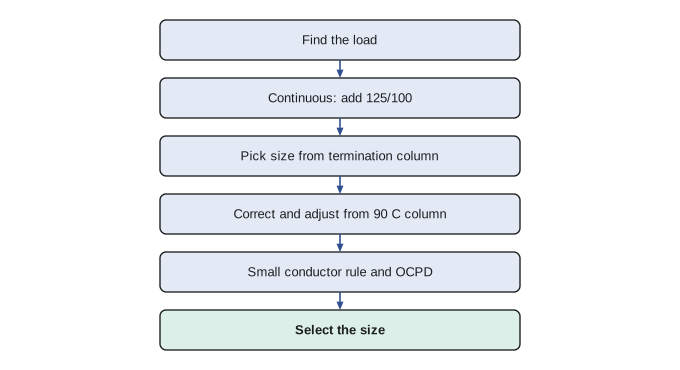
Under 110.14(C), circuits rated 100 amperes or less, or using 14 through 1 AWG conductors, must use the 60-degree column unless the equipment is listed and marked for higher-temperature conductors, in which case the 75-degree column may be used if the conductors are rated at least 75 degrees. Circuits rated over 100 amperes, or with conductors larger than 1 AWG, may use the 75-degree column. Most panelboards, breakers and switches made today are marked for 75-degree terminations, so in practice and on many exam questions the 75-degree column applies, but the question may tell you otherwise, and an exam is exactly where a 60-degree termination will be specified to catch you.
The 90-degree column still matters. When a conductor rated 90 degrees needs correction or adjustment for ambient temperature or for more than three current-carrying conductors, you start from the 90-degree value and apply the factors. The result must then not exceed the ampacity in the termination temperature column. Lesson 5 works through this in detail.
Worked problem
The garage feeder at Maple Street, with sample numbers
The detached garage needs a 60-ampere feeder. The breaker and the garage panel are marked for 75-degree terminations, the conductors are THHN/THWN-2 copper in a buried conduit, and there are three current-carrying conductors at a normal ambient. Using the sample table above, which size is the smallest that works?
Show solution
- The circuit is rated 100 amperes or less, but the equipment is marked 75 degrees and the conductors are rated 90 degrees, so the 75-degree copper column applies.
- In the sample table, Size 3 has 49 amperes at 75 degrees, which is too small; Size 4 has 71 amperes, which is enough.
- No correction or adjustment is needed: three current-carrying conductors and a normal ambient.
- Check the device: a 60-ampere breaker protecting a conductor with a 71-ampere ampacity is fine.
Answer: Size 4 in the sample table. In a real question, read the 75-degree copper column of Table 310.16 in your book.
Counting current-carrying conductors
Because the table assumes not more than three current-carrying conductors, you must count them correctly. Section 310.15(E) says a neutral that carries only the unbalanced current of other conductors of the same circuit is not counted. A neutral of a three-phase, four-wire wye circuit where a major portion of the load is nonlinear, such as electronic equipment or LED drivers, is counted, because harmonic currents add in the neutral. A neutral of a three-wire circuit taken from two phases of a four-wire wye system is counted, because it carries close to the same current as the phase conductors. Section 310.15(F) says equipment grounding and bonding conductors are not counted.
| Circuit | Count the neutral? |
|---|---|
| 120/240 V single-phase, three-wire | No: it carries only the unbalanced current |
| 208Y/120 V three-phase, four-wire, mostly linear loads | No |
| 208Y/120 V three-phase, four-wire, mostly nonlinear loads | Yes: harmonic currents add |
| Two phases and the neutral of a 208Y/120 V system | Yes: it carries about the same current as the phases |
| Any circuit's equipment grounding conductor | Never |
Parallel conductors and other special cases
Large feeders often use two or more conductors in parallel for each phase. Section 310.10(G) allows this for sizes 1/0 AWG and larger, with all conductors in each phase or neutral set the same length, the same material, the same size, the same insulation type and terminated the same way. Where parallel conductors run in separate raceways, each raceway must contain one conductor of each phase, the neutral if there is one, and an equipment grounding conductor sized for the overcurrent device. The ampacity of the set is the sum of the individual ampacities after any adjustment for the number of conductors in each raceway.
Other special cases include the 83 out of 100 rule for dwelling services from lesson 2, conductors in cable assemblies such as Type NM, which use the 60-degree column for ampacity but may use the 90-degree rating for derating, and conductors for motors, air-conditioning equipment and welders, which have their own sizing rules in Articles 430, 440 and 630.
# Choosing the smallest size from a column (sample table values, not the Code's)
sample = {"Size 1": {"60": 20, "75": 24, "90": 28}, "Size 2": {"60": 28, "75": 34, "90": 39},
          "Size 3": {"60": 41, "75": 49, "90": 56}, "Size 4": {"60": 59, "75": 71, "90": 81},
          "Size 5": {"60": 84, "75": 101, "90": 115}}

def smallest(load, column):
    for size, row in sample.items():
        if row[column] >= load:
            return size, row[column]
    return None, None

for load, col in [(60, "75"), (60, "60"), (45, "75"), (95, "75")]:
    size, amp = smallest(load, col)
print(f"Load {load} A in the {col} C column: {size} ({amp} A)")Load 60 A in the 75 C column: Size 4 (71 A) Load 60 A in the 60 C column: Size 5 (84 A) Load 45 A in the 75 C column: Size 3 (49 A) Load 95 A in the 75 C column: Size 5 (101 A)
2026 notes
The 2026 edition keeps Article 310 for conductors rated up to 2000 volts and moves medium-voltage conductor material into the 260s. The basic structure of the ampacity tables and the termination rule does not change, but always confirm table numbers in your edition.
Aluminum conductors
Aluminum and copper-clad aluminum conductors are common for feeders and services because they cost less and weigh less than copper. They carry less current for a given size, so an aluminum feeder is usually one or two sizes larger than the copper equivalent. Section 110.14 requires terminals and splicing connectors to be identified for the conductor material: terminals marked AL/CU accept either, those marked CU only accept copper, and dissimilar metals may not be mixed in a terminal or connector unless it is identified for the purpose. Aluminum terminations also need the manufacturer's torque values, which 110.14(D) requires to be applied with a calibrated tool where specified. Modern aluminum building wire uses an AA-8000 series alloy, which avoids the creep and loosening problems of the older alloys used in some 1960s and 1970s branch circuit wiring.
Section 310.10 and the tables limit aluminum in small sizes. Aluminum branch circuits smaller than 12 AWG are not generally available, and the small conductor rule caps 12 AWG aluminum at 15 amperes and 10 AWG aluminum at 25 amperes. On an exam, read the material in the question carefully: the same ampacity table has separate copper and aluminum columns side by side, and choosing the wrong half of the table is one of the easiest ways to lose a point.
Exam habits for ampacity questions
Dana's habits for any ampacity question: underline the material, the insulation type, the termination rating and the number of current-carrying conductors before opening the book; write the column she will use in the margin; and read across the row with a straightedge or the edge of her answer sheet so her eye does not slip to the next line. She also checks whether the question gives the conductors in free air, in cable or in raceway, because the free-air tables give higher values and a question about a cable tray or a single overhead conductor may use them. These small habits remove the most common table errors before any calculation starts.
Common mistakes
MistakeReading the 90-degree column for a circuit with 75-degree terminations.
InsteadThe termination rating limits the usable ampacity; the 90-degree column is only the starting point for correction and adjustment.
MistakeCounting the neutral of a 120/240-volt circuit as current-carrying.
InsteadA neutral carrying only unbalanced current is not counted.
MistakeForgetting that the table assumes three conductors and 30 degrees Celsius.
InsteadMore conductors or a different ambient requires adjustment or correction.
MistakeParalleling 2 AWG conductors.
InsteadParallel conductors must be 1/0 AWG or larger, with listed exceptions.
MistakeUsing THHN in an underground conduit.
InsteadUnderground raceways are wet locations; use a W-rated type such as THWN-2 or XHHW-2.
Summary and key terms
- Conductor type letters describe insulation, temperature and location ratings; -2 means 90 degrees wet.
- Table 310.16 assumes not more than three current-carrying conductors at 30 degrees Celsius.
- Choose the column from the lowest temperature rating of the conductor and its terminations, under 110.14(C).
- Count neutrals only when they carry more than unbalanced current; never count grounding conductors.
- Parallel conductors must be 1/0 AWG or larger and identical in each phase.
- The 90-degree column is the starting point for correction and adjustment, limited by the termination column.
- Ampacity
- The current a conductor can carry continuously under its conditions of use without exceeding its temperature rating.
- Current-carrying conductor
- A conductor that carries load current and counts toward the number of conductors in a raceway.
- kcmil
- Thousands of circular mils, the unit for conductor sizes above 4/0 AWG.
- Termination temperature rating
- The maximum conductor temperature a terminal is listed for, usually 60 or 75 degrees Celsius.
- Parallel conductors
- Two or more conductors connected at both ends to act as one larger conductor.
- Nonlinear load
- A load whose current is not proportional to voltage, such as electronic power supplies, which creates harmonic currents.
Practice problems
Work each problem on paper first, then reveal the answer to check.
A circuit is rated 50 amperes with 75-degree terminations and THHN copper conductors. Which column sets the usable ampacity?
Show answer
The 75-degree copper column, provided the equipment is marked for 75-degree conductors.
A four-wire 208Y/120-volt feeder serves mostly LED drivers and computers. How many current-carrying conductors does it have?
Show answer
Four. The neutral counts because the load is mostly nonlinear.
What is the smallest size permitted for conductors in parallel, in general?
Show answer
1/0 AWG.
Which conductor type is suitable at 90 degrees in a wet location: THHN or THWN-2?
Show answer
THWN-2.
What ambient temperature does Table 310.16 assume?
Show answer
30 degrees Celsius, or 86 degrees Fahrenheit.
Lesson quiz · 5 questions
Score 60% or more to complete this lesson.
Create a free account to save your progress, take quizzes and earn a certificate.