
MELU-103 · Lesson 7 of 12 · 21 min
Raceway fill using Chapter 9
▶ Video coming soon A video version of this lesson is on the way.
Conduit fill questions appear on almost every master exam because they reward exactly the skills the exam is built to test: finding the right table, reading the right column, applying the notes and doing careful arithmetic. Every raceway article in Chapter 3 has a section numbered .22 that says how many conductors the raceway may contain, and almost all of them send you to Chapter 9. This lesson explains the three Chapter 9 tables that work together, the notes that change the answer, the quick method using Annex C for conductors of one size, and the long method for mixed conductors.
Conductor and conduit areas in the worked examples below are illustrative unless stated; use Chapter 9 Tables 4 and 5 in your own book for real values.
Why fill is limited
A raceway packed too tightly causes three problems. Conductors pulled into a crowded conduit can have their insulation scraped or crushed, especially around bends. Heat from the conductors has less room to escape, which is why fill and the adjustment factors of lesson 5 often go together. And a full raceway leaves no room for future conductors. The Code's fill limits leave enough free space to pull conductors without damage. Separately, the .26 section of each raceway article limits the bends between pull points to 360 degrees in total, so pulls do not become impossible even within the fill limits.
The three tables
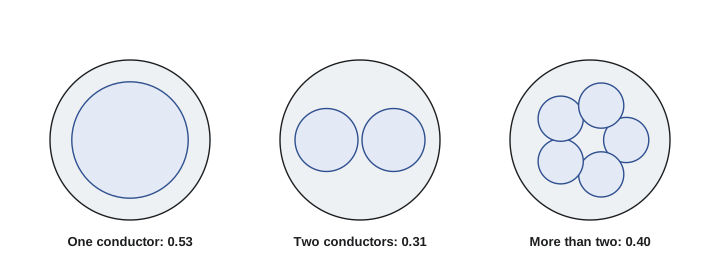
Chapter 9 Table 1 gives the maximum share of a conduit's internal cross-sectional area that conductors may occupy: 0.53 for one conductor, 0.31 for two conductors, and 0.40 for more than two. The odd middle value for two conductors exists because two round conductors of nearly the conduit's diameter can jam side by side. Table 4 gives the internal area of each trade size of each raceway type, with separate columns for the 0.53, 0.31 and 0.40 areas already calculated, so you rarely multiply by the share yourself. Table 5 gives the approximate area of each conductor size for each insulation type, and Table 5A covers compact conductors. Table 8 gives bare conductor dimensions.
| Number of conductors or cables | Allowable share of the raceway area |
|---|---|
| 1 | 0.53 |
| 2 | 0.31 |
| More than 2 | 0.40 |
The notes that change answers
The notes to Table 1 are part of the table, and several of them decide exam questions. Equipment grounding and bonding conductors, when installed, must be included in the fill calculation, using their actual dimensions; insulated or bare. Where a calculation of the number of same-size conductors results in a decimal of 0.8 or larger, the next higher whole number may be used, which is how Annex C arrives at some of its values. A nipple 24 inches or shorter between boxes or enclosures may be filled to 0.60 of its area, and the adjustment factors of 310.15(C)(1) do not apply to it. Multiconductor cables are treated as a single conductor using the cable's actual area, and an elliptical cable uses the area of a circle with its major diameter. Conductors not listed in Table 5, such as some compact or fixture types, use the actual dimensions.
| Note | Effect on the answer |
|---|---|
| Equipment grounding conductors count | Add their area to the total |
| 0.8 rounding for same-size conductors | A result of 7.8 conductors may be rounded to 8 |
| Nipples 24 inches or shorter | Fill up to 0.60; no adjustment factors |
| Cables count as one conductor | Use the cable's actual area; two cables use 0.31 |
| Elliptical cables | Use the area of a circle with the major diameter |
The quick method: Annex C
When every conductor in the raceway is the same size and insulation type, informative Annex C gives the answer directly. It has a table for each raceway type, such as EMT, rigid metal conduit, Schedule 40 and 80 PVC and flexible metal conduit, each listing the maximum number of conductors of each size and insulation in each trade size. Annex C applies the 0.40 share, the conductor areas of Table 5 and the 0.8 rounding rule. A question such as 'How many 10 AWG THHN conductors may be installed in 3/4-inch EMT?' takes seconds: find the EMT table, the THHN rows, the 10 AWG line and the 3/4 column. Annex C does not handle mixed sizes or equipment grounding conductors of a different size, so do not use it when the conductors differ.
The long method for mixed conductors
When conductors differ in size or type, add their areas from Table 5, including any equipment grounding conductors, and compare the total with the 0.40 column of Table 4 for the raceway type. Choose the smallest trade size whose allowable area is at least the total. Dana does these on the exam in a fixed layout: one line per conductor size with the quantity, the area of one conductor and the subtotal, then a total, then the raceway lookup.
Worked problem
The Copper Kettle kitchen conduit, with illustrative areas
Dana must choose an EMT size for six 10 AWG THHN conductors, three 8 AWG THHN conductors and one 10 AWG THHN equipment grounding conductor. Suppose Table 5 gives 0.0211 square inch for 10 AWG THHN and 0.0366 for 8 AWG THHN, and Table 4's 0.40 column for EMT gives 0.213 square inch for 3/4 inch and 0.346 for 1 inch. Which size is required?
Show solution
- 10 AWG: six conductors plus one grounding conductor is seven, times 0.0211, which is 0.1477 square inch.
- 8 AWG: three times 0.0366, which is 0.1098 square inch.
- Total: 0.1477 plus 0.1098 is 0.2575 square inch.
- 3/4-inch EMT allows 0.213: too small. 1-inch EMT allows 0.346: enough.
Answer: 1-inch EMT, with the illustrative areas. With your book's values the method is the same.
# Mixed-conductor raceway fill (areas are illustrative; use Chapter 9 Tables 4 and 5)
conductor_area = {"10 THHN": 0.0211, "8 THHN": 0.0366, "6 THHN": 0.0507}
emt_40 = {"1/2": 0.122, "3/4": 0.213, "1": 0.346, "1-1/4": 0.598}

def smallest_raceway(items):
    total = sum(qty * conductor_area[kind] for kind, qty in items)
    for size, allowed in emt_40.items():
        if allowed >= total:
            return round(total, 4), size
    return round(total, 4), "larger than listed"

print(smallest_raceway([("10 THHN", 7), ("8 THHN", 3)]))
print(smallest_raceway([("6 THHN", 4), ("8 THHN", 1)]))(0.2575, '1') (0.2394, '1')
Maximum conductors of one size, the long way
Sometimes a question gives a raceway size and asks how many conductors of one size fit, but the conductor type or raceway is one Annex C does not cover, or the exam wants to see the method. Divide the raceway's 0.40 area by the area of one conductor. If the result has a decimal of 0.8 or more, round up; otherwise round down. For example, with an allowable area of 0.346 square inch and a conductor area of 0.0437, the result is 7.92 conductors, which may be rounded up to 8.
# Number of same-size conductors with the 0.8 rounding rule of the Chapter 9 notes
import math

def max_conductors(allowed_area, conductor_area):
    n = allowed_area / conductor_area
    whole = math.floor(n)
    return n, whole + 1 if n - whole >= 0.8 else whole

for allowed, each in [(0.346, 0.0437), (0.213, 0.0211), (0.598, 0.0824)]:
    n, answer = max_conductors(allowed, each)
print(f"{allowed} / {each} = {n:.2f} -> {answer} conductors")0.346 / 0.0437 = 7.92 -> 8 conductors 0.213 / 0.0211 = 10.09 -> 10 conductors 0.598 / 0.0824 = 7.26 -> 7 conductors
Cables, nipples and other cases
A raceway containing a single multiconductor cable uses the 0.53 share; two cables use 0.31; three or more use 0.40. A short nipple between a panelboard and a gutter, 24 inches or less, may be filled to 0.60, which is why gutters are often connected by close nipples. Wireways and auxiliary gutters are not Chapter 9 raceways: Article 376 limits a metal wireway's conductors to 0.20 of its cross-sectional area at any point, and the number of current-carrying conductors to 30 before adjustment factors apply, while 0.75 of the area is allowed at splices and taps. Cable trays have their own fill rules in Article 392. Remember these different numbers: a question about a wireway answered with the conduit rule is wrong.
| Enclosure | Fill limit | Article |
|---|---|---|
| Conduit or tubing, more than two conductors | 0.40 of area | Chapter 9, Table 1 |
| Nipple 24 inches or shorter | 0.60 of area | Chapter 9, Table 1, notes |
| Metal wireway, conductors | 0.20 of area at any point | 376.22 |
| Metal wireway, splices and taps | 0.75 of area at that point | 376.56 |
| Auxiliary gutter | Similar to wireways | 366.22 |
Bends and pull points
Section .26 of each raceway article limits the bends between pull points, such as boxes and conduit bodies, to the equivalent of four quarter bends, 360 degrees in total, including offsets and kicks. Offsets count as the sum of their bends: a typical offset made with two 30-degree bends adds 60 degrees. Dana counts the bends on the Copper Kettle conduit as she lays it out: a 90 at the panel, two offsets of 30 and 30, and a 90 into the ceiling make 240 degrees, so one more 90 is the limit before a pull box.
Compact conductors and the actual-dimension rule
Large feeders sometimes use compact stranded conductors, whose strands are shaped to reduce the conductor's diameter. Chapter 9 Table 5A gives the areas of compact conductors with common insulations, and those smaller areas let more conductors fit in a raceway. Compact aluminum feeders are popular for that reason: an aluminum conductor larger than its copper equivalent may still fit in the same conduit when compacted. When a conductor type or size does not appear in Table 5 or 5A, the notes to Table 1 require the actual dimensions, usually from the manufacturer's data sheet. Exam questions using compact conductors always say so; if a question does not mention compact conductors, use Table 5.
Conduit fill and derating together
Conduit fill and the adjustment factors of lesson 5 often appear in the same question. A conduit large enough to hold twelve conductors within the 0.40 limit can still require their ampacity to be reduced to 0.50, because ten to twenty current-carrying conductors share it. Designers sometimes split a large group of circuits between two conduits for exactly this reason: two conduits with six current-carrying conductors each use the 0.80 multiplier instead of 0.50, which can save a conductor size on every circuit. When Dana lays out the Copper Kettle's kitchen circuits, she checks both: first that the conduit size meets Chapter 9, then that the conductors still carry their loads after adjustment for the number in that conduit.
Worked problem
Two conduits or one?
Twelve current-carrying conductors could share one 1-1/4-inch conduit, or be split into two 1-inch conduits with six each. Using a sample 90-degree ampacity of 30 amperes for each conductor, compare the adjusted ampacities.
Show solution
- One conduit, twelve conductors: multiplier 0.50, so 30 times 0.50 is 15 amperes.
- Two conduits, six conductors each: multiplier 0.80, so 30 times 0.80 is 24 amperes.
- The split arrangement keeps the conductors usable on 20-ampere circuits; the single conduit does not.
Answer: Two conduits: 24 amperes each versus 15 amperes in one conduit, with the sample value.
Checking a fill answer quickly
A fast sanity check for any conduit fill answer is to compare it with field experience. Six 10 AWG THHN conductors plus a ground fit comfortably in 3/4-inch EMT on most jobs; twelve 12 AWG conductors usually need 1-inch; and four 500 kcmil conductors need a raceway of 3 inches or more. If a calculation suggests 1/2-inch conduit for a dozen conductors, something has gone wrong, usually a misread area or the wrong fill column. Dana keeps a short list of these benchmark combinations on the inside cover of her study binder, taken from Annex C in her own book, so she can spot a wrong answer before she marks it.
Common mistakes
MistakeUsing 0.40 for two conductors.
InsteadTwo conductors use 0.31; one conductor uses 0.53; more than two use 0.40.
MistakeLeaving equipment grounding conductors out of the fill calculation.
InsteadGrounding and bonding conductors count toward fill.
MistakeUsing Annex C for mixed conductor sizes.
InsteadAnnex C is for conductors of one size and type; mixed sizes need Tables 4 and 5.
MistakeApplying conduit fill rules to a wireway.
InsteadWireways allow 0.20 of their area at any point, under 376.22.
MistakeForgetting the 0.8 rounding rule.
InsteadWhen a same-size count ends in 0.8 or more, the next whole number may be used.
Summary and key terms
- Chapter 9 Table 1 sets fill shares: 0.53 for one conductor, 0.31 for two, 0.40 for more than two.
- Table 4 gives raceway areas; Table 5 gives conductor areas; the notes to Table 1 are mandatory.
- Grounding conductors count; nipples 24 inches or less may be filled to 0.60.
- Annex C answers same-size questions directly; mixed sizes need the long method.
- Wireways and gutters use 0.20 of area for conductors and 0.75 at splices.
- Bends between pull points must not exceed 360 degrees.
- Trade size
- The nominal size of a raceway, such as 3/4 inch, which differs from its actual internal diameter.
- Fill
- The share of a raceway's internal area occupied by conductors.
- Annex C
- Informative tables of the maximum number of same-size conductors in each raceway.
- Nipple
- A short raceway, 24 inches or less, between enclosures.
- Pull point
- A box, conduit body or fitting where conductors can be pulled.
- Wireway
- A sheet metal or nonmetallic trough with a hinged or removable cover.
Practice problems
Work each problem on paper first, then reveal the answer to check.
What share of a conduit's area may two conductors occupy?
Show answer
0.31.
A raceway allows 0.598 square inch at 0.40 fill. Conductors total 0.55 square inch. Does it fit?
Show answer
Yes. 0.55 is less than 0.598.
A calculation gives 11.85 same-size conductors. How many may be installed?
Show answer
12, because the decimal is 0.8 or more.
What fill share applies to a 20-inch nipple?
Show answer
0.60.
What is the most total bend allowed between pull points?
Show answer
360 degrees.
Lesson quiz · 5 questions
Score 60% or more to complete this lesson.
Create a free account to save your progress, take quizzes and earn a certificate.