
MELU-103 · Lesson 2 of 12 · 23 min
Feeders and services under Articles 215 and 230
▶ Video coming soon A video version of this lesson is on the way.
Lesson 1 worked at the outlet end of the system. This lesson moves upstream to the feeders that carry power between panelboards and the service that brings power into the building from the utility. Article 215 covers feeders and Article 230 covers services, and together they produce some of the most heavily tested rules on master exams: feeder sizing, ground-fault protection of equipment, service conductor sizing, overhead clearances, the location and number of service disconnects, and the minimum service rating for a dwelling. Feeder and service load calculations, which feed into these rules, are covered in depth in MELU-102; here the focus is on what Articles 215 and 230 require once you have the load.
Delgado Fabrication's upgrade
Brightwater has won the contract for the service upgrade at Delgado Fabrication, a small machine shop moving from an old 200-ampere, 208-volt service to a new 400-ampere, 480Y/277-volt service with a step-down transformer for the office and lighting loads. Ray wants Dana to lay out the service equipment and the feeders. 'This job has a service, three feeders, a transformer and a panel in a mezzanine,' he says. 'If you can explain every conductor on it, you can pass the service and feeder questions.' Gloria Haynes, the city's chief electrical inspector, has already asked to see the plan before the utility schedules the new drop.
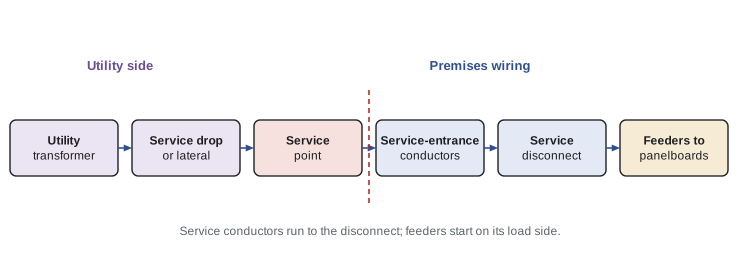
Feeder or service?
The first exam skill is naming the conductor. Article 100 defines the service point as the point of connection between the utility's facilities and the premises wiring. Everything from the service point to the service disconnecting means is service conductors: overhead service conductors and service drops on overhead systems, underground service conductors and service laterals on underground systems, and service-entrance conductors within or on the building. Everything from the service equipment, or from a separately derived system such as a transformer, to the final branch-circuit overcurrent device is a feeder. The distinction matters because services have rules feeders do not, such as limited routes inside buildings and no overcurrent protection at the supply end, and feeders have rules services do not.
| Conductor at Delgado | Classification | Main article |
|---|---|---|
| Utility conductors to the weatherhead | Overhead service conductors (utility side) | Article 230, Part II, where premises-owned |
| Weatherhead to the 400 A disconnect | Service-entrance conductors | Article 230, Part IV |
| 400 A disconnect to the shop distribution panel | Feeder | Article 215 |
| Distribution panel to the 45 kVA transformer | Feeder (transformer primary) | Articles 215, 240 and 450 |
| Transformer secondary to the office panel | Feeder from a separately derived system | Articles 215 and 240.21(C) |
| Office panel breakers to the outlets | Branch circuits | Article 210 |
Feeder sizing under 215.2
Section 215.2 uses the same structure as branch circuits. The feeder conductors must have an ampacity not less than the noncontinuous load plus 125 out of 100 of the continuous load, before any adjustment or correction factors, and not less than the maximum load to be served after them. The feeder's overcurrent protection, under 215.3, must likewise be rated not less than the noncontinuous load plus 125 out of 100 of the continuous load, unless the whole assembly is listed for 100 out of 100 operation. A feeder must also have an ampacity not less than the service conductors when it carries the total load supplied by service conductors with an ampacity of 55 amperes or less, a small-system rule that rarely applies to commercial work.
Feeders that supply two-wire or multiwire branch circuits must have a grounded conductor if any of those branch circuits need one, and the feeder neutral is sized from the calculated neutral load in Article 220, which can be less than the ungrounded conductors when loads are balanced or are line-to-line. Feeders to a building or structure other than the one with the service also bring in the rules of Article 225, including a disconnect at each building.
Worked problem
Sizing the shop distribution feeder
The shop's distribution panel will carry 260 amperes of noncontinuous motor and receptacle load and 64 amperes of continuous lighting and process heating load at 480 volts, three-phase. What minimum ampacity must the feeder conductors have before adjustment and correction, and what is the smallest standard overcurrent device that satisfies 215.3?
Show solution
- Noncontinuous load: 260 amperes. Continuous load: 64 times 1.25 is 80 amperes.
- Required ampacity: 260 plus 80 is 340 amperes.
- Standard overcurrent device ratings around that value include 300, 350 and 400 amperes; the device must be not less than 340, so 350 amperes is the smallest that works.
- Dana writes down that the conductors must then be chosen from the 75-degree column if the terminations are rated 75 degrees, and checked again after any adjustment factors, which lesson 5 covers.
Answer: Feeder ampacity of at least 340 amperes, protected by at least a 350-ampere device.
# Feeder minimum ampacity and device (illustrative list of standard ratings)
standard = [100, 110, 125, 150, 175, 200, 225, 250, 300, 350, 400, 450, 500, 600]

def feeder(noncontinuous, continuous):
    need = noncontinuous + 1.25 * continuous
    return need, next(r for r in standard if r >= need)

for name, nc, c in [("Shop distribution", 260, 64), ("Mezzanine panel", 70, 40), ("Office transformer primary", 40, 12)]:
    need, dev = feeder(nc, c)
print(f"{name}: at least {need:.0f} A ampacity, device at least {dev} A")Shop distribution: at least 340 A ampacity, device at least 350 A Mezzanine panel: at least 120 A ampacity, device at least 125 A Office transformer primary: at least 55 A ampacity, device at least 100 A
Ground-fault protection of equipment
Large solidly grounded wye systems at 480Y/277 volts can sustain low-level arcing ground faults that do not draw enough current to trip a large breaker quickly, and those arcs can destroy switchgear. Sections 230.95 for services and 215.10 for feeders therefore require ground-fault protection of equipment for each service or feeder disconnect rated 1000 amperes or more on a solidly grounded wye system with more than 150 volts to ground but not more than 600 volts phase to phase in older editions, with the voltage limit worded as 1000 volts in recent ones. The protection must operate to open all ungrounded conductors, with a maximum setting and time delay set by the Code, and it must be performance tested when first installed. Fire pumps and continuous industrial processes where a sudden shutdown would create more hazard are exempt.
Delgado's 400-ampere service is below the 1000-ampere threshold, so ground-fault protection of equipment is not required there. On the exam, check three facts before you apply these sections: the disconnect rating, whether the system is a solidly grounded wye, and the voltage to ground. A 208Y/120-volt system is only 120 volts to ground and never triggers the requirement.
| Disconnect | System | GFPE required? |
|---|---|---|
| 1200 A | 480Y/277 V solidly grounded wye | Yes: rating at or above 1000 A and more than 150 V to ground |
| 1200 A | 208Y/120 V | No: only 120 V to ground |
| 800 A | 480Y/277 V | No: below 1000 A |
| 1600 A | 480 V delta, ungrounded | No: not a solidly grounded wye |
Service conductors and clearances
Article 230 starts with a basic rule in 230.2: a building or structure is supplied by only one service, with exceptions for fire pumps, emergency and standby systems, parallel power production, multiple-occupancy buildings, large capacity requirements and different voltages or uses. Service conductors from one building may not pass through the interior of another, and service conductors inside a building are treated as outside the building only when they are under at least 2 inches of concrete, in a raceway encased in brick or concrete, or in a vault, under 230.6. That rule exists because service conductors have no overcurrent protection on their supply end.
Overhead service conductors need clearances: from building openings such as windows and doors, from roofs, and above grade, driveways and roads. The vertical clearances above ground step up with the risk: lower values over areas accessible only to pedestrians, higher values over residential driveways and commercial areas not subject to truck traffic, and higher still over roads, alleys and parking lots where trucks travel. Rather than memorize every value, know the structure of the rule, which section holds it and how the voltage to ground changes the lowest values, and look the numbers up in your book. Service-entrance conductors must have sufficient ampacity for the load calculated under Article 220 and must not be smaller than the minimum service rating.
The service disconnect
Section 230.70 requires a means to disconnect all service conductors from the building wiring, installed at a readily accessible location either outside the building or inside nearest the point of entrance of the service conductors. Many jurisdictions set a maximum length of service-entrance conductor inside the building before the disconnect, so check local amendments. Each disconnect must be permanently marked as a service disconnect, and where there is more than one, a plaque or directory must identify the others.
Section 230.71 limits the number of service disconnects. Under editions since 2020, each service may have up to six disconnects, but they must be in separate enclosures, in separate vertical sections of switchgear or switchboards with barriers, or in separate compartments; the old practice of six main breakers in one panelboard with no main is no longer permitted. Section 230.72 requires the disconnects to be grouped. Section 230.79 sets minimum ratings: 100 amperes for a one-family dwelling, 60 amperes for other installations, with smaller values for installations of one or two circuits.
For one- and two-family dwellings, 230.85 now requires an emergency disconnect at a readily accessible outdoor location, so firefighters can shut off power without entering the building. It can be the service disconnect itself, a meter disconnect or another listed device, and it must be marked. And under 230.67, services supplying dwelling units, and in recent editions dormitory units, guest rooms and some patient rooms, must have a surge-protective device, a rule lesson 11 returns to.
| Rule | Requirement in brief | Section |
|---|---|---|
| Number of services | One per building, with listed exceptions | 230.2 |
| Conductors considered outside | Under 2 in of concrete, encased, or in a vault | 230.6 |
| Disconnect location | Readily accessible, outside or nearest the point of entrance | 230.70(A) |
| Number of disconnects | Up to six, in separate enclosures or compartments | 230.71 |
| Minimum rating | 100 A one-family dwelling; 60 A other installations | 230.79 |
| Emergency disconnect | Outdoor, readily accessible, for one- and two-family dwellings | 230.85 |
| Surge protection | Required for services supplying dwelling units | 230.67 |
Dwelling services and feeders: the 83 out of 100 rule
For 120/240-volt, three-wire single-phase dwelling services and the feeders that carry the entire load of a dwelling unit, 310.12 allows the service-entrance or feeder conductors to be sized at 83 out of 100 of the service rating, before any adjustment and correction factors. A 200-ampere service may therefore use conductors with an ampacity of at least 166 amperes. Older editions had a separate table of conductor sizes for this; since 2020 the rule is the 83 out of 100 factor. It does not apply to a feeder that does not carry the whole dwelling load, to three-phase services, or to a 208Y/120-volt service in an apartment building where each unit is fed by two phases and a neutral.
Worked problem
A fourplex unit feeder
Each Maple Street unit has a 125-ampere panel fed from a meter stack at the building's service, at 120/240 volts single-phase, and each feeder carries the entire load of its unit. What minimum conductor ampacity is required for each unit feeder under 310.12?
Show solution
- The feeder carries the whole dwelling unit load at 120/240 volts, single-phase, three-wire, so the 83 out of 100 rule applies.
- 125 times 0.83 is 103.75 amperes.
- Choose a conductor with an ampacity of at least 103.75 amperes in the column for the termination temperature, then apply any correction or adjustment factors.
Answer: At least 103.75 amperes, before any adjustment or correction.
2026 notes
In the 2026 edition, the service and feeder sizing rules stay in Articles 230 and 215, but the load calculations they refer to move from Article 220 to Article 120, and medium-voltage service and feeder material is gathered in new articles in the 260s. Section numbers you have tabbed for services and feeders under 1000 volts mostly stay put. Always check which edition your exam uses.
Common mistakes
MistakeCalling the conductors from the service disconnect to a subpanel service conductors.
InsteadConductors on the load side of the service disconnect are feeders.
MistakeApplying ground-fault protection rules to a 1200-ampere 208Y/120-volt service.
InsteadGFPE applies only above 150 volts to ground on solidly grounded wye systems, at 1000 amperes or more.
MistakeInstalling six main breakers in a single panelboard with no main as the service disconnects.
InsteadSince 2020, multiple service disconnects must be in separate enclosures or compartments.
MistakeUsing the 83 out of 100 rule for a feeder that serves only part of a dwelling.
InsteadThe rule applies only to services and feeders carrying the entire dwelling load at 120/240 volts, single-phase.
MistakeForgetting the outdoor emergency disconnect on a new one-family dwelling.
Instead230.85 requires an outdoor emergency disconnect for one- and two-family dwellings.
Summary and key terms
- Service conductors run from the service point to the service disconnect; feeders run from the service equipment or a separately derived system to the final branch-circuit device.
- Feeders and their devices are sized for noncontinuous load plus 125 out of 100 of continuous load.
- GFPE is required at 1000 amperes or more on solidly grounded wye systems over 150 volts to ground.
- A building has one service, with exceptions; service disconnects are readily accessible and limited to six, in separate enclosures.
- One-family dwelling services must be at least 100 amperes, with an outdoor emergency disconnect and surge protection.
- Single-phase dwelling services and whole-unit feeders may be sized at 83 out of 100 of the rating.
- Service point
- The point of connection between the utility and the premises wiring.
- Service-entrance conductors
- Service conductors between the terminals of the service equipment and the point of connection to the service drop or lateral.
- Feeder
- Conductors between the service equipment or a separately derived system and the final branch-circuit overcurrent device.
- GFPE
- Ground-fault protection of equipment: a system that opens all ungrounded conductors on a ground fault below the device's normal trip level.
- Emergency disconnect
- An outdoor disconnect for one- and two-family dwellings used by first responders.
- Separately derived system
- A system supplied by a source such as a transformer with no direct connection to the supply conductors of another system except through grounding and bonding.
Practice problems
Work each problem on paper first, then reveal the answer to check.
A feeder carries 120 amperes noncontinuous and 40 amperes continuous load. What minimum ampacity is required before adjustment?
Show answer
120 plus 50, which is 170 amperes.
Is ground-fault protection of equipment required for a 1000-ampere, 480Y/277-volt solidly grounded wye service disconnect?
Show answer
Yes. It meets all three conditions.
What is the minimum service rating for a one-family dwelling?
Show answer
100 amperes.
A 150-ampere dwelling service at 120/240 volts single-phase uses the 83 out of 100 rule. What minimum conductor ampacity is required?
Show answer
150 times 0.83, which is 124.5 amperes.
How many service disconnects may a service have, and how must they be arranged?
Show answer
Up to six, in separate enclosures, sections or compartments, grouped together.
Lesson quiz · 5 questions
Score 60% or more to complete this lesson.
Create a free account to save your progress, take quizzes and earn a certificate.