
MELU-103 · Lesson 10 of 12 · 22 min
Raceway wiring methods
▶ Video coming soon A video version of this lesson is on the way.
Raceways protect conductors where cables would be damaged, where the environment is harsh, where future changes are expected, and where the building type or the owner requires them. Each raceway type has its own Chapter 3 article, organized with the same section endings as the cable articles. Master exams test raceway questions in three ways: which raceway is permitted in a given location, how it must be supported and connected, and how many conductors and bends it may have. This lesson covers the metal raceways, rigid metal conduit, intermediate metal conduit and electrical metallic tubing; the nonmetallic raceways, PVC and electrical nonmetallic tubing; the flexible raceways; and the Article 300 rules that apply to all of them, such as expansion, sealing and induced currents.
Support distances and other numbers in this lesson are the commonly tested values; check each against the article in your edition, because the support tables for rigid conduit and PVC vary by trade size.
Delgado's shop floor
The machine shop at Delgado Fabrication is full of forklifts, coolant, steel chips and moving machinery. The new feeders and motor circuits there need raceways, and Dana has to choose the type for each run: overhead from the new service to the distribution panel, down the walls to the machines, under the slab to the CNC machine, and the final connections to vibrating equipment. Ray tells her to choose the cheapest raceway that the Code permits for each location, and to defend every choice.
Rigid metal conduit and intermediate metal conduit
Rigid metal conduit, Article 344, is the heaviest and most protective raceway. Section 344.10 permits it in all atmospheric conditions and occupancies, including direct burial and concrete encasement, with corrosion protection where needed, and it is the default for severe physical damage. Intermediate metal conduit, Article 342, has thinner walls and the same broad uses. Both are threaded and use threaded couplings or listed threadless fittings, and both must be supported within 3 feet of each box, conduit body or other termination, and at intervals that depend on trade size, generally 10 feet, with longer spacing for larger sizes with threaded couplings under the support tables. Both may serve as equipment grounding conductors under 250.118.
Electrical metallic tubing
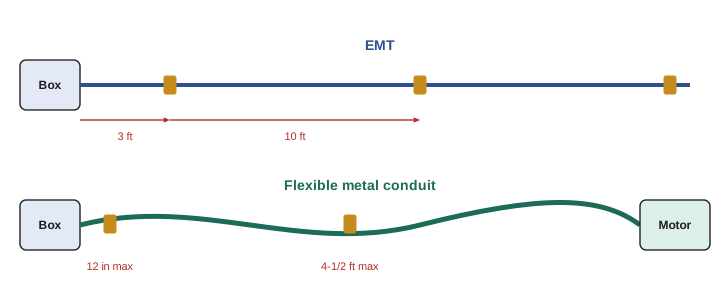
Electrical metallic tubing, Article 358, is thin-walled, unthreaded tubing joined with set-screw or compression fittings. It is the most common commercial raceway because it is light and quick to install. Section 358.10 permits it exposed and concealed, in wet locations with fittings listed for wet use, and in concrete or direct burial where protected from corrosion and approved. Section 358.12 prohibits it where subject to severe physical damage and in certain corrosive environments. EMT must be secured within 3 feet of each outlet box, junction box, cabinet or conduit body, and at intervals not exceeding 10 feet, with an exception allowing longer unbroken lengths to be fastened up to 5 feet from terminations in some structural members. Like RMC and IMC, EMT may serve as an equipment grounding conductor.
| Raceway | Article | Support within | Support interval | Severe physical damage |
|---|---|---|---|---|
| Rigid metal conduit | 344 | 3 ft of terminations | Generally 10 ft; longer for larger sizes per table | Permitted |
| Intermediate metal conduit | 342 | 3 ft | Generally 10 ft; longer per table | Permitted |
| Electrical metallic tubing | 358 | 3 ft | 10 ft | Not permitted |
| Rigid PVC conduit | 352 | 3 ft | By trade size, 3 ft to 8 ft per table | Schedule 80 where identified for the use |
| Flexible metal conduit | 348 | 12 in | 4-1/2 ft | Not permitted |
| Liquidtight flexible metal conduit | 350 | 12 in | 4-1/2 ft | Limited |
| Electrical nonmetallic tubing | 362 | 3 ft | 3 ft | Not permitted |
Rigid PVC conduit and electrical nonmetallic tubing
Rigid polyvinyl chloride conduit, Article 352, is permitted concealed in walls, floors and ceilings, in corrosive locations, in wet locations, in cinder fill, underground and encased in concrete, and exposed where not subject to physical damage unless identified for it. Schedule 80 PVC, with its thicker walls, is used where physical damage is a concern. PVC is not permitted in hazardous locations except where specifically allowed, for support of luminaires, where ambient temperatures exceed 50 degrees Celsius, or in theaters except as specified. Its support distances in Table 352.30 increase with trade size, from 3 feet for small sizes to about 8 feet for the largest.
PVC expands and contracts much more than metal with temperature changes. Section 352.44 requires expansion fittings where the expected length change between securely mounted items is 1/4 inch or more, which is common on long exposed runs outdoors and on rooftops. The amount is calculated from the length of the run and the temperature range, using the coefficient for PVC, which Table 352.44 tabulates. PVC does not serve as an equipment grounding conductor, so a separate grounding conductor must be installed.
# PVC expansion: change in length from temperature swing (coefficient is illustrative)
COEFF_IN_PER_100FT_PER_F = 0.0406   # check Table 352.44 in your edition

def expansion_inches(run_ft, low_f, high_f):
    return COEFF_IN_PER_100FT_PER_F * (run_ft / 100) * (high_f - low_f)

for run, low, high in [(80, 20, 110), (40, 50, 80), (200, -10, 120)]:
    change = expansion_inches(run, low, high)
    note = "expansion fitting required" if change >= 0.25 else "no fitting required"
print(f"{run} ft run, {low} F to {high} F: {change:.2f} in -> {note}")80 ft run, 20 F to 110 F: 2.92 in -> expansion fitting required 40 ft run, 50 F to 80 F: 0.49 in -> expansion fitting required 200 ft run, -10 F to 120 F: 10.56 in -> expansion fitting required
Electrical nonmetallic tubing, Article 362, is a corrugated, pliable raceway often used in concrete slabs and in walls of buildings where the building code permits. It is restricted from use where exposed in buildings over three floors above grade unless behind a thermal barrier, and in other locations listed in 362.12, and it must be secured within 3 feet of terminations and every 3 feet.
Flexible raceways
Flexible metal conduit, Article 348, and liquidtight flexible metal conduit, Article 350, connect motors, transformers and other equipment that vibrates or needs adjustment. Both must be secured within 12 inches of each box and at intervals not exceeding 4-1/2 feet, with exceptions for lengths not exceeding 3 feet at terminals where flexibility is needed, and up to 6 feet from luminaires in accessible ceilings. Flexible metal conduit is not permitted in wet locations, underground or in concrete; liquidtight is permitted in wet locations and some direct burial applications where listed. Liquidtight flexible nonmetallic conduit, Article 356, serves similar purposes.
Flexible raceways have limited use as equipment grounding conductors. Under 250.118, flexible metal conduit and liquidtight flexible metal conduit can serve as the grounding path only in short lengths, generally not over 6 feet total in the ground return path, with overcurrent protection limits and, for flexibility after installation, a separate equipment grounding conductor required. MELU-104 covers those limits in detail; on the shop floor, Dana simply installs a separate grounding conductor in every flexible whip to a machine.
Rules that apply to all raceways
Article 300 sets rules that apply across wiring methods. Section 300.3 requires all conductors of a circuit, including the neutral and equipment grounding conductor, to be in the same raceway, cable or trench. Section 300.20 requires this for metal raceways in particular, because separating the conductors of an AC circuit in ferrous metal enclosures causes induced currents and heating; where a single conductor passes through a steel enclosure wall, the wall must be slotted between holes or nonmagnetic material used. Section 300.7 requires raceways passing from a warm area to a cold one, such as from a heated building into a freezer, to be sealed to prevent condensation migration. Section 300.6 addresses corrosion protection, and 300.18 requires a raceway system to be complete between pull points before conductors are installed.
Each raceway article also limits the number of conductors in its .22 section, by referring to Chapter 9 as lesson 7 explained, and the bends between pull points in its .26 section to 360 degrees. Reaming in the .28 section requires cut ends to be reamed or otherwise finished to remove rough edges, and the .42 section covers couplings and connectors, which must be made up tight and, in wet locations, listed for the purpose.
| Rule | Requirement in brief | Section |
|---|---|---|
| All circuit conductors together | Same raceway, cable or trench | 300.3(B) |
| Induced currents in steel | Keep circuit conductors together; slot or use nonmagnetic material for single conductors | 300.20 |
| Warm to cold passage | Seal the raceway against condensation | 300.7(A) |
| Complete system before pulling | Install the raceway between pull points first | 300.18 |
| Bends between pull points | No more than 360 degrees | .26 of each article |
| Cut ends | Ream to remove rough edges | .28 of each article |
Dana's raceway choices at Delgado
Worked problem
Choosing raceways for the shop
Assign a raceway type to each run, giving the deciding reason: (1) the overhead feeder above the crane rail; (2) wall drops to machines along a forklift aisle; (3) the run under the slab to the CNC machine; (4) the final connection to a vibrating air compressor.
Show solution
- Overhead, out of reach and not subject to damage: EMT is permitted and the lowest cost.
- Wall drops along a forklift aisle are subject to severe physical damage: RMC or IMC, which 344.10 and 342.10 permit, while 358.12 prohibits EMT there.
- Under the slab in contact with the earth: Schedule 40 PVC is permitted underground and in concrete, with a separate equipment grounding conductor, and Schedule 80 or RMC where it emerges in a traffic area.
- The compressor connection needs flexibility and faces oil and coolant: liquidtight flexible metal conduit, secured within 12 inches and with a separate grounding conductor.
Answer: EMT overhead, RMC or IMC on the walls, PVC under the slab and liquidtight at the compressor.
Raceways underground and in concrete
Raceways installed underground must meet the minimum cover depths of 300.5, which vary with the raceway type: rigid metal conduit and intermediate metal conduit need the least cover in most locations, nonmetallic raceways somewhat more and direct-buried cables the most. Where a raceway emerges from the ground, it must be protected from physical damage up to a set height, and where it enters a building, it must be sealed to keep water and gases out. Raceways under buildings are permitted where the method is suitable, and conductors in underground raceways are in a wet location, so they need W-rated insulation as lesson 4 explained.
In concrete slabs, PVC and ENT are common because they resist corrosion, while EMT and RMC need corrosion protection where approved for the conditions. Raceways embedded in concrete must have their fittings made up tight so concrete does not enter, and expansion joints in the structure need expansion fittings in the raceway. Dana's under-slab PVC run to the CNC machine will have a coupling at the slab edge where an RMC elbow brings the conductors up out of the floor, since the elbow will be exposed in the traffic area.
Worked problem
Counting bends on the CNC run
The under-slab run to the CNC machine has a 90-degree elbow down from the wall, two 45-degree bends to avoid a footing, and a 90-degree elbow up through the slab. Is a pull point needed?
Show solution
- 90 plus 45 plus 45 plus 90 is 270 degrees.
- The limit between pull points is 360 degrees.
- 270 is within the limit, so no intermediate pull point is required, although a long pull may still be easier with one.
Answer: No pull point is required: 270 degrees of bends.
Common mistakes
MistakeUsing EMT where subject to severe physical damage.
Instead358.12 prohibits it; use RMC, IMC or Schedule 80 PVC where identified.
MistakeSupporting EMT within 3 feet of boxes but every 12 feet.
InsteadEMT supports may not exceed 10 feet.
MistakeForgetting expansion fittings on long PVC runs outdoors.
Instead352.44 requires them when the expected change is 1/4 inch or more.
MistakeRunning the conductors of one circuit in two different metal raceways.
Instead300.3 and 300.20 require all circuit conductors in the same raceway.
MistakeRelying on PVC as the equipment grounding conductor.
InsteadPVC is nonmetallic; install a separate grounding conductor.
Summary and key terms
- RMC and IMC are permitted almost everywhere, including severe physical damage; EMT is not permitted where damage is severe.
- Metal raceways are supported within 3 feet of terminations; EMT at no more than 10 feet.
- PVC support distances grow with trade size; expansion fittings are needed when movement reaches 1/4 inch.
- Flexible raceways are secured within 12 inches and every 4-1/2 feet and have limited grounding use.
- All circuit conductors run together; raceways from warm to cold areas are sealed.
- Every raceway article limits bends to 360 degrees and refers to Chapter 9 for fill.
- RMC
- Rigid metal conduit, the heaviest threaded metal raceway, Article 344.
- IMC
- Intermediate metal conduit, a lighter threaded metal raceway, Article 342.
- EMT
- Electrical metallic tubing, a thin-walled unthreaded metal raceway, Article 358.
- PVC conduit
- Rigid polyvinyl chloride conduit, Article 352.
- Expansion fitting
- A fitting that lets PVC conduit lengthen and shorten with temperature.
- Induced current
- Current induced in ferrous metal around separated AC conductors, causing heat.
Practice problems
Work each problem on paper first, then reveal the answer to check.
How far apart may EMT supports be?
Show answer
Not more than 10 feet, with a support within 3 feet of each box or termination.
A PVC run is expected to change length by 0.3 inch. Is an expansion fitting required?
Show answer
Yes. The threshold is 1/4 inch.
Within what distance of a box must flexible metal conduit be secured?
Show answer
12 inches.
Which raceways in this lesson may be used where subject to severe physical damage?
Show answer
RMC and IMC, and Schedule 80 PVC where identified.
Why must a raceway from a heated room into a walk-in freezer be sealed?
Show answer
To prevent warm moist air from circulating and condensing inside the raceway, under 300.7(A).
Lesson quiz · 5 questions
Score 60% or more to complete this lesson.
Create a free account to save your progress, take quizzes and earn a certificate.