
MELU-103 · Lesson 6 of 12 · 25 min
Voltage drop calculations
▶ Video coming soon A video version of this lesson is on the way.
Every conductor has resistance, and current through resistance produces a voltage drop. On a short circuit the drop is trivial; on a long run with a heavy load it can leave motors struggling to start, lights dim and electronics misbehaving. The NEC treats voltage drop mostly as a design recommendation rather than a rule, but master exams test it often, because it is a good calculation question and because a handful of articles do make it mandatory. This lesson explains where voltage drop appears in the Code, the formulas exam questions use, how to calculate the drop, the minimum conductor size for a given drop, and the maximum length for a given conductor.
Where the Code talks about voltage drop
The most quoted voltage drop guidance is in informational notes, which, as MELU-101 explained, are explanatory and not enforceable. The notes to 210.19 and 215.2 suggest sizing branch circuit conductors so the voltage drop does not exceed 3 out of 100 at the farthest outlet, and so the total drop on feeders and branch circuits together does not exceed 5 out of 100. Because these are informational notes, an exam answer that says the Code requires a 3 out of 100 limit on a general branch circuit is wrong; a question asking what the Code recommends is looking for those figures.
Some rules are mandatory. Article 695 sets a voltage limit at the controller and motor terminals of a fire pump during starting and running. Article 647, for sensitive electronic equipment, limits voltage drop on certain branch circuits and feeders. Energy codes adopted alongside the NEC in many states also set voltage drop limits, and project specifications often do. On the job, Dana treats the informational note values as the minimum standard of good work.
| Source | What it says | Enforceable? |
|---|---|---|
| Informational note to 210.19 | Branch circuit drop of no more than 3 out of 100 suggested | No |
| Informational note to 215.2 | Combined feeder and branch drop of no more than 5 out of 100 suggested | No |
| Article 695 | Voltage at fire pump controller and motor within set limits | Yes |
| Article 647 | Drop limits for sensitive electronic equipment circuits | Yes |
| Energy codes and specifications | Often require drop limits | Where adopted or contracted |
The formulas
Exam questions use a simple direct-current approximation based on conductor resistance. For single-phase circuits, the voltage drop is 2 times K times I times L divided by the circular mil area of the conductor. For three-phase circuits, replace the 2 with the square root of 3, about 1.732. K is the resistance of a conductor one circular mil in area and one foot long, in ohms: about 12.9 for copper and about 21.2 for aluminum at normal operating temperatures. I is the load current in amperes, L is the one-way length of the circuit in feet, and the circular mil area comes from Chapter 9 Table 8.
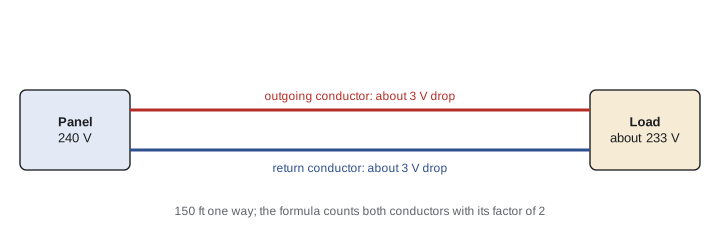
The factor of 2 in the single-phase formula accounts for the current traveling out and back. The three-phase formula uses 1.732 because the phase currents are displaced and the line-to-line drop is the square root of 3 times the drop in one conductor. Some questions instead use the resistance per thousand feet directly from Chapter 9 Table 8 or Table 9: voltage drop equals 2 times the length times the resistance per foot times the current for single-phase. Both methods give nearly the same answer for small conductors, and both are acceptable exam methods unless the question specifies one.
| Conductor size | Approximate area (circular mils) |
|---|---|
| 14 AWG | 4,110 |
| 12 AWG | 6,530 |
| 10 AWG | 10,380 |
| 8 AWG | 16,510 |
| 6 AWG | 26,240 |
| 4 AWG | 41,740 |
| 2 AWG | 66,360 |
| 1/0 AWG | 105,600 |
Calculating the drop
Worked problem
The garage subpanel at Maple Street
A 120/240-volt single-phase feeder to a detached garage subpanel is 150 feet long, carries 40 amperes, and uses 6 AWG copper. Using K of 12.9, what is the voltage drop, and what share of 240 volts is it?
Show solution
- Formula: VD equals 2 times K times I times L divided by circular mils.
- 2 times 12.9 times 40 times 150 is 154,800.
- Divide by 26,240 circular mils for 6 AWG: 5.9 volts.
- As a share of 240 volts: 5.9 divided by 240 is about 0.025, or 2.5 out of 100.
Answer: About 5.9 volts, within the suggested 3 out of 100 for the feeder alone.
Worked problem
A three-phase feeder at Delgado
A 480-volt three-phase feeder to the CNC machine's disconnect is 220 feet long and carries 120 amperes on 1/0 AWG copper. What is the voltage drop?
Show solution
- Formula: VD equals 1.732 times K times I times L divided by circular mils.
- 1.732 times 12.9 times 120 times 220 is about 589,800.
- Divide by 105,600 circular mils: about 5.6 volts.
- 5.6 divided by 480 is about 0.012, or 1.2 out of 100.
Answer: About 5.6 volts, about 1.2 out of 100 of 480 volts.
# Voltage drop, minimum size and maximum length (K = 12.9 copper, 21.2 aluminum)
CM = {"14": 4110, "12": 6530, "10": 10380, "8": 16510, "6": 26240, "4": 41740, "2": 66360, "1/0": 105600}

def vdrop(k, amps, feet, cmil, three_phase=False):
    m = 1.732 if three_phase else 2
    return m * k * amps * feet / cmil

print("Garage feeder:", round(vdrop(12.9, 40, 150, CM["6"]), 2), "V")
print("Delgado CNC feeder:", round(vdrop(12.9, 120, 220, CM["1/0"], True), 2), "V")
print("Same garage feeder in aluminum 6 AWG:", round(vdrop(21.2, 40, 150, CM["6"]), 2), "V")Garage feeder: 5.9 V Delgado CNC feeder: 5.59 V Same garage feeder in aluminum 6 AWG: 9.7 V
Finding the minimum size for an allowed drop
Rearranging the formula gives the minimum circular mil area for a target drop: circular mils equal 2 times K times I times L divided by the allowed voltage drop for single-phase, or 1.732 times K times I times L divided by the allowed drop for three-phase. You then choose the smallest conductor in Chapter 9 Table 8 with at least that area, and finally confirm that its ampacity is also enough. Voltage drop never replaces the ampacity check; it adds to it.
Worked problem
Sizing for 3 out of 100
The Copper Kettle's outdoor sign is a 120-volt single-phase load of 16 amperes, 180 feet from the panel. What minimum copper size keeps the drop within 3 out of 100?
Show solution
- Allowed drop: 120 times 0.03 is 3.6 volts.
- Minimum area: 2 times 12.9 times 16 times 180 divided by 3.6 is 20,640 circular mils.
- From the table, 8 AWG at 16,510 is too small; 6 AWG at 26,240 is the smallest that works.
- Ampacity check: 6 AWG copper easily carries 16 amperes, and the 20-ampere breaker is fine because the conductor is larger than the minimum.
Answer: 6 AWG copper, chosen for voltage drop rather than ampacity.
Upsizing branch circuit conductors for voltage drop has a consequence many candidates forget. Section 250.122(B) requires the equipment grounding conductor to be increased in proportion to the increase in the ungrounded conductors' circular mil area. If the 12 AWG conductors the 20-ampere circuit would normally need are increased to 6 AWG, the equipment grounding conductor must grow by the same ratio. MELU-104 covers that rule in detail.
Finding the maximum length
The same formula solved for length gives the longest run for a conductor size and allowed drop: length equals allowed drop times circular mils divided by 2 times K times I, for single-phase. This is a common exam form: 'What is the maximum distance a 20-ampere, 120-volt load can be from the panel on 10 AWG copper with a drop of no more than 3 out of 100?' The answer is 3.6 times 10,380 divided by 2 times 12.9 times 20, which is about 72 feet.
# Maximum one-way length for an allowed drop
def max_length(volts, share, k, amps, cmil, three_phase=False):
    m = 1.732 if three_phase else 2
    return volts * share * cmil / (m * k * amps)

print("20 A at 120 V on 10 AWG copper, 3 out of 100:", round(max_length(120, 0.03, 12.9, 20, 10380)), "ft")
print("30 A at 240 V on 10 AWG copper, 3 out of 100:", round(max_length(240, 0.03, 12.9, 30, 10380)), "ft")
print("50 A at 480 V three-phase on 6 AWG copper:", round(max_length(480, 0.03, 12.9, 50, 26240, True)), "ft")20 A at 120 V on 10 AWG copper, 3 out of 100: 72 ft 30 A at 240 V on 10 AWG copper, 3 out of 100: 97 ft 50 A at 480 V three-phase on 6 AWG copper: 338 ft
Exam habits for voltage drop
Write the formula first, then plug in values with units. Check whether the length is one-way, which the formula expects, or total. Check whether the system is single-phase or three-phase, and use 1.732 only for three-phase. Use the K value the question gives; if none is given, use 12.9 for copper and 21.2 for aluminum, but some exam bulletins specify slightly different values. And watch for the question that asks for the voltage at the load rather than the drop: subtract the drop from the source voltage.
| Step | Check |
|---|---|
| 1 | Single-phase (factor 2) or three-phase (factor 1.732)? |
| 2 | One-way length in feet |
| 3 | K for the conductor material |
| 4 | Circular mils from Chapter 9 Table 8 |
| 5 | Is the answer a drop, a voltage at the load, a size or a length? |
| 6 | For a size, confirm ampacity too, and upsize the grounding conductor in proportion |
Voltage at the load and motor starting
Some questions ask for the voltage at the load rather than the drop. The answer is the source voltage minus the calculated drop: a 240-volt circuit with a 7.5-volt drop delivers 232.5 volts at the load. Motors are the loads most sensitive to drop, because a motor's starting current is several times its running current, and the drop during starting is correspondingly larger. A motor that runs well may fail to start, or start slowly and overheat, if its circuit is long and the conductors are sized only for running current. That is why the fire pump rules in Article 695 limit the voltage drop during starting as well as running, and why many specifications add a starting drop limit for large motors.
Voltage drop also wastes energy. The power lost in the conductors is the current squared times the resistance, which shows up on the owner's electric bill as heat in the walls. For a heavily loaded circuit that runs all day, the energy saved by one size larger conductor can repay its cost within a few years, an argument Dana uses with the Copper Kettle's owner when she recommends 8 AWG for the long kitchen exhaust fan circuit.
Worked problem
Voltage at a pump motor
A 230-volt single-phase well pump draws 9.8 amperes and is 300 feet from the panel on 10 AWG copper. What voltage reaches the pump while running?
Show solution
- Drop: 2 times 12.9 times 9.8 times 300 divided by 10,380 is about 7.3 volts.
- Voltage at the pump: 230 minus 7.3 is about 222.7 volts.
- That is about 3.2 out of 100 below 230 volts: slightly over the suggested branch circuit value.
Answer: About 222.7 volts while running; the starting drop will be larger.
Common mistakes
MistakeCalling the 3 out of 100 branch circuit limit a Code requirement.
InsteadIt is in an informational note and is a recommendation, except where specific articles or adopted energy codes make limits mandatory.
MistakeUsing the round-trip length in the formula.
InsteadThe formula's factor of 2 already accounts for the return path; use the one-way length.
MistakeUsing the factor 2 for a three-phase circuit.
InsteadThree-phase circuits use 1.732.
MistakeChoosing a conductor for voltage drop without checking ampacity.
InsteadVoltage drop adds a requirement; the ampacity check still applies.
MistakeForgetting to increase the equipment grounding conductor.
Instead250.122(B) requires it to grow in proportion when ungrounded conductors are upsized.
Summary and key terms
- Voltage drop limits in the informational notes are recommendations: 3 out of 100 for branch circuits and 5 out of 100 total.
- Fire pumps and sensitive electronic equipment circuits have enforceable limits.
- Single-phase: VD equals 2 K I L over circular mils; three-phase uses 1.732.
- K is about 12.9 for copper and 21.2 for aluminum; circular mils come from Chapter 9 Table 8.
- Solve for circular mils to find a minimum size, or for L to find a maximum length.
- Upsizing for voltage drop requires a proportional increase in the equipment grounding conductor.
- Voltage drop
- The reduction in voltage along a conductor caused by current through its resistance.
- K
- The resistance of a conductor one circular mil in area and one foot long.
- Circular mil
- The area of a circle one mil, a thousandth of an inch, in diameter; used to state conductor area.
- One-way length
- The distance from the source to the load along the circuit route.
- Informational note
- Explanatory material in the Code that is not an enforceable requirement.
- Chapter 9 Table 8
- The table of conductor properties, including area and resistance.
Practice problems
Work each problem on paper first, then reveal the answer to check.
What is the voltage drop on a 120-volt circuit carrying 15 amperes 100 feet on 12 AWG copper?
Show answer
2 times 12.9 times 15 times 100 divided by 6,530, about 5.9 volts.
What K value is commonly used for aluminum?
Show answer
About 21.2.
A three-phase load draws 60 amperes 200 feet away. What is the minimum copper area for a 6-volt drop?
Show answer
1.732 times 12.9 times 60 times 200 divided by 6, about 44,700 circular mils. 4 AWG at 41,740 is too small, so the next size, 3 AWG at about 52,620 circular mils, is the minimum.
Is the 5 out of 100 combined feeder and branch circuit drop enforceable under the NEC alone?
Show answer
No. It is an informational note.
What must happen to the equipment grounding conductor when branch conductors are upsized for voltage drop?
Show answer
It must be increased in proportion to the increase in circular mil area.
Lesson quiz · 5 questions
Score 60% or more to complete this lesson.
Create a free account to save your progress, take quizzes and earn a certificate.