
MELU-103 · Lesson 11 of 12 · 20 min
GFCI, AFCI and surge protection
▶ Video coming soon A video version of this lesson is on the way.
Few parts of the Code change as much from edition to edition as the rules for ground-fault circuit interrupters, arc-fault circuit interrupters and surge-protective devices. Each cycle has added locations, raised voltage and current limits and extended requirements to new occupancies. That makes these rules a favorite of exam writers and a hazard for candidates who learned the trade under an older edition. This lesson explains what each device does, where 210.8 requires GFCI protection in dwellings and other occupancies, where 210.12 requires AFCI protection, the special rules for replacement receptacles, and the surge protection requirements that started with dwelling services in 2020.
Because these rules change so often, the lists in this lesson describe the 2023 edition in general terms. Verify every location against the edition your exam uses, and treat any study guide older than your edition with suspicion.
Three devices, three hazards
A GFCI protects people from electric shock. It compares the current on the ungrounded and grounded conductors of a circuit, and if more than a small difference flows, meaning current is leaking to ground through some other path, possibly a person, it opens the circuit within a fraction of a second. Class A GFCIs used for personnel protection trip at about 4 to 6 milliamperes. An AFCI protects against fires caused by arcing faults, such as a damaged cord or a loose connection, by recognizing the current signature of an arc and opening the circuit. A surge-protective device protects equipment and wiring from transient overvoltages, such as those from lightning or utility switching, by diverting surge current to ground.
| Device | Protects against | Detects | Main section |
|---|---|---|---|
| GFCI | Electric shock to people | Current imbalance to ground of a few milliamperes | 210.8 |
| AFCI | Fires from arcing faults | Arc current signatures | 210.12 |
| SPD | Damage from transient overvoltage | Voltage spikes above a clamping level | 230.67, Article 242 |
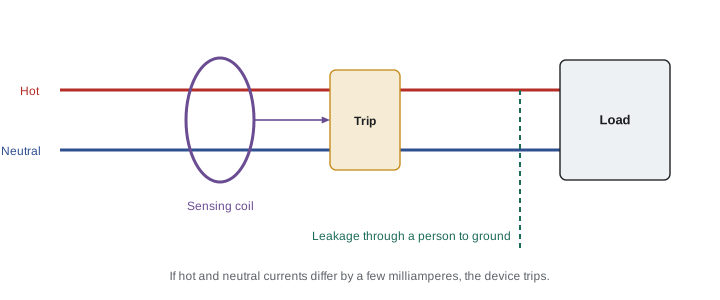
GFCI protection in dwelling units
Section 210.8(A) requires GFCI protection for 125-volt through 250-volt receptacles, single-phase, supplied by circuits of 150 volts or less to ground, in specific dwelling unit locations. The 2023 list covers bathrooms; garages and accessory buildings with floors at or below grade used for storage or work; outdoors; crawl spaces at or below grade; basements, finished or not; kitchens, for all receptacles in the kitchen, not only those serving countertops; areas with sinks, where receptacles are within 6 feet of the top inside edge of the bowl; boathouses; bathtubs and shower stalls, within 6 feet of the outside edge; laundry areas; and indoor damp and wet locations. Earlier editions covered only receptacles serving countertops in kitchens, did not include laundry areas or 250-volt receptacles, and had exceptions for basement and garage receptacles that have since been removed.
Section 210.8(F), added in 2020, requires GFCI protection for outdoor outlets in dwelling units supplied by single-phase branch circuits rated 150 volts or less to ground and 50 amperes or less, which reaches hardwired equipment such as air-conditioning condensers. Because some older condensers caused nuisance tripping, the 2023 edition includes a temporary exception for certain listed HVAC equipment until a set date. The rule is a classic example of why candidates must read the edition carefully.
| Dwelling location | GFCI required for receptacles? | Note |
|---|---|---|
| Bathrooms | Yes | All receptacles |
| Kitchens | Yes | All receptacles in 2023, not only countertop |
| Within 6 ft of a sink | Yes | Measured from the top inside edge of the bowl |
| Laundry areas | Yes | Added in recent editions |
| Garages and accessory buildings | Yes | Floors at or below grade used for storage or work |
| Basements | Yes | Finished or unfinished |
| Outdoors | Yes | And outdoor outlets up to 50 A under 210.8(F) |
| Bedrooms | No GFCI rule | AFCI protection applies instead |
GFCI protection in other occupancies
Section 210.8(B) requires GFCI protection in other than dwelling units for receptacles supplied by single-phase branch circuits rated 150 volts or less to ground and 50 amperes or less, and three-phase circuits rated 150 volts or less to ground and 100 amperes or less, in listed locations: bathrooms; kitchens and areas with a sink and permanent provisions for food preparation, beverage preparation or cooking; rooftops; outdoors; within 6 feet of sinks; indoor damp and wet locations; locker rooms with showering facilities; garages, service bays and similar areas other than vehicle exhibition halls and showrooms; crawl spaces and unfinished areas of basements; laundry areas; and others. The Copper Kettle's kitchen receptacles, including those supplied by 208-volt circuits for equipment such as warmers and mixers, need GFCI protection under these rules.
Other sections add GFCI requirements for specific equipment and occupancies: 210.8(D) for dishwashers in dwelling units, 422.5 for appliances such as vending machines, drinking fountains and high-pressure spray washers, 680 for pools, spas and fountains, 590.6 for temporary power on construction sites, and 511 and 555 for garages and marinas.
Worked problem
The Copper Kettle kitchen
Which of these restaurant kitchen receptacles need GFCI protection under 210.8(B)? (a) a 120-volt, 20-ampere receptacle for a mixer; (b) a 208-volt, single-phase, 30-ampere receptacle for a food warmer; (c) a 208-volt, three-phase, 60-ampere receptacle for a dish machine.
Show solution
- The location is a kitchen with food preparation, which is listed.
- (a) 120 volts to ground and 20 amperes, single-phase: within the limits, GFCI required.
- (b) 208-volt single-phase from a 208Y/120 system is 120 volts to ground and 30 amperes: within the single-phase limits of 150 volts to ground and 50 amperes, GFCI required.
- (c) Three-phase at 120 volts to ground and 60 amperes: within the three-phase limits of 150 volts to ground and 100 amperes, GFCI required.
Answer: All three, under the 2023 edition. Dana specifies GFCI breakers for the 208-volt receptacles.
AFCI protection in dwelling units
Section 210.12(A) requires AFCI protection for 120-volt, single-phase, 15- and 20-ampere branch circuits supplying outlets or devices in dwelling unit kitchens, family rooms, dining rooms, living rooms, parlors, libraries, dens, bedrooms, sunrooms, recreation rooms, closets, hallways, laundry areas and similar rooms or areas. The protection may be a combination-type AFCI breaker at the panel, or one of several listed arrangements using outlet branch-circuit AFCI devices at the first outlet, with limits on the wiring method and length of the home run. Section 210.12 also extends AFCI requirements to dormitory units and to guest rooms and guest suites of hotels and motels.
When branch circuit wiring in an AFCI-required area is modified, replaced or extended, 210.12(D) requires the branch circuit to be protected by a listed combination AFCI at the origin or a listed outlet branch-circuit AFCI at the first receptacle of the existing circuit. An exception allows extensions of not more than 6 feet that do not add outlets or devices.
| Location in a dwelling unit | AFCI required for 15/20 A 120 V circuits? |
|---|---|
| Bedrooms, living rooms, family rooms, dens | Yes |
| Kitchens and laundry areas | Yes, and GFCI also applies to receptacles |
| Hallways and closets | Yes |
| Bathrooms | Not in the AFCI list in recent editions; GFCI applies |
| Garages and outdoors | Not in the AFCI list; GFCI applies |
# Which protection applies to a 120 V, 20 A receptacle circuit in a 2023-style dwelling?
GFCI = {"bathroom", "kitchen", "laundry", "garage", "basement", "outdoors", "crawl space", "near sink"}
AFCI = {"kitchen", "family room", "dining room", "living room", "bedroom", "closet", "hallway", "laundry", "den", "sunroom"}

def protection(room):
    need = []
    if room in GFCI: need.append("GFCI")
    if room in AFCI: need.append("AFCI")
    return " + ".join(need) if need else "neither rule (check your edition)"

for room in ["kitchen", "bedroom", "bathroom", "garage", "laundry", "hallway"]:
print(f"{room}: {protection(room)}")kitchen: GFCI + AFCI bedroom: AFCI bathroom: GFCI garage: GFCI laundry: GFCI + AFCI hallway: AFCI
Replacing receptacles
Section 406.4(D) governs replacement receptacles. Where a grounding means exists in the box, the replacement must be a grounding-type receptacle connected to it. Where no grounding means exists, a non-grounding receptacle, a GFCI receptacle marked No Equipment Ground, or a grounding-type receptacle protected by a GFCI may be used. Where GFCI protection is now required at the location by 210.8, the replacement must be GFCI-protected, and where AFCI protection is now required, the replacement must be a listed outlet branch-circuit AFCI receptacle, a receptacle protected by an upstream AFCI, or similar. Tamper-resistant receptacles, required in dwelling units and many other occupancies by 406.12, must be used for replacements where now required, and weather-resistant receptacles are required in damp and wet locations.
Surge protection
Section 230.67, added in 2020, requires a surge-protective device for all services supplying dwelling units, and the 2023 edition extends it to dormitory units, guest rooms and guest suites of hotels and motels, and areas of nursing homes and limited-care facilities used exclusively as patient sleeping rooms. The SPD must be an integral part of the service equipment or located immediately adjacent to it, and it must be Type 1 or Type 2. Where service equipment is replaced, the SPD rule applies. The 2023 edition also adds 215.18, which requires SPD protection for feeders supplying dwelling units in some arrangements, such as a feeder from a building's service to each apartment's panel, when the service SPD does not protect it. Article 242 covers SPD installation in general, including connection length and conductor size.
| Rule | Requirement in brief | Section |
|---|---|---|
| Dwelling services | Type 1 or Type 2 SPD integral to or adjacent to the service equipment | 230.67 |
| Expanded occupancies (2023) | Dormitories, guest rooms, patient sleeping rooms | 230.67 |
| Dwelling unit feeders (2023) | SPD for certain feeders supplying dwelling units | 215.18 |
| Installation details | Location, connection, conductor sizing | Article 242 |
2026 notes
The 2026 edition continues to adjust GFCI and AFCI rules and reorganizes some occupancy-specific requirements. Expect exam questions to follow the edition your state adopted, which in late 2026 may be 2020, 2023 or 2026 depending on where you test.
Testing and documentation
GFCI and AFCI devices have test buttons, and manufacturers recommend monthly testing. Inspectors often test GFCI protection at receptacles with a plug-in tester that creates a small leakage current, and they check that GFCI-protected receptacles downstream of a GFCI device are marked as protected, as required when a GFCI receptacle protects other outlets. AFCI testing in the field is usually limited to the device's test button, because plug-in AFCI testers do not reproduce every arc signature. Ground-fault protection of equipment on large services, from lesson 2, is different: it must be performance tested by a qualified person when first installed, with written records kept for the inspector.
Documentation matters on master and contractor exams for another reason: many exams include questions on record keeping, permits and inspections, which MELU-107 covers. A master electrician signing off a job is responsible for its compliance, including protection devices installed by others on the crew. Dana adds a column to her panel schedules showing which circuits have GFCI, AFCI or dual-function protection, so the inspector and the owner can see the protection at a glance.
Special-purpose and low-voltage GFCI cases
Not every ground-fault device is a Class A GFCI for personnel. Special-purpose GFCIs with higher trip levels exist for some industrial equipment, and ground-fault protection of equipment, set at hundreds of amperes, protects switchgear rather than people. Pools, spas and fountains in Article 680 add GFCI requirements for lighting and equipment, including underwater luminaires above set voltages. Construction sites need GFCI protection for temporary receptacles under 590.6, either by GFCI devices or, in some cases, an assured equipment grounding conductor program. Exam questions about these use the specific article, not 210.8.
Common mistakes
MistakeLimiting kitchen GFCI to countertop receptacles under the 2023 edition.
InsteadThe 2023 edition covers all kitchen receptacles in dwelling units.
MistakeExempting a 240-volt laundry receptacle.
InsteadRecent editions extend dwelling GFCI requirements to receptacles up to 250 volts in listed locations, including laundry areas.
MistakeRequiring AFCI protection in bathrooms.
InsteadBathrooms are not on the AFCI list in recent editions; GFCI applies.
MistakeForgetting GFCI for three-phase kitchen receptacles in a restaurant.
Instead210.8(B) covers three-phase receptacles at 150 volts or less to ground up to 100 amperes.
MistakeInstalling the dwelling service SPD in a bedroom closet away from the panel.
InsteadThe SPD must be integral to or immediately adjacent to the service equipment.
Summary and key terms
- GFCIs protect people from shock, AFCIs protect against arcing fires, SPDs protect against surges.
- Dwelling GFCI covers 125- to 250-volt receptacles in bathrooms, kitchens, laundry areas, garages, basements, outdoors and near sinks.
- Other occupancies need GFCI in kitchens, bathrooms, rooftops, outdoors and more, including some three-phase receptacles.
- Dwelling AFCI covers 15- and 20-ampere, 120-volt circuits in most living areas, closets, hallways, kitchens and laundry areas.
- Replacement receptacles must meet the current GFCI, AFCI, tamper-resistant and weather-resistant rules.
- Dwelling services need a Type 1 or Type 2 SPD; 2023 adds more occupancies and some dwelling feeders.
- GFCI
- A device that opens a circuit when current to ground exceeds a small value, protecting people from shock.
- AFCI
- A device that opens a circuit when it detects the characteristic current of an arcing fault.
- SPD
- A surge-protective device that limits transient voltages by diverting surge current.
- Combination AFCI
- A breaker-type AFCI that detects both series and parallel arcs on the whole branch circuit.
- Outlet branch-circuit AFCI
- An AFCI device installed at the first outlet of a branch circuit.
- Tamper-resistant receptacle
- A receptacle with shutters that block objects inserted into one slot.
Practice problems
Work each problem on paper first, then reveal the answer to check.
Does a 120-volt receptacle in a dwelling bedroom need GFCI protection?
Show answer
Not under 210.8(A) in general; it needs AFCI protection under 210.12.
Within what distance of a sink do receptacles need GFCI protection?
Show answer
6 feet from the top inside edge of the bowl.
What SPD types are permitted at a dwelling service?
Show answer
Type 1 or Type 2.
A restaurant has a 208-volt, three-phase, 80-ampere kitchen receptacle on a 208Y/120 system. Is GFCI required under 2023?
Show answer
Yes. It is 120 volts to ground and under 100 amperes.
An existing bedroom circuit is extended by 4 feet with no new outlets. Is AFCI protection required?
Show answer
No. The exception covers extensions up to 6 feet without new outlets or devices.
Lesson quiz · 5 questions
Score 60% or more to complete this lesson.
Create a free account to save your progress, take quizzes and earn a certificate.