
MELU-103 · Lesson 1 of 12 · 24 min
Branch circuits under Article 210
▶ Video coming soon A video version of this lesson is on the way.
Article 210 is where most exam questions about everyday wiring begin. It decides how branch circuits are rated, how many and which circuits a dwelling must have, how big the conductors and the overcurrent device must be, what loads a circuit may carry, which receptacles may be installed on it, and where receptacle and lighting outlets are required. This course moves from the circuits closest to the load, in this lesson, out to feeders and services in lesson 2, then through overcurrent protection, conductor ampacity, voltage drop, raceway and box fill and wiring methods, before finishing with ground-fault, arc-fault and surge protection and a mixed practice set.
As in MELU-101, this course cites the National Electrical Code by article, section and table number and explains the rules in its own words. It never reproduces the Code's text or tables, and the numbers in sample tables and worked examples are labeled when they are illustrative. Keep your own copy of the edition your state has adopted open beside each lesson, and check your state and local amendments. Where the 2026 edition moves material, the lesson says so.
Dana's assignment
Ray Ochoa has handed Dana Whitfield the branch circuit layout for the Maple Street fourplex and the panel schedule for the Copper Kettle restaurant. 'Every one of these decisions is on the exam somewhere,' he tells her. 'Do them by the book, write down the section for each one, and you will have studied half of Article 210 by Friday.' Dana's study partner Marcus Lee joins her at the plan table with a stack of practice questions, and the apprentice, Tyler Brooks, is there to learn why the circuits he pulls are sized the way they are.
What a branch circuit is and how it is rated
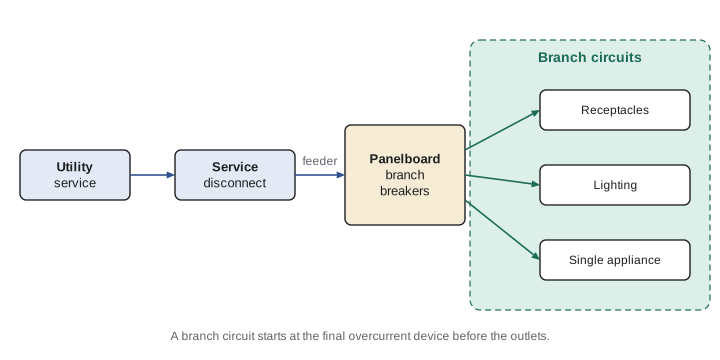
Article 100 defines a branch circuit as the circuit conductors between the final overcurrent device protecting the circuit and the outlets. That definition matters on the exam because it separates branch circuits from feeders: once the conductors leave the last breaker or fuse before the outlets, they are a branch circuit. A conductor from a main panel to a subpanel is a feeder, even if it is small; the circuits leaving the subpanel's breakers are branch circuits.
Section 210.3 says a branch circuit's rating comes from the rating or setting of its overcurrent device, not from the size of its conductors. A 20-ampere breaker feeding 10 AWG conductors is still a 20-ampere circuit. For circuits serving two or more receptacles or outlets, the Code recognizes standard ratings of 15, 20, 30, 40 and 50 amperes; individual branch circuits serving a single load can have any rating. When an exam asks for the rating of a circuit, read the overcurrent device, not the wire.
Multiwire branch circuits
A multiwire branch circuit uses two or more ungrounded conductors with a common grounded conductor, such as a 120/240-volt circuit with two hots and one neutral, or a 120/208-volt circuit with three hots and one neutral. They save copper and conduit space, and they are common in the Copper Kettle's kitchen. Section 210.4 sets the rules that make them safe. The ungrounded conductors must be disconnected simultaneously at the point where the circuit originates, which in practice means a two-pole or three-pole breaker or listed handle ties. The conductors of each multiwire circuit must be grouped together in the panelboard or enclosure, by cable ties or similar means, unless the grouping is obvious, as when they are in a single cable. And the circuit may supply only line-to-neutral loads, except where it supplies a single piece of equipment or where all ungrounded conductors open together.
The reason for these rules is the shared neutral. If one of the ungrounded conductors is switched off for work while the other stays live, the neutral can still carry current from the live leg, and an electrician who opens the neutral expecting a dead circuit can be shocked. Section 300.13(B) adds a related rule for device removal: the continuity of a grounded conductor in a multiwire branch circuit must not depend on the device, so the neutrals are pigtailed instead of being run through the screws of a receptacle.
| Situation | Rule | Section |
|---|---|---|
| Two hots and a neutral feeding kitchen countertop receptacles | Breaker handles must open both hots together | 210.4(B) |
| Several multiwire circuits in one panelboard | Group each circuit's hots and neutral together | 210.4(D) |
| Removing a receptacle on a multiwire circuit | The neutral must not depend on the device for continuity | 300.13(B) |
| Line-to-line load on a multiwire circuit | Permitted only when all ungrounded conductors open simultaneously | 210.4(C) |
Required branch circuits in dwelling units
Section 210.11 lists branch circuits every dwelling unit must have in addition to those calculated for general lighting. Each fourplex unit needs at least two 20-ampere small-appliance branch circuits for the receptacles in the kitchen, pantry, breakfast room and dining room; at least one 20-ampere laundry circuit; at least one 20-ampere circuit for bathroom receptacle outlets; and, under recent editions, at least one 20-ampere circuit for receptacle outlets in an attached garage or a detached garage with power. The small-appliance circuits may serve only the receptacles in those rooms, with a few listed exceptions such as a clock outlet or the igniter of a gas range. The bathroom circuit may serve the receptacles in more than one bathroom, or it may serve all the outlets in a single bathroom if it serves no other bathroom.
On the exam these circuits appear in two ways. Some questions ask directly how many of a circuit type are required or what they may supply. Others hide them inside a load calculation, where each small-appliance and laundry circuit adds a fixed load in volt-amperes. Lesson 2 and MELU-102 treat the calculation side; here the point is to know the minimum count and what each circuit may and may not serve.
| Required circuit | Minimum number and rating | What it may serve |
|---|---|---|
| Small-appliance | Two or more, 20 A | Receptacles in the kitchen, pantry, breakfast room, dining room and similar areas |
| Laundry | At least one, 20 A | Receptacle outlets in the laundry area |
| Bathroom | At least one, 20 A | Bathroom receptacles, or everything in one bathroom |
| Garage | At least one, 20 A | Receptacle outlets in the garage, and outdoor receptacles reachable from it in some editions |
Sizing conductors and overcurrent devices
Section 210.19 sets the minimum conductor ampacity and 210.20 the minimum overcurrent device rating. The common thread is the continuous load rule: the conductors and the device must be sized for the noncontinuous load plus 125 out of 100 of the continuous load. A continuous load, from Article 100, is one where the maximum current is expected to continue for three hours or more, such as store lighting, a walk-in cooler or an electric water heater in many cases. The exception is equipment whose assembly, including its overcurrent device, is listed for operation at 100 out of 100 of its rating, which is rare in branch circuit sizes.
The conductor must also have an ampacity not less than the maximum load to be served after any adjustment or correction factors, which lesson 5 covers. In practice there are two separate checks, and the larger result wins: one at 125 out of 100 of the continuous load using the termination temperature column, and one at the full load after correction and adjustment, often using the conductor's 90-degree column as the starting point.
Worked problem
A continuous lighting circuit at the Copper Kettle
The restaurant's dining room lighting will draw 13.5 amperes and stay on through the entire evening service. What minimum overcurrent device rating is required, and what is the largest continuous load a 20-ampere breaker could carry?
Show solution
- The load runs more than three hours, so it is continuous.
- Minimum rating: 13.5 times 1.25 is 16.9 amperes. The next standard rating at or above that value is 20 amperes.
- A 20-ampere breaker may carry a continuous load of 20 divided by 1.25, which is 16 amperes.
- 13.5 amperes is within that limit, so the 20-ampere circuit works. A 15-ampere circuit would not: 15 divided by 1.25 is only 12 amperes.
Answer: A 20-ampere breaker, which may carry up to 16 amperes of continuous load.
# Continuous-load sizing for a branch circuit (illustrative standard ratings list)
standard = [15, 20, 25, 30, 35, 40, 45, 50, 60]

def minimum_device(noncontinuous, continuous):
    need = noncontinuous + 1.25 * continuous
    rating = next(r for r in standard if r >= need)
    return round(need, 2), rating

for name, nc, c in [("Dining lighting", 0, 13.5), ("Prep receptacles", 9, 6), ("Walk-in cooler", 2, 14)]:
    need, rating = minimum_device(nc, c)
print(f"{name}: needs {need} A, use a {rating} A device")Dining lighting: needs 16.88 A, use a 20 A device Prep receptacles: needs 16.5 A, use a 20 A device Walk-in cooler: needs 19.5 A, use a 20 A device
Permissible loads and receptacle ratings
Section 210.23 limits what a circuit may carry. On a 15- or 20-ampere circuit, a single cord-and-plug-connected piece of utilization equipment must not exceed 80 out of 100 of the circuit rating, so 12 amperes on a 15-ampere circuit and 16 amperes on a 20-ampere circuit. Equipment fastened in place, other than luminaires, must not exceed 50 out of 100 of the rating when the circuit also supplies lighting outlets, cord-and-plug equipment not fastened in place, or both. A 30-ampere circuit may supply fixed lighting with heavy-duty lampholders in other than dwellings, or utilization equipment in any occupancy, with cord-and-plug equipment limited to 80 out of 100 of the rating. Circuits of 40 and 50 amperes may supply cooking appliances fastened in place in any occupancy and certain heavy-duty lighting in other than dwellings.
Section 210.21(B) and its table match receptacle ratings to circuit ratings on circuits with two or more receptacles. A 15-ampere circuit takes 15-ampere receptacles; a 20-ampere circuit may have 15- or 20-ampere receptacles; a 30-ampere circuit takes 30-ampere receptacles; a 40-ampere circuit may have 40- or 50-ampere receptacles; and a 50-ampere circuit takes 50-ampere receptacles. A single receptacle on an individual branch circuit must have a rating not less than the circuit's rating, which is why a lone 15-ampere single receptacle cannot be installed on a 20-ampere individual circuit, though a 15-ampere duplex receptacle can, because a duplex counts as two receptacles.
| Circuit rating | Receptacles permitted with two or more on the circuit | Largest single cord-and-plug load on 15/20 A |
|---|---|---|
| 15 A | 15 A | 12 A |
| 20 A | 15 A or 20 A | 16 A |
| 30 A | 30 A | Not applicable (80 out of 100 limit still applies) |
| 40 A | 40 A or 50 A | Not applicable |
| 50 A | 50 A | Not applicable |
Receptacle and lighting outlets
The rest of Article 210 tells you where outlets are required. In dwelling units, 210.52 requires receptacles along walls so that no point along the floor line of a wall space is more than 6 feet from a receptacle, which spaces them at most 12 feet apart; any wall space 2 feet or wider counts. Kitchen countertops have their own rules: receptacles serving countertop and work surfaces 12 inches or wider must be placed so that no point along the wall line is more than 24 inches from a receptacle. The 2023 edition changed the rules for islands and peninsulas, so check your edition carefully before answering an island question. Bathrooms need a receptacle within 3 feet of the outside edge of each basin; every dwelling needs at least one outdoor receptacle at the front and back; and laundry areas, basements, garages and hallways 10 feet or longer each need receptacle outlets.
Other required outlets include the receptacle within 25 feet of heating, air-conditioning and refrigeration equipment for servicing, in 210.63, and the lighting outlets of 210.70: a switched lighting outlet in every habitable room and bathroom, in hallways, stairways, attached garages and at outdoor entrances, and a lighting outlet near equipment requiring servicing in attics, crawl spaces and basements used for storage. Non-dwelling occupancies have their own lists, such as show window receptacles and sign outlets at accessible entrances to commercial buildings.
Worked problem
Wall space at Maple Street
A living room wall in a fourplex unit is 15 feet long, uninterrupted by doors. Using the 6-foot rule, what is the minimum number of receptacles needed along that wall if one is placed 6 feet from each end?
Show solution
- No point along the floor line may be more than 6 feet from a receptacle.
- A receptacle 6 feet from the left end covers points from 0 to 12 feet; one 6 feet from the right end, at 9 feet, covers points from 3 to 15 feet.
- Together they cover the whole wall, so two receptacles satisfy the rule.
- Dana notes the trick: the 6-foot rule measures to any point along the floor line, so two well-placed receptacles can cover up to 24 feet of wall.
Answer: Two receptacles, provided they are placed so every point is within 6 feet of one.
2026 notes
The 2026 edition keeps Article 210 as the home of branch circuit rules but moves the general lighting load values and most load calculation material from Article 220 into new Article 120. Where this lesson refers to the lighting load that determines how many general lighting circuits a dwelling needs, look in Article 120 in a 2026 book. The 2026 edition also uses the abbreviation OCPD throughout for overcurrent protective device. Neither change alters the basic sizing rules taught here.
Common mistakes
MistakeReading the conductor size as the circuit rating.
InsteadThe circuit rating comes from the overcurrent device, under 210.3.
MistakeForgetting the 125 out of 100 factor for continuous loads.
InsteadSize the conductors and the device for the noncontinuous load plus 125 out of 100 of the continuous load.
MistakeRunning the neutral of a multiwire circuit through receptacle terminals.
InsteadSplice and pigtail the neutral so removing a device does not open it.
MistakeInstalling a single 15-ampere receptacle on a 20-ampere individual circuit.
InsteadA single receptacle on an individual circuit must be rated not less than the circuit; a duplex counts as two receptacles.
MistakeUsing the 6-foot rule on countertops.
InsteadCountertops use their own 24-inch rule and the 2023 changes for islands and peninsulas.
Summary and key terms
- A branch circuit runs from the final overcurrent device to the outlets, and its rating is the device rating.
- Multiwire circuits need simultaneous disconnection, grouping and neutrals that do not depend on devices.
- Dwellings need two small-appliance circuits, a laundry circuit, a bathroom circuit and a garage circuit, all 20 amperes.
- Conductors and devices are sized for noncontinuous load plus 125 out of 100 of continuous load.
- A single cord-and-plug load is limited to 80 out of 100 of a 15- or 20-ampere circuit; fixed equipment to 50 out of 100 when lighting is also served.
- Wall receptacles follow the 6-foot rule; countertop receptacles follow the 24-inch rule.
- Branch circuit
- Conductors between the final overcurrent device and the outlets.
- Multiwire branch circuit
- A branch circuit with two or more ungrounded conductors sharing one grounded conductor.
- Continuous load
- A load whose maximum current is expected to last three hours or more.
- Individual branch circuit
- A branch circuit that supplies only one piece of utilization equipment.
- Small-appliance branch circuit
- A 20-ampere dwelling circuit serving receptacles in kitchens, dining rooms and similar areas.
- Wall space
- A wall 2 feet or more wide, measured along the floor line, that counts toward the receptacle spacing rule.
Practice problems
Work each problem on paper first, then reveal the answer to check.
What is the rating of a branch circuit protected by a 20-ampere breaker and wired with 10 AWG copper?
Show answer
20 amperes. The rating comes from the overcurrent device.
What is the minimum overcurrent device rating for a continuous load of 22 amperes?
Show answer
22 times 1.25 is 27.5 amperes, so the next standard rating, 30 amperes.
What is the largest single cord-and-plug load permitted on a 15-ampere circuit?
Show answer
12 amperes, which is 80 out of 100 of 15.
May a 50-ampere receptacle be installed on a 40-ampere circuit with two receptacles?
Show answer
Yes. A 40-ampere circuit with two or more receptacles may use 40- or 50-ampere receptacles.
How many 20-ampere small-appliance circuits must a dwelling kitchen and dining area have at a minimum?
Show answer
Two.
Lesson quiz · 5 questions
Score 60% or more to complete this lesson.
Create a free account to save your progress, take quizzes and earn a certificate.