
MBA-611 · Lesson 9 of 12 · 21 min
Managing the multinational: structure, global versus local, and talent
Dr. Tan begins the ninth session with a story from her years at the Danish consumer company. Head office had designed a single global advertising campaign, shot in Copenhagen, with one slogan in English and subtitles everywhere else. It worked well in the Netherlands and the Nordic countries, poorly in Germany and not at all in Japan, where the local team had warned against it. A year later the company swung the other way, letting each country design its own campaigns; costs rose, the brand began to look different everywhere, and good ideas in one country were never used in others. Getting the balance right, she says, took another five years and a new organization structure. The tension between global efficiency and local responsiveness is the central problem of managing a multinational.
Global integration versus local responsiveness
C. K. Prahalad and Yves Doz described two forces acting on every multinational. Pressures for global integration push toward standardized products, centralized decisions and worldwide coordination: economies of scale in production and research, global customers who expect consistent service, rivals that compete across markets, and the need to transfer knowledge and protect a global brand. Pressures for local responsiveness push toward adapted products, local decisions and autonomous subsidiaries: differences in customer tastes, distribution channels, regulations, infrastructure and government demands. Industries differ in the balance. Semiconductors and aircraft face strong integration pressures; food, retail and many services face strong responsiveness pressures; consumer goods and pharmaceuticals face both.
Christopher Bartlett and Sumantra Ghoshal, in Managing Across Borders in 1989, used the two dimensions to describe four strategies. An international strategy transfers the parent's products and knowledge to foreign markets with little adaptation, keeping most decisions at home; it suits companies early in internationalization. A multidomestic strategy gives country subsidiaries wide freedom to adapt products and marketing; it suits industries with strong local differences. A global strategy standardizes products and centralizes key activities to exploit scale; it suits industries with strong integration pressures. A transnational strategy tries to achieve both global efficiency and local responsiveness, and to share learning across the network, by distributing different roles to different units and linking them through strong coordination.
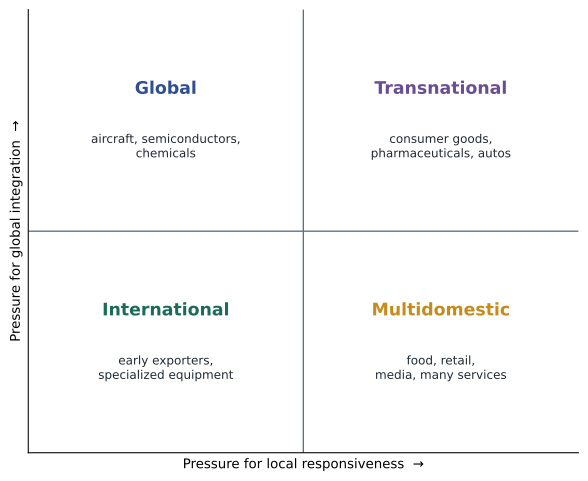
Standardize or adapt?
In a famous 1983 article, The Globalization of Markets, Theodore Levitt argued that technology was making consumers everywhere alike, so that companies selling standardized products at low prices would beat those that adapted to local preferences. Some of his predictions came true: global brands in electronics, sportswear and fast food now sell nearly identical products across much of the world. But many companies that standardized aggressively later retreated, as differences in tastes, incomes and rules proved more durable than Levitt expected. Most successful multinationals now standardize what customers do not care about and adapt what they do. The core design and technology may be global, while sizes, shades, packaging, channels, pricing and advertising are local. Some call this glocalization.
For an apparel company such as Cedarline, the choices are concrete. Technical features, materials and quality standards can be global. Sizing must often be adapted: Japanese customers on average need shorter sleeves and different fits than North American ones. Insulation weights may differ between markets with dry cold and wet cold. Product ranges may differ by season and activity. Marketing images must reflect local outdoor culture, and prices must reflect local competition and purchasing power. The art lies in keeping enough common to preserve the brand and scale economies while adapting enough to sell.
Ghemawat's triple A
Pankaj Ghemawat offered a related framework in 2007. Companies can create value across borders through adaptation, adjusting to local differences to increase local relevance; aggregation, overcoming differences by grouping countries into regions or by standardizing products, to achieve economies of scale; and arbitrage, exploiting differences, such as lower labor costs or tax rates, by locating activities where they are cheapest or most productive. Each strategy pulls in a different direction: adaptation increases differences, aggregation reduces them, and arbitrage depends on them. Ghemawat argued that few companies can pursue all three at once and that most should emphasize one or two. Cedarline's sourcing in Asia is arbitrage; its potential European operation might use aggregation, treating northern Europe as a single region with common products and one distribution center.
Organization structures
Companies typically organize their international activities in one of several ways as they grow. An international division groups all foreign operations under one executive, reporting alongside the domestic business; it is simple and common early on, but it can isolate international activities from the rest of the company. A geographic structure organizes the company by regions or countries, each responsible for its own results, which supports local responsiveness. A global product structure organizes the company by product lines, each responsible for its products worldwide, which supports integration and scale. A matrix structure combines the two, with managers reporting to both a product and a geographic head; it can balance the pressures but often slows decisions and creates conflict over authority.
Bartlett and Ghoshal argued that no formal structure solves the problem on its own. What matters is the organization's processes and mentality: shared information systems, transfer of managers across units, common values and a habit of solving problems jointly. They described the transnational as an integrated network in which subsidiaries play different roles. Some units are centers of excellence with global responsibility for a product or capability; others implement strategies designed elsewhere; others sense local markets and contribute ideas. Julian Birkinshaw and others have shown that subsidiaries often gain such roles through their own initiative, by developing capabilities that headquarters comes to rely on.
Many companies also create regional headquarters, such as for Europe or Asia-Pacific, to coordinate countries with similar markets, share services and bring decisions closer to customers. Regional headquarters are often located for reasons of talent, transport links, tax and regulation: Singapore and Hong Kong in Asia, the Netherlands, Ireland and Switzerland in Europe, and Miami for Latin America. Since 2020 some multinationals have moved regional headquarters from Hong Kong to Singapore in response to political changes, illustrating how institutional risk shapes organization as well as investment.
Reverse innovation and learning across the network
Multinationals have traditionally developed products at home and adapted them for other markets. Vijay Govindarajan and Chris Trimble described a different pattern, reverse innovation, in which products are developed first for emerging markets, often at much lower cost, and then sold in rich countries. A well-known example is the low-cost, portable electrocardiogram and ultrasound devices that GE developed in India and China and later sold in rich markets for new uses. More broadly, the capacity to learn from every market and transfer that learning across the network is one of the main advantages a multinational can have over local rivals. Knowledge does not travel by itself; it moves with people, through communities of practice and through deliberate processes for sharing what works.
Staffing the multinational
Howard Perlmutter described in 1969 three attitudes that shape how multinationals staff their foreign operations. An ethnocentric company fills key positions abroad with managers from headquarters, trusting home-country people and ways of working. A polycentric company hires local managers to run each country, but rarely promotes them to headquarters. A geocentric company seeks the best people for each job regardless of nationality, and its top team reflects the countries in which it operates. Many companies move from ethnocentric toward polycentric and geocentric staffing as they mature.
Expatriates, employees sent from one country to work in another, remain important for starting new operations, transferring knowledge and developing leaders. They are also expensive: the total cost of a long-term expatriate assignment, including housing, schooling, tax support and allowances, is often two to three times the employee's salary. Assignments fail when the employee or family cannot adjust, when the role is poorly defined, or when the company neglects the expatriate's career on return; many repatriated managers leave within a few years because their new knowledge is not used. Companies have responded with shorter assignments, commuter and rotational arrangements, local-plus packages and greater use of local hires and virtual teams. Since the pandemic, remote work across borders has added another option, though it raises questions of tax, employment law and data protection in the country where the employee sits.
Compensation for international staff is often based on the balance sheet approach, which aims to keep an expatriate's purchasing power equal to what it would be at home by adding allowances for differences in housing, goods and services, and taxes. Local hires are usually paid according to local market rates, which can create tensions within teams where people doing similar work earn very different amounts. Transparent principles, such as paying local market rates for local hires and clearly defined allowances for assignments, help reduce resentment.
Tax and transfer pricing
Multinationals must also decide where profits are recorded, because the subsidiaries of a group trade with one another. A transfer price is the price charged in such a transaction, such as a European sales subsidiary buying jackets from its parent, or a subsidiary paying a royalty for the use of the parent's brand. Tax authorities in every country require transfer prices to follow the arm's length principle: they should be the prices that independent companies would agree in comparable circumstances. Common methods compare prices with similar transactions between independent parties, add a markup to costs, or allocate a routine return to distributors and leave the residual profit with the owner of the brand and technology.
Rules have tightened considerably. The OECD's project on base erosion and profit shifting led to rules requiring large multinationals to report their revenue, profits, taxes and employees country by country to tax authorities. A global minimum tax of 15 percent for groups with revenue above 750 million euros, known as Pillar Two, began to take effect in many countries, including Canada, from 2024. In 2025 the G7 agreed that groups headquartered in the United States would be largely exempted from parts of these rules in recognition of American minimum taxes, and the OECD's members worked through 2026 to implement that arrangement. For most mid-sized companies the practical message is simple: set transfer prices that reflect where functions are performed and risks are borne, document them well, and expect tax authorities to look closely.
# Transfer pricing for a European sales subsidiary buying jackets from its parent
units = 40_000
retail_net = 230.0          # subsidiary's average net selling price per jacket
landed_cost = 108.0         # parent's cost to source and ship one jacket
sub_costs = 2_400_000       # subsidiary's marketing, staff and warehousing
tax_parent, tax_sub = 0.265, 0.25
def results(transfer_price):
    sub_profit = units * (retail_net - transfer_price) - sub_costs
    parent_profit = units * (transfer_price - landed_cost)
    tax = sub_profit * tax_sub + parent_profit * tax_parent
    margin = sub_profit / (units * retail_net)
    return sub_profit, parent_profit, tax, margin
for tp in (150.0, 158.0, 170.0):
    s, p, t, m = results(tp)
    print(f"transfer price {tp:5.0f}: subsidiary profit {s / 1e6:5.2f}m (operating margin {m:5.1%}), "
          f"parent profit {p / 1e6:5.2f}m, total tax {t / 1e6:4.2f}m")
# Arm's length test: comparable independent distributors earn operating margins of 3 to 6 per cent
for tp in (150.0, 158.0, 170.0):
    m = results(tp)[3]
print(f" {tp:.0f}: {'within' if 0.03 <= m <= 0.06 else 'outside'} the comparable range")transfer price 150: subsidiary profit 0.80m (operating margin 8.7%), parent profit 1.68m, total tax 0.65m transfer price 158: subsidiary profit 0.48m (operating margin 5.2%), parent profit 2.00m, total tax 0.65m transfer price 170: subsidiary profit 0.00m (operating margin 0.0%), parent profit 2.48m, total tax 0.66m 150: outside the comparable range 158: within the comparable range 170: outside the comparable range
The code shows why transfer pricing is a matter of compliance rather than tax planning for a company like Cedarline. A high transfer price shifts profit to the parent; a low one shifts it to the subsidiary. Because the tax rates are similar, total tax barely changes, but only a price that leaves the subsidiary with a margin similar to independent distributors performing the same functions will satisfy tax authorities on both sides. A price that leaves the subsidiary with losses year after year would invite an audit in the market country; one that leaves it with very high margins would invite one at home.
Worked problem
Organizing Cedarline abroad
Cedarline plans to sell in one or two foreign markets within three years. It has a head office of 180 people, including design, sourcing, marketing and e-commerce teams, and no international experience. How should it organize its first international operations, and whom should it put in charge?
Show solution
- Strategy: Cedarline's technical products and brand are global assets, but sizing, ranges and marketing need adaptation. It should start with an international strategy, transferring products and brand from home, and move toward more local adaptation as it learns.
- Structure: an international division, led by a vice-president who reports to the chief executive, is simple and keeps attention on the new markets. Design, sourcing and e-commerce should remain global functions serving all markets, with clear processes for international input.
- People: a small team of experienced Cedarline staff should lead the launch, to transfer knowledge of the brand and products, supported by local hires who know customers, retailers and regulations. Within a few years, the local country manager should be a local hire.
- Learning: Cedarline should create a regular forum where the international team reports what it learns to design, merchandising and marketing, so that the new markets improve the whole company.
Answer: An international division with global functions and a mixed team of transferred and local staff fits Cedarline's stage. The structure should be reviewed once international sales reach about a fifth of the total, when a regional or matrix structure may make sense.
Common mistakes
MistakeA single global strategy is always most efficient.
InsteadStandardize what customers do not care about and adapt what they do; integration and responsiveness pressures vary by industry.
MistakeChanging the organization chart will solve coordination problems.
InsteadProcesses, information systems, transfers of people and shared values matter as much as formal structure.
MistakeExpatriates are the best way to run foreign subsidiaries.
InsteadThey are costly and often fail to adjust; combine them with local managers and plan for repatriation.
MistakeTransfer prices are a tool to minimize tax.
InsteadThey must follow the arm's length principle and reflect functions and risks, with documentation to support them.
Summary and key terms
- Multinationals balance pressures for global integration and local responsiveness; Bartlett and Ghoshal described international, multidomestic, global and transnational strategies.
- Most firms standardize core products and technology and adapt sizing, ranges, channels, prices and marketing.
- Ghemawat's adaptation, aggregation and arbitrage describe three ways to create value across borders.
- Structures include international divisions, geographic and product structures and matrices; processes and mentality matter as much as charts.
- Staffing can be ethnocentric, polycentric or geocentric; expatriates are valuable but costly and need support on return.
- Transfer prices between subsidiaries must follow the arm's length principle; a 15 percent global minimum tax now applies to large groups in many countries.
- Transnational strategy
- A strategy that seeks global efficiency, local responsiveness and worldwide learning at once.
- Multidomestic strategy
- A strategy in which country subsidiaries adapt products and marketing with wide autonomy.
- Center of excellence
- A subsidiary given worldwide responsibility for a product or capability.
- Expatriate
- An employee sent from one country to work in another.
- Transfer price
- The price charged in a transaction between units of the same company.
- Arm's length principle
- The requirement that transfer prices match those independent parties would agree.
Practice problems
Work each problem on paper first, then reveal the answer to check.
Place each industry on the integration–responsiveness grid: commercial aircraft, packaged food, smartphones.
Show answer
Aircraft: high integration, low responsiveness (global). Packaged food: low integration, high responsiveness (multidomestic). Smartphones: high integration with moderate responsiveness in software, services and channels.
Why do many repatriated managers leave within a few years?
Show answer
Their new skills and knowledge are not used, their roles on return are poorly planned, and they find more valued opportunities elsewhere.
A subsidiary buys goods at 120 and sells them at 200, with other costs of 60 per unit. What is its operating margin, and is it within a comparable range of 3 to 6 percent?
Show answer
Profit 20 per unit; margin 10 percent, above the range, so tax authorities at home may argue the transfer price is too low.
Give an example of arbitrage in Ghemawat's framework.
Show answer
Locating sewing in Bangladesh to exploit lower labor costs, or locating a service center where skilled multilingual staff are available.
Lesson quiz · 5 questions
Score 60% or more to complete this lesson.
Create a free account to save your progress, take quizzes and earn a certificate.