
MBA-611 · Lesson 12 of 12 · 24 min
Capstone: Cedarline's international expansion
The last session of Global Business takes place in Cedarline Outdoor's boardroom at its head office in Chicago. After the strategy work of MBA-514, the board approved a plan to focus on durable, repairable technical apparel, with the goal of raising revenue to about 530 million dollars, the operating margin to about 11.5 percent and return on invested capital to about 12 percent by fiscal 2029. The plan was deliberately domestic. Now, with the supply chain redesign from MBA-513 under way and working capital falling, the chief executive has asked a question the strategy left open: should Cedarline begin to sell seriously abroad within the next five years, and if so, where and how? The board has set two limits. The international plan may not require more than 25 million dollars of investment over five years, and it must not put the 12 percent return target at risk.
Dr. Tan divides the cohort into two teams to prepare competing recommendations, then asks them to merge their work into one. This lesson follows the analysis they present. It draws on almost every lesson of the course: the world economy and Cedarline's exposure from lesson 1, trade policy from lesson 3, currency from lesson 4, institutions and culture from lessons 5 and 6, market choice from lesson 7, entry modes from lesson 8, organization from lesson 9, supply chains from lesson 10 and risk from lesson 11.
Why go abroad at all?
The teams begin with the case for and against international expansion. The case for rests on four arguments. Cedarline's home market is maturing: the outdoor apparel category is growing at perhaps 3 to 4 percent a year, and the durability strategy deliberately gives up low-margin volume. Cedarline's main advantages, its reputation for durable technical products and its repair service, are ownership advantages in Dunning's sense that could travel, since outdoor customers in other cold-climate countries value the same things. Design, sourcing and brand costs are largely fixed, so additional volume abroad would spread them over more sales. And foreign revenue would partly offset Cedarline's currency exposure on the cost side, and sales in other currencies would diversify a business that now depends entirely on one economy.
The case against is also serious. MBA-514 found that Cedarline's earlier growth had destroyed value because it spread the company too thin; international expansion could repeat the mistake. Management attention is limited, and the durability strategy, the supply chain redesign and the people program from MBA-601 are already demanding. And the trade environment of 2026 is unusually uncertain. The teams agree that expansion makes sense only if it is staged, focused on markets where Cedarline's advantages clearly matter, and designed so that a failure would be affordable.
The three finalists
Lesson 7's screen left three finalists: Canada, Germany together with the Nordic countries, and Japan. The table compares them on the dimensions that matter most for Cedarline.
| Factor | Canada | Germany and Nordics | Japan |
|---|---|---|---|
| Category size | Moderate; about a tenth of the US market | Large in Germany; small but rich in the Nordics | Large and affluent |
| Cultural distance | Very low in English Canada; French required in Quebec | Moderate; German and Nordic languages, strong outdoor culture | High; language, sizing, retail practices |
| Administrative distance | Rising since 2025: tariffs, surtaxes, consumer backlash against American brands | Low to moderate: EU rules on products and data | Moderate: distinct product and labeling rules |
| Geographic distance | Low; same time zones, goods can ship directly from Asia | Moderate; six-hour time difference, separate warehouse needed | High for management; close to Asian factories |
| Competition | Strong Canadian brands with loyal customers | Strong local and Scandinavian brands | Strong Japanese and international brands |
| Duty on Cedarline's Asian-made jackets | Canadian duty of up to 18 percent; surtaxes apply only to US-origin goods | EU duty of about 12 percent unless goods qualify for preferences | Japanese duties |
Canada is the closest market in culture and geography and has a strong outdoor culture, but it is much smaller than the United States, and since 2025 many Canadian consumers have avoided American brands. Cedarline's jackets are made in Asia; if they are shipped directly from Asian ports to a warehouse in Canada, they pay Canadian duties but not the Canadian surtaxes, which apply only to goods of US origin. Cedarline must avoid routing goods through its Chicago distribution center, document origin carefully and present itself in a way that respects Canadian customers' concerns, for example by partnering with Canadian retailers and highlighting its repair service, which fits Canadian interest in durable products. In Quebec, labels, packaging, websites and signs must be in French.
Germany and the Nordic countries offer large, wealthy, outdoor-oriented customers, but strong local brands, a new language environment and the need for a separate European warehouse and returns operation. Japan is large and affluent, close to Cedarline's factories and has a strong market for premium outdoor apparel, but it is the most distant market culturally and administratively: sizing, product preferences, retail relationships and service expectations differ substantially, and Cedarline has no Japanese-speaking staff.
Entry modes
Applying lesson 8, the teams match each market with an entry mode suited to its distance. For the large, close market, Cedarline would sell online directly to consumers from a third-party logistics warehouse in the market, supplemented by wholesale to about thirty independent specialty retailers in cold-climate regions, chosen because their staff can explain technical features and repairs. The repair service would be offered through mail-in kits and partner workshops. For Germany and the Nordics, Cedarline would sell online in German, Swedish and English from a warehouse in the Netherlands, with a non-exclusive, performance-tied distributor for a limited number of specialty stores. For Japan, where distance is greatest, the teams propose a distributor: an established Japanese outdoor retailer and wholesaler that would buy Cedarline products, adapt sizing with Cedarline's designers, handle marketing and sell through its own stores and partners, with Cedarline keeping control of design, brand standards and pricing guidelines.
Licensing is considered and rejected for all three markets. It would earn royalties with almost no investment, but Cedarline's brand rests on quality and repair, and a licensee who controlled production and service would put that reputation at risk in markets where it is being built from nothing.
The financial case
The teams build five-year projections for each option. Each projection includes the initial investment in marketing, systems and inventory; revenue growing as awareness builds; operating margins that start negative and rise as volume covers fixed costs; working capital tied up in inventory and receivables; and a value for the business beyond year five based on steady growth and the return earned on new investment. Each is discounted at Cedarline's cost of capital of 9 percent plus a premium for the risks of the market, giving rates of 10.5 to 11 percent. To capture the risk that the brand fails to win customers, the teams also model a downside in which revenue is 40 percent lower and margins 3 points lower than planned, which they judge has a 40 percent probability.
# Cedarline international options: five-year plan plus steady-state value (millions)
tax, g, p_base = 0.25, 0.03, 0.6
options = {
    "Canada (online + wholesale)":  {"invest": 8.0,  "rev": [6, 12, 18, 24, 29], "margin": [-0.25, -0.04, 0.05, 0.09, 0.11], "wc": 0.22, "rate": 0.105},
    "Germany and Nordics (online + dist.)": {"invest": 7.0,  "rev": [4, 9, 15, 21, 26],  "margin": [-0.30, -0.08, 0.04, 0.08, 0.10], "wc": 0.22, "rate": 0.105},
    "Japan (distributor)":                  {"invest": 1.5,  "rev": [3, 6, 9, 12, 14],   "margin": [0.04, 0.08, 0.10, 0.11, 0.11],   "wc": 0.15, "rate": 0.105},
}
def value(o, scale=1.0, cut=0.0, stop_after=None):
    rev = [x * scale for x in o["rev"]]
    m = o["margin"][:2] + [x - cut for x in o["margin"][2:]]
    r, flows, prev_wc = o["rate"], [], 0.0
    for t in range(5):
        ebit = rev[t] * m[t]
        nopat = ebit * (1 - tax) if ebit > 0 else ebit
        wc = rev[t] * o["wc"]
        flows.append(nopat - (wc - prev_wc)); prev_wc = wc
        if stop_after == t + 1:                      # exit: sell off working capital at 70 per cent
            flows[-1] += 0.7 * wc
            return -o["invest"] + sum(cf / (1 + r) ** (k + 1) for k, cf in enumerate(flows)), None
    nopat5 = rev[-1] * m[-1] * (1 - tax)
    roic = nopat5 / (o.get("capital", o["invest"]) + prev_wc)
    terminal = nopat5 * (1 + g) * (1 - g / roic) / (r - g)
    npv = -o["invest"] + sum(cf / (1 + r) ** (k + 1) for k, cf in enumerate(flows)) + terminal / (1 + r) ** 5
    return npv, roic
print(f"{'option':<38}{'base NPV':>9}{'downside':>10}{'expected':>10}{'yr-5 ROIC':>11}")
for name, o in options.items():
    base, roic = value(o)
    down, _ = value(o, scale=0.6, cut=0.03)
    print(f"{name:<38}{base:>9.1f}{down:>10.1f}{p_base * base + (1 - p_base) * down:>10.1f}{roic:>11.1%}")
# Staging the largest option: invest 3.0 now and 5.0 after a review at the end of year 2;
# in the downside, exit at the review instead of making the second investment
o = dict(options["Canada (online + wholesale)"], invest=3.0, capital=8.0)
r = o["rate"]
base_staged = value(o)[0] - 5.0 / (1 + r) ** 2
exit_down = value(o, scale=0.6, cut=0.03, stop_after=2)[0]
print(f"staged entry: base {base_staged:.1f}, downside with exit {exit_down:.1f}, "
f"expected {p_base * base_staged + (1 - p_base) * exit_down:.1f}")option base NPV downside expected yr-5 ROIC Canada (online + wholesale) 4.8 -5.0 0.9 16.6% Germany and Nordics (online + dist.) 2.5 -5.5 -0.7 15.3% Japan (distributor) 7.9 2.1 5.6 32.1% staged entry: base 5.7, downside with exit -4.5, expected 1.6
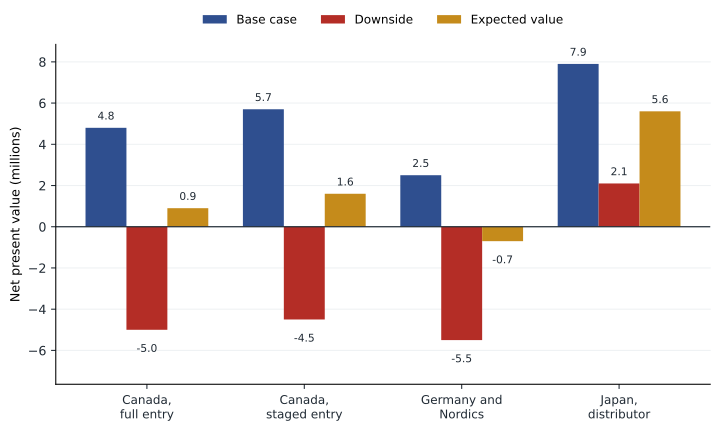
The results reshape the debate. Canada adds about 29 million dollars of revenue by year five with a good return on capital, but if Cedarline commits fully from the start, the downside would destroy about 5 million dollars of value, and the expected value is barely positive. Germany and the Nordics have a thin margin of value even in the base case and a negative expected value, because the European market requires a separate warehouse and heavy marketing to build awareness against strong local brands. Japan through a distributor, surprisingly to some in the room, has the highest expected value and is positive even in the downside, because the distributor bears most of the marketing cost and the market-specific risk; its weakness is scale, adding only about 14 million dollars of revenue by year five, and Cedarline's dependence on one partner.
Staging changes the picture for the largest option. If Cedarline invests only the first part of the money, enough for online sales and a small wholesale test, and makes the second investment only after a review at the end of year two, it can stop in the downside before most of the investment is made. The expected value of the staged entry is roughly double that of committing in full, and the base-case value is higher because the second investment comes later. This is the logic of real options from MBA-511 applied to international entry: the right to expand is valuable precisely because the outcome is uncertain.
The recommendation
The merged team recommends a two-market plan within the board's limits. First, a staged entry into Canada: 3 million dollars in the first two years for online sales in English and French from a third-party warehouse near Toronto and wholesale to about twenty specialty retailers in Ontario, Quebec, Alberta and British Columbia, followed by about 5 million dollars more only if the year-two review shows that the base case is being met. Second, a distribution agreement in Japan with an established outdoor retailer and wholesaler, with about 1.5 million dollars of Cedarline investment in sizing adaptation, brand support and inventory. Germany and the Nordics are deferred: Cedarline will test demand cheaply by accepting online orders from Europe through a partner marketplace, and revisit the market in year three. Total investment, about 9.5 million dollars, is well within the board's limit of 25 million.
The review at the end of year two will use metrics agreed in advance: online revenue and repeat purchase rates against plan, sell-through at wholesale partners, customer acquisition cost by channel, return rates and the gross margin after duties and freight. The board will receive a clear go or no-go recommendation, and the plan states in advance what the company would do in each case, including how it would wind down inventory and honor repair commitments if it withdrew.
Making it work
The teams then turn to the organization and risks. Following lesson 9, international sales will be run by a small international division led by a vice-president reporting to the chief executive, with design, sourcing and e-commerce remaining global functions. A Cedarline merchandiser will spend the first year working with the Japanese distributor on sizing and ranges. The country manager for the online and wholesale market will be a local hire with experience in specialty outdoor retail.
Following lessons 4 and 9, Cedarline will adopt a written currency policy, hedging most of the next twelve months of expected foreign-currency profits with forwards and less beyond, and will set transfer prices for the foreign sales operation so that it earns a routine distributor's margin, with documentation prepared from the start. Following lesson 10, products for each market will be shipped directly from Asian ports to the market's warehouse, with origin documented for every style. Following lesson 11, the distributor and wholesale partners will be screened for ownership and sanctions, the distribution agreement will include anti-bribery and compliance terms, and the online operation will meet data protection rules in each market.
Finally, the teams estimate the effect on the company. In the base case, by fiscal 2031 international sales would add about 43 million dollars of revenue, roughly 7 percent of the total, and their returns on capital are above the 12 percent target, so the international plan raises rather than dilutes Cedarline's overall return once the markets are established. In the downside, staging limits the loss to about 5 million dollars of value, an amount the company could absorb without endangering its domestic plan.
The board's questions
The chief executive and two directors question the cohort. Why not the much larger market with full commitment, if the base case is so attractive? Because the downside is severe and the probability of it is substantial for a brand unknown in the market; staging captures most of the upside and avoids most of the downside. Why Japan, the most distant market? Because the distributor model transfers most of the distance to a partner who already knows the market, which is exactly what lesson 8 suggests for distant markets; the risk is dependence on the partner, which the contract must manage with performance targets, brand standards and a defined right to change the arrangement after five years. What would make the team change its mind? A sharp rise in trade barriers affecting Cedarline but not its local rivals, a failure of the year-two review, or a distributor partner that cannot be found on acceptable terms.
Dr. Tan ends the course with the same caution she began with. The plan rests on estimates that will turn out wrong in ways no one can foresee. Its strength is not that its forecasts are right but that it is designed to learn: it starts small where the company knows least, commits more where evidence supports it, and states in advance how decisions will be made. That, she says, is what managing a business in an uncertain world requires, at home or abroad.
Worked problem
Testing the recommendation
A director asks what happens if the probability of the downside for the staged entry is not 40 percent but 60 percent. Using the values from the code, estimate the expected value of the staged entry and of full commitment, and say whether the recommendation changes.
Show solution
- Staged entry: 0.4 × 5.7 + 0.6 × (−4.5) = 2.28 − 2.70 ≈ −0.4 million dollars.
- Full commitment: 0.4 × 4.8 + 0.6 × (−5.0) = 1.92 − 3.00 ≈ −1.1 million dollars.
- Japan through a distributor: positive in both cases, so its expected value remains positive at any probability.
- At a 60 percent probability of the downside, both forms of entry into the large market have negative expected values, but the staged entry loses less and keeps the possibility of the base case.
Answer: The recommendation is sensitive to the probability of the downside, which is a judgment. If the board believes failure is more likely than not, it should begin with Japan alone and a cheap online test in the larger market. The year-two review exists precisely to replace this judgment with evidence.
Common mistakes
MistakeChoose the market with the largest base-case value.
InsteadCompare downside and expected values, and consider how staging changes them.
MistakeDistant markets should always be entered last.
InsteadA low-commitment mode with an experienced partner can make a distant market the lowest-risk option.
MistakeTariffs on the home country's goods apply to all of a company's products.
InsteadDuties depend on the goods' origin; Asian-made goods shipped directly to a market pay that market's duties on Asian goods.
MistakeA staged plan avoids the need to decide.
InsteadIt requires decision rules and metrics agreed in advance, and a willingness to stop if the evidence is poor.
Summary and key terms
- Cedarline's case for going abroad rests on a maturing home market, transferable advantages, fixed-cost leverage and diversification; the case against rests on focus and uncertainty.
- The three finalists differ in size, CAGE distance, competition and duties; origin rules determine which tariffs apply.
- Entry modes are matched to distance: direct online and wholesale for the close market, online plus a limited distributor for Europe, a distributor for Japan.
- Base, downside and expected values show that full commitment to the largest market carries a severe downside; staging and a distributor model reduce it.
- The recommendation combines a staged entry into the closest large market with a Japanese distributor, deferring Europe, within the board's investment limit.
- Organization, currency policy, transfer prices, supply routes, compliance and a year-two review with agreed metrics make the plan work.
- Staged entry
- Entering a market with a limited first investment and committing more only after a review.
- Expected value
- The probability-weighted average of values across scenarios.
- Go or no-go review
- A planned decision point at which a project continues or stops based on agreed metrics.
- Country risk premium
- An addition to the discount rate reflecting the risks of a particular market.
- Origin documentation
- Records proving where goods were made, which determine the duties that apply.
- Real option
- The right, but not the obligation, to take a future action such as expanding or exiting.
Practice problems
Work each problem on paper first, then reveal the answer to check.
If the base and downside values of an option are 8 and −6 million and the probability of the downside is 30 percent, what is its expected value?
Show answer
0.7 × 8 + 0.3 × (−6) = 5.6 − 1.8 = 3.8 million.
Why does staging raise the base-case value of the large-market entry in the code?
Show answer
The second investment is made two years later, so its present value is lower; the business is otherwise the same.
Name three metrics the year-two review should use.
Show answer
Examples: online revenue against plan; repeat purchase rate; wholesale sell-through; acquisition cost by channel; return rates; gross margin after duties and freight.
Why did the teams reject licensing even though it requires almost no investment?
Show answer
A licensee would control production and service, putting Cedarline's reputation for quality and repair at risk in markets where the brand is being built from nothing.
Lesson quiz · 5 questions
Score 60% or more to complete this lesson.
Create a free account to save your progress, take quizzes and earn a certificate.