
MBA-611 · Lesson 6 of 12 · 20 min
Culture and cross-cultural management
Hana begins the sixth session with a story from Lakeview Health. Last year the hospital hired forty nurses who had trained in the Philippines, India and Nigeria. Their clinical skills were excellent, but within months several unit managers reported problems: some new nurses rarely questioned a physician's order even when they had doubts, and some managers read their reluctance to speak up as a lack of initiative. A few nurses, for their part, found their managers' casual, first-name style confusing and their blunt feedback upsetting. Nobody had done anything wrong, Hana says. People were following different, unspoken rules. Dr. Tan replies that this is what culture means for managers: the unwritten rules that people carry from one setting to another, and that become visible only when they meet a different set.
What culture is
Culture is the shared set of values, beliefs, norms and assumptions that members of a group learn and that shape how they see the world and behave. It exists at many levels: nations, regions, ethnic and religious communities, professions, industries and organizations. Edgar Schein, whose work on organizational culture the cohort met in MBA-503, described three layers: visible artifacts and behaviors, espoused values that people state, and underlying assumptions so deeply held that people rarely notice them. Cultural differences are hardest to manage at the deepest layer, because people are least aware of them.
National culture is only one influence on any individual. A software engineer in Bangalore may have more in common with one in Chicago than with a farmer in her own country. Generations, education and profession all matter. Frameworks that describe national cultures describe averages, and Dr. Tan warns that using them to predict the behavior of a particular person is a form of stereotyping. Used well, they are a map of likely differences to explore and test, not a description of the person sitting across the table.
Hofstede's dimensions
The most influential study of national culture began with surveys of IBM employees in more than fifty countries between about 1967 and 1973, analyzed by the Dutch psychologist Geert Hofstede. Because the respondents worked for the same company in similar jobs, differences among countries could be attributed largely to national culture. Hofstede identified four dimensions and later added two more.
- Power distance: the extent to which less powerful members of a society accept that power is distributed unequally. In high power distance cultures, hierarchy is expected and subordinates defer to superiors; in low ones, people expect consultation and treat bosses as approachable equals.
- Individualism versus collectivism: whether people see themselves mainly as individuals responsible for themselves and their immediate families, or as members of groups that protect them in exchange for loyalty.
- Motivation toward achievement and success, originally called masculinity versus femininity: whether a society values competition, achievement and material success, or caring, consensus and quality of life.
- Uncertainty avoidance: the extent to which people feel threatened by ambiguity and prefer clear rules, structure and predictability.
- Long-term versus short-term orientation, added in 1991 from work with Michael Bond: whether people emphasize persistence, saving and adaptation for the future, or tradition and immediate results.
- Indulgence versus restraint, added in 2010 with Michael Minkov: whether a society allows relatively free gratification of desires or regulates it through strict norms.
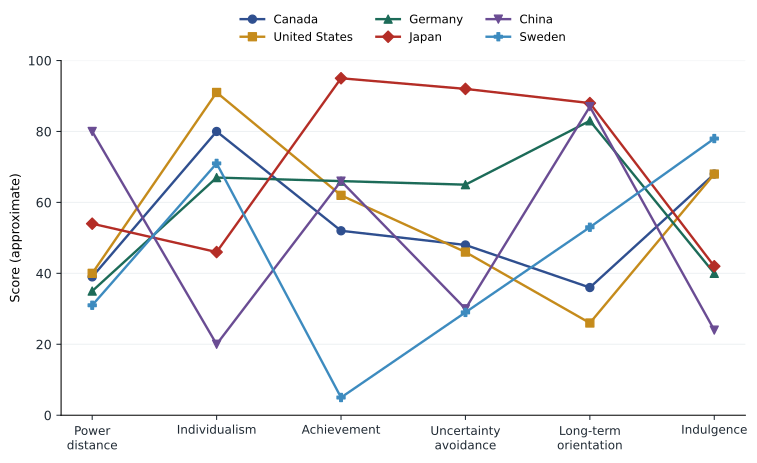
The figure shows how close Canada and the United States are on most dimensions: both are low in power distance, high in individualism and indulgence, and moderate in uncertainty avoidance. Japan stands out for very high uncertainty avoidance and achievement orientation; China for high power distance, collectivism and long-term orientation; Sweden for very low achievement orientation, reflecting an emphasis on consensus and quality of life. These patterns help explain why a North American manager may find it easy to start working with Swedes but slow to build the consensus Swedes expect, or why a project plan that seems sensibly flexible at home may seem dangerously vague to a Japanese partner.
Other frameworks
The GLOBE project, led by Robert House and published in 2004, surveyed about 17,000 middle managers in 62 societies and measured nine dimensions, distinguishing between how things are and how respondents think they should be. Its findings on leadership are especially useful: charismatic and team-oriented leadership was endorsed almost everywhere, while the value placed on participative, autonomous or status-conscious leadership varied widely. The anthropologist Edward Hall distinguished high-context cultures, such as Japan, China and much of the Middle East, in which much of the meaning of a message lies in the setting, relationships and what is left unsaid, from low-context cultures, such as Germany, Scandinavia and North America, in which meaning is expected to be explicit in the words.
Erin Meyer's The Culture Map, published in 2014, translated such research into eight practical scales for managers: communicating, evaluating, persuading, leading, deciding, trusting, disagreeing and scheduling. Her most useful insight is that positions on the scales are relative. Americans are more direct in negative feedback than the Japanese but less direct than the Dutch or Germans; to a German, an American manager's carefully balanced feedback can sound evasive, while to a Thai employee it can sound brutal. Leo laughs in recognition. Kestrel's Dutch customer, he says, once told his team that their software was not good enough in a meeting that Kestrel's staff found shocking and the Dutch found routine.
Using the frameworks well
Researchers have criticized the dimension approach. National averages hide large variation within countries, especially in diverse societies such as Canada, the United States, India and Nigeria. Cultures change over time; the original IBM data are now more than fifty years old, and later surveys show shifts, for example toward greater individualism in many countries as incomes rise. Applying a national average to an individual is an error statisticians call the ecological fallacy. And people adapt their behavior to context: a Chinese manager working for a multinational in Shanghai may behave quite differently from one in a state-owned enterprise.
Dr. Tan suggests three habits instead of rigid prediction. First, use the frameworks to generate hypotheses about where misunderstandings may arise, then test them by observing and asking. Second, explain your own culture's rules explicitly to others, since they are invisible to you but not to them. Third, agree on shared working norms for the team, such as how decisions will be made, how disagreement will be expressed and how deadlines will be treated, rather than assuming that everyone's defaults will match.
Cultural distance
Researchers often summarize differences across several dimensions in a single measure of cultural distance. A widely used index, proposed by Bruce Kogut and Harbir Singh in 1988, averages the squared differences between two countries' scores on each dimension, each divided by the variance of that dimension across countries. Studies have linked greater cultural distance to a preference for lower-commitment entry modes and to higher failure rates for acquisitions, though the effects are often modest and the measure has been criticized for ignoring which differences matter for a particular business.
# Kogut-Singh cultural distance from a home country to several markets (approximate scores)
dims = ["power", "individualism", "achievement", "uncertainty", "long_term", "indulgence"]
scores = {
    "Canada":         [39, 80, 52, 48, 36, 68],
    "United States":  [40, 91, 62, 46, 26, 68],
    "United Kingdom": [35, 89, 66, 35, 51, 69],
    "Germany":        [35, 67, 66, 65, 83, 40],
    "Sweden":         [31, 71,  5, 29, 53, 78],
    "Japan":          [54, 46, 95, 92, 88, 42],
    "China":          [80, 20, 66, 30, 87, 24],
}
# variance of each dimension across the countries listed
n = len(scores)
means = [sum(s[k] for s in scores.values()) / n for k in range(len(dims))]
var = [sum((s[k] - means[k]) ** 2 for s in scores.values()) / (n - 1) for k in range(len(dims))]
def distance(a, b):
    return sum((scores[a][k] - scores[b][k]) ** 2 / var[k] for k in range(len(dims))) / len(dims)
for home in ("Canada", "United States"):
    others = [c for c in scores if c != home]
    ranked = sorted(others, key=lambda c: distance(home, c))
print(home + ": " + ", ".join(f"{c} {distance(home, c):.2f}" for c in ranked))Canada: United States 0.08, United Kingdom 0.19, Sweden 0.79, Germany 1.08, Japan 2.45, China 3.50 United States: Canada 0.08, United Kingdom 0.22, Sweden 1.21, Germany 1.44, Japan 2.83, China 4.05
The index ranks the United States and the United Kingdom as culturally closest to Canada, and Japan and China as most distant, with Germany and Sweden in between. For Cedarline's expansion, this suggests that early markets in the English-speaking world or northern Europe would require less cultural adaptation than markets in East Asia. But the index cannot tell Cedarline which differences matter for selling jackets. Uncertainty avoidance might affect how much product information and warranty detail customers expect; indulgence might affect attitudes to leisure; individualism might affect whether advertising should show a lone climber or a group of friends.
Language
Language is the most visible part of culture and often the most practical barrier. English is the main language of international business, but most of the world's consumers do not speak it well, and many business relationships deepen only when one side speaks the other's language. Language rules also apply to companies directly. Any company selling into Canada must plan for French: in Quebec, the Charter of the French Language, strengthened by Bill 96 in 2022, requires product labels, packaging, commercial signs, websites and many business documents to be in French, with rules on trademarks in other languages tightened from June 2025. The European Union, with twenty-four official languages, requires product safety information in the languages of the countries where products are sold.
Translation is not enough. Brand names, slogans and images carry different associations in different languages and cultures. Marketers tell many stories of brand names that turned out to mean something embarrassing in another language; some of these stories are exaggerated, but the risk is real enough that most companies test names with native speakers in every target market before launch.
Managing across cultures
Cross-cultural differences affect almost every management task. Negotiation styles vary in how quickly parties move to business, how much they rely on written contracts and how openly they express disagreement; MBA-604 examines these differences in detail. Leadership expectations vary from directive to participative. Feedback can be direct or indirect, public or private. Decision making can be top-down, as in many high power distance cultures, or consensual, as in Japan, where the practice of nemawashi builds agreement informally before a formal meeting. Attitudes to time vary between cultures that treat schedules as fixed and those that treat them as flexible.
Researchers Christopher Earley and Soon Ang proposed in 2003 the concept of cultural intelligence: the capability to function effectively across cultures. It has four parts: motivation to engage with other cultures, knowledge of how cultures differ, strategy for planning and checking one's understanding, and the ability to adapt behavior. Unlike personality, cultural intelligence can be developed through training, experience and reflection. Companies that rely on international teams increasingly assess and develop it, and some use it in selecting managers for foreign assignments.
Worked problem
Helping Lakeview's new nurses speak up
Several of Lakeview's internationally trained nurses rarely question physicians' orders, even when they have concerns. Using the frameworks in this lesson, explain the likely cause and suggest how Hana should respond.
Show solution
- Many of the nurses come from health systems with higher power distance, where questioning a physician can be seen as disrespectful and hierarchy is clear. Their behavior reflects a different set of rules, not a lack of skill or initiative.
- Patient safety research shows that hierarchy in clinical teams can prevent concerns from being raised, so Lakeview's own norm of speaking up is a safety requirement, not just a cultural preference.
- Hana should make the norm explicit: explain why Lakeview expects every nurse to voice concerns, model it in training, and use structured tools that give permission to speak, such as standard phrases for escalating concerns.
- She should also coach managers to recognize indirect signals of concern and to invite questions privately as well as in rounds, and pair new nurses with experienced mentors from similar backgrounds who have adapted to the Lakeview norm.
Answer: The problem is a mismatch of unwritten rules. Making Lakeview's rules explicit, explaining the safety reason, and adapting how managers invite input will help more than telling new nurses to show more initiative.
Common mistakes
MistakeA country's average cultural score predicts how any individual will behave.
InsteadAverages hide wide variation; use frameworks to form hypotheses and test them with real people.
MistakeCanada and the United States are culturally identical.
InsteadThey are close on most dimensions but differ in some, and both contain great regional and ethnic diversity.
MistakeTranslation of labels and slogans is enough to adapt to a new language.
InsteadNames, slogans and images carry cultural associations that must be tested with native speakers.
MistakeDirect feedback is always clearer and therefore better.
InsteadDirectness is relative; what sounds clear in one culture can sound harsh in another, so adapt the style while keeping the message.
Summary and key terms
- Culture is the shared values, norms and assumptions of a group; national culture is one of several influences on a person.
- Hofstede's six dimensions are power distance, individualism, achievement, uncertainty avoidance, long-term orientation and indulgence.
- GLOBE, Hall's high- and low-context distinction and Meyer's eight scales add practical detail; positions on scales are relative.
- Frameworks describe averages; avoid the ecological fallacy and use them as hypotheses to test.
- Cultural distance indices such as Kogut and Singh's summarize differences but do not show which ones matter for a business.
- Language rules, such as Quebec's Charter of the French Language, and cultural intelligence are practical concerns for international managers.
- Culture
- The shared values, beliefs, norms and assumptions learned by members of a group.
- Power distance
- The extent to which less powerful members of a society accept unequal distribution of power.
- High-context culture
- A culture in which much meaning is conveyed by setting, relationships and what is left unsaid.
- Ecological fallacy
- The error of applying a group average to an individual member.
- Cultural distance
- A measure of how different two countries' cultures are across several dimensions.
- Cultural intelligence
- The capability to function effectively across cultures.
Practice problems
Work each problem on paper first, then reveal the answer to check.
A manager from a low power distance culture leads a team from a high power distance culture. What problem might arise in meetings, and how could she address it?
Show answer
Team members may wait for her decisions and avoid disagreeing in public; she could seek input individually, explain that she wants disagreement, and use structured rounds in which everyone speaks.
Why might a project schedule that seems sensibly flexible to a Canadian manager worry a Japanese partner?
Show answer
Japan scores very high on uncertainty avoidance; partners may expect detailed plans and firm commitments and see flexibility as risk.
Two countries differ by 20 points on one dimension whose cross-country variance is 400, and by zero on all others, in a six-dimension index. What is the Kogut–Singh distance?
Show answer
(20² / 400) / 6 = 1 / 6 ≈ 0.17.
What is the ecological fallacy, and why does it matter for managers using cultural frameworks?
Show answer
Applying group averages to individuals; it leads to stereotyping and to misreading people who do not fit the national pattern.
Lesson quiz · 5 questions
Score 60% or more to complete this lesson.
Create a free account to save your progress, take quizzes and earn a certificate.