
MBA-611 · Lesson 10 of 12 · 20 min
Global supply chains and geoeconomics
In MBA-513, the cohort redesigned Cedarline's supply chain for cost, speed and inventory. Dr. Tan opens the tenth session by asking them to look at the same supply chain through a different lens: power. Who could cut it, and why? Grace answers first. Second Ascent's zippers come from one Japanese company's factories, one of them in China; its waterproof membranes from Taiwan. If relations between China and Taiwan deteriorated, she says, both could stop at once. Owen adds that the gas turbines Prairie Ridge depends on use rare earth magnets refined almost entirely in China. Dr. Tan says that this is geoeconomics: the use of economic tools, including trade, investment, finance and technology, to pursue geopolitical goals, and the way it is reshaping where companies make and buy things.
From efficiency to resilience
For three decades, supply chain strategy aimed mainly at cost. Companies concentrated production in the cheapest locations, often China, held little inventory and relied on long, finely tuned chains. The model delivered enormous efficiency, and it carried hidden risks that became visible after 2020. The pandemic closed factories and ports; a ship blocked the Suez Canal for six days in 2021; Russia's invasion of Ukraine cut supplies of energy, grain and metals; attacks on shipping in the Red Sea from late 2023 forced many vessels around Africa; and conflict in the Middle East in early 2026 disrupted energy supplies and shipping again. Meanwhile, governments began using supply chains deliberately as instruments of pressure.
Companies have responded by giving more weight to resilience: the ability to absorb a disruption and recover quickly. Resilience costs money. It may require holding more inventory, qualifying second suppliers, paying more to produce closer to customers or designing products that can use alternative parts. The strategic question is not whether to trade efficiency for resilience, but how much resilience is worth for each product and input, given the likelihood and impact of disruption.
The tools of geoeconomics
Governments use a growing set of economic tools for strategic ends. Tariffs, discussed in lesson 3, raise the cost of goods from particular countries. Sanctions prohibit dealings with designated countries, firms or people; the sanctions imposed on Russia since 2022 by the European Union, the United States, Canada, the United Kingdom, Japan and others are the most extensive ever applied to a large economy, and the EU extended its regime in September 2026 to 2029. Export controls restrict sales of sensitive technologies: since October 2022 the United States has progressively restricted exports of advanced semiconductors and chip-making equipment to China, and allies including Japan and the Netherlands have adopted related controls.
China has used similar tools. It imposed export controls on gallium and germanium, used in electronics, in 2023, and on several rare earth elements and magnets in 2025, before agreeing in late 2025 to suspend some of the newest controls for a year as part of a truce with the United States. Since China refines most of the world's rare earths and many other critical minerals, such controls can halt production lines far from China. Investment screening allows governments to block foreign acquisitions in sensitive sectors; Canada, the United States, the European Union, Japan and the United Kingdom have all tightened their regimes since 2018. Subsidies and industrial policy, such as American, European, Japanese and Canadian programs for semiconductors, batteries and clean energy, aim to build domestic capacity in strategic industries.
Fragmentation and connector countries
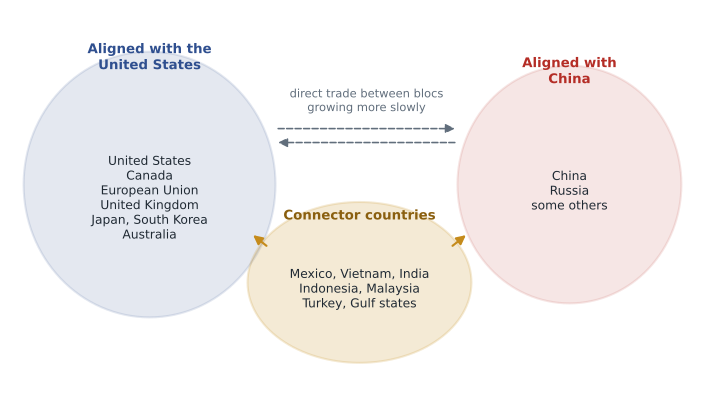
Research at the International Monetary Fund and elsewhere has documented how trade has begun to shift along geopolitical lines. Since 2022, trade and investment between countries in rival blocs have grown more slowly than trade among allies. At the same time, connector countries, which trade extensively with both sides, have gained. Mexico became the largest source of American imports in 2023, overtaking China. Vietnam, India, Indonesia, Malaysia and Turkey have attracted factories moving out of China. Some of this shift is genuine relocation of production; some is rerouting, in which Chinese inputs are assembled or transshipped through connector countries, which is why the United States and others have tightened rules of origin and enforcement.
Economists estimate that severe fragmentation could reduce world output by several percent in the long run, with the largest losses in emerging and developing economies that depend on trade with both blocs. For companies, fragmentation means that supply chain decisions now carry political as well as economic consequences. A factory in a connector country may face new tariffs if its home country's alignment changes; a supplier owned by a firm from a rival bloc may become subject to sanctions or controls.
Strategies: China plus one, nearshoring and friendshoring
Companies have adopted several overlapping strategies. China plus one keeps production in China, often for the Chinese and Asian markets, while adding capacity in at least one other country to serve other markets and reduce dependence. Nearshoring moves production closer to customers, such as from Asia to Mexico or Central America for the North American market, or from Asia to Turkey and eastern Europe for Europe; it shortens lead times, reduces inventory and shipping risk and, under USMCA, can qualify goods for duty-free treatment, though labor costs are higher. Friendshoring, a term popularized by the US Treasury in 2022, concentrates supply chains among politically allied countries. Reshoring brings production back home, usually with heavy automation, and has been significant in a few strategic industries, such as semiconductors and batteries, but limited elsewhere because of labor costs and shortages.
Each strategy has costs. Production outside China often costs more, at least at first, because suppliers, skilled workers and infrastructure are less developed; many inputs still come from China even when final assembly moves. Nearshoring to Mexico exposes companies to its own risks, including security, energy supply and the future of North American trade rules. Dr. Tan stresses that moving production rarely eliminates dependence on rival countries; it often moves it one tier further back in the supply chain, where it is harder to see.
Seeing the whole chain
Most companies know their direct suppliers well and their suppliers' suppliers poorly. Yet many disruptions start several tiers back: a chemical plant that makes a coating, a mine that supplies a mineral, a mill that spins a yarn. Mapping the supply chain beyond the first tier is the first step in managing geoeconomic risk. It is also increasingly required by law. The United States' Uyghur Forced Labor Prevention Act, in force since 2022, presumes that goods made wholly or partly in the Xinjiang region of China were made with forced labor and bars them unless the importer proves otherwise; cotton, polysilicon and aluminum have been major targets. Canada has prohibited imports of goods made with forced labor since 2020 and, since 2024, requires larger companies to report on the steps they take to prevent forced and child labor in their supply chains. The European Union has adopted a forced labor regulation that will ban such products from its market from late 2027, and its corporate sustainability due diligence directive requires large companies to identify and address human rights and environmental harms in their chains, though its scope and timing were reduced in 2025 and 2026.
For Cedarline, which uses cotton in some casual lines and buys from factories that source fabric from many countries, these rules make supply chain mapping a legal necessity, not just good practice. Shipments that cannot be traced to their fiber source risk being detained at the border.
Stress-testing the supply chain
Companies increasingly stress-test their supply chains against scenarios: a closure of a key shipping lane, the imposition of sanctions on a supplier's country, an export ban on a critical input, a natural disaster at a key plant. For each scenario they estimate the time to recover, how long it would take to restore supply, and the time to survive, how long the company could continue to meet demand from inventory and alternative sources. MBA-513 introduced these measures for Cedarline's membrane supplier. A geoeconomic stress test extends the approach to political scenarios, which may last much longer than physical disruptions: a factory flooded by a typhoon may be back in weeks, but an export ban or sanctions regime can last for years.
# Choosing a sourcing mix under geoeconomic scenarios (costs per jacket, home currency)
sources = {"Country A (current)": 104.0, "Country B (connector)": 109.0, "Nearshore": 121.0}
# scenarios: (probability over the planning period, extra cost per jacket by source)
scenarios = {
    "base":                    (0.60, {"Country A (current)": 0.0,  "Country B (connector)": 0.0,  "Nearshore": 0.0}),
    "new tariffs on A":        (0.20, {"Country A (current)": 26.0, "Country B (connector)": 4.0,  "Nearshore": 0.0}),
    "shipping disruption":     (0.15, {"Country A (current)": 9.0,  "Country B (connector)": 9.0,  "Nearshore": 1.0}),
    "export ban affecting A":  (0.05, {"Country A (current)": 80.0, "Country B (connector)": 12.0, "Nearshore": 3.0}),
}
mixes = {"all A": {"Country A (current)": 1.0},
         "70/30 A and B": {"Country A (current)": 0.7, "Country B (connector)": 0.3},
         "50/30/20": {"Country A (current)": 0.5, "Country B (connector)": 0.3, "Nearshore": 0.2}}
for name, mix in mixes.items():
    costs = {}
    for sc, (p, extra) in scenarios.items():
        costs[sc] = sum(w * (sources[s] + extra[s]) for s, w in mix.items())
    expected = sum(scenarios[sc][0] * c for sc, c in costs.items())
    worst = max(costs.values())
print(f"{name:<14} base {costs['base']:6.1f} expected {expected:6.1f} worst case {worst:6.1f}")all A base 104.0 expected 114.5 worst case 184.0 70/30 A and B base 105.5 expected 113.7 worst case 165.1 50/30/20 base 108.9 expected 115.1 worst case 153.1
The illustration shows a familiar pattern. Concentrating on the cheapest source has the lowest cost in the base case and a respectable expected cost, but a very high cost in the worst case. Diversifying raises the base cost slightly but sharply reduces the worst case. The 70/30 mix also lowers the expected cost, because the chance of new tariffs on the main source is substantial; adding a nearshore source raises the expected cost a little but cuts the worst case further, so it buys insurance rather than savings. The right mix depends on the probabilities, which are judgments, and on how much the company values protection against the worst case; a company with thin margins and high debt should value it more.
Dr. Tan adds two cautions about such models. First, scenarios are not independent: a conflict that leads to an export ban is also likely to disrupt shipping and raise tariffs, so the worst case may be worse than any single scenario suggests. Second, the cost of a disruption is not only the higher price of the jacket. If supply is cut off altogether, the company loses sales, and perhaps customers, for a season. A proper analysis adds the margin lost on sales that cannot be made, which usually strengthens the case for diversifying critical inputs.
Designing for flexibility
The most robust supply chains are designed to switch. Products can be designed to use common parts and materials available from several sources, or with alternative specifications approved in advance. Suppliers can be qualified in advance even if they receive little business, so that volume can be moved quickly. Contracts can include flexibility on volumes and locations. Inventory of critical inputs can be held strategically rather than uniformly. And information systems that track origin, content and supplier ownership allow a company to see within hours, rather than weeks, which products a new tariff or sanction affects. Dr. Tan tells the cohort that the companies that handled the tariff changes of 2025 and 2026 best were not those with the lowest costs, but those that already knew exactly what was in every product and where it came from.
Worked problem
Second Ascent's zipper risk
Second Ascent buys about 90 percent of its replacement zippers from one supplier's factory in China and 10 percent from the same supplier's factory in Vietnam. Zippers cost about 4 percent of its average repair cost, but without them about 40 percent of repairs cannot be done. Lead time is 8 weeks. Grace holds 6 weeks of stock. How should she manage the risk?
Show solution
- Time to survive: 6 weeks of stock, extendable to perhaps 8 by prioritizing high-value repairs. Time to recover if the Chinese factory were cut off: switching volume to Vietnam might take 10 to 14 weeks while that factory expands, and qualifying another supplier longer.
- Since time to recover exceeds time to survive, Second Ascent is exposed: a disruption would halt 40 percent of its work for several weeks.
- Because zippers are a small share of cost but critical to revenue, extra stock is cheap insurance. Raising stock to 14 weeks would cost little relative to the revenue protected.
- Grace should also shift more volume to the Vietnamese factory, qualify a second brand of compatible zippers, and record in her systems which repairs use which components so she can prioritize in a disruption.
Answer: For a cheap but critical input, the best responses are more inventory, a second source and better information, not a costly relocation of the whole supply chain.
Common mistakes
MistakeMoving final assembly out of a country removes dependence on it.
InsteadMany inputs may still come from that country; map the chain beyond the first tier.
MistakeResilience is always worth any price.
InsteadIts value depends on the probability and impact of disruption for each input; analyze critical inputs separately.
MistakeGeopolitical disruptions are as short as physical ones.
InsteadSanctions, export bans and tariffs can last for years, so recovery plans must assume long durations.
MistakeSupply chain mapping is optional good practice.
InsteadForced labor and due diligence laws in Canada, the United States and the EU now require it for many firms.
Summary and key terms
- Geoeconomics is the use of trade, investment, finance and technology to pursue geopolitical goals; supply chains are now instruments of power.
- Sanctions, export controls, investment screening and subsidies have expanded since 2018, on all sides.
- Trade has shifted toward allies and connector countries such as Mexico and Vietnam; some shifts are rerouting rather than relocation.
- China plus one, nearshoring, friendshoring and reshoring each reduce some risks and add costs; dependence often moves back a tier.
- Forced labor and due diligence laws require companies to map their chains beyond the first tier.
- Stress tests compare time to survive with time to recover; flexible design, qualified second sources and good data are the best defenses.
- Geoeconomics
- The use of economic tools to pursue geopolitical goals.
- Export controls
- Restrictions on the export of sensitive goods and technologies.
- Connector country
- A country that trades extensively with rival geopolitical blocs.
- Nearshoring
- Moving production closer to the markets it serves.
- Friendshoring
- Concentrating supply chains among politically allied countries.
- China plus one
- Keeping production in China while adding capacity in at least one other country.
Practice problems
Work each problem on paper first, then reveal the answer to check.
Give one example of geoeconomic action by the United States and one by China since 2022.
Show answer
United States: export controls on advanced semiconductors and chip-making equipment to China. China: export controls on gallium, germanium and rare earths.
Why might moving apparel production from China to Vietnam not remove Cedarline's dependence on China?
Show answer
Vietnamese factories may use fabric, yarn, zippers and trims made in China, so the dependence moves to the second or third tier.
In the code example, why does the diversified mix have a lower expected cost despite a higher base cost?
Show answer
The probability-weighted extra cost from tariffs and an export ban on the main source exceeds the small premium paid for alternative sources.
What does the Uyghur Forced Labor Prevention Act require of importers?
Show answer
It presumes goods made wholly or partly in Xinjiang involve forced labor and bars them unless the importer proves otherwise.
Lesson quiz · 5 questions
Score 60% or more to complete this lesson.
Create a free account to save your progress, take quizzes and earn a certificate.