
MBA-611 · Lesson 5 of 12 · 22 min
Institutions, political economy and the rule of law
Owen brings a decision to the fifth session. Prairie Ridge Energy has been invited to join a gas-processing venture in a fast-growing country with large reserves, a state-owned partner and a government eager for foreign expertise. The project's numbers look excellent: an expected return well above anything available at home. The board, however, keeps asking questions the spreadsheet cannot answer. What happens if the government changes the gas price it guarantees? Who decides a dispute with the state partner? Could the plant be taken over? Dr. Tan tells the cohort that these are questions about institutions, and that they often decide the success of an international investment more than costs, demand or technology.
What institutions are
The economic historian Douglass North, who shared the Nobel Prize in 1993, defined institutions as the rules of the game in a society, the humanly devised constraints that shape interaction. Formal institutions include constitutions, laws, regulations, courts and the agencies that enforce them. Informal institutions include norms, customs, codes of conduct and expectations about how people will behave. Organizations, including companies, are the players who act within these rules and sometimes try to change them. Institutions matter for business because they determine whether contracts are enforced, property is secure, officials are honest and policies are predictable. Where they are weak, every transaction carries extra cost and risk.
Formal and informal institutions interact. A country can have excellent laws on paper that are poorly enforced in practice, or weak formal rules that are offset by strong informal norms of trust within business networks. Managers entering a new country therefore need to understand both: what the law says, and how things actually get done. Dr. Tan recalls a supplier in one Asian market whose written contracts were models of precision but whose real obligations were set in conversations over dinner. A foreign buyer who relied only on the contract misunderstood what had been agreed.
Political systems
Political systems vary along a spectrum from democracies, in which citizens choose governments through free and competitive elections and enjoy protected civil liberties, to authoritarian systems, in which power is concentrated in a party, a ruler or the military. Most countries fall somewhere in between. For business, the features that matter most are predictability, accountability and constraint. A government whose power is checked by courts, legislatures, a free press and regular elections is less able to expropriate assets or change rules arbitrarily, though it may change policy often through normal politics. A government without such checks may offer speed and decisive support, but its promises are only as reliable as the people who make them.
Democracies are not immune to policy risk, as the past two years of trade policy have shown. Policies can swing sharply with changes of government, and populist movements in many countries have challenged trade, immigration and independent institutions. Yet even in turbulent democracies, courts have constrained executive action: the Supreme Court's ruling on tariffs in February 2026 is an example. In authoritarian systems, by contrast, there may be no independent body to which a company can appeal.
Economic systems and state capitalism
Economic systems range from market economies, in which prices are set by supply and demand and most productive assets are privately owned, to command economies, in which the state plans production and sets prices. Pure forms are rare. Most rich countries are mixed economies with large private sectors, regulated markets and significant public services. The most important variant for international business today is state capitalism, in which the government uses state-owned enterprises, state-controlled banks, sovereign wealth funds and industrial policy to direct investment toward national goals while still operating through markets.
China is the leading example, with state-owned enterprises dominant in banking, energy, telecommunications and heavy industry, and with party committees present even in many private firms. But state capitalism also describes the national oil companies of the Gulf and the industrial policy of many emerging economies. For foreign companies, state-owned enterprises may be customers, partners, suppliers or competitors, often all at once. They may have goals other than profit, access to cheap finance and close ties to regulators, which can make them powerful allies and difficult rivals. Rich democracies have also moved toward more active industrial policy since 2020, with large subsidies for semiconductors, batteries and clean energy in the United States, the European Union, Japan and Canada.
Legal systems
Legal systems also differ. Common law systems, found in the United Kingdom, the United States, most of Canada, Australia, India and other former British colonies, rely heavily on judges' decisions in past cases, which create precedents. Contracts tend to be long and detailed because the parties try to anticipate every contingency. Civil law systems, found in continental Europe, Latin America, Quebec for private law, Japan and much of Asia and Africa, rely on comprehensive written codes, and contracts can be shorter because the code fills in many terms. Some countries apply religious law in certain areas; in parts of the Muslim world, for example, Islamic principles shape finance by prohibiting interest, which has led to the growth of financing structures based on profit sharing and leasing.
Research led by Rafael La Porta, Florencio López-de-Silanes, Andrei Shleifer and Robert Vishny in the late 1990s found that countries with common law origins tended to offer stronger legal protection to outside investors, and had larger stock markets and more dispersed ownership, than countries with civil law origins. The findings have been debated, and many civil law countries have strengthened investor protections since. But the broader point stands: how well a country's legal system protects contracts and investors shapes how companies finance themselves and whom they trust.
Property rights, contracts and the rule of law
The rule of law means that the same rules apply to everyone, including the government, that laws are public and stable, and that disputes are settled by independent courts. For a foreign company, the most important aspects are secure property rights, including intellectual property, the enforceability of contracts and protection against expropriation, the taking of assets by the state. Outright nationalization, as in the seizure of oil assets in several countries over the past century, is now rare. Creeping expropriation is more common: tax changes, price controls, permit revisions, forced renegotiation or regulatory harassment that gradually transfer value from the foreign investor to the state or to local partners.
Companies protect themselves in several ways. Bilateral investment treaties and investment chapters in trade agreements give foreign investors the right to bring claims against host governments before international arbitration tribunals, though such provisions have become controversial and some newer agreements limit them. Political risk insurance from private insurers or public agencies, such as Export Development Canada and the US International Development Finance Corporation, covers expropriation, political violence and currency inconvertibility. Partnering with local firms, international lenders or development banks can make governments less willing to take hostile action. And structuring an investment so that the host country needs the foreign firm's continuing technology, markets or management reduces the incentive to seize it.
Corruption
Corruption, the abuse of entrusted power for private gain, raises the cost of doing business, distorts competition and undermines the rule of law. It ranges from small payments to speed up routine services, sometimes called facilitation payments, to large bribes to win contracts or change laws. Transparency International's Corruption Perceptions Index, published each year since 1995, ranks countries by perceived public-sector corruption; the Nordic countries, New Zealand and Singapore are usually near the top, and countries affected by conflict near the bottom. Canada and the United States usually rank among the cleaner third of countries, though both have slipped in recent years.
Corruption is not only a risk to manage but a crime to avoid. Laws in Canada, the United States, the United Kingdom and most other OECD countries make it an offense for companies and individuals to bribe foreign officials anywhere in the world. Lesson 11 examines these laws and the compliance programs they require. Dr. Tan's experience is that the most effective protection is clarity: a company known never to pay bribes is asked far less often than one whose position is ambiguous.
Institutional voids and how firms fill them
Tarun Khanna and Krishna Palepu of Harvard Business School coined the term institutional voids for the absence, in many emerging markets, of the intermediaries that make markets work in rich countries: credit bureaus, reliable auditors, independent ratings, trustworthy courts, employment agencies, efficient logistics providers and consumer protection agencies. Voids raise the costs of finding customers, suppliers, employees and capital. They also create opportunities. Diversified business groups, such as the Tata group in India, have often thrived by filling voids internally, providing their affiliates with capital, managers and reputation that markets cannot supply. Platform companies have built payment systems, logistics networks and ratings where none existed, as M-Pesa did with mobile money in Kenya.
For a foreign company, voids require adaptation. A firm used to relying on credit checks, delivery companies and contract enforcement may have to build its own versions or partner with local firms that have them. Khanna and Palepu suggested that multinationals entering emerging markets either adapt their business models to the voids, avoid markets where the voids are too costly, or, in some cases, build businesses that fill the voids for others.
Why institutions matter for growth
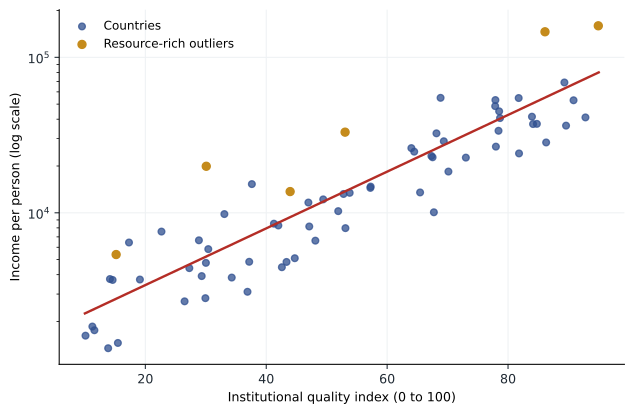
Daron Acemoglu, Simon Johnson and James Robinson, who shared the Nobel Prize in 2024, argued that the deepest cause of differences in prosperity among countries lies in institutions. Inclusive institutions, which protect property rights, enforce contracts, allow broad participation in the economy and constrain the powerful, encourage investment and innovation. Extractive institutions concentrate power and wealth in a narrow elite and discourage investment by everyone else. Their research used the history of European colonization: where settlers faced high mortality, colonizers set up extractive institutions to remove resources, and those institutions persisted long after independence.
# A simple composite institutional quality index for five hypothetical markets
weights = {"rule_of_law": 0.30, "control_of_corruption": 0.25, "regulatory_quality": 0.20,
           "political_stability": 0.15, "voice_accountability": 0.10}
markets = {   # indicator scores on a 0-100 scale
    "Market A": {"rule_of_law": 88, "control_of_corruption": 90, "regulatory_quality": 86, "political_stability": 80, "voice_accountability": 92},
    "Market B": {"rule_of_law": 62, "control_of_corruption": 48, "regulatory_quality": 66, "political_stability": 55, "voice_accountability": 70},
    "Market C": {"rule_of_law": 45, "control_of_corruption": 35, "regulatory_quality": 58, "political_stability": 62, "voice_accountability": 12},
    "Market D": {"rule_of_law": 30, "control_of_corruption": 25, "regulatory_quality": 34, "political_stability": 28, "voice_accountability": 40},
    "Market E": {"rule_of_law": 74, "control_of_corruption": 70, "regulatory_quality": 80, "political_stability": 75, "voice_accountability": 60},
}
for name, s in sorted(markets.items(), key=lambda kv: -sum(weights[k] * kv[1][k] for k in weights)):
    idx = sum(weights[k] * s[k] for k in weights)
    weakest = min(s, key=s.get)
print(f"{name}: index {idx:5.1f}; weakest dimension: {weakest.replace('_', ' ')} ({s[weakest]})")Market A: index 87.3; weakest dimension: political stability (80) Market E: index 73.0; weakest dimension: voice accountability (60) Market B: index 59.0; weakest dimension: control of corruption (48) Market C: index 44.4; weakest dimension: voice accountability (12) Market D: index 30.2; weakest dimension: control of corruption (25)
A composite index is a starting point, not an answer. Market C, for example, scores reasonably on regulatory quality and stability but very low on accountability, a pattern typical of efficient authoritarian systems. For some investments, such as a factory supplying export markets, that profile may be acceptable; for others, such as a consumer brand that depends on intellectual property and fair courts, the weak rule of law may be decisive. The World Bank's Worldwide Governance Indicators, on which the dimensions in the code are modeled, and its Business Ready assessments, which replaced the discontinued Doing Business rankings in 2024, are common sources for such comparisons.
Political economy for managers
Political economy is the study of how politics and economics interact: who gains and loses from policies, how interest groups organize, and how governments make decisions. For managers, it suggests a practical habit. Before entering a market or making a large investment, ask who in the host country benefits from the company's presence and who loses, how powerful each group is, and how the balance might shift. A foreign retailer may be welcomed by consumers and resented by local shopkeepers; a mining company may be welcomed by the national government and opposed by the communities near the mine. Companies that understand these interests can design their entry to build support, for example by sourcing locally, training local staff, sharing benefits with communities or partnering with respected local firms.
Worked problem
Prairie Ridge's venture: what could go wrong?
Prairie Ridge would own 40 percent of a gas-processing plant, with a state-owned company holding 60 percent. The government guarantees a processing fee in US dollars for ten years. The country scores well on regulatory quality and stability but poorly on rule of law and control of corruption, and its last government renegotiated two mining contracts. Identify the main institutional risks and possible protections.
Show solution
- Creeping expropriation: the government could cut the guaranteed fee or raise taxes once the plant is built and Prairie Ridge's investment is sunk. Protection: an investment treaty with arbitration rights, political risk insurance, and lenders such as a development bank whose involvement deters hostile action.
- Partner risk: the state partner controls the board and may pursue goals other than profit. Protection: reserved matters requiring Prairie Ridge's consent, clear dividend policy and an operating role for Prairie Ridge that keeps the plant dependent on its expertise.
- Corruption: officials may seek payments for permits. Protection: a clear policy of refusal, due diligence on agents and contractors, and transparent procurement.
- Currency: the fee is in US dollars, but convertibility could be restricted. Protection: an offshore account for proceeds and insurance against inconvertibility.
Answer: The project may still be worth doing, but only with protections built in before the investment is sunk. Owen recommends a smaller initial stake, a development bank as co-lender and an option to expand if the government honors its commitments for three years.
Common mistakes
MistakeInstitutions are just laws and regulations.
InsteadInformal norms and how rules are enforced matter as much as what is written down.
MistakeAuthoritarian governments are always riskier for business.
InsteadThey can offer speed and stability, but their commitments lack independent checks; the risk is of a different kind.
MistakeExpropriation means outright nationalization.
InsteadCreeping expropriation through taxes, fees and regulation is now far more common.
MistakeA composite governance score is enough to decide whether to enter a market.
InsteadLook at the dimensions that matter for the specific business model and at who gains and loses from the company's presence.
Summary and key terms
- Institutions are the formal and informal rules of the game; they decide whether contracts are enforced and property is secure.
- Political systems differ in predictability, accountability and constraint; democracies have policy risk, authoritarian systems lack checks.
- State capitalism uses state-owned enterprises and industrial policy; such firms can be partners and rivals at once.
- Common law and civil law systems differ in how contracts and investors are protected.
- Creeping expropriation and corruption are major risks; treaties, insurance, partners and dependence on the firm's capabilities are protections.
- Institutional voids raise costs in emerging markets but create opportunities; inclusive institutions support long-run prosperity.
- Institutions
- The formal and informal rules that shape economic and social interaction.
- State capitalism
- An economic system in which the state directs investment through state-owned firms, banks and industrial policy.
- Rule of law
- A system in which public, stable laws apply equally to all, including the government, and are enforced by independent courts.
- Creeping expropriation
- The gradual transfer of value from a foreign investor through taxes, regulation or forced renegotiation.
- Institutional voids
- The absence of market intermediaries such as credit bureaus, reliable auditors and effective courts.
- Political risk insurance
- Insurance against losses from expropriation, political violence or currency inconvertibility.
Practice problems
Work each problem on paper first, then reveal the answer to check.
Give one example of a formal and one of an informal institution that would affect a company selling in a new country.
Show answer
Formal: the country's product safety regulations. Informal: norms about how long business relationships must develop before a large order is placed.
Why might a common law contract be longer than a civil law contract for the same deal?
Show answer
Common law relies less on a code to fill in terms, so parties try to specify more contingencies in the contract itself.
Name three ways a foreign investor can reduce the risk of creeping expropriation.
Show answer
Examples: investment treaty protection with arbitration; political risk insurance; co-investment by development banks; keeping the project dependent on the firm's technology or markets; local partners with political standing.
What is an institutional void, and how might a foreign retailer respond to one in delivery services?
Show answer
The absence of a reliable market intermediary; the retailer might build its own delivery network or partner with a local firm that has one.
Lesson quiz · 5 questions
Score 60% or more to complete this lesson.
Create a free account to save your progress, take quizzes and earn a certificate.