
MBA-611 · Lesson 11 of 12 · 20 min
Global risk: political, currency and compliance risk
Dr. Tan starts the eleventh session with a question she was once asked by a board: what is the worst thing that could happen to us abroad? Owen's answer is a war that closes a plant. Leo's is a data breach that brings a regulator's fine. Hana suggests a scandal in a supplier's factory that ends up on the front page. Dr. Tan says that all three are right, and that the hardest part of managing international risk is that it comes in many forms, most of them unlikely in any given year and some of them catastrophic. A company cannot avoid risk by staying at home, but it can decide which risks to take, how to measure them and what to do about them.
A map of international risks
International risks fall into several families. Political risk is the possibility that political events or government decisions will harm a company's interests. Macro political risks affect all foreign firms in a country: war, civil unrest, revolution, expropriation and sudden changes of regime. Micro political risks affect particular industries or firms: a new regulation, a tax on a sector, the withdrawal of a permit, or a government's decision to favor a local rival. Policy volatility, frequent changes in rules such as tariffs, is a form of political risk that has risen sharply in rich democracies since 2018. Geopolitical risk, discussed in lesson 10, arises from rivalry between states and can turn a supplier, customer or partner into a target of sanctions or controls.
Financial risks include currency risk, discussed in lesson 4; transfer risk, the possibility that a government will restrict conversion or transfer of money out of the country; and the credit risk of foreign customers and partners. Compliance risks arise from the laws a company must follow when it operates abroad: anti-bribery laws, sanctions, export controls, data protection rules, tax laws, customs rules and labor and environmental standards. Operational risks include the security of staff and assets, natural disasters and disruptions to supply chains. Reputational risk, the risk that a company's conduct or that of its partners will damage its standing with customers, employees, investors or governments, cuts across all of these.
Assessing risk
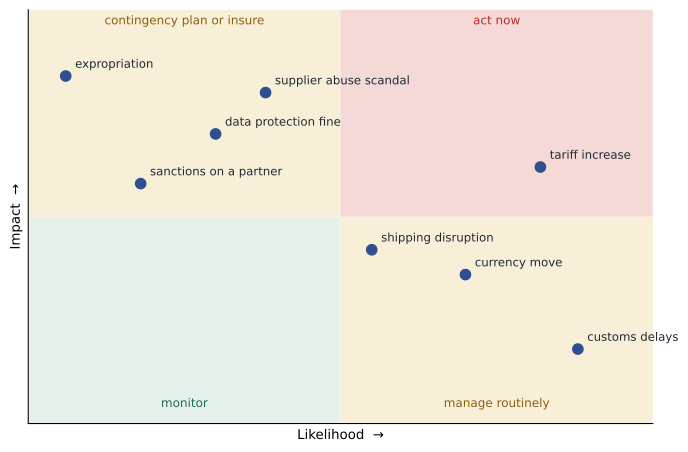
Risk assessment begins with a register: a list of the risks a company faces in each market, with an estimate of each risk's likelihood over a period and its impact if it occurs. Plotting risks on a heat map, with likelihood on one axis and impact on the other, shows at a glance which deserve attention. Risks with high likelihood and high impact require action; those with low likelihood but very high impact, such as war or expropriation, require contingency plans and often insurance; those with high likelihood but low impact, such as routine delays, can be managed in the course of business; and those low on both can be monitored.
Where possible, risks should be quantified. The expected loss from a risk is its probability multiplied by its impact. For a project, risks can be reflected either by adjusting cash flows for expected losses, or by adding a premium to the discount rate, as lesson 4 described. Adjusting cash flows is usually more transparent, because it forces managers to state what they think could go wrong and how likely it is. Scenario analysis, which the cohort used in MBA-514, captures risks that change many variables at once, such as a recession combined with a currency crisis.
# Risk register: expected annual loss and priority for a company's foreign operations (thousands)
risks = [  # name, annual probability, impact if it occurs
    ("Tariff increase on main export market", 0.30, 1800),
    ("Currency move of 15 per cent against home currency", 0.20, 900),
    ("Data protection fine and remediation", 0.04, 4000),
    ("Worker abuse scandal at a key supplier", 0.06, 3500),
    ("Sanctions imposed on a distributor's owner", 0.02, 2500),
    ("Expropriation of a foreign plant", 0.005, 30000),
    ("Shipping lane closure for three months", 0.10, 1200),
]
def zone(p, impact):
    if p >= 0.15 and impact >= 1000: return "act now"
    if impact >= 3000: return "contingency plan or insure"
    if p >= 0.15: return "manage routinely"
    return "monitor"
total = 0
for name, p, impact in sorted(risks, key=lambda r: -r[1] * r[2]):
    el = p * impact
    total += el
    print(f"{name:<52} expected loss {el:6.0f}  -> {zone(p, impact)}")
print(f"total expected annual loss: {total:,.0f}")Tariff increase on main export market expected loss 540 -> act now Worker abuse scandal at a key supplier expected loss 210 -> contingency plan or insure Currency move of 15 percent against home currency expected loss 180 -> manage routinely Data protection fine and remediation expected loss 160 -> contingency plan or insure Expropriation of a foreign plant expected loss 150 -> contingency plan or insure Shipping lane closure for three months expected loss 120 -> monitor Sanctions imposed on a distributor's owner expected loss 50 -> monitor total expected annual loss: 1,410
The register shows why expected loss alone is not enough. Expropriation has a tiny probability, but its impact would be ruinous, so it calls for insurance and contingency planning even though its expected loss is modest. Tariff increases are likely and costly enough to need action now, while currency moves are frequent but manageable in the normal course of business. The value of the exercise lies less in the numbers, which are rough, than in the conversation it forces among managers about what could go wrong and what they would do.
Responding to risk
Companies have four broad responses. They can avoid a risk by not entering a market, not dealing with a partner or withdrawing from an activity. They can reduce it, for example by diversifying suppliers, building local partnerships, keeping assets mobile or hedging currencies. They can transfer it, through insurance, contracts that shift risks to others, or financing structures that involve international lenders. Or they can accept it, deliberately, when the expected return justifies it and the company can bear the worst case. The choice should match the company's risk appetite, which boards increasingly state explicitly.
Political risk insurance covers losses from expropriation, political violence, currency inconvertibility and breach of contract by governments. It is offered by private insurers, by national export credit and development agencies, including the US International Development Finance Corporation, and by the World Bank's Multilateral Investment Guarantee Agency. Insurance is not a substitute for judgment, but its availability and price are useful signals: insurers who refuse cover or charge high premiums for a country are telling a company something.
Anti-bribery laws
Bribery of foreign officials is illegal under the laws of most countries where multinationals are based. The Foreign Corrupt Practices Act of 1977 prohibits American companies, citizens and companies listed on American exchanges from bribing foreign officials, and requires listed companies to keep accurate books and adequate internal controls. In February 2025 an executive order paused new enforcement for review; in June 2025 the Justice Department issued guidelines resuming enforcement with a focus on cases linked to cartels and transnational criminal organizations, on bribery that harms American companies' ability to compete, on threats to national security and on serious misconduct by individuals. The law itself is unchanged, the statute of limitations is generally five years, and future administrations could prosecute conduct that occurs today.
The United Kingdom's Bribery Act of 2010 is broader still: it covers bribery of private parties as well as officials and makes a company liable for failing to prevent bribery by anyone acting on its behalf, unless it had adequate procedures in place. Because it applies to any company that carries on business in the United Kingdom, many North American companies are covered. The common lesson of these laws is that a company is responsible not only for its employees but for its agents, distributors, consultants and joint venture partners, who are the source of most bribery cases.
Sanctions and export controls
Sanctions prohibit dealings with designated countries, entities and individuals. The United States imposes sanctions mainly through the Treasury Department's Office of Foreign Assets Control, whose list of Specially Designated Nationals is the most widely used screening list in the world. American sanctions also apply to entities owned 50 percent or more by designated parties, and some American sanctions are secondary, threatening penalties for non-American companies that deal with sanctioned parties. The European Union, the United Kingdom and others maintain their own lists, which overlap but do not match. Violations can bring large fines and, for individuals, imprisonment.
Export controls restrict the export of goods, software and technology that have military or dual uses, from encryption software to advanced chips and machine tools. Canada controls exports through its Export Control List; the United States through the Export Administration Regulations and the Entity List of restricted foreign parties. Controls can apply even to technology shared by email or to foreign nationals within the home country. Companies manage these risks by screening every customer, supplier, distributor and owner against sanctions and restricted-party lists, classifying their products under export control rules, and building controls into their order and shipping systems so that a prohibited transaction is stopped automatically.
Data protection
Data protection has become a major compliance area for any company that collects personal information from customers or employees in another country. The European Union's General Data Protection Regulation, in force since May 2018, applies to any company that offers goods or services to people in the EU or monitors their behavior, wherever the company is based. It requires a lawful basis for processing data, gives individuals rights to access and delete their data, requires notification of breaches, restricts transfers of data outside the EU and allows fines of up to 4 percent of global annual revenue. Transfers to the United States rely mainly on the EU–US Data Privacy Framework adopted in 2023; transfers to Canada benefit from an EU finding that Canadian private-sector law provides adequate protection. In the United States, more than twenty states now have comprehensive privacy laws, and companies selling across states must reconcile their differences. Leo's Kestrel, which processes data for European retailers, must meet GDPR requirements as a processor on its customers' behalf.
Building a compliance program
Regulators in many countries describe what an effective compliance program looks like, and they consider it when deciding whether to prosecute a company and what penalties to seek. The common elements are a clear commitment from the board and senior leaders; written policies on bribery, gifts, sanctions, export controls and data; a risk assessment that directs effort to the highest-risk markets, products and partners; due diligence on third parties before and during relationships; training tailored to the risks people face; confidential channels for raising concerns, with protection against retaliation; investigation of reports and discipline for violations; and regular testing and improvement. A program that exists on paper but is ignored in practice offers no protection and can be evidence of a company's indifference.
Dr. Tan returns to her earlier point. The most effective protection in international business is a reputation for clear rules. Agents, officials and partners quickly learn which companies will not pay, will not cut corners on sanctions and will walk away from a deal that requires it, and they stop asking. Building that reputation costs some business in the short run and saves far more in the long run.
Worked problem
Screening a new distributor
Cedarline's preferred distributor in a central European country is a family-owned company whose largest shareholder, with 35 percent, is a holding company registered in Cyprus. A second holding company owns 20 percent. The distributor has asked for a marketing fee of 4 percent of sales to be paid to a consulting firm owned by the founder's brother. What should Cedarline do before signing?
Show solution
- Identify the ultimate owners: trace the Cypriot and other holding companies to the individuals who control them, and screen them, the distributor and its directors against Canadian, American, EU and UK sanctions lists.
- Check that no combination of designated owners reaches 50 percent, which would bring the distributor under American ownership rules, and that no owner is a politically exposed person who would raise bribery risk.
- Question the marketing fee: payments to a related consulting firm with no clear service are a common way to hide bribes or kickbacks. Cedarline should require a written description of the services, evidence they are performed, payment only against invoices to the distributor itself, and audit rights.
- Include contract terms requiring compliance with anti-bribery and sanctions laws, allowing termination for breach, and requiring notice of any change in ownership.
Answer: Cedarline should complete ownership and sanctions screening, refuse or restructure the related-party fee, and build compliance terms into the agreement before signing. If the owners cannot be identified, it should look for another distributor.
Common mistakes
MistakePolitical risk means war and revolution.
InsteadMost political risk is micro: regulations, taxes, permits and policy changes affecting particular industries.
MistakeA small facilitation payment to speed up customs is legal.
InsteadCanada abolished its exception in 2017 and the UK has none; such payments are risky and often illegal.
MistakeA company is responsible only for its own employees' conduct.
InsteadAgents, distributors and partners are the source of most bribery cases, and laws hold companies responsible for them.
MistakeA compliance program is a set of written policies.
InsteadEffective programs combine leadership, risk assessment, due diligence, training, reporting channels, investigation and testing.
Summary and key terms
- International risks include political, geopolitical, financial, compliance, operational and reputational risks.
- Risk registers and heat maps assess likelihood and impact; expected loss guides but does not replace judgment about catastrophic risks.
- Responses are to avoid, reduce, transfer or accept risk; political risk insurance transfers some political risks.
- Anti-bribery laws in Canada, the United States and the United Kingdom reach conduct abroad and the actions of agents and partners.
- Sanctions and export controls require screening of all counterparties and classification of products.
- Data protection laws such as the GDPR apply across borders; effective compliance programs are judged by how they work in practice.
- Political risk
- The possibility that political events or government decisions harm a company's interests.
- Transfer risk
- The risk that a government restricts conversion or transfer of money out of a country.
- Risk register
- A list of risks with estimates of their likelihood and impact.
- Expected loss
- The probability of a risk multiplied by its impact.
- Sanctions
- Legal prohibitions on dealings with designated countries, entities or individuals.
- Third-party due diligence
- Checks on the ownership, reputation and conduct of agents, distributors and partners.
Practice problems
Work each problem on paper first, then reveal the answer to check.
A risk has a 5 percent annual probability and an impact of 6 million. What is its expected annual loss, and where would it sit on a heat map?
Show answer
300,000 a year; low likelihood and high impact, so it calls for a contingency plan or insurance.
Why are agents and distributors a common source of bribery risk?
Show answer
They deal directly with officials and customers, are paid commissions that can hide bribes, and are less closely supervised than employees.
A Canadian firm sells to a company 30 percent owned by one sanctioned person and 25 percent by another. Why might American rules matter?
Show answer
Under American rules, entities owned 50 percent or more in aggregate by designated persons are treated as blocked; here the total is 55 percent.
Name four elements of an effective compliance program.
Show answer
Examples: leadership commitment; risk assessment; third-party due diligence; training; reporting channels; investigation and discipline; testing and improvement.
Lesson quiz · 5 questions
Score 60% or more to complete this lesson.
Create a free account to save your progress, take quizzes and earn a certificate.