
MBA-611 · Lesson 4 of 12 · 21 min
Exchange rates and international finance
Leo opens the fourth session with a confession. Two years ago Kestrel signed a three-year contract with a Dutch retailer priced in euros, worth about 1.2 million euros a year. Kestrel's costs are almost all in US dollars. Nobody hedged. Since then the contract has been worth noticeably different amounts each quarter, not because the customer changed anything but because the euro moved. Dr. Tan says that every company that buys or sells abroad faces the same problem in some form. Exchange rates are the prices that connect national economies, and they move more, and less predictably, than almost any other price a manager deals with.
What an exchange rate is
An exchange rate is the price of one currency in terms of another. It can be quoted either way: at the end of October 2026 one US dollar bought about 1.40 Canadian dollars, which is the same as saying that one Canadian dollar bought about 71.5 US cents. When a currency buys more of another currency, it has appreciated; when it buys less, it has depreciated. Because quotes can be written in either direction, Dr. Tan asks the cohort always to say which currency is getting stronger rather than whether the rate went up or down. A rise in the number of Canadian dollars per US dollar is a weakening of the Canadian dollar.
Most currency trading takes place in the foreign exchange market, a global network of banks, funds, companies and central banks that trades several trillion US dollars a day. The spot rate is the rate for immediate exchange, usually settled in two business days. The forward rate is a rate agreed today for exchange on a future date. Most trades involve the US dollar on one side, because it is the main currency for trade invoicing, international borrowing and central bank reserves.
Exchange rate regimes
Countries manage their currencies in different ways. Canada has let its dollar float since 1970, with the Bank of Canada targeting inflation rather than the exchange rate; the United States, the euro area, Japan and the United Kingdom also float. Some countries peg their currency to another: Hong Kong to the US dollar, Denmark to the euro within a narrow band. China manages its currency against a basket, allowing it to move within a daily range around a rate set by the central bank. Twenty countries of the European Union share the euro, giving up their own monetary policy in exchange for removing currency risk among themselves. Each choice involves a trade-off described by economists as the impossible trinity: a country cannot have a fixed exchange rate, free movement of capital and an independent monetary policy all at once.
What moves exchange rates
Over long periods, inflation matters most. A country whose prices rise faster than its partners' tends to see its currency depreciate, so that its goods do not become ever more expensive abroad. Over months and years, interest rates matter: higher interest rates attract investors and tend to strengthen a currency, at least until markets expect them to fall. Commodity prices matter for commodity exporters; the Canadian dollar has historically moved with the price of oil and other resources. Risk sentiment matters too. In times of stress, investors tend to buy US dollars and a few other safe currencies, which is why the US dollar often strengthens during global crises, even crises that begin in the United States.
In October 2026, these forces were pulling in several directions. The energy shock earlier in the year raised inflation in many countries, and on 28 October the Bank of Canada raised its policy rate by a quarter point to 2.50 percent. The Canadian dollar was weaker than at the start of the year, with the US dollar trading between about 1.35 and 1.43 Canadian dollars during 2026, as tariffs and uncertainty over trade weighed on Canada's outlook. Dr. Tan warns the cohort against reading too much into any one explanation. Exchange rates over periods of months are notoriously hard to forecast; research since the 1980s has found that a simple forecast of no change performs about as well as most economic models.
Purchasing power parity
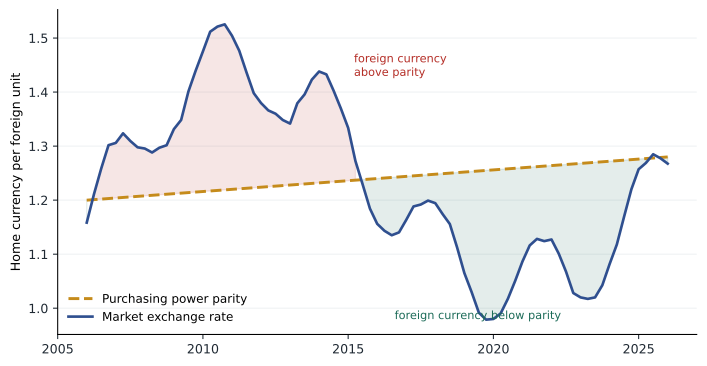
The theory of purchasing power parity holds that, in the long run, exchange rates should move to equalize the prices of identical goods in different countries. If a basket of goods costs 100 dollars in one country and 70 units of another currency abroad, the parity rate is 0.70. Actual exchange rates can deviate from parity for years, because many goods and services are not traded, transport and tariffs add costs, and capital flows and interest rates dominate in the short run. But large deviations tend to shrink over time, and parity offers a rough guide to whether a currency is cheap or expensive.
The Economist magazine's Big Mac index, started in 1986, applies the idea to a single product sold in almost identical form around the world. If a Big Mac costs more in US dollars in one country than in the United States, that country's currency is, by this measure, overvalued. The index is a light-hearted tool with serious limits: the burger contains local labor and rent, which are cheaper in poorer countries. But it shows managers something practical. A product that sells at a given price at home will look expensive or cheap abroad depending on the exchange rate, and local purchasing power is often far below what market exchange rates imply.
# Implied purchasing power parity from local prices of an identical product (illustrative prices)
home_price = 7.50            # price at home, in home currency
local = {   # country: (local price, market exchange rate in local currency per home-currency unit)
    "Euro area":      (5.40, 0.62),
    "United Kingdom": (4.80, 0.54),
    "Japan":          (520.0, 109.0),
    "Mexico":         (88.0, 13.2),
    "Switzerland":    (7.30, 0.58),
}
for name, (p, fx) in local.items():
    implied = p / home_price                 # PPP exchange rate
    gap = implied / fx - 1                   # positive: local currency overvalued against home
print(f"{name:<15} implied rate {implied:8.3f} market {fx:8.3f} local currency {gap:+.0%} vs PPP")Euro area implied rate 0.720 market 0.620 local currency +16% vs PPP United Kingdom implied rate 0.640 market 0.540 local currency +19% vs PPP Japan implied rate 69.333 market 109.000 local currency -36% vs PPP Mexico implied rate 11.733 market 13.200 local currency -11% vs PPP Switzerland implied rate 0.973 market 0.580 local currency +68% vs PPP
Interest rate parity and forward rates
Forward rates are not forecasts; they are set by arbitrage. Suppose an investor can earn 2.5 percent a year in US dollars and 2.0 percent in euros. If the investor converts into euros today, invests for a year and agrees today to convert back at the forward rate, the forward rate must be set so that this round trip earns the same as investing at home; otherwise banks could make riskless profits. This relationship is covered interest parity. It implies that the currency with the higher interest rate trades at a forward discount: the forward rate builds in a depreciation equal, approximately, to the interest rate difference.
Here S and F are spot and forward rates expressed as units of home currency per unit of foreign currency. Uncovered interest parity is the bolder claim that the expected future spot rate equals the forward rate, so that higher interest rates are exactly offset by expected depreciation. The evidence is weak; in practice high-interest currencies have often stayed strong or appreciated for long periods, which is why the carry trade, borrowing in low-interest currencies to invest in high-interest ones, can be profitable until a sudden reversal. For a company, the practical point is that hedging with forwards does not cost or earn a forecast; it locks in today's rate adjusted for the interest rate difference.
Three kinds of currency exposure
Transaction exposure arises when a company has a contract to pay or receive a foreign currency at a future date: Kestrel's euro invoices, or Cedarline's orders for jackets priced in US dollars and paid months later. Translation exposure arises when a company consolidates the financial statements of foreign subsidiaries, whose assets and profits change in home-currency value as rates move, even though nothing has happened to the business. Economic exposure, the broadest and often the largest, is the effect of exchange rates on the company's future cash flows and competitive position: a stronger home currency makes a firm's exports more expensive abroad and its rivals' imports cheaper at home, whether or not the firm has any foreign contracts.
For Cedarline, which pays its Asian factories in US dollars and sells in US dollars, transaction exposure is small today. Its economic exposure is not. If the dollar weakens against Asian currencies, its suppliers' costs in dollars will rise over time; if it strengthens, foreign brands find it harder to compete in the United States. Once Cedarline sells abroad, it will also have revenue in foreign currencies and costs in dollars, creating a new transaction exposure that it will need to manage.
Managing currency risk
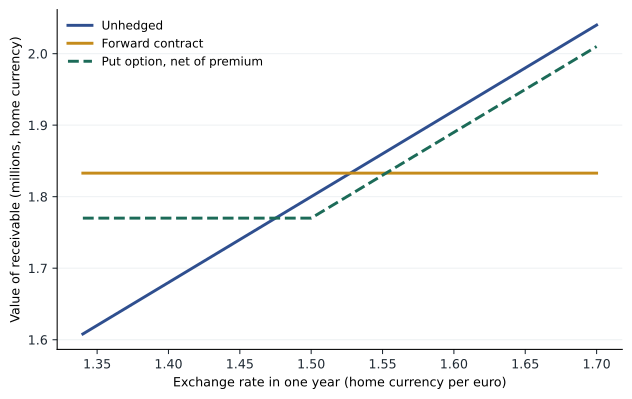
Companies use several tools. A forward contract fixes the exchange rate for a future transaction, removing uncertainty but also giving up any gain if the rate moves favorably. An option gives the right but not the obligation to exchange at a set rate, protecting against bad outcomes while keeping good ones, at the cost of an upfront premium. A natural hedge matches revenues and costs in the same currency, for example by borrowing, buying or employing in the currency in which the company earns. Choosing the currency of invoicing shifts risk to the other party. And operational flexibility, such as the ability to move production or sourcing among countries, reduces economic exposure over the longer term.
# Kestrel: value in home currency of a 1.2 million euro receivable in one year
receivable = 1_200_000
spot, i_home, i_eur = 1.52, 0.025, 0.020          # home currency per euro, annual interest rates
forward = spot * (1 + i_home) / (1 + i_eur)       # covered interest parity
strike, premium = 1.50, 0.025                     # put option on euros, premium per euro
print(f"forward rate {forward:.4f} (euro at a {forward / spot - 1:+.2%} forward premium)")
print(f"{'rate in one year':>17}{'unhedged':>12}{'forward':>12}{'option':>12}")
for future in (1.38, 1.45, 1.52, 1.59, 1.66):
    unhedged = receivable * future
    fwd = receivable * forward
    opt = receivable * (max(future, strike) - premium)
print(f"{future:>17.2f}{unhedged:>12,.0f}{fwd:>12,.0f}{opt:>12,.0f}")forward rate 1.5275 (euro at a +0.49% forward premium)
rate in one year unhedged forward option
1.38 1,656,000 1,832,941 1,770,000
1.45 1,740,000 1,832,941 1,770,000
1.52 1,824,000 1,832,941 1,794,000
1.59 1,908,000 1,832,941 1,878,000
1.66 1,992,000 1,832,941 1,962,000The table shows the trade-off. Unhedged, Kestrel's receivable could be worth anything from about 1.66 to about 1.99 million in its home currency. The forward contract fixes the value at about 1.83 million whatever happens. The option guarantees at least about 1.77 million, after its premium, while keeping most of the gain if the euro strengthens. Dr. Tan stresses that none of these is the right answer in general. A firm with thin margins and fixed-price contracts should hedge most of its transaction exposure, because a currency move could wipe out its profit; a firm with a natural hedge or the ability to reprice quickly may hedge less. What matters is to decide deliberately, write the policy down and avoid the temptation to speculate.
International capital markets and the cost of capital
Companies can also raise money abroad. Large firms issue bonds in foreign currencies or in international markets, and many borrow in US dollars because the market is the deepest in the world. Borrowing in a foreign currency creates a liability exposure that can be useful as a natural hedge for foreign revenues but dangerous when it is not matched: many companies in emerging economies have suffered when their home currency fell and their dollar debts became much harder to service.
When valuing a foreign project, managers must also decide how to reflect country risk. A common approach, associated with Aswath Damodaran, adds a country risk premium to the cost of equity for projects in countries with greater default and political risk, derived from the spreads on their government bonds. Another approach adjusts the cash flows for specific risks, such as expropriation or currency controls, rather than adding a premium to the discount rate. Cash flows and discount rates must be in the same currency: a project's cash flows in euros should be discounted at a euro discount rate, or converted at expected future exchange rates and discounted at a home-currency rate, and the two methods give the same answer only if the expected exchange rates are consistent with the interest rate differences.
Worked problem
Should Kestrel hedge?
Kestrel's euro contract brings in 1.2 million euros a year, about 9 percent of revenue, while all its costs are at home. Its operating margin is 12 percent. The euro has moved by up to 9 percent a year against Kestrel's home currency over the past decade. Would a one-year forward hedge make sense, and what are the alternatives?
Show solution
- A 9 percent fall in the euro would cut home-currency revenue from the contract by about 0.8 percent of total revenue (9 percent of 9 percent), reducing the operating margin from about 12 to about 11.2 percent.
- That is material but not threatening. A forward hedge would remove the uncertainty for the coming year at the cost of giving up any gain from a stronger euro.
- A partial hedge, for example covering 50 to 75 percent of expected receipts for the next twelve months and less for later years, balances certainty and flexibility.
- Alternatives include pricing future European contracts in Kestrel's home currency, adding currency-adjustment clauses, or building a natural hedge by hiring support staff in Europe paid in euros.
Answer: A layered hedge of most of next year's receipts, plus a gradual natural hedge as Kestrel grows in Europe, fits a firm of this size. The key is a written policy that sets the hedge ratio and prevents staff from trading on their own views of the euro.
Common mistakes
MistakeA rise in the exchange rate means the home currency strengthened.
InsteadIt depends on how the rate is quoted; say which currency got stronger.
MistakeForward rates are the market's forecast of future spot rates.
InsteadForward rates are set by interest rate differences through covered interest parity.
MistakeA firm with no foreign contracts has no currency exposure.
InsteadEconomic exposure affects competitiveness and cash flows through rivals, suppliers and customers.
MistakeHedging is speculation.
InsteadHedging reduces risk from an existing exposure; speculation creates exposure in the hope of a gain.
Summary and key terms
- An exchange rate is the price of one currency in another; always state which currency strengthened.
- Countries float, peg, manage or share currencies; the impossible trinity limits their choices.
- Inflation, interest rates, commodity prices and risk sentiment move exchange rates, which are hard to forecast in the short run.
- Purchasing power parity is a long-run anchor; the Big Mac index illustrates it.
- Covered interest parity sets forward rates from spot rates and interest rate differences.
- Firms face transaction, translation and economic exposure and manage it with forwards, options, natural hedges, invoicing choices and operational flexibility.
- Spot rate
- The exchange rate for immediate settlement.
- Forward rate
- An exchange rate agreed today for settlement on a future date.
- Purchasing power parity
- The exchange rate that would equalize the price of identical goods across countries.
- Covered interest parity
- The relationship that sets forward rates so that hedged investment returns are equal across currencies.
- Economic exposure
- The effect of exchange rates on a firm's future cash flows and competitive position.
- Natural hedge
- Matching revenues and costs, or assets and liabilities, in the same currency.
Practice problems
Work each problem on paper first, then reveal the answer to check.
If one US dollar buys 1.40 Canadian dollars, how many US cents does one Canadian dollar buy?
Show answer
1 / 1.40 ≈ 0.714, or about 71.4 US cents.
The spot rate is 1.50 home units per euro, the home interest rate is 4 percent and the euro rate is 2 percent. What is the one-year forward rate?
Show answer
1.50 × 1.04 / 1.02 ≈ 1.5294; the euro trades at a forward premium of about 2 percent.
A product costs 6.00 at home and 4.50 abroad, and the market rate is 0.60 units of foreign currency per home unit. Is the foreign currency overvalued or undervalued by purchasing power parity?
Show answer
Implied rate 4.50 / 6.00 = 0.75; market 0.60. The foreign currency buys more home currency than parity implies, so it is overvalued by about 25 percent.
Give an example of economic exposure for a company that sells only at home.
Show answer
A domestic furniture maker whose currency strengthens faces cheaper imported furniture from foreign rivals and loses market share, even though it has no foreign contracts.
Lesson quiz · 5 questions
Score 60% or more to complete this lesson.
Create a free account to save your progress, take quizzes and earn a certificate.