
MBA-611 · Lesson 8 of 12 · 21 min
Entry strategies: exporting, licensing, joint ventures and acquisitions
Leo has a decision to make before the eighth session. Kestrel Analytics has twelve customers in Europe, served from home by a sales team that flies over every few weeks. A Dutch software reseller has offered to take over sales and support across the Benelux countries and Germany in exchange for a 30 percent margin. Kestrel's investors would prefer that it open its own subsidiary in Amsterdam or Dublin. A German analytics firm has suggested a joint venture. Dr. Tan says that Leo's three options cover most of the ground of this lesson: a company entering a foreign market must decide not only where to go but how, and the choice of entry mode determines how much it invests, how much control it keeps, how much it learns and how easily it can change course.
The range of entry modes
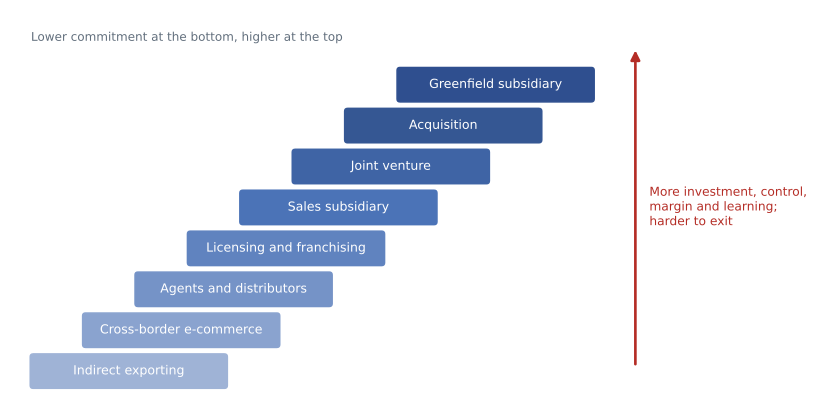
Entry modes can be arranged by the level of resource commitment and control they involve. At the lowest level, indirect exporting sells through intermediaries at home, such as export trading companies or a domestic customer that takes the product abroad. Direct exporting sells to foreign customers through agents, who find buyers and earn commissions without taking ownership of the goods, or distributors, who buy the goods, hold inventory, resell them and earn a margin. Cross-border e-commerce sells directly to foreign consumers online, often through marketplaces or a localized website, and can be launched quickly with modest investment.
Contractual modes transfer the use of the company's assets for a fee. Licensing allows a foreign firm to use a brand, technology or design in exchange for royalties. Franchising extends licensing to an entire business format, including operating systems, training and support, and is common in restaurants, hotels and retail services. Contract manufacturing pays a foreign firm to make products to the company's design, as Cedarline already does in Asia. Management contracts pay the company to operate a facility owned by others, common in hotels and airports.
Equity modes involve ownership. A joint venture creates a new company owned by two or more partners, often a foreign firm and a local one. A wholly owned subsidiary can be built from scratch, known as a greenfield investment, or acquired by buying an existing local company. A sales subsidiary, which sells and supports products made elsewhere, is a common intermediate step between exporting and full local operations.
The trade-offs
Each step up the ladder brings more control over marketing, pricing, quality and customer relationships; more of the profit from each sale; more learning about the market; and more ability to protect intellectual property. Each step also brings more investment, more fixed costs, more risk if the market disappoints, and more difficulty in exiting. Low-commitment modes are flexible and cheap but leave the company dependent on intermediaries who may not share its priorities, who capture a large share of the margin and who own the customer relationship. High-commitment modes put the company in charge but expose it to the full cost of learning a new market.
Transaction cost economics, developed by Ronald Coase and Oliver Williamson, explains when companies prefer to own operations rather than contract with others. Ownership becomes more attractive when the assets involved are specific to the relationship, when it is hard to write and enforce complete contracts, when the partner could behave opportunistically, and when transactions are frequent. Licensing a valuable technology to a foreign firm risks creating a competitor once the licensee has learned it; selling through a distributor risks the distributor neglecting the brand or switching to a rival. These are the internalization advantages of Dunning's OLI paradigm from lesson 1.
| Mode | Investment | Control | Margin captured | Speed | Exit |
|---|---|---|---|---|---|
| Distributor | Low | Low | Lower | Fast | Moderate; contracts may require notice or compensation |
| Cross-border e-commerce | Low to moderate | High online | High | Fast | Easy |
| Licensing | Very low | Low | Royalty only | Fast | Hard during contract term |
| Joint venture | Moderate | Shared | Shared | Moderate | Hard; needs exit clauses |
| Acquisition | High | High | Full | Fast | Hard; sale at a loss possible |
| Greenfield subsidiary | High | Full | Full | Slow | Hard |
Exporting through agents and distributors
For most companies, exporting through a distributor is the first serious step into a foreign market. A good distributor brings knowledge of local customers and retailers, an existing sales force, warehouses and service, and the ability to handle customs, local language and regulations. Choosing one well is critical. Companies should look for distributors whose customers match their target market, who carry complementary rather than competing brands, who are financially sound, and who are large enough to invest in the brand but not so large that the brand becomes one of hundreds in their catalog.
The distribution agreement deserves careful drafting. Key terms include the territory and whether it is exclusive, minimum purchase or sales targets, pricing and marketing obligations, the use of trademarks, who owns customer data, reporting requirements, the length of the agreement and how it can be ended. Termination rules vary greatly across countries. Under European Union rules on commercial agents, an agent whose contract is ended is often entitled to compensation or an indemnity for the customers it brought in, and some countries in Latin America and the Middle East give distributors strong protection against termination. A company that signs a long exclusive agreement with a weak distributor can find itself locked out of its own market.
Licensing and franchising
Licensing generates income with almost no investment and is attractive when a company lacks the capital or knowledge to operate abroad, when trade barriers make exporting costly, or when the market is too small to justify a larger commitment. Royalties are typically a percentage of the licensee's sales, often in the range of a few percent to the low teens depending on the industry and the value of the brand or technology. Apparel brands often license their names for categories they do not make themselves, such as footwear, eyewear or children's clothing, or for entire countries.
The risks are significant. The licensee controls quality, pricing and positioning, and a poorly managed licensing deal can damage the brand in other markets, especially now that consumers see products and prices from around the world online. The licensor may also create a future competitor that has learned its methods. Strong contracts with quality standards, approval rights, audit rights and clear termination rules reduce these risks, as does keeping critical capabilities, such as design or key technology, at home. Franchising, which spread internationally with fast-food chains from the 1970s onward, manages the same risks through detailed operating standards and training, and works best for businesses whose success depends on replicable systems.
Joint ventures
Joint ventures combine the foreign firm's technology, brand or products with a local partner's market knowledge, relationships, distribution or political standing. In some countries and industries they have been required by law; China, for example, required foreign carmakers to form joint ventures with local partners for decades, before phasing out the limit on foreign ownership by 2022. Joint ventures share the investment and the risk, and they can give access to assets that cannot be bought separately, such as a partner's relationships with regulators.
They are also notoriously difficult. Studies over several decades have found that a large share of international joint ventures fail to meet their partners' goals or are dissolved within a few years. Partners' objectives often diverge as the venture develops: the foreign partner may want to reinvest and grow, the local partner to take dividends; one may see the venture as a way to learn the other's technology. Control is shared, so decisions can be slow, and cultural differences between partners add friction. Successful joint ventures usually have a clear division of roles, agreed decision rules for important matters, a plan for resolving deadlocks, and exit provisions, such as rights for one partner to buy out the other at a defined price, agreed at the start rather than in the middle of a dispute.
Acquisitions and greenfield investments
An acquisition gives immediate access to customers, brands, staff, distribution and local knowledge, and can be the fastest way to build a large presence. MBA-514 showed why acquisitions so often disappoint: buyers overpay, overestimate synergies and underestimate the difficulty of integration. Cross-border acquisitions add cultural and institutional distance, which makes integration harder, and they may require approval from investment screening authorities. A greenfield investment, building a subsidiary from scratch, gives full control and lets the company shape the organization and culture from the start, but it is slow, and the company must build every relationship itself. Research by Jean-François Hennart and others suggests that companies tend to prefer acquisitions when they need local resources they cannot build easily, and greenfield investments when their advantages lie in technology or systems that are easier to transfer to a new organization.
Timing and the option to expand
First movers into a market can win the best partners, locations and customers, shape customers' expectations and build brands before rivals arrive. Followers can learn from first movers' mistakes, enter when demand is proven and avoid the cost of educating the market. Research suggests that first-mover advantages are real in some markets, especially where switching costs or network effects are strong, but often overstated. For many companies, the more useful idea is staging: entering with a low-commitment mode that keeps the option to expand if the market proves attractive. MBA-511 showed how to value such real options; the same logic applies to international entry.
# Kestrel in Europe: compare entry modes over five years plus a terminal value (thousands, home currency)
rate, g = 0.12, 0.03
def value(flows):
    pv = sum(cf / (1 + rate) ** t for t, cf in enumerate(flows, start=1))
    terminal = flows[-1] * (1 + g) / (rate - g) / (1 + rate) ** len(flows)
    return pv, pv + terminal
gross = 0.80                                              # software gross margin
reseller_rev = [1800, 2300, 2800, 3300, 3700]
subsid_rev   = [1600, 2600, 3800, 5200, 6800]           # slower start, faster growth with own team
reseller = [r * gross - r * 0.30 - 250 for r in reseller_rev]          # reseller keeps 30 per cent; support costs
subsid = [r * gross - c for r, c in zip(subsid_rev, [1700, 1900, 2200, 2500, 2800])]   # local team costs
subsid[0] -= 600                                          # set-up costs: entity, office, hiring
# Staged: reseller for two years, then take over the customers for a set fee
staged = reseller[:2] + [r * gross - c for r, c in zip(subsid_rev[2:], [2200, 2500, 2800])]
staged[2] -= 900                                          # buy-out fee and set-up in year 3
for name, flows in (("reseller", reseller), ("subsidiary", subsid), ("staged", staged)):
    five, total = value(flows)
print(f"{name:<11} five-year PV {five:7,.0f} with terminal value {total:8,.0f}")reseller five-year PV 3,914 with terminal value 14,304 subsidiary five-year PV 2,384 with terminal value 19,527 staged five-year PV 3,808 with terminal value 20,952
In Leo's illustrative numbers, the reseller produces the most cash over the first five years but caps Kestrel's share of the market's growth, while the subsidiary costs money at first and is worth far more once the value of the business beyond year five is counted. The staged option, using the reseller for two years with a contractual right to take over the customers for a set fee, gives Kestrel time to learn the market and prove demand before committing to its own team, and comes out best in this illustration. That result assumes Kestrel's own team could reach the same revenue from year three as if it had been there from the start, an assumption Leo should test. Its value depends heavily on negotiating that takeover right in the original contract; without it, the reseller would own the customer relationships and could demand a much higher price later.
Worked problem
Choosing Cedarline's mode
Cedarline is considering how to enter Germany. A specialty sporting goods distributor offers to carry its products in 140 stores for a 35 percent margin, with exclusivity for five years. Alternatively, Cedarline could sell online through a German-language website with a third-party logistics warehouse in the Netherlands, investing about 3 million in marketing, systems and inventory. A third option is to license the brand to a German apparel company for a 7 percent royalty. Assess the options.
Show solution
- Distributor: fast access to physical retail and German customers who want to touch technical apparel before buying. But a five-year exclusive term would lock Cedarline in if the distributor underperforms, and the 35 percent margin is high. Cedarline should negotiate a shorter initial term, performance targets with the right to end exclusivity, and shared customer data.
- Online: Cedarline keeps the full margin, the customer data and control of the brand, and learns directly what German customers buy. But building awareness from zero is slow and costly, and returns are high in online apparel.
- Licensing: almost no investment, but low income and serious brand risk: the licensee would control product and price, and its products would sit online beside Cedarline's own.
- A combination is often best: online sales from the start for learning and margin, with a non-exclusive or performance-tied distributor for a limited number of specialty stores.
Answer: Cedarline should avoid licensing for its core brand, combine online sales with a carefully limited distributor agreement, and keep the option to open its own stores or a subsidiary if sales justify it. The capstone tests this against the other markets.
Common mistakes
MistakeThe entry mode with the highest projected return is best.
InsteadWeigh control, risk, learning and flexibility as well as return, and value the option to expand.
MistakeA distributor agreement is easy to end if sales are poor.
InsteadMany countries protect agents and distributors; set short initial terms, targets and exit rules at the start.
MistakeLicensing is a risk-free source of income.
InsteadLicensees can damage the brand and become competitors; protect quality and keep critical capabilities at home.
MistakeJoint venture partners will continue to share goals.
InsteadGoals often diverge; agree decision rules, deadlock procedures and exit rights before signing.
Summary and key terms
- Entry modes range from indirect exporting and e-commerce through licensing and franchising to joint ventures, acquisitions and greenfield subsidiaries.
- Higher-commitment modes bring more control, margin and learning but more investment, risk and difficulty of exit.
- Transaction cost economics and the internalization advantage explain when ownership beats contracting.
- Distributor and licensing agreements need careful terms on territory, exclusivity, targets, quality, data and termination.
- Joint ventures need clear roles, decision rules and exit provisions; acquisitions are fast but hard to integrate; greenfield gives control but is slow.
- Staged entry preserves the option to expand; its value depends on rights negotiated at the start.
- Agent
- An intermediary that finds buyers and earns commissions without owning the goods.
- Distributor
- An intermediary that buys, holds and resells goods, earning a margin.
- Licensing
- Granting a foreign firm the right to use a brand, technology or design in exchange for royalties.
- Joint venture
- A company owned by two or more partners, often a foreign and a local firm.
- Greenfield investment
- Building a new foreign subsidiary from scratch.
- Transaction cost economics
- The theory that firms own activities when contracting for them is costly or risky.
Practice problems
Work each problem on paper first, then reveal the answer to check.
Why might a company prefer an agent to a distributor in a new market?
Show answer
An agent does not take ownership, so the company keeps control of pricing and inventory and the customer relationship, while paying only commission on sales.
A licensee sells 40 million a year of licensed products at a 6 percent royalty. What does the licensor earn, and what risks does it bear?
Show answer
2.4 million a year; risks include damage to the brand from poor quality or positioning, and the licensee learning enough to compete.
Name three provisions that help a joint venture survive disagreement between partners.
Show answer
Examples: reserved matters requiring both partners' consent; a deadlock resolution procedure such as escalation or mediation; buy-sell or put and call options at a defined price.
When might an acquisition be preferable to a greenfield subsidiary?
Show answer
When speed matters and the company needs local resources, such as brands, customers or relationships, that it cannot build quickly itself.
Lesson quiz · 5 questions
Score 60% or more to complete this lesson.
Create a free account to save your progress, take quizzes and earn a certificate.