
IRW-340 · Lesson 3 of 12 · 21 min
Review: safety and fall protection
▶ Video coming soon A video version of this lesson is on the way.
Grace Ndlovu, Crossbeam's safety coordinator, came to the first review session with a cardboard box. In it were a harness with a frayed web, a self-retracting lifeline with a bent snap hook, a beam clamp with a cracked jaw, a lanyard whose energy absorber had partly deployed, and the damaged lifeline Shay had tagged out on his fourth day on the job. She put them on the table and asked Benno to find what was wrong with each one, out loud, in the order he would check them on a real morning. Then she said: "That's the exam. Not this box exactly, but this kind of thinking. Most safety questions ask what you'd do next, and what you'd do next is always to find the hazard and stop it before it hurts somebody."
Safety is part of the common occupational skills area, and it also runs through every other area: a rigging question may be about a damaged sling, an erection question about a column that is not yet stable, an ornamental question about an open edge at a stair. This lesson reviews the safety and fall protection material from IRW-110 and the safety parts of the later courses, in the order the group went through it.
The rules that govern the work
On a U.S. construction project, the Occupational Safety and Health Act sets the general duty of employers and OSHA's construction standards in 29 CFR 1926 set the specific rules. Steel erection has its own standard, Subpart R, and fall protection for other construction work is in Subpart M. Cranes are in Subpart CC. The employer is responsible for its own workers, and on a multi-employer site the controlling contractor, usually the general contractor, has duties too. Workers have the right to a safe workplace, to training in a language they understand, to report hazards and to file a complaint without retaliation.
Fall protection training is required too. Subpart R requires the employer to train each worker exposed to fall hazards, with additional training for connectors and for workers in a controlled decking zone. Crossbeam's own training adds the specific equipment and the site, and many general contractors also require an OSHA 10-hour or 30-hour construction card at the gate.
Fall protection: when it is required
Under Subpart R, an ironworker on a walking or working surface with an unprotected side or edge more than 15 ft above a lower level must be protected by guardrails, safety nets, personal fall arrest, positioning devices or fall restraint. Connectors have a different rule: they must be protected above two stories or 30 ft, whichever is less, and between 15 and 30 ft they must have the equipment and be able to tie off. In a controlled decking zone, deckers between 15 and 30 ft may work without tie-off if every condition of the zone is met. Crossbeam's own rule is stricter: 100 in 100 tie-off above 6 ft wherever there is no guardrail, and no controlled decking zones.
| Situation | Rule | Source |
|---|---|---|
| Ironworker on a surface more than 15 ft up | Fall protection required | Subpart R |
| Connector | Protected above two stories or 30 ft; equipped and able to tie off between 15 and 30 ft | Subpart R |
| Controlled decking zone | Allowed between 15 and 30 ft with strict conditions | Subpart R |
| Any work above 6 ft with no guardrail | 100 in 100 tie-off; no controlled decking zones | Crossbeam rule |
| Covers over holes | Twice the load, secured, marked HOLE or COVER | Subpart R |
The fall arrest system
A personal fall arrest system has three parts that must work together: the anchor, the body harness and the connecting device between them, either an energy-absorbing lanyard or a self-retracting lifeline (SRL). The ABCs are an easy way to remember them: anchorage, body support, connector. A fourth part is just as important and often forgotten: a rescue plan.
- Anchors must be strong enough for the fall. OSHA's rule is 5,000 lb per worker attached, or a system designed by a qualified person with a safety factor of at least two; the manufacturer's rating for a beam clamp, sling or anchor device governs.
- The harness is a full-body harness with the back D-ring between the shoulder blades, fitted snugly so that two fingers fit under each strap, with the leg straps tight and the chest strap at mid-chest.
- Energy-absorbing lanyards are commonly 6 ft long and must keep the maximum arresting force to 1,800 lb and free fall to 6 ft, unless the system is designed for more. The absorber can deploy up to about 4 ft for a 6 ft free fall lanyard.
- SRLs reel out and lock on a sudden pull, so free fall is short, often about 1 ft. Under ANSI Z359.14, Class 1 SRLs arrest within 42 in and are for anchors overhead; Class 2 and leading-edge models are for anchors at foot level, where the line may run over an edge.
- Every part is inspected before each use by the worker and at set intervals by a competent person. Anything that has arrested a fall is taken out of service.
Grace's box was a reminder of what that inspection finds: frayed or cut webbing, burn marks from welding spatter, a deployed energy absorber, a hook gate that does not close by itself, a cracked or bent clamp jaw, a lifeline that does not retract fully. Shay found an abraded lifeline near the snap hook at his first morning inspection in September and tagged it out. That is exactly the answer an exam question about inspection wants: remove it from service and report it, never repair it on site.
Clearance
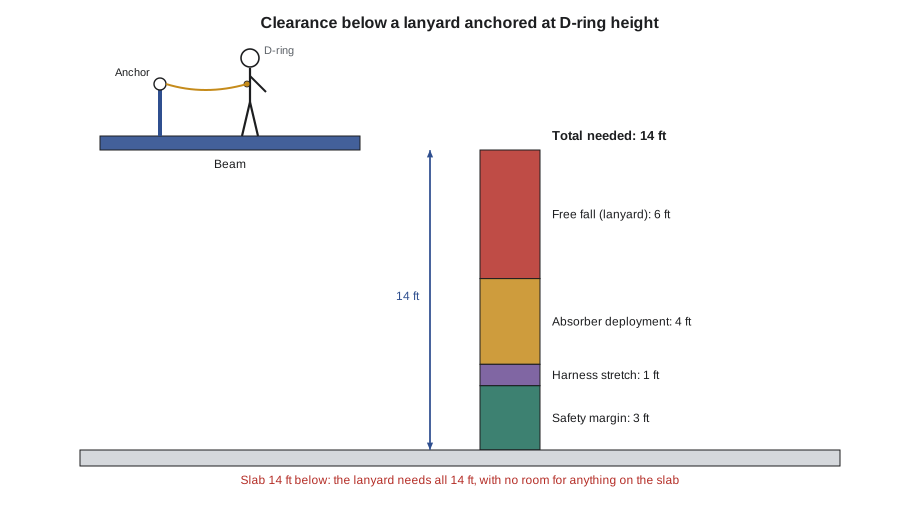
A fall arrest system only works if the worker stops before hitting the level below. The clearance needed below the anchor or working surface adds up everything that happens in a fall. A question on clearance is almost always a calculation question, and the usual mistake is leaving out one of the pieces.
Worked problem
Lanyard or SRL at the second floor
This is the same calculation as in IRW-110. A worker is on second-floor beams 14 ft above the slab, with the anchor at the height of the back D-ring. Compare a 6 ft energy-absorbing lanyard (deployment up to 4 ft) with an overhead SRL (free fall about 1 ft, arrest distance up to 3.5 ft), using harness stretch of 1 ft and a safety margin of 3 ft.
Show solution
- With the anchor at D-ring height, the feet drop the same distance as the D-ring.
- Lanyard: 6 + 4 + 1 + 3 = 14 ft.
- SRL: 1 + 3.5 + 1 + 3 = 8.5 ft.
- Available: 14 ft, less anything on the slab.
Answer: The lanyard needs all 14 ft available, with no room for anything on the slab, so it is not acceptable. The SRL needs about 8.5 ft and is the right choice. At low heights, lanyards often do not have enough clearance.
A second clearance trap is the anchor at foot level. If the anchor is below the D-ring, the free fall is the lanyard length plus the height of the D-ring above the anchor. A 6 ft lanyard clipped to a beam clamp at the feet, 5 ft below the D-ring, gives about 11 ft of free fall, far more than an ordinary lanyard is built for. That is why Crossbeam's connectors use leading-edge SRLs anchored as the maker allows.
Rescue
A worker hanging in a harness after a fall is in danger even if unhurt. Suspension in a harness can restrict blood return from the legs, and a worker who is not rescued quickly can lose consciousness. The harness's trauma straps, loops the worker can stand in, buy time but do not replace rescue. Every job needs a written rescue plan before work at height starts, with the equipment on site and workers trained to use it.
Crossbeam's target is to reach and relieve a suspended worker within six minutes. At the September rescue drill on Shay's first week, the crew reached the suspended worker with the boom lift and had him on the platform in 5 minutes 10 seconds: 30 seconds to raise the alarm, 45 to get the lift moving, 200 seconds to reach him and 35 to secure him. An exam question that asks what should be in place before work at height starts expects the rescue plan in the answer, not just the harness.
Hazards of steel erection
IRW-110 listed the hazards that hurt ironworkers most often, and every later course came back to them. A candidate should be able to name each one and its main control.
| Hazard | Main controls |
|---|---|
| Falls from height | Guardrails or tie-off, inspected equipment, rescue plan |
| Collapse of an unstable structure | Erection plan, required bolts and bracing before release, guying, engineered temporary works |
| Struck by loads and falling objects | No one under the load, tag lines, controlled access zones, tool lanyards, toe boards |
| Caught between | Keep hands off landing loads, use push sticks and tag lines, stay out of pinch points at the crane |
| Crane and power line contact | Minimum distances, a dedicated signaler, a spotter near lines |
| Hot work | Hot work permit, combustibles cleared, fire watch, cylinders secured |
| Impalement on rebar | Engineered caps or troughs designed for impalement, not plastic mushroom caps |
| Noise, dust and fumes | Hearing protection, ventilation and respirators, silica controls for drilling |
| Weather | Wind limits, stop work for lightning, heat and cold plans |
Power line limits come up often. Under Subpart CC, a crane assembled or working near a power line of up to 350 kV must keep at least 20 ft away unless the voltage is known and a smaller Table A distance applies, and work closer than the table requires the full encroachment procedures. Noise exposure under OSHA's construction rule is limited to 90 dBA averaged over eight hours, with a 5 dB exchange rate, so each 5 dB louder halves the allowed time.
Impalement protection is another frequent question. OSHA 1926.701(b) requires protruding reinforcing steel onto and into which workers could fall to be guarded to eliminate the hazard of impalement, and OSHA has said that plastic mushroom caps do not meet that requirement. Where a worker could fall onto bars, Crossbeam uses covers or troughs designed for impalement, as IRW-130 described.
Weather limits
Wind is the hazard that stops steel work most often. Crossbeam's rules, from IRW-110 and IRW-330, are company rules, set below the limits in equipment manuals: connecting stops at gusts of 30 mph, decking at 25 mph, metal building frames are not set in gusts above 25 mph and panels stop at about 20 mph. Subpart R also prohibits work on steel during high winds unless a competent person decides it is safe and the workers are protected. Crane limits come from the crane's manual and the load's sail area. Lightning stops all work at height and crane work until the storm has passed by a safe margin.
Practice questions
Question 1. A worker is about to tie off to a beam clamp at his feet with an ordinary 6 ft energy-absorbing lanyard. What is the main problem? Options: (a) the clamp is too strong; (b) the free fall will be the lanyard length plus the height of the D-ring above the anchor, far more than the lanyard is designed for; (c) the lanyard is too short to reach; (d) there is no problem.
Answer and reasoning: (b). With the anchor at the feet, the free fall grows by the height of the D-ring above the anchor, about 5 ft, giving about 11 ft. A leading-edge SRL rated for foot-level anchors is the right equipment.
Question 2. During a rescue drill, a worker hangs in a harness for several minutes before he is reached. Why does time matter so much? Options: (a) the harness may slip; (b) hanging motionless can restrict blood flow and lead to loss of consciousness; (c) the anchor will fail; (d) it does not matter if he is not injured.
Answer and reasoning: (b). Suspension trauma can harm an uninjured worker; rescue plans set a short target time, six minutes at Crossbeam.
Question 3. A connector stops work because the wind is gusting hard and he believes the work is unsafe. What does Crossbeam's rule and Subpart R say? Options: (a) work must continue; (b) Crossbeam stops connecting at 30 mph gusts, and Subpart R prohibits work on steel in high winds unless a competent person decides it is safe; (c) only the crane operator decides; (d) he must ask the owner.
Answer and reasoning: (b). Crossbeam's company rule and the federal standard point the same way; the competent person makes the call and the worker's concern is taken seriously.
Question 4. Which inspection finding means a harness must be removed from service? Options: (a) a little dirt on the webbing; (b) a burn mark from welding spatter on a strap; (c) the label is easy to read; (d) the buckles work smoothly.
Answer and reasoning: (b). Heat damage weakens webbing, and any doubt about a harness means it comes out of service.
Common mistakes
MistakeClipping a 6 ft lanyard to an anchor at the feet.
InsteadFree fall becomes the lanyard length plus the D-ring height above the anchor; use a leading-edge SRL rated for foot-level anchors.
MistakeForgetting the safety margin or the harness stretch in a clearance calculation.
InsteadAdd free fall, deceleration, stretch and margin, then compare with the distance available.
MistakeTreating trauma straps as a rescue plan.
InsteadStraps buy minutes; a written plan, equipment and trained workers bring the worker down.
MistakeUsing plastic mushroom caps as impalement protection.
InsteadUse caps or troughs designed to stop a falling worker.
MistakeRepairing a damaged lanyard or SRL on site.
InsteadRemove it from service, tag it and report it.
Summary and key terms
- Subpart R requires fall protection above 15 ft, with special rules for connectors and controlled decking zones; Crossbeam requires tie-off above 6 ft and uses no controlled decking zones.
- A fall arrest system is anchor, harness and connector, inspected before every use, plus a rescue plan.
- Clearance is free fall plus deceleration plus harness stretch plus a safety margin; foot-level anchors add the D-ring height to the free fall.
- Crossbeam's rescue target is six minutes; the drill took 5 minutes 10 seconds.
- The main hazards are falls, collapse, struck by, caught between, power lines, hot work, impalement, noise and dust, and weather.
- Wind limits are company rules below the equipment limits.
- Personal fall arrest system
- An anchor, a full-body harness and a connecting device that stop a worker who falls.
- Self-retracting lifeline
- A connector that reels out and locks on a sudden pull, limiting free fall.
- Free fall
- The distance a worker falls before the system begins to slow the fall.
- Clearance
- The distance needed below the working level for a fall to be stopped safely.
- Suspension trauma
- Harm caused by hanging motionless in a harness after a fall.
- Travel restraint
- A system that keeps a worker from reaching a fall hazard at all.
Practice problems
Work each problem on paper first, then reveal the answer to check.
At what height does Subpart R require fall protection for most ironworkers?
Show answer
More than 15 ft.
Name the three parts of a fall arrest system.
Show answer
Anchor, full-body harness and connector (lanyard or SRL).
A 6 ft lanyard is clipped 5 ft below the D-ring. What is the free fall?
Show answer
6 + 5 = 11 ft.
What should be done with a lanyard whose absorber has partly deployed?
Show answer
Remove it from service and report it.
What is OSHA's minimum anchor strength per worker for a non-engineered anchor?
Show answer
5,000 lb.
Lesson quiz · 5 questions
Score 60% or more to complete this lesson.
Create a free account to save your progress, take quizzes and earn a certificate.