
IRW-340 · Lesson 2 of 12 · 23 min
A study plan that works
▶ Video coming soon A video version of this lesson is on the way.
When Andy asked Benno how he had been studying, Benno held up the binder from his last classroom block and said he read it on the bus. Andy nodded. "That's how I failed my first practice test in 2001," he said. "Reading feels like studying. It isn't, not by itself." Over the rest of that first Sunday the group built a plan for the weeks between October 18 and Benno's committee final in late January: what to study, in what order, how many hours a week, and how to check that it was working.
This lesson describes that plan and the reasons behind it. None of it is new science. It is what decades of research on learning and the experience of many apprentices agree on: knowledge sticks when it is pulled out of memory again and again, spread over time, mixed with other topics and checked against the truth. A plan built on those ideas takes less time than a plan built on rereading, and it works better on exam day.
Start with an honest self-assessment
Benno began by rating himself on each part of the trade, from 1 (could not explain it to Shay) to 5 (could teach it to a class). He did it against the weighting from lesson 1, so the result showed both his weak areas and how much each one was worth. Then he took a short diagnostic test of 40 original questions that Andy had collected over the years, without studying first. The diagnostic matters more than the self-rating, because people are poor judges of what they know. Benno rated himself 4 out of 5 on rigging; on the diagnostic he got 6 of 11 rigging questions right, and four of the five he missed were sling angle and load chart calculations.
| Area | Benno's self-rating | Diagnostic result | Weight |
|---|---|---|---|
| Common skills: safety, tools, drawings | 4 of 5 | 6 of 7 | 17 in 100 |
| Rigging, hoisting and cranes | 4 of 5 | 6 of 11 | 31 in 100 |
| Erection, assembly and installation | 3 of 5 | 10 of 15 | 36 in 100 |
| Maintenance and upgrading | 3 of 5 | 4 of 7 | 16 in 100 |
| Total | 26 of 40 (65 in 100) |
Twenty-six of forty is 65 in 100, close to the pass mark but not over it. That was the most useful number of the morning. It said Benno was not starting from nothing, and it said that without a plan he might fail.
Divide the hours by weight and by weakness
Benno worked out that he could study about five hours a week: one on each of three weeknights, plus the Sunday morning group, for fourteen weeks, about 70 hours in all. Andy suggested keeping 10 of those hours for practice tests and review at the end, leaving about 60 hours of topic study. The first cut divides those hours by the exam weighting, so the areas with the most questions get the most time. The second adjustment moves time toward weak areas inside each share.
Worked problem
Dividing study hours by the weighting
Benno has 60 hours of topic study. The weighting is 17, 31, 36 and 16 in 100 for common skills, rigging, erection and maintenance. How many hours go to each area on the first cut?
Show solution
- Common skills: 60 × 17 ÷ 100 = 10.2 hours.
- Rigging and cranes: 60 × 31 ÷ 100 = 18.6 hours.
- Erection: 60 × 36 ÷ 100 = 21.6 hours.
- Maintenance and upgrading: 60 × 16 ÷ 100 = 9.6 hours.
- Check: 10.2 + 18.6 + 21.6 + 9.6 = 60.0 hours.
Answer: About 10, 19, 22 and 10 hours. Benno then moved 3 hours from common skills, where he was strong, to rigging calculations, giving roughly 7, 22, 22 and 10 hours.
Inside each area, the hours follow the same rule. Rigging calculations, where Benno was weakest, got the most of the rigging hours; hand signals, which he used every day, got a quick check. Erection was split between structural steel, decking and precast, which he had done less of since moving to the misc crew, and ornamental work, where he was strong. Jules, building his own plan for the Reinforcing exam a year later, did the same exercise with a different weighting and found his weak area was cranes.
Study actively
The plan uses methods that make the brain work to recall, not just to recognize. Each is simple, and each has strong evidence behind it.
- Retrieval practice: close the book and write down, or say aloud, everything you remember about a topic, then check. Answering practice questions is retrieval practice. So is explaining a topic to Shay.
- Spacing: study a topic, leave it, and come back to it a few days later, then a week later, then two weeks later. Each return takes less time and makes the memory stronger. Cramming the same hours into one night works for a day and is gone in a week.
- Interleaving: mix topics within a session, for example ten minutes on sling angles, then ten on bolting, then back to rigging. It feels harder than doing one topic for an hour, and that is why it works: the exam mixes topics too, and the hard part is recognizing which method a question needs.
- Worked examples, then problems: for calculations, study a worked example step by step, then cover it and do it again, then do a similar problem with different numbers. Lesson 10 is built this way.
- Flash cards for facts: terms, distances, ratios and limits that must simply be known. Benno kept his on his phone and went through them on the bus instead of rereading the binder.
- An error log: a page where every wrong answer is written down with the reason it was wrong and the correct method. Lesson 11 shows how Benno used his.
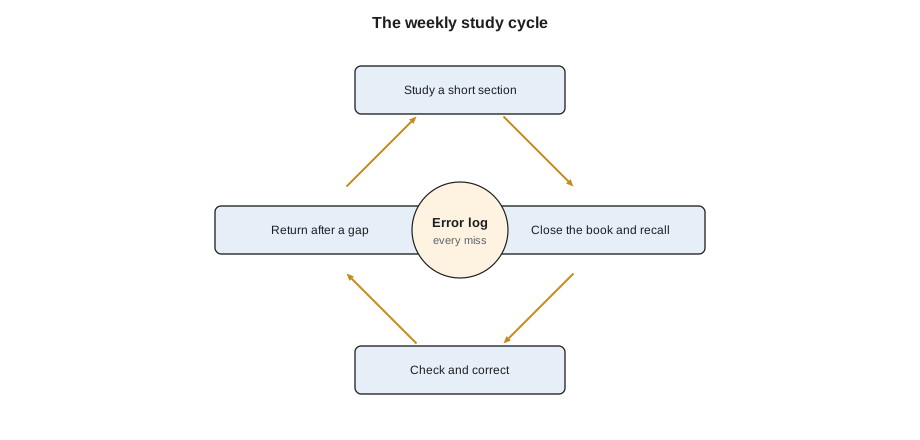
Rereading and highlighting are not useless. They help when material is new. But a candidate who has finished three levels of training has already met almost everything on the exam, and for that candidate rereading mostly produces a feeling of familiarity, not the ability to answer a question cold.
Build the weekly schedule
Benno's schedule had a fixed shape that repeated each week, so he did not have to decide every night what to do. Each weeknight session was an hour: twenty minutes of flash cards and review of earlier topics, thirty minutes on the week's main topic, and ten minutes on the error log. The Sunday session was longer, with the group, a guest from Crossbeam for the topic of the week, and a set of practice questions at the end, marked together.
| Weeks | Main topics | Sunday guest |
|---|---|---|
| Oct 18 – 24 | How the exam works; safety and fall protection | Grace Ndlovu, safety |
| Oct 25 – 31 | Rigging, cranes and signaling; reinforcing and post-tensioning | Carla Duquette and Tobias Reyes |
| Nov 1 – 7 | Structural steel erection; decking, joists and precast; metal buildings | Nate Okonkwo and Ilona Benedek |
| Nov 8 – 14 | Ornamental and miscellaneous metals; welding and cutting; calculation practice | Lionel Hartigan and Ruben Ostergaard |
| Nov 15 | Full practice test and review | Andy marks |
| Nov 16 – Jan 10 | Second pass through weak areas from the error log; practice tests on Dec 13 and Jan 10 | Plan |
| Jan 11 – exam | Final review, light practice, rest before the exam | Plan |
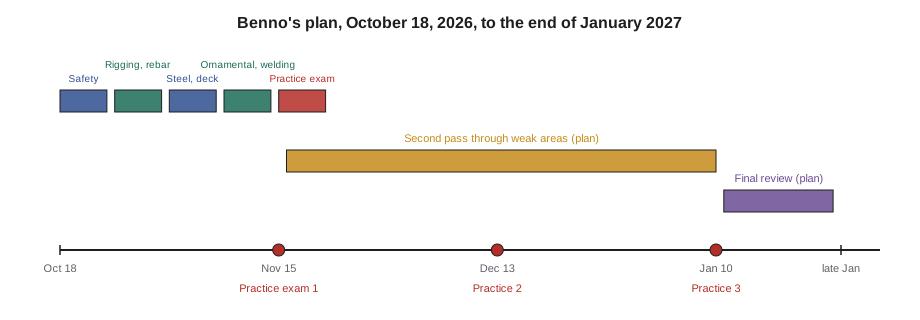
The schedule leaves slack. Crossbeam's work does not stop for exams, and in December the deck crew might work Saturdays to beat the weather. A plan with no room for a lost week fails the first time something happens. Benno's plan assumed he would lose one week in fourteen and still finish.
Use the right sources
The best sources are the ones the exam is built from and the ones the trade actually uses. Benno's list was short.
- The apprenticeship curriculum outline from his training center, to check that every unit was covered.
- His notes and binders from all three levels of training, and the courses in this program.
- Manufacturers' literature he used at work: sling and hardware catalogs, a crane's load chart and manual, bolt and anchor installation instructions.
- The OSHA steel erection standard and the crane and fall protection rules, read from the official text rather than from memory.
- Original practice questions, from the training center and from Andy's collection, never questions claiming to be from a real exam.
Andy warned the group about websites and apps selling what they call actual exam questions. Real exam questions are secure. Material that claims to be real is either invented and possibly wrong, or obtained improperly, and using it can cost a candidate the right to write. The honest route is also the better one: practice questions that teach the reasoning prepare a candidate for any question, while memorized questions prepare a candidate only for those questions.
Exam technique
Technique cannot replace knowledge, but it stops knowledge from being wasted. The group practiced these habits on every set of practice questions until they were automatic.
- Read the whole stem twice before looking at the options. Underline, in the mind or on scrap paper, the words that change the meaning: first, best, minimum, maximum, not, except.
- Answer the question in your head before reading the options, then look for your answer among them. This stops a tempting distractor from steering you.
- Eliminate options you know are wrong. Dropping two of four doubles the chance of a correct guess.
- For calculations, write the setup on scrap paper, estimate the answer roughly, then calculate. If your exact answer is far from your estimate, look for the mistake.
- Do not spend more than about three minutes on any question on the first pass. Mark it, guess, and come back.
- Change an answer only when you find a real reason, such as a word in the stem you missed. Changing on a vague feeling is as likely to make it wrong as right.
- Use the time. A candidate who finishes in two hours and leaves has thrown away two hours of checking.
Worked problem
Pacing a long exam
Benno will have three hours for 100 questions. He plans a first pass at about 1.4 minutes per question and wants at least 30 minutes left for marked questions and a final check. Does the plan fit?
Show solution
- First pass: 100 × 1.4 = 140 minutes.
- Time left: 180 − 140 = 40 minutes.
- 40 minutes is more than the 30 he wants.
Answer: Yes. He finishes the first pass with 40 minutes left. A checkpoint helps: by the end of the first hour he should be past question 43.
Look after the person writing
Benno worked full days on the misc crew through the whole plan. Andy's last advice on the first Sunday was about the body as much as the books: sleep is when the brain fixes what it practiced during the day, so an hour of study after a short night is worth less than half an hour after a full one. Exercise and regular meals help concentration. The week before the exam is for light review and rest, not for new topics. The night before is for packing what the candidate guide says to bring, setting two alarms and going to bed.
Nerves are normal, and a little helps. A candidate who has done several timed practice tests under exam conditions has already met the feeling and knows it passes. Slow breathing for a minute at the start and at any moment of panic in the middle settles most people. A candidate who has a disability or a learning difference that affects testing can ask, when booking, for the accommodations the testing body offers, such as extra time or a reader, with the documentation it asks for. Asking early matters, because arrangements take time.
English is not every ironworker's first language. Some certification bodies offer tests in Spanish or with a reader, and candidates should ask when they book. The trade vocabulary is the hard part for many, and flash cards with the term on one side and a sketch or a plain explanation on the other help more than translation.
Jules built his own plan the same afternoon, using the Reinforcing exam's weighting, and Shay copied the format for the classroom levels he would start in the new year. Andy's view was that the plan matters more than any single study method in it: a candidate who keeps a modest plan for fourteen weeks will beat one who studies hard for two weeks and then stops.
Common mistakes
MistakePlanning to study 'as much as possible' with no schedule.
InsteadSet a fixed number of hours each week, with a fixed shape for each session.
MistakeDividing study time equally among all topics.
InsteadDivide by the weighting first, then shift time toward weak areas shown by a diagnostic test.
MistakeRereading notes until they look familiar.
InsteadUse retrieval practice: close the book, recall, check and correct.
MistakeLeaving practice tests to the last week.
InsteadTake a diagnostic at the start and practice tests regularly; use each result to adjust the plan.
MistakeStudying late into the night before the exam.
InsteadRest the week before; sleep fixes what was practiced.
Summary and key terms
- Start with a timed diagnostic test; self-ratings are unreliable.
- Divide study hours by the exam weighting, then move time toward weak areas.
- Study actively: retrieval practice, spacing, interleaving, worked examples, flash cards and an error log.
- Keep a fixed weekly schedule with slack for lost weeks.
- Use the occupational standard or curriculum, training notes, manufacturers' literature, the actual rules and original practice questions; avoid anything claiming to be real exam questions.
- Read stems carefully, answer before looking at options, eliminate, estimate calculations, pace the exam and use all the time.
- Sleep, exercise, early requests for accommodations and practice under exam conditions all help on the day.
- Retrieval practice
- Recalling information from memory, by answering questions or explaining, rather than rereading it.
- Spacing
- Returning to a topic after gaps of days or weeks instead of studying it all at once.
- Interleaving
- Mixing different topics or problem types within one study session.
- Diagnostic test
- A test taken before studying to find strong and weak areas.
- Error log
- A record of every wrong answer, why it was wrong and the correct method.
- Accommodation
- An arrangement, such as extra time, that a testing body provides for a candidate who needs it.
Practice problems
Work each problem on paper first, then reveal the answer to check.
Why did the group trust the diagnostic test more than Benno's self-rating?
Show answer
People are poor judges of what they know; the test measured it.
Benno has 60 hours and a topic weighted 31 in 100. How many hours does it get on the first cut?
Show answer
60 × 31 ÷ 100 = 18.6 hours.
What is interleaving, and why does it help on an exam?
Show answer
Mixing topics in a session; the exam mixes topics, and the skill is recognizing which method a question needs.
A practice question says 'Which is NOT a requirement…'. What should the candidate do first?
Show answer
Notice the word NOT and answer the question as asked, looking for the false statement.
Why should a candidate avoid material claiming to be real exam questions?
Show answer
Real questions are secure; such material is invented or improper, and using it can cost the right to write.
Lesson quiz · 5 questions
Score 60% or more to complete this lesson.
Create a free account to save your progress, take quizzes and earn a certificate.