
IRW-340 · Lesson 11 of 12 · 20 min
Practice exam and review
▶ Video coming soon A video version of this lesson is on the way.
On Sunday, November 15, the study group met at seven-thirty instead of eight. Andy had set the shop up like an exam room: tables apart, phones in a box by the door, a clock on the wall, scrap paper and two pencils at each place. The practice test was 100 original questions, weighted like the committee final, and the group had three hours. Benno, Jules and Shay wrote it; Andy marked it over lunch; and in the afternoon they went through every wrong answer together.
This lesson describes that practice exam: how to run one, how to mark it and, most of all, how to use the results. A practice exam is not a test of whether a candidate will pass. It is a measurement, taken with enough time left to act on it.
Running a practice exam properly
A practice exam is only useful if it is taken under conditions close to the real one. Andy's rules were simple and strict.
- Full length and full time, in one sitting, at the time of day the real exam will be written.
- No notes, no phone, no talking, and only the aids the candidate guide allows.
- Original questions the candidates have not seen, weighted like the real exam, with a mix of knowledge, application and calculation.
- Answer every question, mark the doubtful ones and use the full time.
- Mark it promptly, and keep a copy of every answer sheet.
Candidates who practice only in short sets of ten questions are often surprised by how tiring a four-hour exam is. Concentration fades in the third hour, and careless errors rise. Practicing at full length builds the stamina and shows where the fatigue starts, so the candidate can plan a short break or a breathing reset at that point.
Benno's result
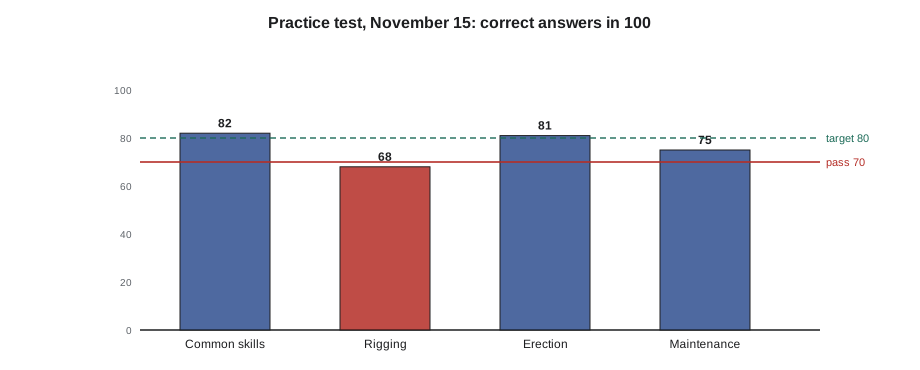
Benno scored 76 of 100, above the pass mark of 70. It was a pass, but not a comfortable one. Andy's rule is that a candidate should score at least 80 in 100 on practice tests before the real one, because the real test has questions that nobody predicted and nerves cost a few marks on the day. The breakdown by area showed where the missing marks were.
| Area | Questions | Benno right | Share right |
|---|---|---|---|
| Common skills | 17 | 14 | 82 in 100 |
| Rigging, hoisting and cranes | 31 | 21 | 68 in 100 |
| Erection, assembly and installation | 36 | 29 | 81 in 100 |
| Maintenance and upgrading | 16 | 12 | 75 in 100 |
| Total | 100 | 76 | 76 in 100 |
Worked problem
How far is the target?
Benno wants 80 in 100 on the next practice test of 100 questions. He scored 76. How many more correct answers does he need, and how many of them could come from rigging if he raised that area from 21 of 31 to 25 of 31?
Show solution
- Target: 100 × 80 ÷ 100 = 80 correct.
- More needed: 80 − 76 = 4.
- From rigging: 25 − 21 = 4.
Answer: He needs 4 more correct answers, and raising rigging to 25 of 31 would give all 4.
Rigging was again the weakest area, as the October diagnostic had shown, even though Benno had moved extra hours to it. Andy was not discouraged. On the diagnostic Benno had got 6 of 11 rigging questions right, 55 in 100; now he was at 68. The plan was working, just not finished.
Reading the wrong answers
The total score says how far a candidate is from the goal. The wrong answers say how to get there. Andy sorted Benno's into four kinds, because each kind needs a different fix.
| Kind of error | Example from Benno's paper | Fix |
|---|---|---|
| Did not know | The removal criterion for broken wires in one strand | Learn it, add it to the flash cards, review it spaced |
| Knew it but misread the question | Answered what to do last when the stem asked what to do first | Slow down on the stem; underline key words |
| Calculation slip | Forgot to subtract the hook block from a chart value | Write every step; compare with an estimate |
| Changed a right answer | Changed a correct guard height answer during the final check | Change only for a real reason |
Benno's 24 wrong answers broke down roughly as follows: 12 he simply did not know, 6 were misreadings, 4 were calculation slips and 2 were changed from right to wrong. That pattern is common. The misreadings and slips are the cheapest marks to win back, because they need habits, not new knowledge. The knowledge gaps take longer but are clearly listed.
Each wrong answer went into the error log with four columns: the topic, what Benno chose, what was right, and why. The why column matters most. "Forgot hook block" is a better entry than "crane question wrong", because it tells Benno exactly what to practice.
| Topic | Chose | Correct | Why |
|---|---|---|---|
| Sling inspection | Use at reduced rating | Remove from service | Did not know the strand criterion |
| Load chart | Gross capacity | Net capacity | Forgot hook block and rigging |
| Multiple lift | Set from the top down | Set from the bottom up | Mixed up rigging order and setting order |
| Fire watch | Leaves with the welder | Stays the required time after | Misread the stem |
| Guard height | Changed to the handrail height | Guard height | Changed a right answer |
Jules and Shay
Jules scored 63 of 100, below the pass mark of 70. He was not worried, and Andy agreed he should not be: the paper was weighted for structural and ornamental work, not for his rebar work. What the paper did show was that his rigging was as weak as Benno's, which mattered, because rigging is a large part of every ironworker's tests and certifications. Shay, in his first year, scored 48, a useful baseline for the long road ahead.
The plan from here
The afternoon ended with a revised plan for the weeks to the exam. It kept the same weekly shape but changed what went into it.
- Rigging calculations and inspection criteria every weeknight for the next three weeks, using the error log as the list.
- A second practice test on Sunday, December 13, and a third on Sunday, January 10, each with new original questions.
- A reading drill for every practice set: underline the key word in each stem before answering.
- A rule against changing answers without a written reason on the scrap paper.
- Maintenance and upgrading, the other weak area, folded into the Sunday sessions in December with Lionel and Ruben.
- Nothing new in the last week; flash cards, the error log, sleep.
If Benno's practice scores reach 80 in 100 by January, he will sit the committee's written final on Saturday, January 23, 2027, as booked, followed by the practical tests. His rigger certification written and practical exams are planned for February. These are plans; the result of November 15 is the only score that exists yet.
What to do on exam day
Andy's final checklist for exam day went into the back of Benno's binder.
| When | What |
|---|---|
| The week before | Light review only; confirm the location, time and ID needed |
| The night before | Pack ID, the confirmation, the allowed calculator and pencils; set two alarms; sleep |
| Morning | Normal breakfast; leave early; arrive 30 minutes before the start |
| First minutes | Read the instructions; breathe slowly for a minute; start with question 1 |
| First pass | About 1.5 minutes per question; mark doubtful ones; guess and move on after 3 minutes |
| Checkpoints | Past question 43 at one hour, 86 at two hours |
| Second pass | Return to marked questions; check calculations against estimates |
| Last minutes | Every question answered; no blank answers; change only with a reason |
Six questions from the practice paper, explained
The group spent the last hour of the afternoon on the six questions that the most people got wrong. All six are original questions written for the practice paper. Each is given here with the reasoning Andy used.
Question 1. A rigger finds a wire rope sling with a short kink near one eye, but no broken wires. What should he do? Options: (a) straighten the kink and use it; (b) remove it from service; (c) use it at half the rating; (d) use it only for basket hitches.
Answer and reasoning: (b). Kinking is a removal criterion in its own right, because it permanently damages the rope's structure even when no wires are broken. Two of the three writers chose (a).
Question 2. A beam is connected with two bolts at each end, wrench-tight, and the crane is about to release it. The erection drawings call for three erection bolts at that connection. How many must be in before release? Options: (a) two; (b) three; (c) one; (d) all the final bolts.
Answer and reasoning: (b). The minimum is two, but where the engineer specifies more, the specified number governs. The question tests whether the candidate reads the whole stem.
Question 3. A crane chart shows a capacity at a radius of 60 ft. The load will be placed at 65 ft. Which capacity should be used? Options: (a) the value at 60 ft; (b) the value at the next longer radius shown on the chart; (c) an average of the two; (d) the value at the shortest radius.
Answer and reasoning: (b). Charts are read at the next longer radius, or the next shorter capacity, never interpolated upward. Benno chose (c).
Question 4. A low-hydrogen electrode has been out of the oven for five hours. What should be done with it, in the absence of a moisture-resistant rating? Options: (a) use it; (b) return it to the oven for reconditioning or discard it as the procedure says; (c) dip it in water; (d) use it only for tack welds.
Answer and reasoning: (b). The exposure limit for ordinary E70XX electrodes is four hours; after that they are reconditioned or scrapped as the procedure says.
Question 5. During a lift, a worker sees a power line close to the boom path. Who may stop the lift? Options: (a) only the signaler; (b) anyone, with the emergency stop signal; (c) only the operator; (d) only the superintendent.
Answer and reasoning: (b). Anyone may give an emergency stop.
Question 6. A tension-control bolt's spline has broken off, but the joint plies are visibly apart. What is the conclusion? Options: (a) the bolt is properly tensioned; (b) the joint was not snugged first and must be redone; (c) the bolt is too long; (d) the spline was defective.
Answer and reasoning: (b). Splines off with a gap between the plies means the bolt reached its torque before the plies were drawn together. IRW-210's October 2 finding at Ashcroft was this case.
Using a practice exam result without fooling yourself
Practice scores can mislead in two directions. A practice paper that is easier than the real exam gives false confidence; one that is harder can make a ready candidate anxious. Andy's papers were written to match the weighting and the mix of question types, and he checked them against the published sample questions on the Red Seal website, which show the style of real questions without being real exam questions. A candidate using another source should check the same things: the number of questions from each area, the share of calculations and the length of the stems.
Another trap is retaking the same paper. A candidate who writes the same practice exam twice scores higher the second time mostly because he remembers the questions, not because he knows more. Benno's December and January practice papers were new questions, and Andy kept the November paper in his truck so nobody could study from it.
A third trap is chasing a single bad area at the expense of everything else. Rigging needed work, but Andy made sure Benno's December plan still had a little of every area each week, because skills that are not used fade, and the exam samples everything.
Andy finished by asking each writer to name the one change that would win the most marks. Benno said rigging calculations. Jules said reading the stems more slowly. Shay said everything, which made everyone laugh, and Andy said that was the right answer for a first-year: the plan for Shay was simply to keep learning the trade properly on the job, and the exam would follow.
Question 7 was added by Jules after the session: a stem that asked for the minimum guard height and offered the handrail range as one option. Two writers chose the handrail range. The lesson, Andy said, is that the exam likes to place two related numbers side by side, and the only defense is to read what the stem is actually asking for.
Common mistakes
MistakeTaking practice exams in short pieces only.
InsteadWrite at least two full-length exams under real conditions.
MistakeLooking only at the total score.
InsteadBreak results down by area and by kind of error.
MistakeWriting 'got it wrong' in the error log.
InsteadWrite why: the exact mistake to fix.
MistakeStudying new topics in the last week.
InsteadReview the error log and flash cards; rest.
MistakeWriting the exam unprepared to keep a booking.
InsteadMove the booking if practice scores are well short.
Summary and key terms
- A practice exam measures readiness in time to act; it must be full length, timed and closed-book.
- Benno scored 76 of 100: a pass, short of the 80 in 100 target.
- Rigging and maintenance were the weak areas; rigging had improved from the diagnostic.
- Wrong answers are sorted into did not know, misread, calculation slip and changed answer, each with its own fix.
- The error log records topic, choice, correct answer and why.
- The revised plan targets the weak areas, adds two practice exams and ends with rest.
- Practice exam
- A full-length, timed test of original questions taken to measure readiness.
- Baseline
- A first measurement against which later progress is compared.
- Breakdown
- Results divided by area or by kind of error.
- Target score
- The practice score a candidate aims for before writing, set above the pass mark.
Practice problems
Work each problem on paper first, then reveal the answer to check.
Why should a practice exam be full length?
Show answer
To build stamina and show where concentration fades.
How many correct answers are 80 in 100 on a 100-question test?
Show answer
80.
Name the four kinds of wrong answer in this lesson.
Show answer
Did not know, misread, calculation slip, changed a right answer.
Which kinds of error are cheapest to fix?
Show answer
Misreadings and calculation slips, because they need habits, not new knowledge.
What goes in the why column of an error log?
Show answer
The exact reason the answer was wrong.
Lesson quiz · 5 questions
Score 60% or more to complete this lesson.
Create a free account to save your progress, take quizzes and earn a certificate.