
IRW-340 · Lesson 1 of 12 · 23 min
How the exam is built
▶ Video coming soon A video version of this lesson is on the way.
On Sunday morning, October 18, 2026, Andy Pruszynski unlocked the Crossbeam yard shop at eight o'clock, put the coffee on and set out five chairs around the layout table. Benno Torvik, a third-year apprentice who had spent most of his time on Lionel Hartigan's misc and ornamental crew, was close to the end of his apprenticeship. His classroom hours were done, his work hours were almost complete, and his final step was the completion examination and the certifications that would go with his journeyworker card. He had asked Andy, who had been through the same apprenticeship twenty-five years earlier, whether he would help him get ready. Andy said yes on one condition: that they did it properly, on Sunday mornings, with a plan.
Shay Donnelly, the first-year apprentice, asked if he could sit in. "You won't be writing for a long time," Andy said, "but you'll learn more in five Sundays of review than in a year of guessing." Jules Ostrowski from the rod gang came too, because his own exam, in the reinforcing side of the trade, was a year away. The study group met five Sundays, ending with a full practice exam on November 15. This course follows those mornings. Each lesson reviews part of the trade as the earlier courses in this program taught it, and adds the practice and strategy that turn knowledge into a passing mark.
This first lesson explains how the exam is built: who writes it, what it is based on, how the questions are divided, what kind of questions to expect and what the pass mark means in numbers. Knowing the structure is not a trick. It tells a candidate where the marks are, and it stops the most common mistake, which is studying the parts of the trade one already likes.
There is no single national exam
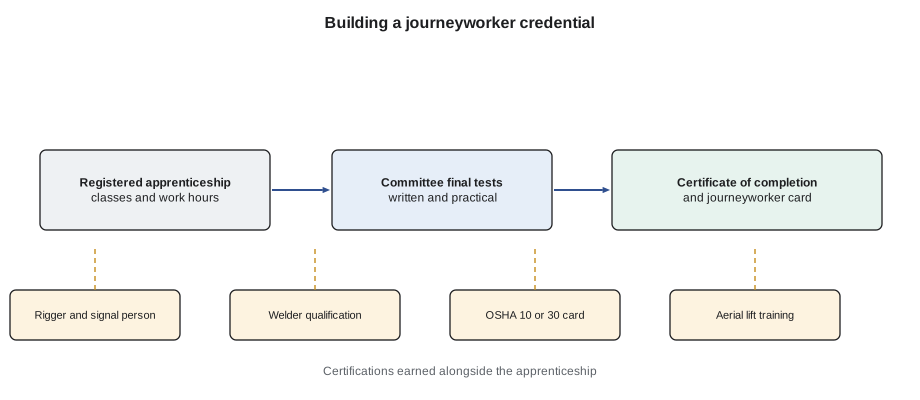
In Canada, the provinces share a national exam for each certified trade. In the United States there is no national journeyworker exam for ironworkers, and there is no single state license for the trade in Ohio. The trade is learned and recognized in other ways: through a registered apprenticeship that ends with a certificate of completion, through the union's own training and records, and through certifications in particular skills that employers and owners ask for. This course calls the whole package the journeyworker credential, and the review in every lesson is built to serve all of its parts.
Because the credential has several parts, a candidate prepares for several kinds of assessment: the apprenticeship's own final tests, written and practical certification exams in rigging, signaling and welding, and the safety training cards that general contractors check at the gate. The knowledge behind all of them is the same trade knowledge that this program has covered. The format differs, and this lesson explains each one.
The apprenticeship and its completion
Benno's apprenticeship is a registered program run by a joint apprenticeship and training committee, a board of union and contractor representatives that sets the curriculum, tracks hours and signs the certificate. In the Columbus area, the Iron Workers' local training center runs a three-year program, with apprentices in class for four to five weeks a year and working on the job the rest of the time. Programs elsewhere run three or four years. The program ends when the apprentice has the required work hours in each area of the trade, has passed the classroom courses and has passed the committee's final tests, and the U.S. Department of Labor or the state apprenticeship agency then issues a certificate of completion.
| Part of the credential | Who gives it | What it proves |
|---|---|---|
| Certificate of completion | The joint committee, registered with the Department of Labor | The full apprenticeship: hours, classes and final tests |
| Committee final tests | The local training center | Written and practical knowledge across the trade |
| Rigger and signal person certification | A certifying body or a qualified-person program | Rigging and signaling skill for crane work |
| Welder qualification | A test witnessed to a welding code | The ability to make a specific weld in a specific position |
| Safety training cards | Authorized trainers | Completed construction safety courses |
What the final tests cover
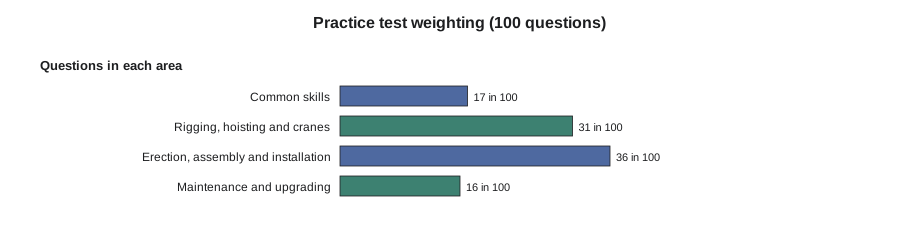
The final tests of a U.S. ironworker apprenticeship are set by each joint committee, so their content and length vary. Most follow the national ironworker curriculum and cover the same areas the Canadian exams use, because the work is the same on both sides of the border. Crossbeam's practice tests in this course use the Canadian Structural/Ornamental weighting as a guide, because it is published, it matches the work Crossbeam does, and it gives a fair picture of where a written test's marks will come from. The table shows that weighting turned into question counts for a 100-question test, the length of the committee's final written test that Benno will sit.
| Area | Share used for practice | About this many of 100 questions |
|---|---|---|
| Common skills: safety, tools, drawings, access | 17 in 100 | 17 |
| Rigging, hoisting and cranes | 31 in 100 | 31 |
| Erection, assembly and installation | 36 in 100 | 36 |
| Maintenance, repair and upgrading | 16 in 100 | 16 |
Two areas outweigh everything else: rigging and cranes, and erection. Together they make up about two thirds of the practice test. The common skills area is the one candidates most often underrate, because it sounds easy; it holds the safety, drawing-reading and calculation questions that decide close results.
Worked problem
Turning weightings into questions
The committee's written final has 100 questions. If it follows the practice weighting, with rigging and cranes at 31 in 100 and erection at 36 in 100, how many questions come from each, and what share do they make up together?
Show solution
- Rigging and cranes: 100 × 31 ÷ 100 = 31 questions.
- Erection: 100 × 36 ÷ 100 = 36 questions.
- Together: 31 + 36 = 67 questions, two thirds of the test.
Answer: 31 rigging questions and 36 erection questions: 67 of the 100. A candidate who is weak in either area cannot make it up elsewhere.
What the questions look like
Written certification tests in the trade are almost all multiple choice, with four possible answers and one correct answer. Practical tests, for rigging, signaling and welding, are done with real equipment in front of an examiner. The written questions fall into three kinds.
- Knowledge questions ask for a fact: the name of a part, the meaning of a term, the purpose of a device, the order of steps in a procedure.
- Application questions describe a situation on a job and ask what to do, what is wrong, or what comes next. These are the most common kind, and they reward experience and careful reading.
- Calculation questions give numbers and ask for a result: a sling leg load, a weight, a clearance, a plumbness tolerance, a stair riser. They often include wrong answers that come from a predictable mistake, such as using the wrong trigonometry or forgetting a deduction. Lesson 10 practices them.
A question has a stem, the part that sets up the problem, and four options. Three of the options are distractors, wrong answers chosen because they are tempting. A distractor might be true in a different situation, might be what a careless reader picks, or might be the result of a common error in arithmetic. The skill of answering well is mostly the skill of reading the stem precisely: noticing whether it asks for the first thing to do or the best thing to do, a minimum or a maximum, and which country's or which code's rule.
| Kind of question | Example stem (original) | What it rewards |
|---|---|---|
| Knowledge | What is the purpose of a drift pin? | Knowing the trade's tools and terms |
| Application | A connector finds that a beam's holes do not line up with the column connection by one hole. What should he do first? | Judgment and the right order of actions |
| Calculation | A two-leg bridle lifts a 5,300 lb beam with legs at 45 degrees from horizontal. What is the load on each leg? | Setting up and checking a calculation |
Time, pass marks and rules
The committee sets the time and pass mark for its own final tests, and certifying bodies set theirs. Crossbeam's practice test, like many committee finals, gives three hours for 100 questions, which is just under two minutes per question, and uses a pass mark of 70 in 100, so at least 70 correct answers are needed. A candidate should read the candidate handbook for each certification, because time limits, pass marks, retest waiting periods and what may be brought into the room differ from one body to another.
Results of written tests are often given within days, and practical tests on the spot. A candidate who does not pass a certification usually receives a breakdown by subject area and can retest after a waiting period. The breakdown is valuable, because it shows exactly where to study; a candidate who reads it and adjusts the plan usually passes the second time.
Worked problem
What the pass mark means
Benno's committee final has 100 questions and a pass mark of 70 in 100. How many correct answers does he need, and how many can he miss?
Show solution
- Correct answers needed: 100 × 70 ÷ 100 = 70.
- Questions he can miss: 100 − 70 = 30.
Answer: 70 correct, so he can miss up to 30. That sounds generous, but if he is weak in rigging and erection, which hold 67 of the questions, it disappears quickly.
Certifications that go with the credential
The table lists the certifications this program has mentioned, with what each one covers. Some are required by law for certain work, some are required by the general contractor or owner, and some are simply what employers look for. Benno already holds several and plans to add two more before the end of his apprenticeship.
| Credential | What it covers | Notes |
|---|---|---|
| OSHA 10-hour and 30-hour construction cards | Construction safety awareness; the 30-hour for leads and forepersons | Often required at the gate |
| Rigger and signal person certification | Written and practical tests for crane rigging and signaling | Offered by NCCCO, NCCER and the union's own qualified program |
| AWS welder qualification | Welding to AWS D1.1 for structural work | Kept current by continuity records and retests |
| Aerial lift training | Boom and scissor lifts | Required before operating |
| NCCER ironworking credentials | Craft training modules and assessments | Used by many open-shop employers |
How the exam treats country and code differences
Committee final tests and certification exams are written for the work in the area they serve, so they use the federal OSHA rules, the national consensus standards such as the ASME B30 rigging and crane standards, the AWS welding codes and the RCSC bolting specification, and the building code the state adopts. A candidate who knows the principle behind each rule and the specific number in the federal rule is prepared for most questions. Where a state or city adds its own rule, the committee's curriculum says so.
The practice questions in this course follow the same approach. Where a rule differs between the countries, the question names the rule it is asking about, and the answer gives the reason as well as the number, so that a candidate who meets a differently worded question on the day can still reason to the right answer.
Practice questions
Question 1. An apprentice wants to know which area carries the most questions on Crossbeam's practice test. Options: (a) common skills; (b) rigging, hoisting and cranes; (c) erection, assembly and installation; (d) maintenance and upgrading.
Answer and reasoning: (c). Erection, assembly and installation carries about 36 in 100 of the questions, slightly more than rigging at 31. The distractor (b) is the second-largest area and the most common wrong answer.
Question 2. A question describes a crew landing deck bundles and asks which action comes first. What kind of question is it, and how should it be read? Options: (a) knowledge, read quickly; (b) application, read for the word first; (c) calculation, estimate the answer; (d) trick question, skip it.
Answer and reasoning: (b). It describes a job situation and asks for the order of actions, so the key word is first. Several options may be correct actions, but only one comes first.
Question 3. A candidate has 120 questions and has answered 100 with confidence when 20 minutes remain. What should he do with the rest? Options: (a) leave them blank; (b) answer every one, using elimination and the best guess; (c) answer only the calculation questions; (d) hand in the paper.
Answer and reasoning: (b). Unless the rules say otherwise, a blank answer scores nothing and a guess has a chance, especially after eliminating one or two options.
Common mistakes
MistakeStudying the parts of the trade one already knows well.
InsteadStudy by the weighting: the activities with the most questions get the most hours.
MistakeAssuming a certificate of completion covers every certification.
InsteadRigging, signaling and welding certifications are separate tests with their own renewal rules.
MistakeTreating calculation questions as a small part of the exam.
InsteadCalculations appear in rigging, erection, ornamental and common skills questions; practice them every week.
MistakeLeaving questions blank when unsure.
InsteadUnless the rules say otherwise, an educated guess has a chance and a blank has none.
MistakeIgnoring the results report after a failed attempt.
InsteadIt shows performance by area; build the next study plan from it.
Summary and key terms
- There is no national journeyworker exam for ironworkers in the United States; the credential is a registered apprenticeship completion plus certifications.
- A joint apprenticeship committee sets the classes, tracks the hours and gives the final tests; the certificate of completion follows.
- Crossbeam's practice tests follow the published Canadian Structural/Ornamental weighting: 17, 31, 36 and 16 in 100.
- Questions are multiple choice with four options, and they test knowledge, application and calculation.
- The practice test gives three hours for 100 questions with a pass mark of 70 in 100.
- Rigging and erection together hold about two thirds of the marks.
- Red Seal endorsement
- A seal added to a provincial certificate showing that the holder passed the interprovincial exam.
- Occupational standard
- The document that describes the work of a trade and the tasks a qualified worker performs.
- Major work activity
- One of the main areas of a trade in the occupational standard, used to weight the exam.
- Exam weighting
- The share of the exam drawn from each major work activity.
- Distractor
- A wrong answer in a multiple-choice question, chosen because it is tempting.
- Joint apprenticeship committee
- A board of union and contractor representatives that runs an apprenticeship program.
- Certificate of completion
- The document issued when an apprentice finishes a registered apprenticeship.
Practice problems
Work each problem on paper first, then reveal the answer to check.
How many questions are on Crossbeam's practice test, and how many must be correct to pass?
Show answer
100 questions; 70 correct (70 in 100).
Who issues an apprentice's certificate of completion?
Show answer
The joint committee, through the registered apprenticeship agency.
About how many practice questions come from maintenance and upgrading at 16 in 100?
Show answer
16.
What are the three kinds of question described in this lesson?
Show answer
Knowledge, application and calculation.
Name two certifications that sit beside the certificate of completion.
Show answer
Any two of: rigger or signal person certification, welder qualification, OSHA 10 or 30, aerial lift training.
Lesson quiz · 5 questions
Score 60% or more to complete this lesson.
Create a free account to save your progress, take quizzes and earn a certificate.