
IRW-340 · Lesson 9 of 12 · 23 min
Review: welding and cutting
▶ Video coming soon A video version of this lesson is on the way.
Ruben Ostergaard, Crossbeam's welding foreman, took the second half of November 8. He had run the field welding on Larkmont's moment frames in 2025 and had trained most of Crossbeam's welders since. He set a cutting torch, a stinger with a rod in it and a rod oven thermometer on the table, then asked Benno the question he asked every new welder: "Your oxygen cylinder fell over in the yard and the valve snapped off. What happens?" Benno said it would take off like a rocket. "Right," Ruben said. "So everything we do with cylinders, and with heat, starts there."
Welding and cutting appear across the trade's written tests: in common skills (safety, equipment and cutting), and in erection and maintenance (field welding, repairs and modifications). This lesson reviews the welding courses in the program, WLD-110, WLD-120 and WLD-210, as they apply to an ironworker, and the field welding parts of IRW-230 and IRW-310. Welder qualification itself is a separate test, done to AWS D1.1, and this lesson does not replace it.
Compressed gas cylinders
A full oxygen cylinder holds gas at about 2,200 psi. If its valve is broken off, the escaping gas can drive the cylinder through a wall. Cylinders are kept upright and secured with chains or in carts, valve caps on when not in use, away from heat and electrical circuits, and moved with a cylinder cart, never rolled or dragged by the valve. In storage, OSHA requires oxygen to be kept at least 20 ft from fuel gas cylinders or separated by a noncombustible barrier at least 5 ft high with a fire-resistance rating of at least half an hour. A cylinder is never used as a roller or a support, and oil or grease never touches oxygen fittings.
Acetylene is stable only when dissolved in acetone inside its cylinder. If it is drawn off too fast, acetone comes with it, damaging the equipment and leaving the remaining acetylene less stable. The general rule from WLD-110 is that acetylene is not withdrawn from a single cylinder at more than one-seventh of the cylinder's contents per hour; bigger torches are fed from manifolded cylinders. Acetylene is also not used above about 15 psi gauge pressure, because above that it can decompose violently.
Worked problem
How many acetylene cylinders for a heating tip?
A full acetylene cylinder holds 300 ft³. A rosebud heating tip uses 90 ft³ of acetylene per hour. How many cylinders are needed on a manifold?
Show solution
- Allowed from one cylinder: 300 ÷ 7 = 42.9 ft³/h.
- Cylinders needed: 90 ÷ 42.9 = 2.1.
- Round up: 3 cylinders.
Answer: A manifold of 3 cylinders, as in WLD-110. Rounding 2.06 down to 2 would draw too much from each cylinder, which is the usual trap.
Oxyfuel cutting
An oxyfuel outfit has two cylinders, two regulators, two hoses, reverse-flow check valves and flashback arrestors, and a torch. The setup order matters: crack the cylinder valves to clear dirt before attaching regulators, attach the regulators with the adjusting screws backed out, open the cylinder valves slowly while standing to the side of the regulator, set the working pressures, purge each line, and light the fuel first. To shut down, close the oxygen first, then the fuel, then close the cylinder valves and bleed the lines. A flashback, a flame burning back into the torch or hoses, is stopped by closing the valves at once.
Cutting steel with oxygen works because iron burns in pure oxygen once it is heated to its ignition temperature. The preheat flames bring the steel to that temperature, then the cutting oxygen jet burns a narrow kerf through it and blows the slag out. Tip size and pressures follow the manufacturer's chart for the plate thickness. A clean cut has a smooth face with little slag on the bottom; a cut with deep gouges or heavy slag means the speed, pressure or tip distance is wrong.
Plasma arc cutting uses an electric arc through a constricted gas stream and cuts any conductive metal, including stainless and aluminum, faster than oxyfuel in thin plate. Air carbon arc gouging uses a carbon electrode and compressed air to remove metal, for back-gouging welds or removing defects. Both are loud, produce fumes and spatter, and need full eye, face and hearing protection.
Hot work and fire prevention
Hot work, which includes welding, cutting, grinding and torch work, needs a hot work permit on most sites. Before work starts, combustibles within 35 ft are moved or protected with fire-resistant covers, openings in walls and floors within that distance are covered, an extinguisher is at hand, and a fire watch is assigned. The fire watch has no other duty and continues after the work, at least 30 minutes under OSHA and one hour under current NFPA 51B, the standard most owners and insurers follow, with further checks as the permit requires.
Worked problem
When can the fire watch leave?
Hot work ends at 14:40 (2:40 p.m.). The permit requires a 60-minute fire watch, then 60 minutes of monitoring. When does the fire watch end, and when is the permit signed off?
Show solution
- Fire watch ends: 14:40 + 60 minutes = 15:40 (3:40 p.m.).
- Monitoring ends: 15:40 + 60 minutes = 16:40 (4:40 p.m.).
Answer: The fire watch stays until 15:40 (3:40 p.m.) and the area is checked until 16:40 (4:40 p.m.), when the permit is signed off. Planning the last cut of the day around that time is part of the job.
Welding processes
Ironworkers mostly weld with shielded metal arc welding (SMAW, stick welding) and flux-cored arc welding (FCAW), and sometimes with gas metal arc welding (GMAW). SMAW uses a covered electrode; the covering melts to shield the weld and forms slag. FCAW uses a continuous tubular wire with flux inside, with or without shielding gas; self-shielded wire is common in the field because wind blows shielding gas away. GMAW uses a solid wire and an external shielding gas and is used mostly in shops.
Electrodes are classified so the code tells the welder what they are. E7018 is a covered electrode with a minimum tensile strength of 70 ksi, usable in all positions, with a low-hydrogen covering, run on AC or DCEP. E6010 is a deep-penetrating electrode often used for root passes. Low-hydrogen electrodes such as E7018 must be kept dry in a rod oven, because moisture puts hydrogen into the weld and can cause cracks hours after welding; AWS D1.1 limits how long they may be out of the oven, four hours for ordinary E70XX electrodes.
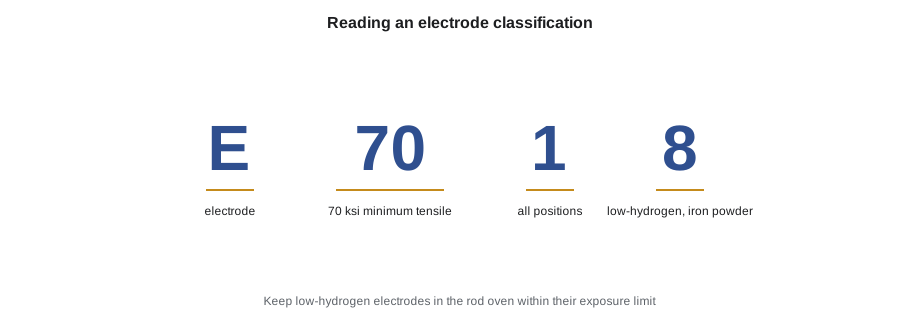
Polarity matters. DCEP, direct current electrode positive, also called reverse polarity, gives deeper penetration and a more forceful arc and is the polarity for low-hydrogen electrodes. The work clamp goes as close to the weld as practical, on clean metal, never through a bearing, a hinge or a lifted load, so the current does not arc through something that should not carry it.
Field welding on structural work
Field welding of structural connections is done by qualified welders to an approved welding procedure. The procedure sets the process, electrode, preheat, position and sequence. Preheat slows the cooling of thick or high-strength steel and drives out moisture; Larkmont's moment frame procedure called for 150 °F on its thick flanges, checked with temperature-indicating crayons. Wind, rain and cold are controlled with enclosures and heat. Completed welds are inspected visually and, where the design requires, tested by ultrasonic or magnetic particle methods before the structure depends on them.
Ironworkers also make many welds that are not structural connections: deck welds, studs, misc steel, embeds and clips. Each still has a procedure and an inspection. On the deck in IRW-230, arc spot welds were made at the pattern the drawings called for, with weld washers on thin deck; at Ashcroft's lobby in IRW-320, the replaced clip C-7 was welded by Ruben and passed a magnetic particle test before the curtain wall was hung on it.
| Common weld problem | Usual cause | Fix |
|---|---|---|
| Porosity (gas pockets) | Damp electrodes, wind, dirty steel, too long an arc | Dry electrodes, wind screens, clean steel, correct arc length |
| Undercut | Too much current or travel speed, wrong angle | Adjust current, speed and angle |
| Lack of fusion | Too little heat, wrong angle, traveling too fast | Correct heat and technique |
| Cracks | Hydrogen, restraint, no preheat, wrong filler | Remove and reweld to the procedure; find the cause |
| Slag inclusions | Slag not cleaned between passes | Clean every pass |
Health hazards of welding and cutting
Welding fumes contain metal oxides and, depending on the steel and coating, manganese, chromium, nickel, zinc or lead. Galvanized steel gives off zinc oxide fumes that cause metal fume fever; painted steel may contain lead. Ventilation, local exhaust and respirators control fumes, and coatings are removed from the weld area before welding where possible. Arc rays burn the eyes and skin, so the right filter shade, a helmet, and fire-resistant clothing with no exposed skin are needed. Screens protect other workers from the arc. Electric shock is a hazard in wet conditions or tight spaces; dry gloves, insulation from the work and machines in good repair prevent it.
Ruben's field welding checklist
Ruben handed out the checklist he uses before any field weld on a Crossbeam job. It is short, and every line is something an exam question has asked about in one form or another.
- The welder holds a current qualification for the process, position and thickness.
- The welding procedure for the joint is on hand and its settings are on the machine.
- The electrodes or wire match the procedure, and low-hydrogen electrodes come from the rod oven within their exposure time.
- The joint is clean, dry and fitted as the drawing shows, with coatings removed from the weld area where the procedure requires.
- Preheat is applied and checked if the procedure requires it.
- Wind, rain and cold are controlled with screens, covers or heat.
- The work clamp is on clean metal close to the weld, not through a bearing, hinge or lifted load.
- The hot work permit is signed, combustibles are cleared or protected, an extinguisher is at hand and the fire watch is assigned.
- Fumes are controlled with ventilation, local exhaust or respirators, especially on galvanized, painted or coated steel.
- After welding, the weld is cleaned and inspected, and any required testing is booked before the steel is loaded.
Practice questions
Question 1. A welder is about to weld on galvanized steel in a stairwell with little air movement. What is the main health concern, and the control? Options: (a) noise, earplugs; (b) zinc oxide fumes that cause metal fume fever, controlled by removing the coating where allowed, ventilation and a respirator; (c) cold, a heater; (d) none.
Answer and reasoning: (b). Zinc fumes from galvanizing are a well-known cause of metal fume fever.
Question 2. Which polarity is used with E7018 electrodes on direct current? Options: (a) DCEN; (b) DCEP; (c) either, it does not matter; (d) neither.
Answer and reasoning: (b). DCEP, also called reverse polarity, is the polarity for low-hydrogen electrodes on DC.
Question 3. A cut through plate leaves deep gouges on the face and heavy slag on the bottom. What is the likely cause? Options: (a) perfect settings; (b) wrong speed, pressure or tip distance for the thickness; (c) wrong cylinder color; (d) too much acetone.
Answer and reasoning: (b). A clean cut needs the right tip, pressures and travel speed from the manufacturer's chart.
Question 4. Why are oxygen cylinders kept away from oil and grease? Options: (a) they make the valves slippery; (b) oil and grease can ignite violently in pure oxygen; (c) they stain the paint; (d) they affect the gauge reading.
Answer and reasoning: (b). Oxygen does not burn by itself, but it makes oil and grease burn explosively.
Question 5. After hot work ends, the welder must leave for another job. Who keeps the fire watch? Options: (a) nobody; (b) a worker assigned as fire watch, with no other duty, for the full required time; (c) the welder from a distance; (d) the crane operator.
Answer and reasoning: (b). The fire watch is a separate role and stays for the full time after the work ends.
Common mistakes
MistakeLighting the torch with oxygen first.
InsteadLight the fuel first; shut off oxygen first.
MistakeDrawing acetylene from one cylinder too fast.
InsteadKeep withdrawal under one-seventh of the contents per hour; use a manifold for big tips.
MistakeLeaving low-hydrogen electrodes on the steel all day.
InsteadKeep them in the rod oven and respect the exposure limit.
MistakeSending the fire watch home with the welder.
InsteadThe fire watch stays for the full required time after hot work ends.
MistakeAttaching the work clamp through a bearing or a lifted load.
InsteadClamp on clean metal close to the weld.
Summary and key terms
- Cylinders are stored upright and secured, oxygen apart from fuel gases, valve caps on, never oiled.
- Acetylene withdrawal is limited to one-seventh of the contents per hour; round up when manifolding.
- Oxyfuel outfits use check valves and flashback arrestors; light fuel first and shut off oxygen first.
- Hot work needs a permit, combustibles cleared or protected, an extinguisher and a fire watch that stays after the work.
- E7018 is a 70 ksi low-hydrogen electrode run on DCEP or AC and kept dry in a rod oven.
- Structural field welds follow an approved procedure, with preheat and inspection; fumes, arc rays and shock are controlled.
- Flashback arrestor
- A device that stops a flame from traveling back into the hoses and regulators.
- Kerf
- The narrow slot that a cutting process removes.
- Fire watch
- A worker who watches for fires during and after hot work and has no other duty.
- Low-hydrogen electrode
- An electrode whose covering keeps hydrogen out of the weld, which must be kept dry.
- Preheat
- Heating the steel before welding to slow cooling and prevent cracking.
- DCEP
- Direct current with the electrode positive, also called reverse polarity.
- Welding procedure specification
- The approved document that sets how a particular weld is made.
Practice problems
Work each problem on paper first, then reveal the answer to check.
What is the pressure in a full oxygen cylinder?
Show answer
About 2,200 psi.
Which gas is shut off first when shutting down an oxyfuel torch?
Show answer
Oxygen.
A heating tip needs twice the one-seventh flow of a single cylinder plus a little more. How many cylinders?
Show answer
Three; always round up.
What does the 70 in E7018 mean?
Show answer
A minimum tensile strength of 70 ksi.
Why are low-hydrogen electrodes kept in a rod oven?
Show answer
Moisture puts hydrogen into the weld, which can cause delayed cracking.
Lesson quiz · 5 questions
Score 60% or more to complete this lesson.
Create a free account to save your progress, take quizzes and earn a certificate.